Sep 17, 2019 | Advocacy
The ICJ welcomes the final report of the FFM (Independent International Fact Finding Mission).
Having monitored justice and human rights in Myanmar for over 50 years, the ICJ has an established presence in the country, and supports justice sector actors to implement reforms necessary to protect human rights through the rule of law.
With this experience, the ICJ concurs with conclusions of the FFM and the Special Rapporteur: particularly those highlighting the pervasive damage of unchecked military power and impunity on human rights, the rule of law, and development of an inclusive democratic society.
Myanmar’s Government has failed to fulfill international law obligations to investigate, prosecute and punish perpetrators of rights violations. In this context, the launch of an IIMM (Independent Investigative Mechanism for Myanmar) is necessary, and welcome. Myanmar should cooperate with the Mechanism, whose files may enable future prosecutions of individual criminals.
But this Mechanism is not a court: all States, particularly Myanmar, must work toward holding criminal trials, in competent jurisdictions, inline with international standards – noting that prosecutions target criminals, not the country.
Other immediate opportunities for Myanmar to protect human rights include: amending the National Human Rights Commission Law to expand its mandate and independence; amending laws that facilitate impunity such as the 1959 Defence Services Act; enacting an anti-discrimination law; and reviewing the 1982 Citizenship Law. These legislative reforms are urgent and possible steps that are necessary to demonstrate if the Government is genuine about its international law obligations. Any constitutional reform must also expand rights protections.
As the FFM’s mandate is ending, the ICJ would like to ask the experts: how can States best monitor and implement your recommendations, particularly related to international criminal accountability?
See also:
ICJ, Achieving Justice for Gross Human Rights Violations in Myanmar, January 2018
Terms of Reference for the UN Independent International Mechanism for Myanmar (unofficial Burmese translation), 16 January 2019, available here.
Statement to the Human Rights Council by Mr. Nicholas Koumjian, Head of the Independent Investigative Mechanism for Myanmar (unofficial Burmese translation with accompanying English text), 9 September, available here.
Sep 16, 2019 | Events, News
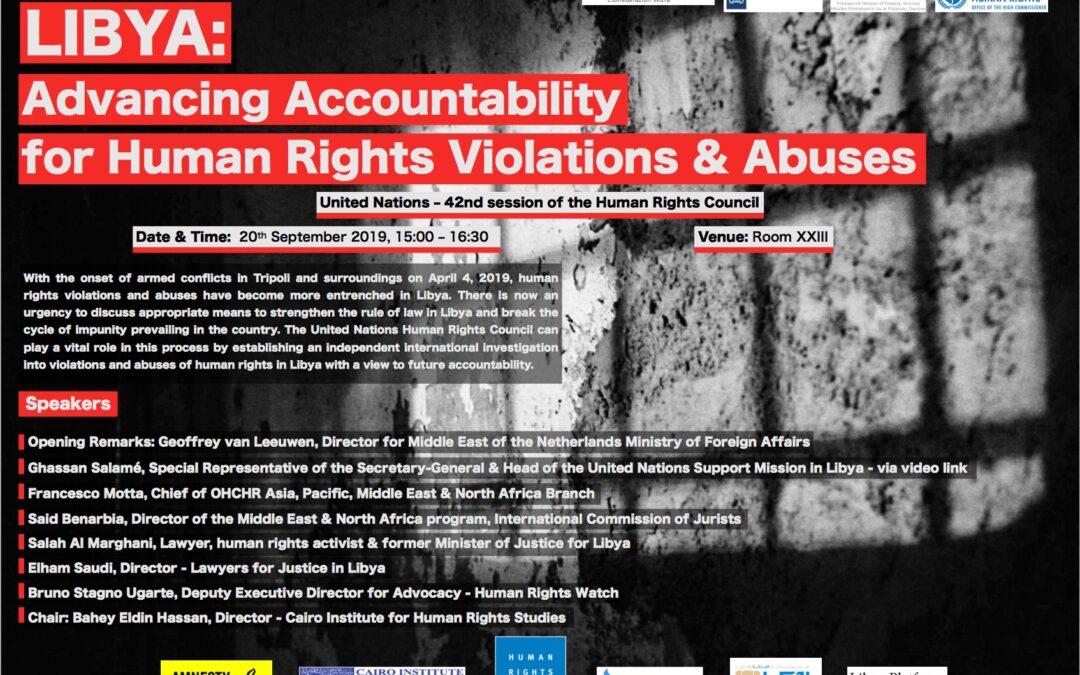
The ICJ, together with the Netherlands, Finland and Swiss missions to Geneva, OHCHR and other NGOs invite you to a panel discussion on Advancing accountability for human rights violations and abuses in Libya at the UN Human Rights Council in Geneva.
The event takes place on Friday 20 September 2019, at 15:00 – 16:30, Room XXIII, in the Palais des Nations.
With the onset of armed conflicts in Tripoli and surroundings on April 4, 2019, human rights violations and abuses have become more entrenched in Libya. There is now an urgency to discuss appropriate means to strengthen the rule of law in Libya and break the cycle of impunity prevailing in the country. The United Nations Human Rights Council can play a vital role in this process by establishing an independent international investigation into violations and abuses of human rights in Libya with a view to future accountability.
The event will be opened by Geoffrey van Leeuwen, Director for Middle East of the Netherlands Ministry of Foreign Affairs, moderated by Bahey Eldin Hassan, Director of the Cairo Institute for Human Rights Studies, and feature:
–Elham Saudi, Director – Lawyers for Justice in Libya
–Ghassan Salamé, Special Representative of the Secretary-General & Head of the United Nations Support Mission in Libya – via video link
–Francesco Motta, Chief of OHCHR Asia, Pacific, Middle East & North Africa Branch
–Said Benarbia, Director of the Middle East & North Africa program, International Commission of Jurists
–Salah Al Marghani, Lawyer, human rights activist & former Minister of Justice for Libya
–Bruno Stagno Ugarte, Deputy Executive Director for Advocacy – Human Rights Watch
A flyer for the event is available here.
Sep 11, 2019 | Advocacy, Non-legal submissions
The ICJ today reiterated its call for the UN Human Rights Council to establish an international independent Commission of Inquiry on the human rights situation in Venezuela.
The statement, delivered in a general debate at the Council following the oral update by the UN High Commissioner for Human Rights mandated by the previous Human Rights Council resolution on Venezuela, read as follows:
“Mr. President,
The International Commission of Jurists (ICJ) welcomes the High Commissioner for Human Rights’ oral update on the situation in Venezuela.
The update and previous reporting point to a wide range of human rights violations, which continue to occur inside the country. These include arbitrary deprivation of liberty, serious violations of indigenous people’s rights, excessive use of force by security forces and attacks on freedom of expression, among others, as well as the impacts of laws, policies and practices that have adversely affected the independence of the judiciary.
Over the years, the International Commission of Jurists has monitored and documented the lack of judicial independence in Venezuela and the absence of accountability for those responsible for gross human rights violations.
The ICJ urges the Human Rights Council to establish an independent Commission of Inquiry on the human rights situation in Venezuela, given that Venezuelan authorities have been unable or unwilling to pursue effective domestic accountability, and judicial and prosecutorial mechanisms in the country lack independence and impartiality.
The Commission of Inquiry should be mandated to investigate reports of violations of international human rights law in Venezuela, establish the facts and circumstances of violations committed since at least 2014, and identify those responsible with a view to contributing to full accountability for all violations, including those that constitute crimes under international law.
Thank you.”
The oral update of the UN Human Commissioner for Human Rights, on the situation in Venezuela, may be accessed here.
In August 2019, the ICJ joined other NGOs in calling for an international commission of inquiry on Venezuela.
States are expected to discuss a further resolution on Venezuela at the current Human Rights Council session, for adoption on 26 or 27 September.
Sep 10, 2019 | Events, News
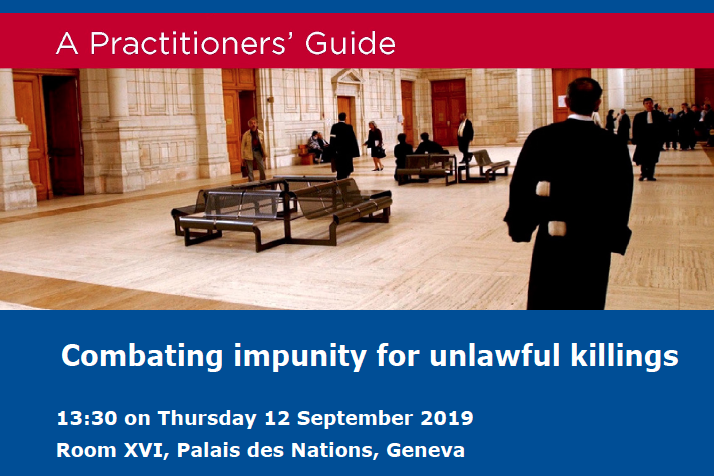
The ICJ invites you to a discussion of new tools to assist investigation and accountability for extrajudicial, summary or arbitrary executions, and other potentially unlawful deaths. The event takes place on Thursday, 12 September, 13:30, Room XVI, at the Palais des Nations in Geneva.
ICJ’s new Practitioners’ Guide No 14 on the Investigation and Prosecution of Unlawful Death helps legal practitioners ensure that investigation and accountability processes are implemented in accordance with international human rights law.
The Guide elaborates on the revised Minnesota Protocol on the Investigation of Potentially Unlawful Death (2016), a set of practical standards and guidelines that was updated by former UN Special Rapporteur on extrajudicial, summary or arbitrary executions, Christof Heyns, and published by the Office of the United Nations High Commissioner for Human Rights (OHCHR) in 2017.
The panel discussion will highlight key elements of the Protocol and Practitioners Guide, and their relevance to cases such as the 2016 killing of political commentator, Kem Ley, in Cambodia and the 2018 killing of Saudi Journalist, Jamal Khashoggi in Turkey.
Speakers
- Agnes Callamard, Special Rapporteur on extrajudicial, summary or arbitrary executions (by video conference, TBC).
- Stuart Maslen, Honorary Professor, Centre for Human Rights, University of Pretoria.
- Kingsley Abbott, Senior Legal Adviser & Coordinator of the ICJ’s Global Accountability Initiative.
Moderator
- Carolina Villadiego, ICJ Legal and Policy Adviser, Latin America
Printed copies of the ICJ’s Practitioners’ Guide No 14 on the Investigation and Prosecution of Unlawful Death will be available.
A flyer for the event is available here.
*** Room XVI is on the 5th floor of Building A, behind the Assembly Hall, accessible by the elevators at the Salle des Pas Perdus. Details here.
Aug 30, 2019 | News
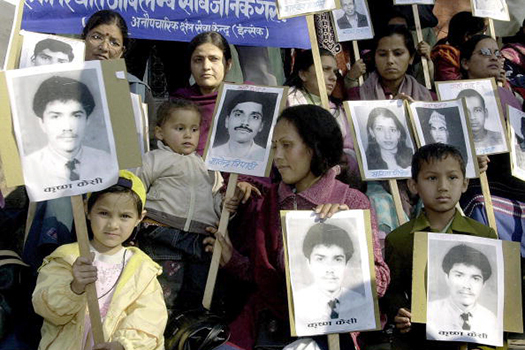
On the occasion of the International Day of the Victims of Enforced Disappearances, Advocacy Forum-Nepal, the Terai Human Rights Defenders Alliance (THRD), and the ICJ voiced their concern about the Government’s failure to provide justice for the victims of the country’s decade-long armed conflict, including victims of enforced disappearance.
The organizations also remembered the victims of enforced disappearances in Nepal and recognized the unceasing efforts of victims and their families and others advocating and campaigning for truth and justice for serious human rights violations in Nepal for over a decade.
Nepal faced a protracted internal armed conflict from 1996 to 2006. In the decade-long conflict, serious human rights violations and abuses were committed by both sides: the Government, including the Royal Nepal Army; and the Communist Party of Nepal (Maoist). Approximately 1,300 people were “disappeared” during the conflict. The fate of many of “disappeared” is yet to be known.
The Comprehensive Peace Agreement (CPA) put an end to the conflict on 21 November 2006, with both sides agreeing to hold perpetrators of human rights violations and abuses accountable and provide access to effective remedies and reparation to victims, including a commitment to publicize the fate or whereabouts of “disappeared”. However, nearly 13 years after the signing of the Comprehensive Peace Agreement in November 2006, these promises remain unfulfilled.
The Truth and Reconciliation Commission and Commission on Investigation of Disappeared Persons, both established in February 2015, have failed to resolve the many thousands of complaints brought to them by victims and their families, and have yet to publicize their findings. Furthermore, in 2015, the Supreme Court ruled the 2014 Act creating the legal framework for the Commissions to be unconstitutional, due in part to the inclusion of provisions that could be used to grant amnesty to perpetrators. In February 2019, the tenure of the commissions was extended to 2020, but the terms of the commissioners expired on 13 April 2019. As of August 2019, no formal replacements had been announced, though a committee to recommend appointments has been established. The ICJ and other organizations have called for a suspension of the current appointment process until amendments to the legal framework are made, and a more consultative and transparent process is initiated.
Nepal has also enacted a new Penal Code, with effect from August 2018. For the first time, the Penal Code recognized enforced disappearance as a distinct crime. While the intent behind this measure is commendable, the law does not meet Nepal’s obligations concerning crimes under international law. In particular, the definition of enforced disappearance falls short of international standards; the crime of enforced disappearance is not absolutely prohibited; provisions related to superior and command responsibility are inadequate; and the penalties for enforced disappearance are inconsistent with international standards. The provisions will apply retroactively to the more than 1,300 conflict era cases.
The organizations urged the Government of Nepal to:
- Amend the 2014 Transitional Justice Act to ensure it is consistent with international human rights standards and Supreme Court rulings, including removing amnesty for perpetrators;
- Revise the criminal code to bring it in line with international standards. At the minimum, this should include:
- amending the definition of enforced disappearances to bring it in line with Nepal’s international obligations and the Convention on the Protection of All Persons from Enforced Disappearance (CED)
- revising the penalty provisions in the Criminal Code Bill to comply with relevant provisions of the CED and other international law and standards
- removing the statute of limitations for enforced disappearance cases
- Ratify International Convention for the Protection of All Persons from Enforced Disappearances;
- Publicize the findings of the CIEDP; and
- Ensure that in Nepal’s legal system, the victims of enforced disappearance, including family members of “disappeared” persons, have the right to obtain reparation and prompt, fair and adequate compensation; and they can effectively exercise that right in practice.
Contact:
For the ICJ: Frederick Rawski, ICJ Asia-Pacific Director, t: +66 64 478 1121; e: frederick.rawski(a)icj.org
Background:
The International Day of the Victims of Enforced Disappearances falls on 30 August every year. Nepal is bound by international legal obligations under the International Covenant on Civil and Political Rights (ICCPR) and Convention against Torture and Other Cruel, Inhuman or Degrading Treatment or Punishment (CAT) – both of which it has acceded to – to investigate, prosecute, punish and provide remedies and reparation for the crimes of torture, other acts of ill-treatment, and enforced disappearance.
Nepal-International Day Enforced Disappearances-Press releases-2019-NEP (Story in Nepali)