Oct 21, 2018 | News
On 21 October, the ICJ, together with Cross Cultural Foundation (CrCF), organized a lawyers’ meeting in Bangkok on the admissibility of evidence in the context of application of special security laws in Thailand.
Attendees included 30 human rights lawyers, paralegal officers, documentation officers, human rights defenders and journalists from Bangkok and other regions in Thailand.
The objectives of the meeting were:
- To discuss about the challenges that lawyers currently face regarding the admissibility of evidence in criminal proceedings, both in law and in practice, in the context of existing special security laws. These laws include the Martial Law, Emergency Decree, and the Internal Security Act that are applied in the southern border provinces, and certain repressive National Council for Peace and Order (NCPO) Orders that are applied nationwide;
- To discuss how to address the adverse effects on human rights and the administration of justice as a consequence of the implementation of these laws and how lawyers, members of civil society, and other stakeholders, at national and international levels, may work together to address such challenges; and
- To gather recommendations from participants and discuss future advocacy strategies to tackle identified challenges.
The ICJ’s Legal Memorandum on Hearsay Evidence and International Fair Trial Standards was used as one of the main reference materials during the meeting.
A main recommendation of the Workshop, echoed the ICJ’s assessment in the Legal Memorandum, namely that Thailand should review existing standards in all special security laws and relevant articles in the Criminal Procedure Code regarding the admissibility of evidence that are not compatible with international fair trial standards to ensure safeguards required to protect individuals from unfair trials.
Read also
Thailand : legal memorandum – hearsay evidence and international fair trial standards
Oct 14, 2018 | News
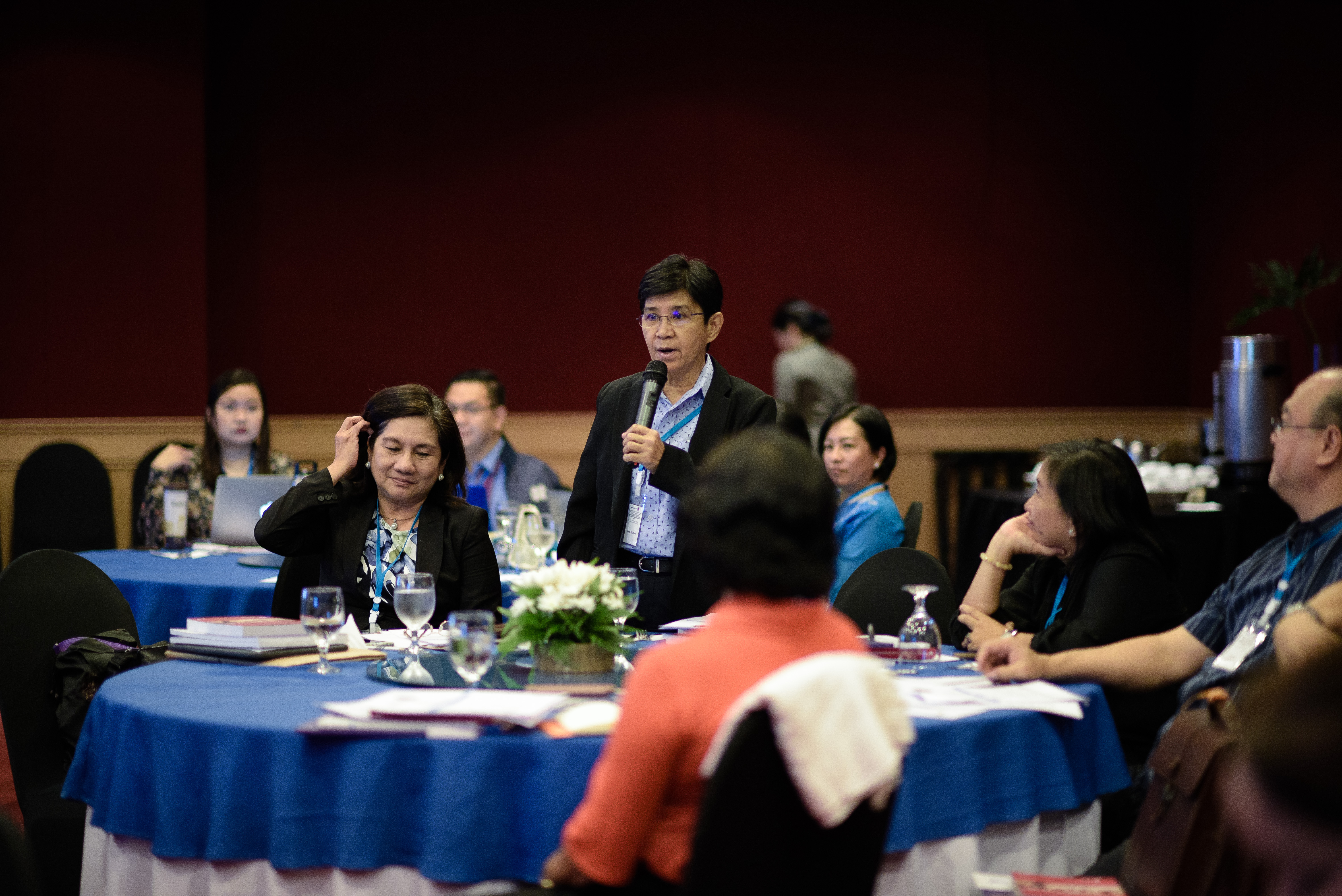
From 12 to 13 October 2018, the ICJ and the Integrated Bar of the Philippines (IBP) held its second national workshop on eliminating gender discriminatory attitudes and behaviours towards women.
Participants at the workshop were members of IBP’s Board of Governors and Committee on Bar Discipline. The workshop was held in Cebu City, Philippines.
Emerlynne Gil, ICJ’s Senior International Legal Adviser opened the workshop by emphasizing that it is crucial for lawyers of all areas of expertise to engage in dialogues such as this in order to further enhance women’s access to justice.
Gil pointed out that gender stereotypes incorporated in laws and perpetuated in the administration of justice impair the capacity of women to exercise their right to access to justice.
She emphasized that lawyers, as frontline formal justice actors, play a key role in eliminating these stereotypes.
Marienne Ibadlit, IBP’s Governor for Western Visayas, spoke about the establishment of the Gender and Development (GAD) Committee as a standing committee of the IBP.
The establishment of the GAD Committee is expected to advance gender and women’s human rights within the IBP.
It is also expected to institutionalize within the IBP efforts to build the capacity of lawyers in the Philippines to assist women in accessing justice.
The participants recognized during the opening session that recourse to gender stereotypes in the practice of law and administration of justice is widespread in the Philippines and that gender stereotypes directly impact women’s access to justice.
A range of stereotypes were identified, including the idea of women being the ‘weaker sex’ and the perception that female lawyers are not suited for litigation of controversial political or criminal cases.
During the workshop, participants discussed how they could maximize their role as lawyers in facilitating women’s access to justice, specifically in the areas of domestic violence, sexual violence, family law, and employment law.
Some of the participants noted that they themselves had been influenced by gender stereotypes and committed to be more consciously gender sensitive in their work and personal life.
While acknowledging that much more must be done to bring about systematic change, it was agreed that incremental measures could be impactful.
Abdiel Dan Fajardo, National President of the IBP, expressed support for more action by lawyers in the Philippines on women’s human rights.
Both the ICJ and IBP reinforced their commitment to joint collaboration in furthering the advancements in women’s access to justice in the country.
Contact
Emerlynne Gil, Senior International Legal Adviser for Southeast Asia, t: +662 619 8477 (ext. 206) ; e: emerlynne.gil(a)icj.org
Oct 1, 2018 | News
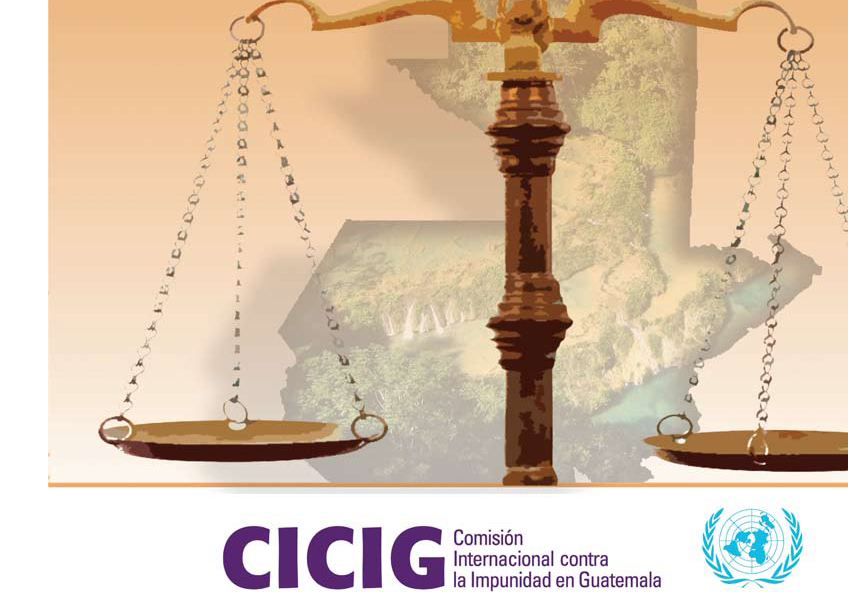
The Inter-American Commission of Human Rights (IACHR) held a special hearing on the role of the International Commission against Impunity in Guatemala (CICIG) in Boulder, Colarado.
Ramón Cadena, the ICJ Director stated “We regret that the Government of Guatemala requested the IACHR to hold the hearing behind closed doors since all the points discussed were of public interest. The discussions should have been open to the press and the general public. We urge the authorities to ensure there will be no retaliations against the work carried out by human rights organizations and human rights defenders.”
The ICJ welcomed the participation of many NGOs at the event and the frank dialogue that took place on this crucial issue for human rights in that country. The Guatemalan government delegation claimed that the Inter-American System of Human Rights was not competent to consider the matter. However, the IACHR maintained it was competent, according to the American Convention of Human Rights and other regional human rights legislation. As an “external observer”, the IACHR stated it was “surprised” by the latest decisions taken by government authorities at the highest level not to extend the CICIG mandate nor allow the entry of Commissioner Iván Velásquez into the country. It considered these decisions were “excessive” and in no way strengthened the rule of law in Guatemala.
The government delegation further argued that the CICIG acted as a “parallel prosecutor” which affects the internal order of the country. The NGO delegation stated that on the contrary the CICIG acted as a “complementary prosecutor”. The delegation further noted that before the CICIG mandate was approved, the Constitutional Court, in an opinion published in the official gazette on 8 May 2007 (document no 791-2007), considered that the CICIG did not violate the constitutional order nor the rule of law in Guatemala.
The Constitutional Court referred to the CICIG as having “the function of supporting, assisting and strengthening the state institutions responsible for investigating crimes committed by illegal and clandestine security forces .. and does not exclude the possibility of receiving support from other institutions in the collection of evidence, provided that the participation has been established in a legal manner, as in the present case.”
The IACHR considered that the essential question was whether the State of Guatemala already had the judicial independence and strong institutions necessary to fight against corruption in Guatemala without the support of the CICIG. The NGO delegation considered, based on different arguments, that the presence of the CICIG in Guatemala was still necessary.
The IACHR also informed the government delegation that it was in their interest to invite an in-situ visit of the IACHR as soon as possible so as to better understand the human rights situation.
The ICJ Director for Central America Ramón Cadena participated in the hearing at the request of the Central American Institute for Social Democracy Studies (DEMOS), the Committee for Peasant Development (CODECA) and the Network of Community Defenders. The Indigenous Peoples Law Firm had been requested to attend by these organizations but was unable to do so at the last moment.
Sep 26, 2018 | Advocacy, Non-legal submissions
The ICJ today emphasised the continuing failure of domestic accountability mechanisms to ensure proper accountability for crimes under international law in Libya, speaking at the UN Human Rights Council in Geneva.
The statement, made during an Interactive Dialogue with the UN High Commissioner for Human Rights on her oral update on the situation in Libya, at the Human Rights Council in Geneva, read as follows:
“Mr President,
The International Commission of Jurists (ICJ) remains concerned by the scale and magnitude of the human rights violations that continue in Libya, and the failure of domestic accountability mechanisms to address them.
Impunity prevails for crimes under international law committed during and after the 2011 uprising, including extrajudicial killings, torture and other ill-treatment, and enforced disappearances. Broad amnesty laws allow those responsible to avoid prosecution.
Even in the rare cases where former officials of the Gadhafi regime have faced trial,[1] the integrity of the justice process has been compromised by failures to respect international fair trial standards, including the right to legal counsel and the right to call and examine witnesses.
On August 15, 2018, following an unfair mass trial, 99 defendants were convicted for the killing of 146 anti-Gaddafi protesters in Tripoli during the 2011 uprising.[2] 45 were sentenced to death, violating the right to life.
Such unfair trials and unlawful sentences not only violate the human rights of the accused: they deprive the victims of the crimes of the right to know the truth about the legacy of past violations and the legitimate and untainted justice to which they are entitled. New, fair trials are required.
Political and security instability in Libya undermines the ability of the judiciary to administer justice independently and impartially, including with a view to combating impunity. Judges and prosecutors are threatened, intimidated, abducted and in some instances killed, particularly when attempting to address crimes by members of armed groups.
The ICJ would like to ask the High Commissioner, how can other States and civil society help ensure that Libya, while fully cooperating with the International Criminal Court, implements an effective legal and practical framework to address crimes under international law and eradicate impunity?
Thank you.”
[1] Case 630/2012.
[2] https://www.hrw.org/news/2018/08/22/libya-45-sentenced-death-2011-killings.
Sep 17, 2018 | Artículos, Noticias
La Corte de Constitucionalidad hizo pública ayer 16 de septiembre, su decisión de ordenar permitir el ingreso al país, del comisionado de la Comisión Internacional contra la Impunidad (CICIG), Iván Velásquez.
La CIJ celebra dicha decisión, ya que permitirá continuar el trabajo de la CICIG y de esta forma la decisión de la Corte de Constitucionalidad, logrará remover uno de los obstáculos más apremiantes, impuestos por el propio Presidente de la República, para el cumplimiento de las obligaciones internacionales del Estado de Guatemala, contenidas en el Acuerdo Internacional de Derechos Humanos que crea dicha comisión.
Con respecto a los recursos de amparo que buscan dejar sin efecto la decisión del Presidente de la República de no prorrogar el mandato de la CICIG, la Corte de Constitucionalidad (CC) decidió no otorgar el amparo provisional y, por lo tanto, los procesos deberán continuar hasta su resolución final.
Para el efecto, la CIJ insta a la Corte de Constitucionalidad, a respetar los plazos legales y resolver finalmente los recursos de amparo, conforme los principios, costumbre internacional y normas del Derecho Internacional de los Derechos Humanos.
La CIJ reitera que el no prorrogar el mandato de la CICIG, también podría causar un grave daño a la justicia y ser un obstáculo definitivo para el cumplimiento de las obligaciones internacionales del Estado de Guatemala, de combatir la impunidad.
Con respecto al diálogo que deberá continuar para resolver las diferencias, según el artículo 12 del Acuerdo Internacional de Derechos Humanos citado, la CIJ considera que es necesario incorporar a dicho diálogo, al Procurador de los Derechos Humanos y a la Sociedad Civil organizada, que fueron precisamente quienes propusieron la creación de tan importante comisión.
Uno de los puntos fundamentales a analizar entre todos los actores involucrados, entre otros temas, es si las entidades estatales nacionales ya están suficientemente fortalecidas y capacitadas para continuar la lucha contra la impunidad, sin el apoyo de la CICIG.
La CIJ considera que para seguir impulsando acciones eficientes en la lucha contra la corrupción e impunidad, es de vital importancia suspender los efectos de la decisión gubernamental, de no prorrogar el mandato de la CICIG.
De esta forma, se dará mayor confianza y viabilidad al diálogo entre todas las partes sobre el futuro de la CICIG; además, de esta forma se protegerán los derechos de la población guatemalteca.
Ramón Cadena, Director de la Comisión Internacional de Juristas para Centroamérica expresó: “Falta revertir la decisión del Presidente Jimmy Morales de no prorrogar el mandato de la CICIG. De esta forma, quedarán removidos todos los obstáculos impuestos a la CICIG y se contribuirá al fortalecimiento del Estado de Derecho en el país.”