May 24, 2018 | News, Publications, Reports, Thematic reports
The widespread occurrence of sexual and gender-based violence (SGBV) in Swaziland requires prompt action to enact the Sexual Offences and Domestic Violence Bill, says the ICJ in a report released today.
The ICJ’s report found that discriminatory practices based on customary laws and traditional beliefs undermine equality between men and women and contribute to an environment in which SGBV is at crisis point in the country.
“As the Senate of Swaziland deliberates over the Sexual Offences and Domestic Violence Bill, it must recall that enactment of the Bill is an essential step in complying with recommendations of the UN Human Rights Committee and CEDAW Committee and as a means of discharging the commitments made by His Majesty’s Government during the 2016 Universal Periodic Review,” said Arnold Tsunga, Director of the ICJ Africa Regional Programme.
In earlier submissions to the Senate of Swaziland, the ICJ noted that enactment of the Bill is a matter required of the Kingdom of Swaziland pursuant to its international human rights law obligations, including those arising from the Africa region, to criminalize and sanction the perpetrators of SGBV.
His Majesty’s Vision 2022, the aims and targets of the Deputy Prime Minister’s Office and Swaziland’s consensus in the adoption of the 2030 Agenda for Sustainable Development reinforce compliance with those obligations.
The Sexual Offences and Domestic Violence Bill 2015, first drafted over ten years ago, has still not been passed into law, including because there is a perception that some of its provisions will infringe Swazi law and custom.
“Legislative and policy reform is needed as is the enhanced technical capacity and commitment of justice actors and policy makers to combat domestic and sexual violence,” Tsunga added.
Contact
Arnold Tsunga, Director, ICJ Africa Regional Programme, t: +27.73.131.8411; e: arnold.tsunga(a)icj.org
Alex Conte, ICJ Global Redress and Accountability Initiative, t: +41.79.957.2733; e: alex.conte(a)icj.org
Download
Swaziland-GRABaselineStudy-Publications-Reports-Thematic reports-2018-ENG (full report in PDF)

May 9, 2018 | News
The ICJ said today that Gina Haspel, nominated by Donald Trump to be Director of the CIA, should be subject to a full criminal investigation for her alleged involvement torture and other serious crimes, rather than elevated to serve as the country’s highest intelligence office.
The ICJ statement came as the United States Senate Intelligence was poised to beginning hearings on her confirmation to the position.
“If Gina Haspel becomes CIA Director, the United States will be sending a signal to the world that it has dropped the pretence of caring about even the most serious human rights violations,” said Sam Zarifi, ICJ Secretary General.
“It will show that torturing and disappearing people by US officials will not only be met with impunity, but will be no bar to career advancement.”
Following the terror attacks against the United States of 11 September 2001 until 2007, the CIA held at least 119 terror suspects or persons it suspected to have intelligence value in places of secret detention outside of US territory.
The black sites were situated in several countries, including Afghanistan, Lithuania, Poland Romania, and Thailand.
The detainees, who had no contact with the outside world, were placed beyond the protection of the law and subjected to torture and cruel, inhuman and degrading treatment.
The torture included near drowning (“waterboarding”), prolonged sleep deprivation, placement in painful stress positions for extended periods, forced rectal feedings, and slamming against walls.
Gina Hapel oversaw at least one “black site” detention centre in Thailand in 2002, while detainee Abd al-Rahim al Nashiri was being tortured there.
She is credibly alleged to have played a significant role in destroying video evidence of interrogations that were carried out under torture.
“The European Court of Human Rights has already condemned Poland for violating the rights of Abd al-Rahim al Nashiri, after he was transferred to secret CIA detention facility in Poland, yet nobody directly responsible CIA has ever been held accountable for these serious crimes,” said Sam Zarifi.
Contact
Ian Seiderman, ICJ Legal and Policy Director, t +41 22 979 3837 ; e: ian.seiderman(a)icj.org
Apr 17, 2018 | Events, Multimedia items, News, Video clips
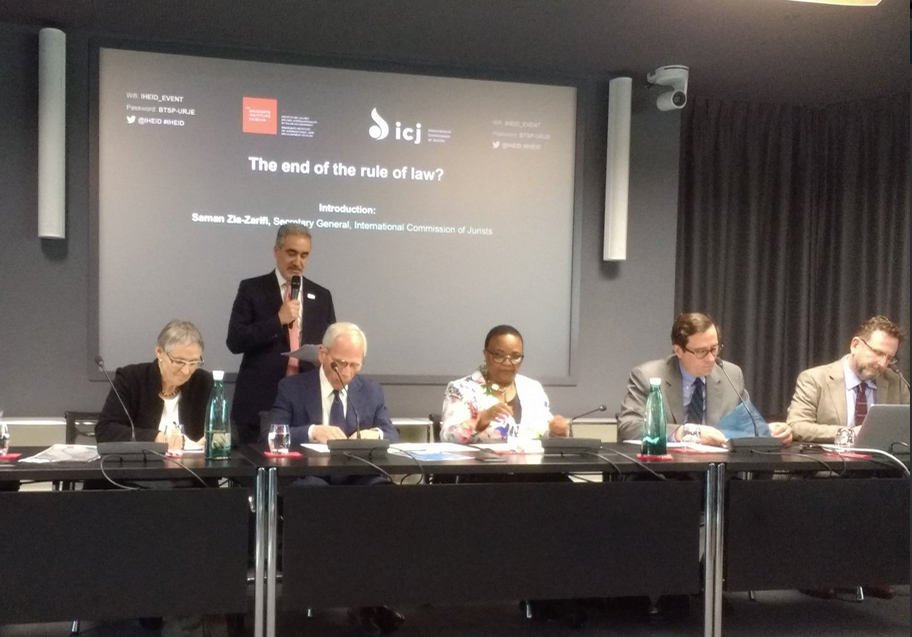
International commitment to the rule of law is under assault around the world, said a global panel of eminent academics, diplomats, and jurists.
The panelists, speaking at a public event by the ICJ and the Geneva Graduate Institute, commented that this assault is threatening to reverse the progress made over the last 70 years since the Universal Declaration of Human Rights(UDHR) came into force.
The panelists addressed progress in asserting the rule of law since the UDHR, for instance through the development of the International Criminal Court and greater awareness and commitment to rights, but also highlighted current challenges at the national level, such as in Venezuela, and at the global level, with ongoing discrimination and violence against women.
“The rule of law is a principle that helps the world and also helps individuals,” said ICJ Secretary General Saman Zia-Zarifi, in his introductory remarks.
“It is a principle that elevates democracy from mob rule and is necessary to harness the energy of democracy and give it a direction and progression towards the protection and promotion of human rights and sustainable development for the betterment of the lives of people around the world,” he added.
Professor Carlos Ayala, ICJ Vice-President and former President of the Inter-American Commission on Human Rights, spoke about the importance of having regional rights frameworks that were accessible to individuals when the rule of law has been eradicated at a national level.
Speaking in relation to Venezuela, Professor Ayala explained that the rule of law cannot be simply overturned by a political party, even with a majority, as the erosion of the rule of law puts all human rights at risk and these rights must be safeguarded regionally and internationally.
Next Patricia Schulz, member of the UN Committee on the Elimination of Discrimination against Women, pointed out that in many countries, the rule of law has been weak or never even properly existed.
She addressed failings where access to justice is undermined by systems that are gender discriminatory and explained that in almost all countries, even where the rule of law seems strong, there is a lack of will and/or means to fight gender-based violence.
Professor Andrew Clapham, Professor of Public International Law at the Graduate Institute and member of the UN Commission on Human Rights in South Sudan, evaluated issues of accountability and the rule of law in the context of international criminal law.
He noted the important role international criminal law and its operational mechanisms have in holding individuals to account, but warned that focusing on prosecution and focusing on issues such as genocide and the use of chemical weapons ran the risk of undermining the universality of ideas enshrined in the UDHR.
His Excellency Luis Gallegos, the Permanent Representative of Ecuador to the United Nations, raised concerns about the politicization of human rights and the capacity of UN mechanisms to address transnational rights issues such as migration.
He said that addressing the rule of law was not a simple question but that states had to come together to consistently and systematically address the rights violations that arose from a break-down in the rule of law.
Final panelist, Sanji Monageng, ICJ Commissioner and Justice of the International Criminal Court, spoke about the need for international organizations to rethink their approach to the rule of law and the way they apply this to cases, to avoid focusing narrowly on singular issues when rights violations need to be addressed homogenously.
Justice Monageng explained that for victims, sexual violence, for instance, is rarely a singular incident but part of broader array of rights violations that have far-reaching impacts.
In his concluding remarks, Professor Robert Goldman, who moderated the event, said that “the rule of law deals with a central tenet of any just society, not only equal protection and equal access but it is something that protects the vulnerable.”
He explained that the treat to the rule of law today is endemic and it is global, but the ICJ is uniquely placed to robustly address these difficult questions and to continue to use the rule of law to defend and advance rights protections.
The event, which took place at the Graduate Institute at the Maison de la Paix, promoted by the Permanent Mission of Germany, was attended by 150 persons including academics, diplomats, lawyers and representatives of civil society and international rights mechanisms. The event was also streamed online by RIDH Global.
You can watch the full event here.
https://www.facebook.com/ridhglobal/videos/10158134493084616/UzpfSTQ3MTQ2NzA4NjIyMTM3MzoxOTk5MjM0NDc2Nzc3OTUy/
https://www.youtube.com/watch?v=ije_iAegxFs&feature=youtu.be

Mar 28, 2018 | Advocacy, Non-legal submissions
The ICJ today submitted a report to the UN Committee against Torture, calling for recommendations to be made on prevention of and accountability for continued recourse to torture and ill-treatment in Tajikistan.
The ICJ’s submission is made ahead of consideration by the Committee against Torture in April to May 2018 of Tajikistan’s third periodic report on the implementation of its obligations under the Convention against Torture and Other Forms of Cruel, Inhuman or Degrading Treatment or Punishment.
The ICJ’s report draws from an earlier study on Achieving Justice for Gross Human Rights Violations in Tajikistan and calls on the Committee against Torture to make recommendations concerning:
- The obligation to adequately sanction torture;
- The obligation to prevent torture and other forms of ill-treatment, including in places of detention;
- The obligation to investigate allegations of torture and ill-treatment;
- The use of amnesties and pardons for torture;
- The prohibition against the use of evidence obtained by torture;
- The right to complain about torture and ill-treatment; and
- The right of victims to effective remedies and reparation.
Tajikistan-CAT-Advocacy-AlternativeReport-2018ENG (download the ICJ’s submission, in PDF)
Mar 12, 2018 | Advocacy, Non-legal submissions
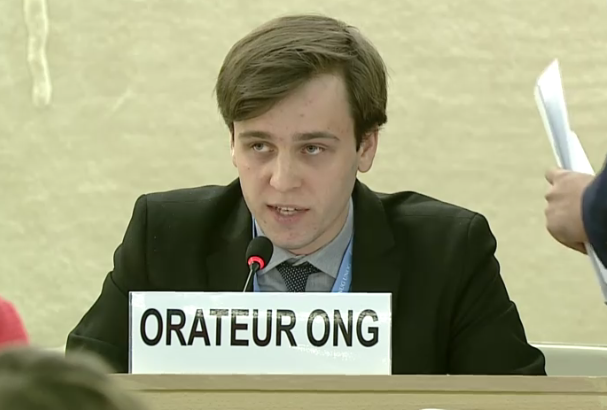
The ICJ today delivered a statement at the UN Human Rights Council calling on Myanmar to cooperate with UN mechanisms and for all UN agencies in the country to make human rights central to their approach.
The statement, made in the interactive dialogue with the international Fact Finding Mission on Myanmar, and the Special Rapporteur, read as follows:
“The International Commission of Jurists (ICJ) welcomes the update of the Independent International Fact Finding Mission. In relation to crimes under international law, the ICJ encourages the experts to continue to develop further specific recommendations for securing criminal accountability and providing redress.
The ICJ also welcomes the report of the Special Rapporteur, and strongly supports the renewal of her mandate and tenure.
As a UN Member State, the Government of Myanmar should fully cooperate with all the organs and mechanisms of the UN, in accordance with its obligations under the UN Charter.
At this session, the government asked for ‘concrete evidence’ of alleged human rights violations, and committed to taking action against perpetrators, but permission to enter the country is still refused to the Fact Finding Mission, to the Special Rapporteur and to the Office of the High Commissioner for Human Rights.
To demonstrate a genuine commitment to truth and accountability, the Government must allow them full access to areas of concern, particularly to Rakhine State and to conflict areas in Kachin State and Shan State.
Humanitarian actors and independent media must also be immediately allowed full and unimpeded access, particularly to Rakhine State, as recommended by the government’s own Advisory Commission.
The current situation in Rakhine State is incongruous to voluntary returns of Rohingya refugees. At the same time, the UN High Commissioner for Human Rights must be included in repatriation planning with a full mandate to protect refugees. This is contemplated in current repatriation arrangements with the Government of Bangladesh, and the Government of Myanmar must now formalize this relationship with UNHCR.
Experts, what can be done to ensure all UN agencies present in Myanmar actually put ‘human rights up front’ in the line with the mandate of every UN organ under the UN Charter?”