Mar 4, 2013 | News
The ICJ expressed its concern over the criminal trial of 94 individuals, including judges, lawyers, academics, human rights defenders and civil society activists, in the State Security Chamber of the UAE Federal Supreme Court.
Following a wave of arbitrary arrests and detention, which began in March 2012, the case was referred to the Supreme Court on 27 January 2013.
“The ICJ is gravely concerned over the fairness of the upcoming proceedings, including the lack of any right of appeal, the lack of restrictions on the use of evidence obtained through torture or ill-treatment and severe restrictions imposed on the rights of the defence, in contravention of international human rights law, including the Arab Charter on Human Rights, to which the UAE is a party,” said Said Benarbia, ICJ Senior Legal Adviser of the Middle East and North Africa Programme. “Furthermore, allegations of torture and ill-treatment by detainees, including incommunicado detention, prolonged solitary confinement, sleep deprivation and verbal and physical abuse, must be promptly, impartially and thoroughly investigated.”
The ICJ further notes that there have been violations of international fair standards.
These include the failure of State authorities to formally charge defendants, severe restrictions on access to legal counsel, including during questioning and the failure to disclose case files to the defence until a few days before trial.
Until two weeks before the trial, there was a single lawyer acting for all detainees and other lawyers who tried to assist have faced harassment, including detention and deportation, the ICJ says.
The trial is part of a broader crackdown by the UAE authorities in response to a petition signed by 100 academics, legal professionals, and civil society activists, in March 2011, for political reforms and increased public participation in government.
“The ICJ condemns the use of criminal proceedings to suppress peaceful calls for increased democracy as an unlawful restriction on the right to freedom of expression,” Benarbia added. “Extending the clampdown on critics to include numerous members of the legal profession severely compromises the Rule of Law in the UAE.”
Contact:
Said Benarbia, ICJ Senior Legal Adviser of the Middle East and North Africa Programme, tel: 41 22 979 38 17, e-mail: said.benarbia(at)icj.org
Sep 11, 2012 | Events
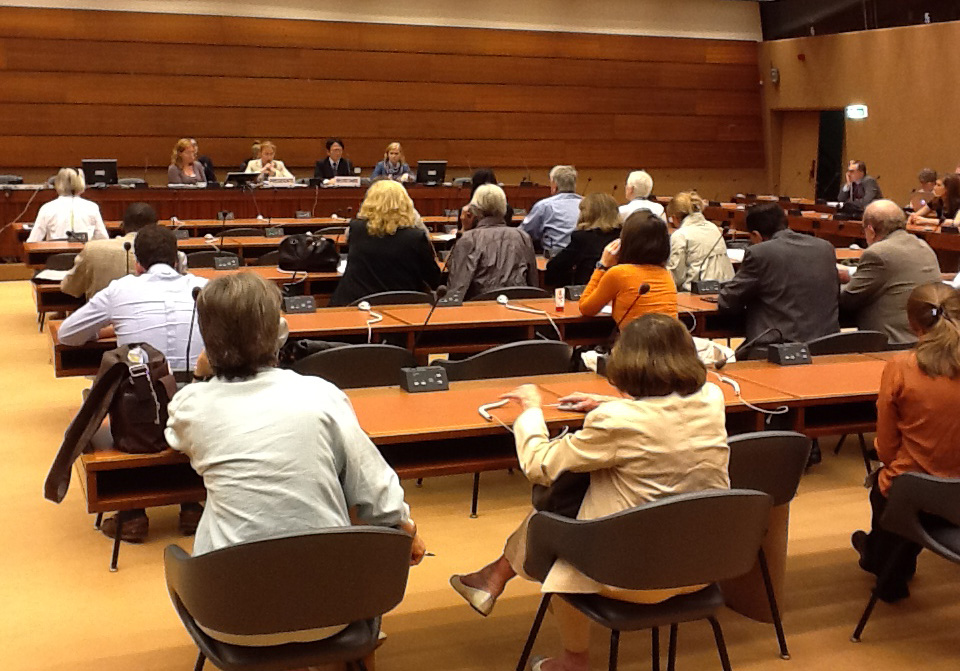 During the 21st session of the UN Human Rights Council (10-28 September 2012), the ICJ and the Geneva Academy of International Humanitarian Law and Human Rights will convene a high-level discussion on ensuring human dignity during detention.
The parallel event will be held in the Palais des Nations in meeting room XXI on Tuesday 25 September 2012 from 14h to 16h.
The event will discuss the need and options for an international instrument clarifying and enhancing the human right legal framework applicable to persons in detention. Panelists include Professor Manfred Nowak, former Special Rapporteur on torture and former member of the Working Group on enforced disappearances; Judge Theodor Meron, Judge on the Appeals Chambers of the ICTY and ICTR; Professor Shaheen Sardar Ali, Vice-Chair of the Working Group on arbitrary detention; and Ian Seiderman, Law and Policy Director of the ICJ. The event will be moderated by Hina Jilani, member of the Panel on Human Dignity and Advocate of the Supreme Court of Pakistan.
The event is open to all persons with access to the Palais des Nations.
HRC21-DetentionEvent-Flyer-2012 (download flyer)
HRC21-DetentionEvent-ConceptNote&BackgroundPaper-2012 (download concept note and background paper)
Aug 6, 2012 | News
 The ICJ calls on the United Arab Emirates (UAE) authorities to end their crackdown on lawyers and human rights defenders.

Apr 16, 2012 | Advocacy, Non-legal submissions
Under the second cycle of the Universal Periodic Review (UPR) mechanism, the UN Human Rights Council Working Group on the UPR will be undertaking a review of Sri Lanka during its 14th session.
In a submission to the Working Group, the ICJ has focused on the discrete issues of:
- the failure of the Lessons Learnt and Reconciliation Commission and previous national commissions of inquiry to hold accountable those responsible for serious human rights violations;
- the systemic barriers affecting the efficacy of the habeas corpus writ as legal remedy for arbitrary detention and enforced disappearance;
- the ongoing detention of Sri Lankans in “rehabilitation camps” and the lack of any independent monitoring mechanism;
- Sri Lanka’s failure to implement witness protection measures;
- Sri Lanka’s failure to properly incorporate the Convention Against Torture into domestic law; and
- Sri Lanka’s party status to international human rights instruments and its cooperation with the UN treaty bodies and the Council’s Special Procedures.
Sri Lanka-ICJ submission UPR-non-judicial submission-2012 (full text in English, PDF)
Sri Lanka-Comparison second cycle-advocacy-2012 (full text in English, PDF)

Apr 12, 2012 | News
 La CIJ y el Observatorio expresaron su preocupación común por la continuada privación arbitraria de libertad de la Jueza María Lourdes Afiuni y por los actos de intimidación y amenazas contra los abogados que la defienden.