
Mar 7, 2014 | News
The ICJ expressed concern at the arrest and detention, on 28 February, of lawyer Taisiya Baskayeva, who represents a significant number of victims of human rights violations before the European Court of Human Rights.
Taisiya Baskayeava was arrested on charges of large-scale fraud under article 159.3 of the Russian Criminal Code, based on allegations by investigators that she misappropriated reparations awarded to victims she represented in the case of Salkazanov and others v. Russia before the European Court.
The arrest followed repeated attempts by the investigator to place her in detention in connection with the case.
A previous request to the Court by the investigator for her arrest, on 14 February, had been based partly on the allegation that she was in hiding in the United Arab Emirates and the fact that she had been “put on an international missing list.”
However the Court on that occasion denied the request, saying that it “received no reliable information that Baskayeva T.S. had left the territory of Russia” and that she had sent an urgent telegram from the Moscow region to prove her presence in the territory of Russia.
Taisiya Baskayeva was detained in Moscow region while undergoing a medical check and driven some 1200 km in a car to North Osetia.
At a hearing on 4 March 2014 the Soviet District Court of Vladikavkaz decided to grant the motion to detain the lawyer for two months pending trial. The Court ruled out other less restrictive measures.
The ICJ has received information indicating that the investigation presented no evidence that Taisiya Baskayeva had left Russia, except for an allegation made by the investigator in the motion for her arrest.
The ICJ is unaware of the reasons for declaring the lawyer missing, since her whereabouts were clearly known.
Moreover, the fact that she was detained while undergoing a medical check, of which the investigative authorities were duly informed by the Central City Hospital, contradicts her inclusion on a “international missing list”.
According to the official letter of the Deputy Head Physician at the disposal of the ICJ, the schedule of her visits was also made known to the investigative authorities.
The ICJ is concerned at that the detention may be arbitrary, and may have been ordered for the improper motive of subjecting Taisiya Baskayeva to persecution, harassment or intimidation in regard to her representation of her clients before the European Court of Human Rights.
If so, the Russian Federation would be in breach of obligations in respect of the right to liberty under article 9 of the International Covenant on Civil and Political Rights and article 5 of the European Convention on Human Rights.
The ICJ recalls that for lawyers to be able to fulfill their role and duties effectively, and independently, the State authorities must ensure that they are able to discharge their functions without any intimidation, harassment or improper interference.
According to the UN Basic Principles on the Role of Lawyers, lawyers must not be threatened with prosecution or any other form of sanctions for any action taken in accordance with professional duties or standards and ethics (Principle 16).
Under these principles when lawyers are threatened as a result of discharging their functions, the state authorities must take adequate steps to protect them (Principle 17).
The ICJ is concerned that the detention may constitute a form of a reprisal for an effective representation of the interests of a significant group of victims before the European Court of Human Rights.
Any such reprisal would be incompatible with Russia’s obligations under article 34 of the European Convention for Human Rights guaranteeing an effective exercise of the right to bring lodge applications claiming violations under the ECHR.
Approximately 200 other cases submitted by Ms. Baskayeva are currently pending before the European Court of Human Rights.
The ICJ will continue to monitor the criminal prosecution of lawyer Taisiya Baskayeva.
Contacts:
Róisin Pillay, Director, Europe Programme, t + 32 273 48 46, roisin.pillay(a)icj.org
Temur Shakirov, Legal Adviser, Europe Programme, t + 41 22 979 38 32, temur.shakirov(a)icj.org
Russia-Concerns over Baskayeva-news-web story-2014-rus (full text in pdf)
Mar 7, 2014 | News, Publications, Reports
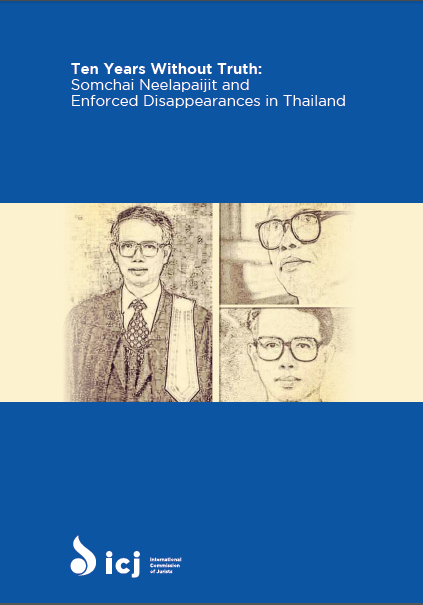
A new ICJ report criticizes the Thai Government’s failure to take the steps necessary to establish the fate and whereabouts of missing lawyer Somchai Neelapaijit, saying it illustrates the challenges of achieving justice in cases of serious human violations in Thailand.
In the report, Ten Years Without Truth: Somchai Neelapaijit and Enforced Disappearances in Thailand, the ICJ documents the tortuous legal history of the case.
It highlights several key problems, such as poor use of forensic evidence, failure to follow and develop leads, unduly restrictive interpretation of national and international law, and above all, a lack of political will to resolve a case that remains emblematic of the culture of impunity in Thailand.
“Over the past 10 years, this case has taken many unexpected turns, including the disappearance of a prime suspect, admissions of Somchai’s death from officials while the courts have rejected such a finding, and most recently, a statement from the Department of Special Investigations that it had lost, and then found, the case files,” said Sam Zarifi, ICJ’s Regional Director for Asia and the Pacific.
“The Royal Thai Government has not exhausted all potential areas of inquiry and it must continue this investigation. There is no statute of limitations on an enforced disappearance and Somchai’s case is not forgotten in Thailand or around the world.”
Somchai, a lawyer and human rights defender, was stopped at a Bangkok roadside on March 12, 2004 and pulled from his car by a group of men. He has not been seen since.
At the time, Somchai was defending clients from Thailand’s restive southern provinces who were accused of attacking a military base as part of the ongoing insurgency in the region. Somchai had alleged police tortured the Muslim suspects.
Ten years later, Somchai’s wife, Angkhana Neelapaijit, and her family are no closer to knowing the truth about what happened to him.
“Somchai’s enforced disappearance, and the failure of the Royal Thai government to provide accountability or even basic information about his fate are emblematic of the challenges of achieving justice in cases of serious human rights violations in Thailand,” said Zarifi. “Enforced disappearance is not only a serious human rights violation but also a crime under international law.”
Thailand signed, but has not yet ratified, the Convention Against Enforced Disappearance in January 2012. Pending the ratification, Thailand must desist from any acts that would defeat the objective and purpose of the convention, which places an obligation on State Parties to make enforced disappearance a criminal offence and treat family members of a ‘disappeared’ person as victims in their own right.
The ICJ has followed Somchai’s case closely and worked with Angkhana Neelapaijit since 2004.
“The Royal Thai government’s failure to shed any more light on the enforced disappearance of Somchai Neelapaijit, despite providing compensation for his family and finding him to be ‘disappeared’, contradicts multiple past declarations of its commitment to seeking justice, or at least truth, including by several former Prime Ministers, Attorneys General, and officials,” the report says.
“It also contradicts official commitments before the United Nations Human Rights Council in March 2008.”
The ICJ’s report calls on the Royal Thai government to prioritize and advance the investigation into Somchai’s disappearance in a manner that conforms to its international obligations. It also recommends that Thailand:
–Ratify the Convention Against Enforced Disappearance;
–Enact legislation that makes enforced disappearance a specific crime in Thai domestic law, together with penalties that recognize its extreme seriousness;
–Amend existing Thai law to conform to the Convention Against Enforced Disappearance, as well as the State’s obligations, including with respect to effective remedy and reparation, under the ICCPR and CAT;
–Provide Angkhana Neelapaijit and her family with effective remedy and full reparation, in particular knowledge and clarification of the facts leading to the enforced disappearance and the progress and results of the Department of Special Investigations, and;
–Address the recommendations the ICJ made to the DSI in its letter of February 4, 2014 with respect to its investigation.
CONTACT
Sam Zarifi, ICJ Asia-Pacific Regional Director, (Bangkok), t:+66 807819002, e-mail: sam.zarifi(a)icj.org
Craig Knowles, ICJ Media & Communications, (Bangkok), t:+66 819077653, e-mail: craig.knowles(a)icj.org
Download the full report in PDF:
Ten Years Without Truth- Somchai Neelapaijit and Enforced Disappearances in Thailand – report – 2014
Thailand-Ten Years Without Truth-Publications-Reports-2014-THAI

Feb 28, 2014 | News
A statement by Sultan Hassanal Bolkiah suggesting that critics of Brunei Darussalam’s new Penal Code may be criminally prosecuted for slander is clearly meant to curb freedom of expression and opinion in the country, the ICJ said.
The ICJ urged the Government of Brunei to ensure full respect for the right of freedom of opinion and expression.
In a speech marking Brunei’s 30th National Day on 23 February 2014, Sultan Hassanal Bolkiah said that social media had been used to express opposition to the implementation of the new Penal Code.
He said that those who use social media to express their opinions against the new Penal Code may be committing offences under the General Offences Chapter of the new law. He reportedly characterized some of this expression as amounting to slander, including of the King and of Ulamas, or Muslim scholars. The Sultan also warned that these critics “cannot continue to be allowed to inflict insults” and that they “can be brought to court.”
“Sultan Hassanal Bolkiah’s statement illustrates that human rights, particularly respect for freedom of opinion and expression, is widely disregarded by the authorities in Brunei,” said Sam Zarifi, ICJ’s Regional Director for Asia and the Pacific.
The ICJ has criticized the new Penal Code for being an affront to human rights and at odds with international standards.
The ICJ reiterates its concern that provisions in the new Penal Code are not in accord with the commitment made by Brunei Darussalam as a member of the Association of Southeast Asian Nations (ASEAN) to promote and protect human rights in the region.
“Free, unhindered debates on issues like the enactment or implementation of a law are important cornerstones of a democratic society,” said Zarifi.
Freedom of opinion and expression is a right that is affirmed in the Universal Declaration of Human Rights and guaranteed under the Convention on the Elimination of All Forms of Discrimination against Women (CEDAW) and the Convention on the Rights of the Child (CRC), to both of which Brunei Darussalam is a party. Under international law, any restrictions or limitations must be exceptional, in accordance with the principles of the proportionality and necessity.
The ICJ urged the Government of Brunei to allow free discussion, particular on matters of public importance such as State law and policies and to fully respect the right to freedom of opinion and expression.
Contact:
Emerlynne Gil, ICJ International Legal Adviser for Southeast Asia, t +66 2 619 8477; email: emerlynne.gil(a)icj.org
Craig Knowles, ICJ Media Consultant, t +66 81 9077653; email:craig.knowles(a)icj.org
Feb 7, 2014 | News
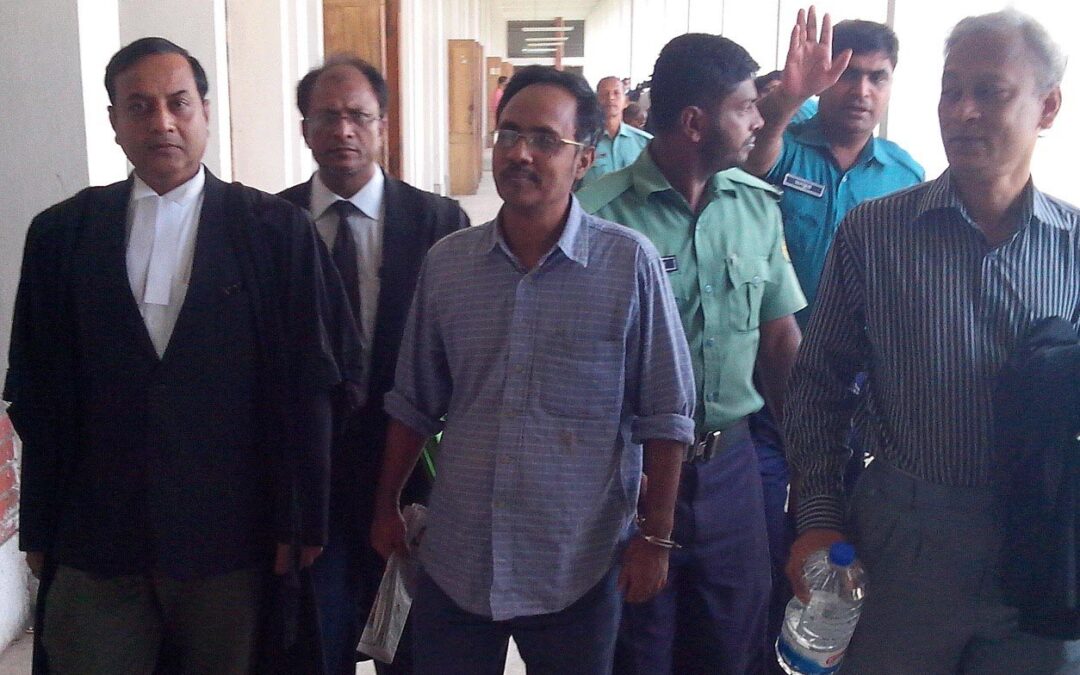
Bangladesh authorities must immediately cease their harassment of Adilur Rahman Khan, Secretary of Odhikar, a prominent human rights organization and ICJ affiliate, and members of his family, the ICJ said today.
On 5 February 2014, Odhikar reported that two officers of the Special Branch of Police followed a member of Adilur Rahman Khan’s family from his home. When he realized he was being followed he decided to return home. The security officers continued to follow him, and parked their motorcycle next to his house.
Odhikar previously reported that security forces monitor its Dhaka offices as well as Adilur Rahman Khan, his family and other staff. In August 2013, security forces raided Odhikar’s office, confiscating computers containing potentially sensitive material such as the identities of witnesses.
“These actions are deliberate acts of intimidation against Odhikar, its staff and their families, designed to silence the legitimate actions of human rights defenders,” said Ben Schonveld, the ICJ’s Asia Director.
Article 12 of the United Nations Declaration on the Right and Responsibility of Individuals, Groups, and Organs of Society to Promote and Protect Universally Recognized Human Rights and Fundamental Freedoms (Declaration on Human Rights Defenders), clarifies that States must take all necessary measures to ensure the protection of human rights defenders from any violence, threat, retaliation, pressure, or any other arbitrary action as a consequence of the legitimate exercise of rights, including the freedom of expression.
Background:
Adilur Rahman Khan and Nasiruddin Elan, Secretary and Director of Odhikar, have been charged under section 57 of the Information and Communication Technology (ICT) Act, 2006, for publishing a report on the Government crackdown on a Hefazat-e-Islam rally in May 2013. The report alleged that 61 people were killed in the protest; the Government disputes the number of casualties. Rahman and Khan were indicted on 8 January 2014 and are both currently on bail.
Contact:
Ben Schonveld, ICJ South Asia Director (Kathmandu), t: +977 14432651; email: ben.schonveld(a)icj.org
Reema Omer, ICJ International Legal Advisor (London), t: +447889565691; email: reema.omer(a)icj.org
Jan 10, 2014 | News
The ICJ calls on the Bangladeshi authorities to immediately and unconditionally drop ‘cybercrime’ charges against Nasiruddin Elan and Adilur Rahman Khan, President and Secretary of the human rights group Odhikar.
“These charges are a flagrant attempt to silence critical voices, and the Bangladeshi authorities must immediately and unconditionally drop all charges against the two human rights defenders,” said Sam Zarifi, ICJ’s Asia director.
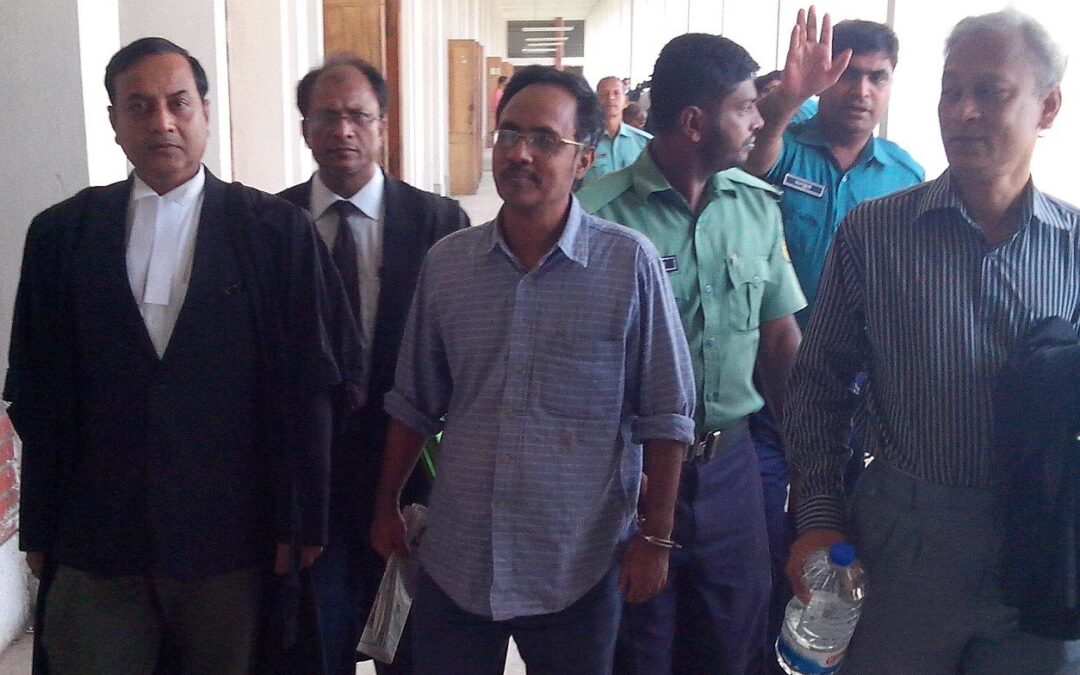
On 8 January 2014, a cyber crimes tribunal in Dhaka indicted Nasiruddin Elan (picture, on centre) and Adilur Rahman Khan under section 57 (1) and (2) of the Information and Communication Technology (ICT) Act, 2006, for publishing “fake, distorted and defamatory” information. Khan and Elan plead innocent to the charges.
The charges relate to a report by Odhikar that alleged that security forces had killed 61 people during a rally by the Islamist group Hefazat-e Islam in May 2013. The Government disputes the casualty numbers.
The trial is set to begin on 22 January 2014. Under the terms of the newly amended ACT the two human rights defenders face a minimum of seven and maximum of 14 years imprisonment.
“The ICJ has warned that the ICT Act can be used to attack freedom of expression in Bangladesh,” said Sam Zarifi. “As predicted, the Government is now using the newly amended law to silence political and public discourse through the threat of punitive sentences and deliberately vague and overbroad offences in clear violation of international law.”
In a briefing paper released on 20 November 2013, ICJ highlighted that provisions of the 2006 ICT Act (amended 2013), particularly section 57, violate Article 19 of the International Covenant on Civil and Political Rights (ICCPR), which Bangladesh ratified on 6 September 2000: the offences prescribed are poorly defined and overbroad; the restrictions imposed on freedom of expression go beyond what is permissible under Article 19(3) of the ICCPR; and the restrictions are not necessary and proportionate to achieve a legitimate purpose.
In addition, the UN Declaration on Human Rights Defenders underscores that States must take all necessary measures to protect human rights defenders “against any violence, threats, retaliation, de facto or de jure adverse discrimination, pressure or any other arbitrary action as a consequence of his or her legitimate exercise of his or her rights.”
Contact:
Sam Zarifi, ICJ Asia-Pacific Regional Director, (Bangkok), t: +66 807819002; email: sam.zarifi(a)icj.org
Ben Schonveld, ICJ South Asia Director, t: +61 422 561834; email: ben.schonveld(a)icj.org
Additional information
Adilur Rahman Khan was arrested his home on 10 August 2013 without an arrest warrant.On August 11, a Magistrate’s Court refused his bail application and remanded him for five days of custodial interrogation.
On August 12, the High Court Division of the Supreme Court stayed the remand order and directed that Adilur Rahman be sent back to jail, where he could be interrogated ‘at the gate of the jail.’
On 4 September 2013, the Detective Branch of Police filed a charge sheet against Adilur Rahman Khan and Odhikar’s Director, Nasiruddin Elan, under Section 57 of the International Communication and Technology Act 2006. On 30 October Adilur Rahman Khan was released on bail. On 6 November 2013, a Dhaka cyber crimes tribunal rejected Nasiruddin Elan’s bail application and ordered his detention in Dhaka Central Jail. Bail was granted on 24 November by the High Court. But the bail order was finally enforced after the appellate division’s order on 3 December 2013.