Mar 31, 2016 | News
A Delhi Court acquitted human rights defender Irom Sharmila of an “attempt to commit suicide” charge. The government of Manipur must in turn immediately drop the charges against her, said the ICJ today.
Irom Sharmila, was charged under section 309 the Indian Penal Code.
She has been on a continuous hunger strike for over 15 years, demanding repeal of the Armed Forces Special Powers Act (AFSPA).
“This order is a welcome recognition that Irom Sharmila’s hunger strike is a form of peaceful dissent and protest protected by the right to freedom of expression,” said Sam Zarifi, ICJ’s Asia Director.
This week, Iron Sharmila was acquitted of the charges against her in Delhi. The case against her in Manipur is, however, still on-going.
The decision of the Delhi court is not binding on the courts in Manipur, but the charges are analogous, and similar reasoning should prevail, the ICJ says.
“The government of Manipur should drop the other charges under section 309 against her, and release her immediately and unconditionally,” said Zarifi.
On at least two occasions previously, courts in Manipur have directed that Irom Sharmila be released, saying that charges under section 309 were not applicable.
“The use of section 309 against Sharmila highlights the outdated and absurd nature of this law,” Zarifi said.
“The government should expedite the repeal of 309 and, instead of criminalizing Irom Sharmila’s protest, focus on the reason behind it and repeal the AFSPA,” he added.
The AFSPA gives armed forces a range of “special powers” in “disturbed areas”, which include the power to arrest without warrant, to enter and search any premises, and in certain circumstances, “fire upon or otherwise use force, even to the causing of death”.
Furthermore, under the AFSPA, governmental permission, or sanction, is required before any member of the armed forces can be prosecuted for crimes in a civilian court.
These provisions are inconsistent with a range of human rights, including the right to life and right to remedy.
They have also facilitated torture, rape and enforced disappearances in areas where operational, the ICJ notes.
“This law is inconsistent with India’s human rights obligations, and has led to human rights violations, wide-spread impunity, and immense grief and suffering in the areas where it operates”, Zarifi said.
“It is high time that it was taken off the books”.
Background
Irom Sharmila began a hunger strike in November 2000, calling for the repeal of the AFSPA, following the unlawful killing of 10 civilians by security forces purportedly acting under it in Malom.
She was arrested by the Manipur government in 2000 under section 309 of the Indian Penal Code, which prohibits an “attempt to commit suicide”.
Irom Sharmila has been in custody almost continuously since her initial arrest, and has continued her hunger strike.
She is fed through a nasal tube at the Jawaharlal Nehru hospital in Imphal where she is usually held.
The Delhi government also charged her on similar grounds with respect to an incident from 2006, when she held a protest in their jurisdiction.
In 2014, a Manipur court quashed charges under section 309 against Irom Sharmila, saying “The agitation of Irom Chanu Sharmila is a political demand through lawful means of repealing a valid statute. … she may continue with the fast till her demand is met politically by the Government”.
However, since she continued her hunger strike, she was immediately re-arrested on the same grounds.
In its 210th report, the Indian Law Commission has recommended that section 309 be repealed. In 2011, the Supreme Court said: “the time has come when [section 309] should be deleted by Parliament as it has become anachronistic.”
In 2014, the government announced that it was in the process of repealing 309.
The AFSPA applies to “disturbed areas” in the states of Arunachal Pradesh, Assam, Manipur, Meghalaya, Mizoram, Nagaland and Tripura.
An almost identical law is also applicable in Jammu and Kashmir.
Mar 23, 2016 | Advocacy, Non-legal submissions
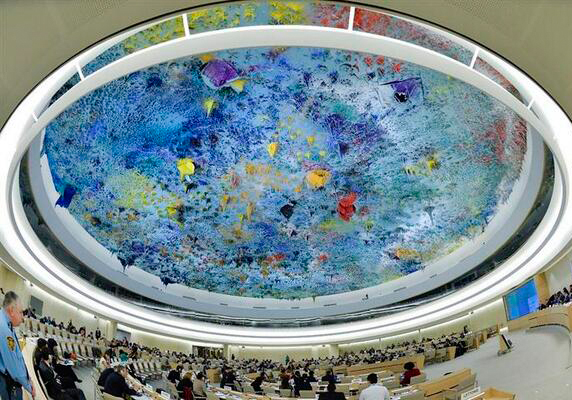
The ICJ today joined other NGOs in an oral statement to the UN Human Rights Council on the findings of the report of the OHCHR investigation mission on Libya.
It includes that violations of international law taking place throughout Libya “may amount to war crimes and other international crimes under international law.”
The statement continued as follows:
All sides to the conflict in Libya continue to perpetrate grave human rights violations and abuses. As highlighted by the UN High Commissioner for Human Rights, these violations continue to take place with “complete impunity” amid the collapse of the domestic justice system.
Unless genuine accountability is provided for these ongoing crimes the cycle of violence in Libya will continue, and the peace process will likely become no more than a well-intentioned piece of paper.
In this context, this Council has a duty to remain seized of the human rights situation in Libya, ensure continued monitoring of the situation and act to strengthen international accountability for crimes committed in Libya if the national system remains incapable of fulfilling this role. We are deeply concerned that the current resolution before this Council falls short of that standard.
Additionally, all UN member states should ensure that the International Criminal Court has the capacity to fulfill the mandate provided to it by the Security Council and begin fully fledged investigations into past and ongoing crimes committed in Libya.
As highlighted by civil society in a letter to this Council: “It is critical that all parties to the conflict are put on notice that their actions are being monitored and that accountability for serious crimes is a real prospect rather than an empty threat. Failure to do so will likely embolden those committing violations of international human rights and humanitarian law and will reinforce the endless cycle of impunity” in Libya.
The statement was on behalf of Cairo Institute for Human Rights Studies, CIVICUS, Human Rights Watch, International Commission of Jurists, FIDH, and OMCT.

Feb 29, 2016 | News
El día 1 de febrero del presente año, el Juez Tercero de Primera Instancia Penal Narcoactividad y Delitos contra el Ambiente desestimó la querella presentada por el Señor Ricardo Méndez Ruiz en febrero de 2015, en contra del Fiscal de Derechos Humanos Licenciado Orlando López.
Dicha querella pretendía afectar la labor que ha venido realizando el Fiscal Orlando López a favor de la lucha contra la impunidad, criminalizándolo y afectando su derecho a la libertad de expresión.
La CIJ celebra dicha resolución que reconoce la función de defensores y defensoras de derechos humanos, operadores de justicia, abogados y abogadas y a la sociedad guatemalteca.
En este caso, el Fiscal de Derechos Humanos tuvo que enfrentar una querella por casi un año.
Recientemente la Corte de Constitucionalidad denegó un Recurso de Amparo presentado por Ricardo Méndez Ruiz en contra del Procurador de los Derechos Humanos, por haber emitido dicho Procurador la resolución en la que declaró “la violación de los derechos a la dignidad, a la integridad, a la seguridad que constituyen una amenaza al derecho a la vida, a la igualdad, la libertad de accion y de asociación de los defensores de Derechos Humanos y los miembros de organizaciones no gubernamentales de derechos humanos…” y señaló como responsable de dicha violación al señor Ricardo Méndez Ruiz.
Finalmente, el Procurador de Derechos Humanos recomendó a Ricardo Méndez Ruiz “abstenerse de realizar señalamientos para criminalizar la labor de los defensores y defensoras de derechos humanos en Guatemala” y lo invitó a reflexionar sobre el “daño social que representa difundir masivamente el tipo de contenidos analizados” en dicha resolución, por medio de los cuales “no sólo agrede a personas, organizaciones o movimientos, representantes diplomáticos y Misiones Internacionales, sino también fomenta el odio y la confrontación social”.
Ante este amparo, la Corte de Constitucionalidad resolvió que “el acto señalado como objeto de reproche no genera agravio constitucional susceptible de ser reparado en amparo” y que “debe denegarse la protección constitucional solicitada” por Ricardo Méndez Ruiz.
La CIJ hace un nuevo llamado a las autoridades del Estado de Guatemala para que inicie una investigación exhaustiva e imparcial acerca de las actuales campañas contra defensores y defensoras de derechos humanos y que adopte las medidas necesarias de acuerdo a derecho con respecto a dichos actos.

Jan 14, 2016 | News
As today marks the fifth anniversary of the toppling of Ben Ali’s regime, the ICJ calls on Tunisian authorities to adopt key legal and policy reforms to combat impunity and to deliver justice to victims of past human rights violations.
Under Ben Ali’s regime, thousands of human rights violations, including torture and other ill-treatment, unlawful killings, enforced disappearances, and arbitrary arrests and detentions, were committed by law enforcement and other security officers.
Numerous similar violations were also committed during the December 2010 to January 2011 uprising and some of them continue today.
“The political and institutional reforms introduced in Tunisia over the past 5 years should not be the sole yardstick to measure the success of the transition,” said Said Benarbia, Director of the ICJ Middle East and North Africa Programme.
“Victims of human rights violations, in particular under Ben Ali’s rule, and during the uprising still await justice,” he added.
Despite several cases being brought before Tunisian courts, in particular military courts, these proceedings have yet to establish the truth about violations, ensure that all those who are responsible are held to account, and fulfill the rights of victims to effective remedies and reparation.
“Until their rights to effective remedies and reparation are realized, including by holding the perpetrators to account, the transition will remain incomplete,” Benarbia said.
Indeed, despite numerous legal and policy reforms, including the adoption of the “Transitional Justice Law”, and the establishment of the Truth and Dignity Commission (Instance Vérité et Dignité), the ICJ is concerned that justice for victims remains mostly elusive.
Obstacles that impede victims’ access to justice and effective remedies include current weaknesses in the Tunisian criminal procedures, such as the broad discretion of the public prosecutor to dismiss cases without providing specific reasons (and the lack of ability of victims effectively to challenge such decisions), the lack of effective measures for the protection of victims and witness, inadequate laws on the definition of crimes and superior responsibility, and the use of military courts to address human rights violations.
“Key reforms both in law and practice are needed for Tunisia to properly address past abuses in Tunisia, end pervasive impunity and provide victims with justice,” Benarbia said.
Contact:
Theo Boutruche, Legal Adviser of the ICJ Middle East and North Africa Programme, tel: +96 170 888 961, e-mail: theo.boutruche(a)icj.org
Tunisia-Anniversary-News Press Release-2016-ARA (Arabic version, in PDF)

Dec 22, 2015 | News
The ICJ today called on Egypt’s newly elected House of Representatives to amend or annul the web of repressive presidential decrees promulgated since the ouster of President Morsi.
“Egypt’s House of Representatives must dismantle the catalogue of repressive presidential decrees that have been used by the authorities to stifle dissent, curtail fundamental rights and freedoms and shield state officials from accountability in cases of human rights violations,” said Said Benarbia, Director of the ICJ’s Middle East and North Africa (MENA) Programme.
Article 156 of the Egyptian Constitution provides that decrees issued by the President while the House of Representatives is not in session must be discussed and approved by the new House of Representatives within 15 days of it convening.
Failure to do so results in the laws being automatically nullified with retroactive effect.
The ICJ and others have detailed how many of these presidential decrees, including the Demonstration Law (No.107 of 2013), the Counter-Terrorism Law (No.94 of 2015), the Terrorist Entity Law (No.8 of 2015), the Law on Military Courts (No.136 of 2014) and laws amending the Criminal Code (No.128 of 2014) and the Prison Law (No.106 of 2015), violate Egypt’s obligations under international law.
Key concerns relate to the right to life, the right to liberty and the right not to be subjected to arbitrary detention, fair trial rights, and the rights to freedom of expression, association and assembly.
These fundamental rights are protected by for instance the International Covenant on Civil and Political Rights, which Egypt ratified in 1982 and which today counts 168 states as parties.
Over the last two years, thousands of individuals have been prosecuted and convicted pursuant to such decrees, including the Demonstration Law, through proceedings that fell short of international fair trial standards.
Further, many of these decrees, in particular the Counter-Terrorism Law and the Demonstration Law, institutionalise the immunity of state officials from legal proceedings against any use of force committed in the course of their duties, including the use of lethal force when it is not strictly necessary to protect lives.
The decrees also fail to provide for any reparations mechanism for victims.
“Egypt’s parliament should, as a matter of urgency, ensure that those who have suffered human rights violations on the basis of these laws obtain effective remedy and reparations, remove all obstacles to justice and accountability, and address the impunity of state officials underpinned by these decrees”, Benarbia added.
Contact:
Alice Goodenough, Legal Adviser of the ICJ Middle East and North Africa Programme, t: +44 7815 570 834; e: alice.goodenough(a)icj.org
Nader Diab, Associate Legal Adviser of the ICJ Middle East and North Africa Programme, t: +41 229 793 804; e: nader.diab(a)icj.org
Egypt-New House of Representatives-News-Press releases-2015-ARA (full text in Arabic, PDF)