Dec 5, 2017 | News
The ICJ, following a mission to Kazakhstan this week to assess the proposed draft law reforming the regulation of the legal profession, called for the postponement of the adoption of the law and more active participation of the legal profession in its development.
The ICJ stressed that any reform of the legal profession should strengthen the independence of lawyers to ensure that it is fully in line with international law and standards on the role of lawyers.
The independence of the legal profession is vital for lawyers to protect the human rights of their clients, including the right to a fair trial and access to justice.
The ICJ is concerned that the Draft Law changes the disciplinary system for lawyers from an independent procedure to one under significant influence of the executive.
In particular, the Draft Law provides for participation of representatives of the executive in disciplinary bodies.
The ICJ recalls that an independent disciplinary procedure is one of the pillars of an independent legal profession and should be guaranteed by law and in practice.
In line with the principle of an independent legal profession, the ICJ also believes that the provision in the Draft Law allowing for the creation of a “State Advokartura” should be removed.
One of the weaknesses of the current administration of the legal profession in Kazakhstan is that the qualification process for lawyers is not independent of the executive.
The ICJ stresses that the reform creates an opportunity to make the qualification procedure for lawyers fully independent, and administered by the Bar Association.
This would bring the current legislation in line with best international practices and with the principle of the independence of the legal profession.
The ICJ has noted that the Bar Association has not been sufficiently involved in the discussion of the reform of the profession. As a professional association of lawyers, the Bar Association should play a significant role the development of the legislation regulating its functioning and should ideally lead the discussion on the reform.
The ICJ believes that the adoption of the law should not be rushed and further discussion among all interested parties should take place before the Draft Law progresses further.
Reforms along the lines set out above would be consistent with Kazakhstan’s international obligations and commitments under, for instance, the International Covenant on Civil and Political Rights, and the UN Basic Principles on the Role of Lawyers.
Background
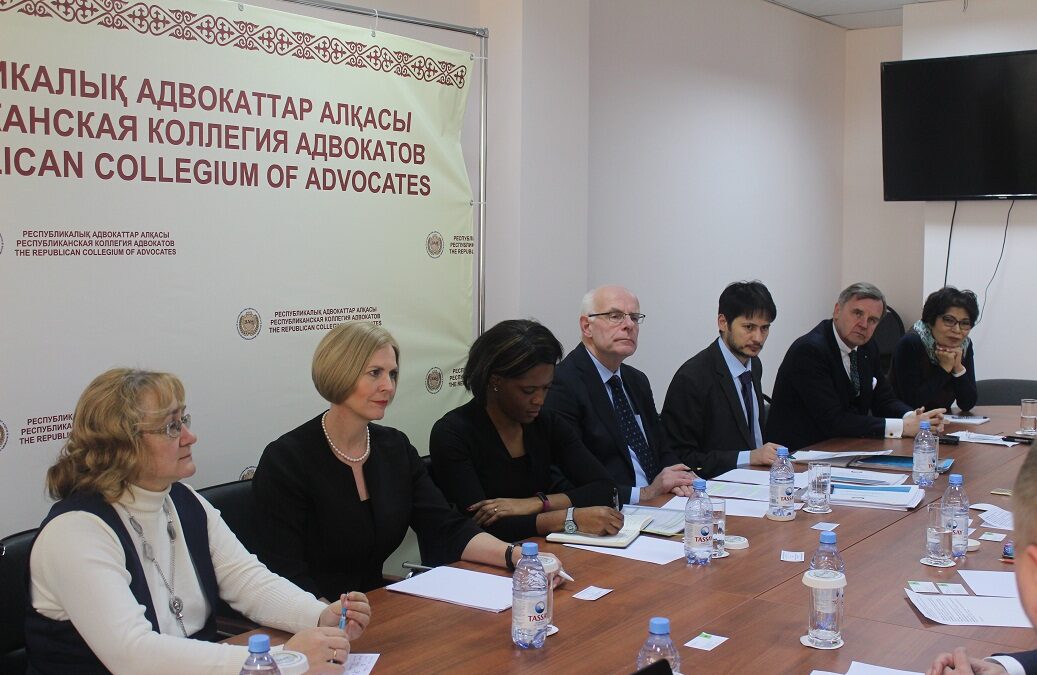
On 4 and 5 December, the ICJ carried out a visit to Astana where a number of high-level meetings were held. The visit was prompted by the reform of the legal profession and the related draft law which has been submitted to the Parliament.
The ICJ is grateful to its delegates from different jurisdictions who agreed to join the ICJ mission:
Mr. Otmar Kury, President of the Hamburg Bar Association, Chairman of the Commission on Federal Lawyers Act of the German Federal Bar
Jeroen Browder, President of the Ethics Commission of the Bar Association of the Netherlands and former President of the Bar Association of the Netherlands
Georg Stawa, President of the European Commission for the Effectiveness of Justice (CEPEJ)
Christina Blacklaws, Vice President of the Law Society of England and Wales
Chika Muorah, International Policy Adviser of the Law Society of England and Wales
The ICJ expresses its gratitude to all who kindly agreed to meet with it. In particular, the Mission thanks the Minister of Justice of Kazakhstan, the Supreme Court, members of the Parliament, the President of the Republican Bar Association, the “Kazbar” NGO and all others who it met with.
Kazakhstan-News-Web stories-Independence of the judiciary-2017-ENG (full report, in English)
Kazakhstan-MissionLawyers-News-pressreleases-2017-RUS (full story in Russian, PDF)
Dec 4, 2017 | News
Today, the International Commission of Jurists (ICJ) began a two-day mission on the reform of the legal profession in Kazakhstan.
The ICJ mission will discuss comparative experiences and international standards on the role and independence of lawyers.
The ICJ mission will include representatives of the Bar Associations of Germany, the Netherlands and the United Kingdom.
The experts will have an opportunity to share their views on the reform and discuss their own country practices on the role of lawyers and institutional guarantees of the independence of the legal profession.
In Astana, the ICJ mission will meet, among others, with the Minister of Justice, the Supreme Court of Kazakhstan, members of the Parliament, the Kazakhstan Collegium of Lawyers and National Public Association of Commercial Lawyers “Kazakhstan Bar Association” (“KazBar”).
Contact:
Temur Shakirov, Senior Legal Adviser, ICJ Europe Programme, temur.shakirov(a)icj.org
Nov 17, 2017 | News
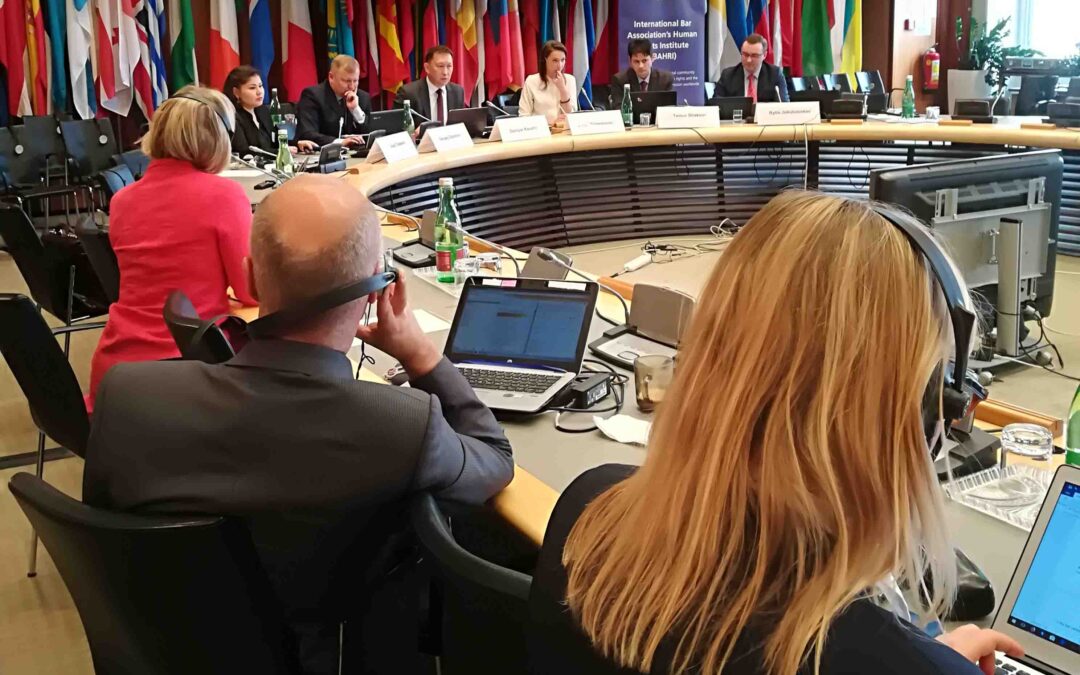
Today, the International Bar Association’s Human Rights Institute (IBAHRI) and the ICJ held a side event in the framework of the OSCE’s Supplementary Human Dimension Meeting (SHDM) on Access to Justice in Vienna.
The event aimed to give an overview of current challenges and key organizational and procedural barriers faced by lawyers in Kazakhstan, in the light of international standards on the independence and role of lawyers.
At the event, lawyers from Kazakhstan as well as international experts discussed what guarantees should be ensured in the planned reform of the legal profession to guarantee professional autonomy and to strengthen the independence of lawyers.
Any undue interference with the independence of the current Bar Association in Kazakhstan would be contrary to international law and standards and would have a significant negative effect not only for Kazakhstan’s justice system but also for the wider Central Asia region.
Nov 7, 2017 | Advocacy, News
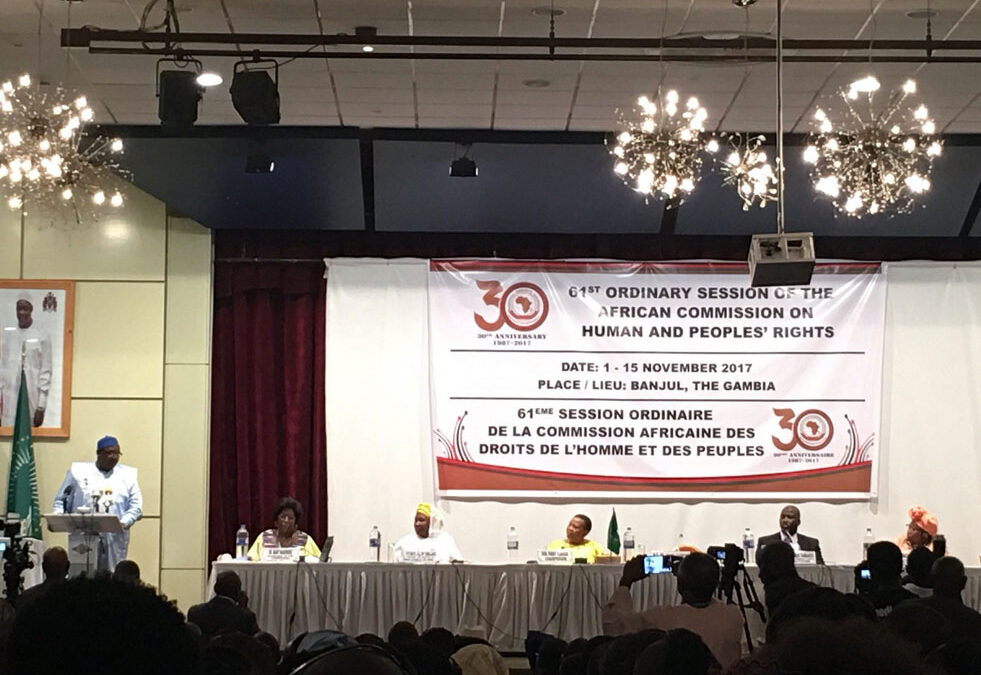
The ICJ today called for the African Commission on Human and Peoples’ Rights (“African Commission”) to establish a special mechanism for the protection and promotion of the independence of judges and lawyers in Africa.
The ICJ made the call in a statement during the public session of the 61st Ordinary Session of the African Commission in Banjul.
The call comes amidst growing threats to the independence of justice in Africa.
In African Union (AU) Member states across the continent, judicial officers and legal practitioners have been targeted for violence and intimidation, or unjustified interference or sanctions.
Recent cases include Burundi, Botswana, Egypt, Lesotho, Libya, Kenya, Swaziland, Zambia, the DRC, Cameroon and Zimbabwe.
The frequency and seriousness of such incidents prompted the ICJ working with the Africa Judges and Jurists Forum to convene a round table meeting in Harare in 2016 to discuss practical steps that could be adopted to minimize the plight of jurists in distress.
The Harare meeting identified the need for a special mechanism for the protection and promotion of judicial independence in Africa, similar to the existing United Nations’ Special Rapporteur on the Independence of Judges and Lawyers.
“It is chilling when a judge is shot in Lubumbashi in the DRC, or a deputy chief justice’s security personnel and driver is shot in Nairobi, Kenya ahead of an important case, or the offices of the Law Association are besieged by militias in Lusaka, Zambia. These are real cases,” said Arnold Tsunga ICJ’s Africa Regional Director.
“An independent, impartial, competent and accountable judiciary and independent and free legal profession are pre-requisites for effective protection of human rights and entrenchment of the rule of law in Africa,” he added.
The ICJ noted that the African Commission have already set out an excellent framework of standards to guarantee independence of the judiciary and access to justice in Africa in the 2003 Principles and Guidelines on the Right to a Fair Trial and Legal Assistance in Africa.
What is needed now is to put in place machinery for their implementation.
The Commission must now to take steps towards establishing a special mechanism for the protection and promotion of judicial independence, including the appointment of a Special Rapporteur on the Independence of Judges and Lawyers, and establishing a Working Group on the Independence of Judges and Lawyers.
Contact
Arnold Tsunga, Director of ICJ’s Africa Regional Programme, t: +27716405926, e: arnold.tsunga(a)icj.org
Banjul- Independence Judges and Lawyers-Advocacy-2017-ENG (Statement in English, pdf)
Oct 5, 2017 | Advocacy, Non-legal submissions
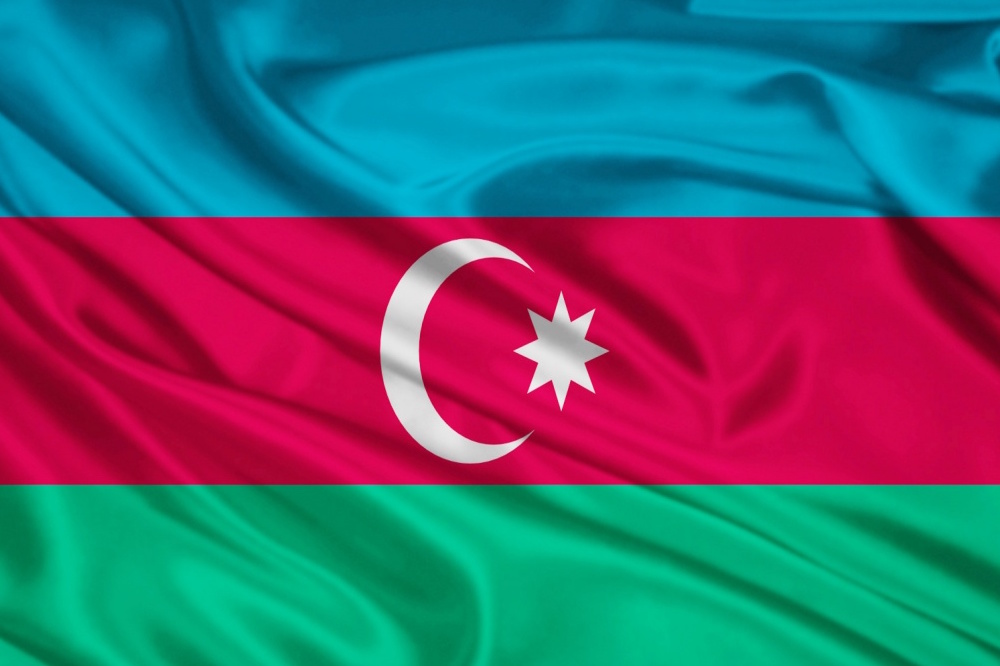
Today, the ICJ made a submission to the Universal Periodic Review of Azerbaijan.
The submission brings to the attention of the members of the Human Rights Council’s Working Group on the UPR issues concerning:
- Azerbaijan’s legislation governing the legal profession;
- the situation of lawyers in practice;
- the lack independence of the legal profession;
- the role of the Bar Association with regard to attacks on lawyers;
- international human rights instruments.
With respect to each of the above-mentioned concerns, the ICJ calls upon the Working Group on the UPR and the Human Rights Council to make a number of recommendations to the authorities of Azerbaijan.
Azerbaijan-UPR-Advocacy-non-legal submissions-2017-ENG (download the submission)