Jun 22, 2018 | Events, News
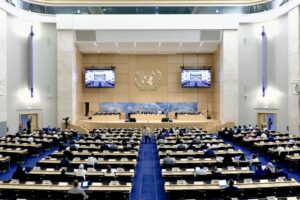
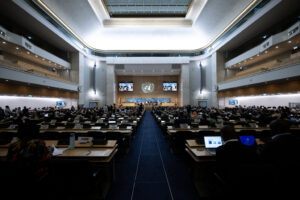
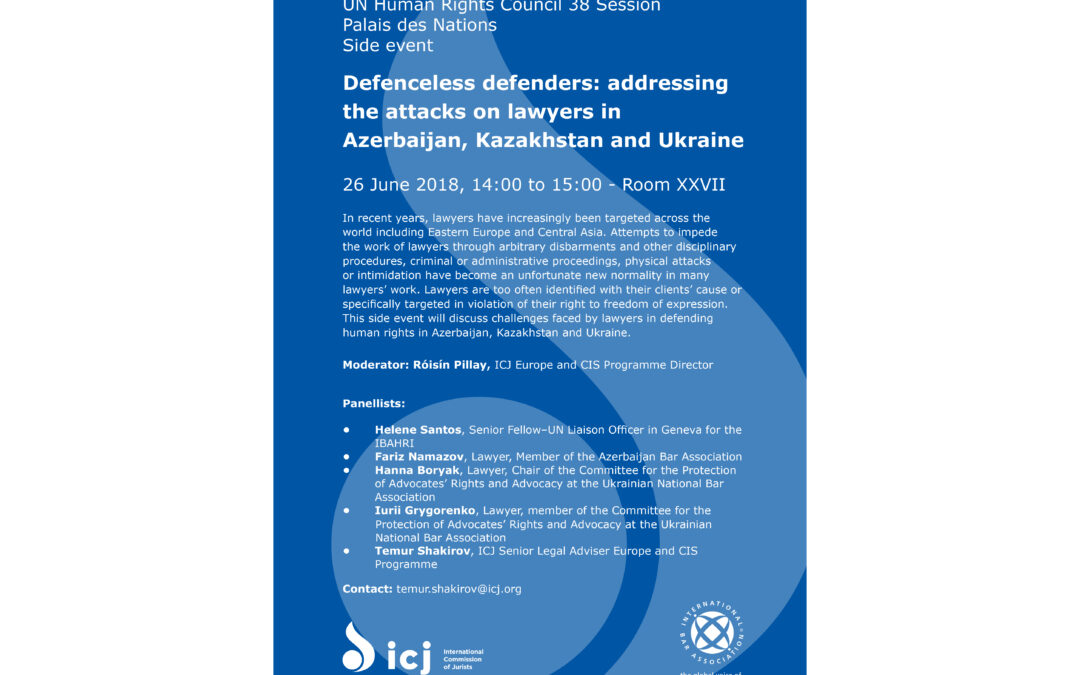
This side event at the Human Rights Council takes place on Tuesday, 26 June, 14:00-15:00, room XXVII of the Palais des Nations. It is organized by the ICJ and the International Bar Association’s Human Rights Institute (IBAHRI).
In recent years, lawyers have increasingly been targeted across the world including Eastern Europe and Central Asia. Attempts to impede the work of lawyers through arbitrary disbarments and other disciplinary procedures, criminal or administrative proceedings, physical attacks or intimidation have become an unfortunate new normality in many lawyers’ work.
Lawyers are too often identified with their clients’ cause or specifically targeted in violation of their right to freedom of expression. This side event will discuss challenges faced by lawyers in defending human rights in Azerbaijan, Kazakhstan and Ukraine.
Moderator: Róisín Pillay, ICJ Europe and CIS Programme Director
Speakers:
- Helene Santos, Senior Fellow–UN Liaison Officer in Geneva for the IBAHRI
- Fariz Namazov, Lawyer, Member of the Azerbaijan Bar Association
- Hanna Boryak, Lawyer, Chair of the Committee for the Protection of Advocates’ Rights and advocacy at the Ukrainian National Bar Association
- Iurii Grygorenko, Lawyer, member of the Committee for the Protection of Advocates’ Rights and Advocacy at the Ukrainian National Bar Association
- Temur Shakirov, ICJ Senior Legal Adviser Europe and CIS Programme
Jun 21, 2018 | Events, News
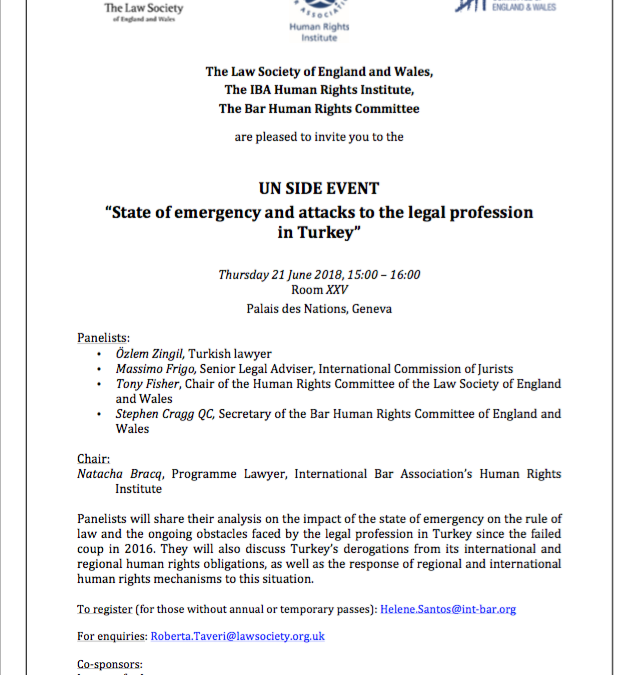
The ICJ will participate today in the side event “State of emergency and attacks on the legal profession in Turkey” organized by IBAHRI, the Law Society, and the Bar Human Rights Committee of England and Wales.
This side event at the Human Rights Council takes place on Thursday, 21 June, 15:00-16:00, room XXV of the Palais des Nations.
It is co-sponsored by Lawyers for Lawyers, Union Internationale des Avocats, Lawyers’ Rights Watch Canada.
In this side event, panelists will share their analysis on the impact of the state of emergency on the rule of law and the ongoing obstacles faced by the legal profession in Turkey since the failed coup in 2016.
They will also discuss Turkey’s derogations from its international and regional human rights obligations, as well as the response of regional and international human rights mechanisms to this situation.
Panelists:
- Özlem Zingil, Turkish lawyer;
- Massimo Frigo, International Commission of Jurists;
- Tony Fisher, Chair of the Human Rights Committee of the Law Society of England and Wales;
- Stephen Cragg QC, Secretary of the Bar Human Rights Committee of England and Wales;
- Natacha Bracq, Programme Lawyer, International Bar Association’s Human Rights Institute.
Geneva-SideEvent-StateofEmergencyLawyersTurkey-IBAHRI&others-June2018-ENG (download the flyer)
Jun 19, 2018 | Advocacy
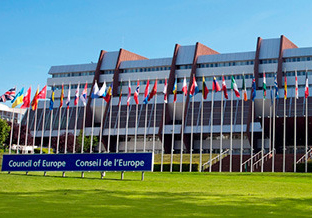
The ICJ welcomes the proposal of the Parliamentary Assembly of the Council of Europe (PACE) in its Recommendation 2121(2018) calling for the development of a Council of Europe Convention on the Profession of Lawyer.
The ICJ believes that such a Convention could make an important contribution to strengthening the rule of law and the protection of human rights in the Council of Europe region, building on existing Council of Europe standards and jurisprudence of the European Court of Human Rights.
The ICJ particularly welcomes PACE’s call for an effective control mechanism to be put in place under a new Convention, as recent developments in a number of Council of Europe Member States show a significant gap in implementation of Council of Europe standards on the independence and security of lawyers.
Lawyers, along with judges and prosecutors, are one of the pillars on which protection of the rule of law and human rights through the justice system rests.
Recognizing this, the ICJ, since its foundation in 1952, has worked to protect lawyers under threat and to develop international standards for the independence, role and integrity of the profession.
Successive ICJ Declarations, adopted by leading jurists from all regions of the world, have affirmed that the role of the legal profession is “paramount in safeguarding human rights and the Rule of Law” (2008 Declaration on Upholding the Rule of Law and the Role of Judges and Lawyers in Times of Crisis (ICJ 2008 Declaration).
In any legal system, the legal profession plays a pivotal role in ensuring access to justice and effective remedies and accountability for violations of human rights, as well as upholding the right to fair trial, right to liberty and freedom from torture and other ill-treatment in the criminal justice process.
In defending criminal cases, in advising and representing victims of human rights violations and their relatives or in challenging before the courts national legislation or policy that is contrary to human rights , lawyers give practical effect to human rights guarantees and rule of law principles.
The importance of this role has been recognized by international standards as well as in the jurisprudence of the European Court of Human Rights, which has emphasized the “specific status of lawyers [having] a central position in the administration of justice as intermediaries between the public and the courts”.
It is thus of fundamental importance that lawyers are able to fulfill their professional duties without interference. As the European Court of Human Rights has held, “persecution and harassment of members of the legal profession strikes at the very heart of the Convention system.”
Full text in ENG (PDF): Europe-Drafting-a-EU-Convention-on-the-Profession-of-Lawyer-2018-ENG
May 7, 2018 | News
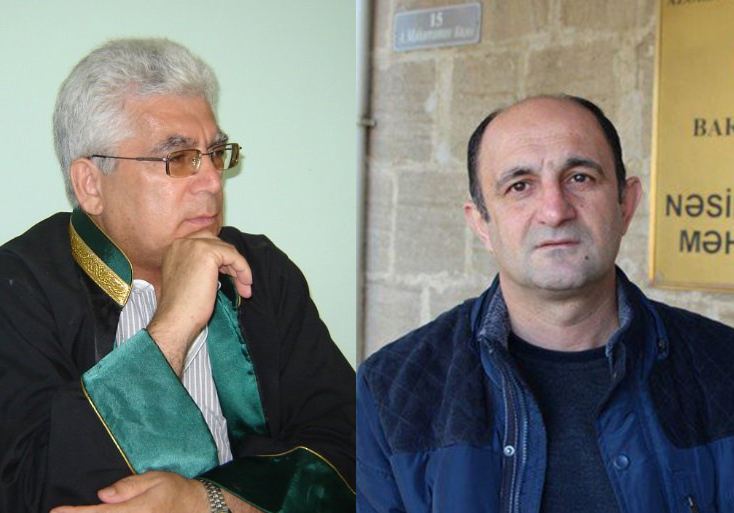
The ICJ today denounced the decision of the Presidium of the Azerbaijan Bar Association, of 23 April 2018, to suspend the licences of two Azerbaijan human rights lawyers Asabali Mustafayev (photo, on the left) and Nemat Karimli (photo, on the right).
The ICJ called on the Presidium to reverse their decision and allow the lawyers to resume their practice.
It stressed that disciplinary proceedings pending against the lawyers should be immediately terminated.
The ICJ said that the decision of the Presidium was contrary to international standards on the role of lawyers including the right to freedom of expression as guaranteed under international law.
The ICJ understands that the proceedings against the two lawyers, initiated following a submission of the Deputy Prosecutor General, were related to the critical statements made by the lawyers in the media, regarding high profile criminal cases.
Nemat Karimli, had stated in media interviews that his client Afgan Mukhtarli, an opposition activist convicted on charges of smuggling, had been illegally and forcibly transferred from Georgia to Azerbaijan and that his life could be at risk if he was returned to Azerbaijan.
The lawyer also complained of excessive searches and being prevented from communicating in private while visiting his client in detention.
The disciplinary proceedings against Asabali Mustafayev relate to allegations he made on social media that the prosecution of politician Gozal Bayramli, on a charge of smuggling, was politically motivated.
Both lawyers were charged with spreading false statements and slanderous information about investigative authorities.
The submission of the Prosecutor to the Bar Association, on 25 October 2017, alleged that lawyers Nemat Karimli and Asabali Mustafayev in their interviews to the media had “politicized” the criminal cases of Bayramli and Mukhtarli, tried to mislead the public and slandered investigative authorities. According to the information provided by the lawyers, no evidence had been attached to this submission.
Instead, the Disciplinary Commission collected evidence to submit to the Presidium of the Bar Association, which subsequently suspended the licence of the lawyers.
Furthermore, the lawyers state that, contrary to what is required by the Law on Lawyers and Advocates Activities, they have not received a copy of the opinion of the Disciplinary Commission submitted to the Presidium of the Bar Association.
The ICJ is concerned that the suspension of the lawyers’ licences, for comments which drew attention to possible violations of human rights, may violate the lawyers’ right to freedom of expression.
These comments appear to be within the bounds of lawyers professional responsibility to protect their clients in every appropriate way (UN Basic Principles, principle 13(b)).
The right to freedom of expression is protected under international treaties to which Azerbaijan is a party, including by Article 19 of the International Covenant on Civil and Political Rights (ICCPR) and article 10 of the European Convention on Human Rights (ECHR).
The UN Basic Principles on the Role of Lawyers specify that lawyers “…have the right to take part in public discussion of matters concerning the law, the administration of justice and the promotion and protection of human rights …”.
The European Court of Human Rights has emphasized that lawyers are entitled to comment in public on the administration of justice, provided that their criticism does not overstep certain bounds, based on principles of dignity, honor, integrity, and respect for the fair administration of justice.
The ICJ emphasizes that protection of lawyers’ freedom of expression, in particular as regards issues of the rule of law and the administration of justice, is not only important to the individuals in question, it also serves as an important safeguard for the protection of human rights.
Where lawyers are subject to disciplinary sanctions for such statements, the role of lawyers in upholding the rule of law in the administration of justice is undermined.
The ICJ therefore calls on the Azerbaijan Bar Association to lift the disciplinary sanctions that would unjustifiably interfere with lawyers’ freedom of expression.
The ICJ also calls on the Azerbaijan Bar Association to ensure that the lawyers subject to disciplinary proceedings obtain a copy of the opinion to be able to prepare their arguments and defence.
Background
Asabali Mustafayev represented Gozal Bayramli who was found guilty and sentenced to three years in prison for smuggling €12,000 ($13,400) in cash. Mustafayev had expressed his opinion about the arrest of Gozal Bayramli in his social media profile, alleging that it was politically motivated. He stated that when he shared this opinion he was not yet engaged as Gozal Bayramli’s lawyer.
Nemat Karimli represented Afgan Mukhtarli, an opposition activist based in Tbilisi, who was convicted of smuggling € 10,000, illegally crossing the border and resisting police arrest and was sentenced to six years in prison. Karimli in an interview stated that Mukhtarli was taken to Azerbaijan illegally and called on the Georgian authorities not to hand him to Azerbaijan authorities since it might endanger Mukhtarli’s life.
Mar 1, 2018 | Advocacy, Non-legal submissions
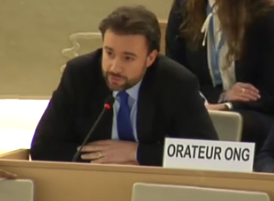
The ICJ today delivered an oral statement to the UN Human Rights Council, on attacks on lawyers and the legal profession in Turkey, Azerbaijan, Kazakhstan and China.
The statement, which was made during an interactive dialogue with the UN Special Rapporteur on human rights defenders and the UN Special Rapporteur on Torture, read as follows:
Our organizations welcome that the main report (A/HRC/37/51, para 13) and communications report (A/HRC/37/51/Add.1, e.g. paras 278-297, 431, 508-510) of the Special Rapporteur on Human Rights Defenders recognizes the role of lawyers as human rights defenders. In this regard, we would highlight the global problem of continued attacks on lawyers and threats to the independence of their profession, including for example as is well known in China (A/HRC/37/51/Add.1, paras 278-297), but also in Azerbaijan, Kazakhstan and Turkey.
In Azerbaijan, lawyers face criminal prosecution, suspension or disbarment for statements clearly constituting protected freedom of expression. The lack of independence of the Bar Association is a serious concern, even more so now that new legislation prohibits lawyers from representing clients before courts unless they become a member.
In Kazakhstan, a proposed new law threatens the independence of lawyers by providing for representatives of the executive to be included on disciplinary bodies of the legal profession, contrary to international standards.
Finally, the situation of lawyers in Turkey under the current state of emergency is of particular concern. In particular, echoing the recent statement of five UN special procedures mandate holders for his release, we expresses concern at the current detention of Taner Kılıç, lawyer and president of Amnesty International Turkey.
These arrests, trial and disbarments as well problematic legislative changes have a chilling effect on the work of lawyers. They undermine access to effective and independent legal assistance to protect human rights, in contravention of the rights of both the lawyers and their clients, including as mentioned in the report of the visit to Turkey by the Special Rapporteur on Torture (A/HRC/37/50/Add.1, paras 24, 26, 41, 63-66, 71, 101(d)(e)(h), 106(c)).
Our organizations urge the Council to address these worrying developments threatening the rule of law.
The following organizations joined the statement, in addition to the ICJ:
- International Bar Association’s Human Rights Institute (IBAHRI)
- Union Internationale des Avocats (UIA)
- Lawyers for Lawyers (L4L)
- the Law Society of England and Wales
- Lawyer’s Rights Watch Canada (LRWC), and
- the Bar Human Rights Committee of England and Wales (BHRC).
The statement can be downloaded in PDF format here: UN-HRC37-JointOralStatement-LawyersHRDsTorture-2018