Dec 19, 2018 | News
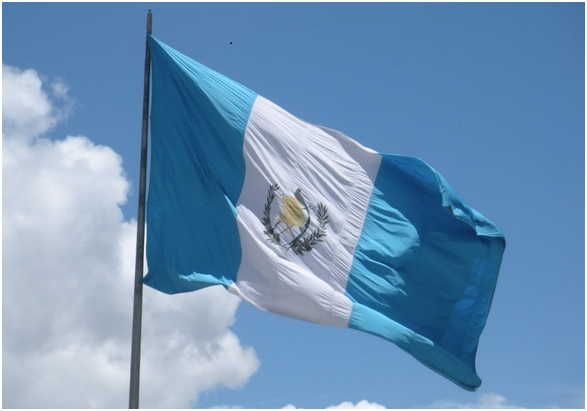
According to information published in the Official Gazette, the government of Guatemala has ordered that eleven more officials and two family relatives from the CICIG leave the country within 72 hours from the time of issuing the notification. However, no official communication using the usual diplomatic channels has yet been sent to the CICIG.
In September 2018, the head of the CICIG, Commissioner Ivan Velasquez, was banned from re-entering the country and the government stated it would not renew the CICIG mandate after September 2019.
Ramon Cadena, the ICJ Director for Central America, stated: “The ICJ considers this new measure is designed to hinder criminal investigations against high-level government officials accused of corruption.”
The CICIG acts as a special prosecutor in serious corruption and other criminal cases and carries out investigations to identify responsible parties. The persons who have been asked to leave the country are the lawyers, police and prosecutors who are investigating important corruption cases, such as the ‘The Line’ case, in which the former President and Vice-President have been charged and other cases including those within the National Police.
Ramon Cadena continued: “It cannot escape anyone’s attention that one of the CICIG investigators who has been asked to leave the country was the person who is responsible for the corruption case involving the General Property Registry, that allegedly implicates both the son and brother of President Jimmy Morales”.
This new measure by the government seriously affects the rule of law and constitutes a flagrant violation of article 10 (4) of the agreement establishing the CICIG signed between Guatemala and the UN, which states:
“The Government agrees to provide to CICIG and its personnel the security necessary for the effective completion of CICIG’s activities throughout Guatemala, and to protect the personnel of CICIG, whether national or international, from abuse, threats, reprisals or acts of intimidations, in virtue of their status as personnel of, or their work for CICIG.”
Cadena added: “It is deeply regrettable that it is precisely the CICIG staff acting in high-impact cases who are being targeted by these measures because of their work to combat corruption and impunity. It is clear that the government is seeking to divert the CICIG from its path.”
Furthermore, according to the UN Basic Principles on the Role of Lawyers, No 16: “Governments shall ensure that lawyers: a) are able to perform all of their professional functions without intimidation, hindrance, harassment or improper interference… “ Cadena continued, “The ICJ is deeply concerned that several CICIG personnel affected by these measures are lawyers and members of the Guatemalan Bar Association. Their work is being hindered and the Guatemalan Bar Association should take action to defend its members.”
“Guatemala should comply with international human rights law and ensure that acts of corruption that impact human rights are fairly and impartially investigated and prosecuted. The presence of the CICIG contributes to ensuring that Guatemala complies with its international obligations” he added.
Cadena concluded by stating: “With these arbitrary measures, the Constitutional order of Guatemala and its democratic institutions are undermined. The Guatemalan State should ensure effective measures are taken against corruption, consistent with its international human rights and other obligations. The CICIG is one of the most successful examples of work to end corruption and impunity. The Guatemalan authorities should support the CICIG instead of hindering its work and obstructing justice.”
Sep 20, 2018 | Advocacy, Non-legal submissions
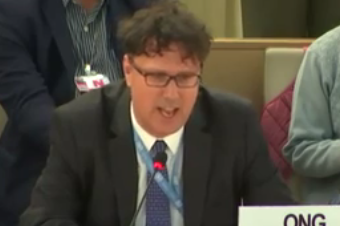
The ICJ today put the spotlight the lack of independence of the legal profession in Azerbaijan speaking at the UN Human Rights Council in Geneva.
The statement, made during the consideration of the Universal Periodic Review (UPR) of Azerbaijan, read as follows:
The International Commission of Jurists (ICJ) welcomes the acceptance by Azerbaijan of the recommendations by France (140.70), by Greece (141.12), Austria (141.13), Estonia (141.68), Slovenia (141.71), and Mexico (141.77), to respect the rights of lawyers.
The ICJ regrets, however, that Azerbaijan only noted and did not explicitly support the recommendations by Sweden (141.33), USA (141.39), Czechia (141.67) and Germany (141.76) and rejected the recommendation by the United Kingdom (141.60) to “End all interference in the work of lawyers through disbarment or other disciplinary measures on improper grounds such as expressing critical views.”
These recommendations call for the amendment of the Law on Advocates and Advocates’ Activities to ensure the effective independence of the Bar Association of Azerbaijan. They also call for the setting up of independent and transparent mechanisms for lawyers’ admission to practice, and disciplinary proceedings against lawyers, in conformity with the UN Basic Principles on the Role of Lawyers.
The ICJ notes that Azerbaijan’s support of most recommendations is predicated on the assumption that the situation of the independence of the legal profession in Azerbaijan is in line with international law.
This, however, is not the situation in the country.
The ICJ expresses concern at the persistent lack of independence of the Bar Association of Azerbaijan; indeed, it has actually played a role in undermining the work of lawyers defending human rights. The situation is exacerbated by recent hasty reforms that prohibit lawyers from appearing in any court hearing unless they are members of this non-independent Bar association, furthermore without a sufficient and meaningful transition period. This seriously curtails access to justice for human rights violations in the country.
Sep 11, 2018 | Advocacy, Non-legal submissions
The ICJ today addressed the new UN High Commissioner for Human Rights, Michelle Bachelet, highlighting the role of her office in countering global threats to the rule of law and human rights.
The statement was made at the UN Human Rights Council, during general debate on the High Commissioner’s oral update. It read as follows:
“Madam High Commissioner,
The International Commission of Jurists (ICJ) warmly welcomes you to your new mandate – a mandate that the ICJ has, since 1964, fought to create and support.
A multitude of issues and situations urgently call for your attention. However, a dark cloud looms over them all, and casts its shadow across the globe, including in this chamber. From different directions, various political actors driven by authoritarian ideologies and impulses, thirst for power and fraudulent populisms, grow in strength and are joining forces to mount a concerted attack on the rule of law.
They openly scorn the stated aims of the UN Charter, including “faith in fundamental human rights” and the maintenance of “justice and respect for … international law.” They seek to undermine, defame, and destroy global, regional and national institutions built over decades as bulwarks to protect human rights and human dignity. They thrive on silence or passivity by global leaders and populations, as they assault independent judiciaries, media, and civil society.
Madam High Commissioner, you can make a unique impact by speaking forcefully and publicly in defense of human rights and the rule of law, in defense of victims, and against governments and individuals who demonstrate their hostility or indifference to these aims. The ICJ stands ready to support you and your office in the challenges that lie ahead.
Thank you.”
Aug 13, 2018 | News
From 9-12 August, the ICJ-supported trainings on human rights and the law for lawyers, youths and activists from Kachin and Shan states in Myanmar’s north.
On 9 and 10 August, the ICJ joined a “training of trainers” organized by the Humanity Institute, a civil society organization based in Myitkyina.
This aims to improve the capacity of local youths and activists from Kachin and Northern Shan State on basic human rights concepts and measures to engage with Regional and UN Human Rights mechanisms.
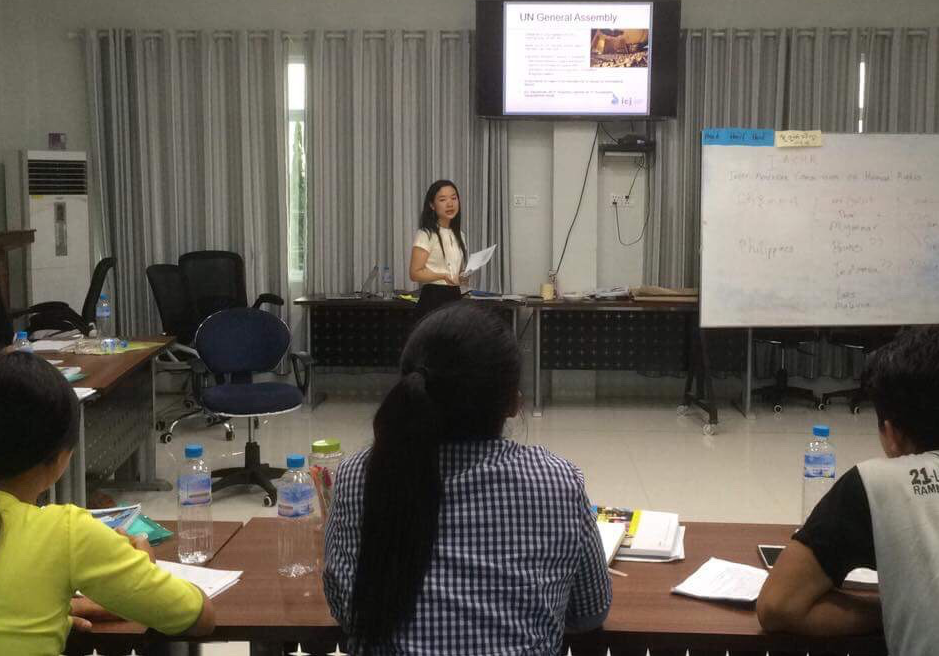
The ICJ’s national legal researcher, Ja Seng Ing, shared information about the advantages and limitations of regional human rights mechanisms, including the Europe Commission of Human Rights and the ASEAN Commission of Human Rights. She provided an overview of the UN human rights framework and human rights mechanisms.
In addition to explaining how these work, she also focused on how human rights defenders can communicate with and participate in UN human rights mechanisms by reporting on human rights violations.
Then on 10 and 11 August, the ICJ facilitated a legal training for senior law students, and junior lawyers hosted by the Kachin Legal Clinic, an independent lawyers network.
The Kachin Legal Clinic seeks to develop a pool of young lawyers and with knowledge on the role of lawyers in the field of domestic and international human rights setting and the independence of the lawyers.
On the first day, a national legal adviser from the ICJ shared experiences of litigating for human rights in Myanmar. She also noted the critical role of independent lawyers in protecting human rights, by representing clients from all communities in different parts of Myanmar.
On the second day, Ja Seng Ing gave an overview of global and local law and standards and issues related to accountability and redress for gross human rights violations.
The ICJ’s international legal adviser, Sean Bain, gave an overview of international laws and standards related to the protection of human rights in times of conflict or crises, sourced from international human rights law as well as international humanitarian law and international criminal law.
These activities are part of the ICJ’s ongoing support to civil society actors in Myanmar, from community to national level.
Jul 11, 2018 | News
Today, the ICJ expressed concern at the adoption of a new law on lawyers in Kazakhstan.
The Law ‘On the Professional Activities of Advocates and Legal Assistance’, signed into law on 10 July 2018, contradicts international law and standards on the independence of the legal profession, by enabling the executive to influence or to have control over who is allowed to practice law and substantial influence on disciplinary proceedings against lawyers.
The law will have negative repercussions for protection of human rights and the rule of law in the Republic of Kazakhstan.
“Some of the key provisions of the adopted law undermine the independence of the legal profession, a cornerstone of the rule of law,” Temur Shakirov, ICJ Europe Program Senior Legal Adviser said today.
“Not only does the law weaken the legal profession, it sends an unfortunate message to the public that, as a result, their human rights, including their right to a fair trial, may be harder to uphold within the legal system,” he added.
More specifically, the ICJ is concerned that, under the new law, the role of the independent Bar Association in the composition of the disciplinary commissions is reduced.
Besides lawyers, the Disciplinary Commission will now include ‘representatives of the public’ designated by the Ministry of Justice. While the law does not specify how these members of the Disciplinary Commission would be selected, the selection is to be made by the Ministry of Justice.
The same procedure is not excluded to select members who are retired judges, which the Law requires also be part of disciplinary commissions.
While many of the specific procedures are unclear, it is apparent that these provisions would give the Ministry extensive influence over the Disciplinary Commission, especially as the law does not explicitly require these members perform their duties independently from the instructions of the Ministry of Justice.
The influence of the executive over the disciplinary proceedings of the Bar Association is contrary to the principles of independence of lawyers.
The UN Basic Principles on the Role of Lawyers provide that disciplinary proceedings against lawyers are to be brought before an impartial disciplinary committee established by the legal profession, before an independent statutory authority, or before a court, and shall be subject to an independent judicial review.
Furthermore, the law continues to give the Ministry of Justice control over admission to the practice of law.
It stipulates that prospective lawyers who have completed their professional training are to be assessed by the Commission for admission to practice established by territorial bodies of the Ministry of Justice.
The commissions consist of seven members, of which only three are members of the Bar Association. The composition of the commissions and the principles of their work are to be approved by the orders of the Minister of Justice of the Republic of Kazakhstan.
The Law therefore preserves the previous procedure on admission to the profession criticized by the ICJ earlier, according to which the attestation of applicants for obtaining the membership to the Bar Association and issuing a license were within the exclusive competence of the Ministry of Justice of the Republic of Kazakhstan.
At the same time, many defense rights listed in the Law are curtailed or compromised by the wording that would allow for enactment of restrictions by secondary legislation, including that the adopted Law would not allow lawyers to freely and without interference collect evidence in defense of their clients or that lawyer’s inquiries can be subject to limitation where they seek to obtain “restricted information”.
The ICJ notes that according to the UN Basic Principles on the Role of Lawyers, States must ensure lawyers have access to appropriate information, files and documents in their possession or control in sufficient time to enable lawyers to provide effective legal assistance to their clients. Such access should be provided at the earliest appropriate time (Principle 21).
Read the full text in English here
Read the full text in Russian here