Nov 9, 2018 | News
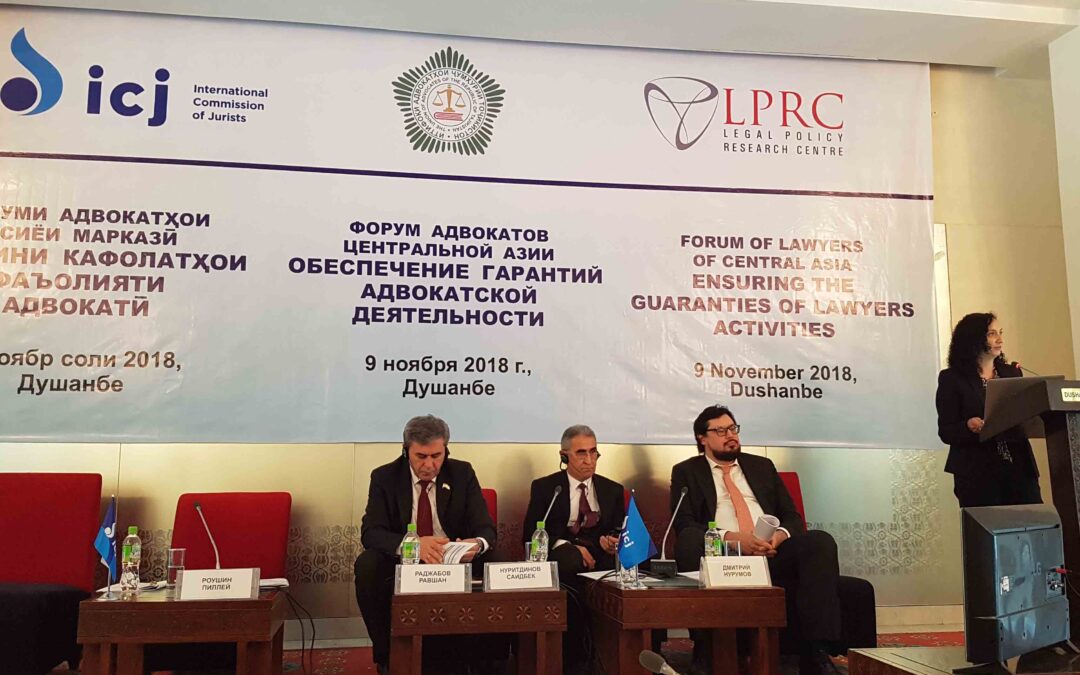
Today the ICJ, in co-operation with the Legal Policy Research Centre and the Union of Lawyers of Tajikistan, is holding a regional conference on the independence and role of lawyers, in Dushanbe.
Lawyers from Tajikistan as well as other countries of Central Asia, the Commonwealth of Independent States and Europe will discuss the legal safeguards that should apply to lawyers to ensure that they can defend the human rights of their clients and the role of bar associations in protecting the security and independence of lawyers.
They will consider the role of committees to protect the rights of lawyers, which have been established within the bar associations of several countries in the region, and how these specialized bodies can work most effectively.
A set of recommendations on the protection of lawyers in the region will be produced following the conference.
Contact:
Temur Shakirov, Senior Legal Advisor, Europe and Central Asia Programme, temur.shakirov(a)icj.org
Tajikistan-Lawyers Conference-News-Agenda-2018-ENG (Agenda, in PDF)
Sep 14, 2018 | News
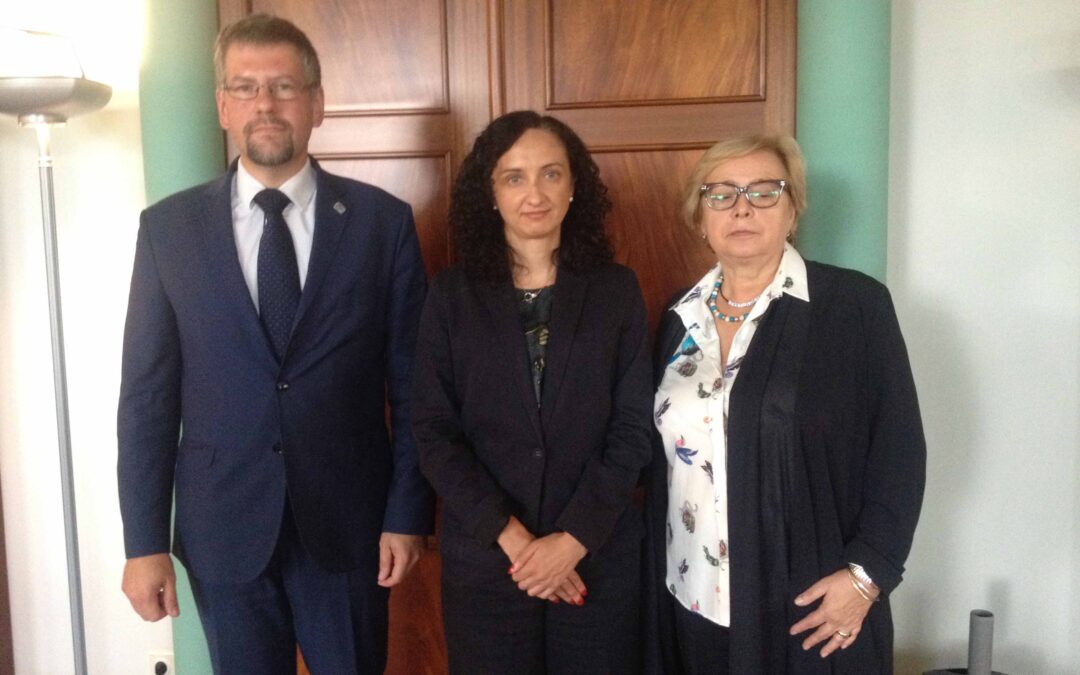
The ICJ met this week in Warsaw with the First President of the Polish Supreme Court, Małgorzata Gersdorf.
Róisín Pillay, Director of the ICJ Europe and Central Asia Programme, met with President Gersdorf to convey the support of the ICJ for the Court’s defence of the rule of law and the independence of the judiciary in Poland, in the face of government attacks.
The ICJ emphasized that a new law on the Supreme Court that attempts to force the “retirement” of 27 of the 72 Supreme Court judges, including the First President, by lowering the mandatory retirement age for its judges from 70 to 65 years, contravenes international human rights law and standards, including the right to a fair hearing.
The measure is contrary to the principle of the security of tenure of judges and therefore to the independence of the judiciary, as expressed in the UN Basic Principles on the Independence of the Judiciary.
In August, the Supreme Court submitted a preliminary ruling request to the Court of Justice of the EU (CJEU) seeking its interpretation on the compliance of the measure with EU law. The Supreme Court has suspended implementation of the law pending the proceedings before the CJEU.
The European Commission has recognized the current situation as undermining “the principle of judicial independence, including the irremovability of judges” and has triggered a procedure under Article 7 of the Treaty of the European Union that could ultimately lead to suspension of Poland’s EU voting rights.
The Commission has also launched infringement proceedings against Poland in respect of the law on the Supreme Court.
An ICJ letter of 11 July 2018, signed by 22 senior judges from all regions of the world, urged the Polish government to act immediately to reinstate the forcibly retired judges in office.
Sep 10, 2018 | Advocacy, News
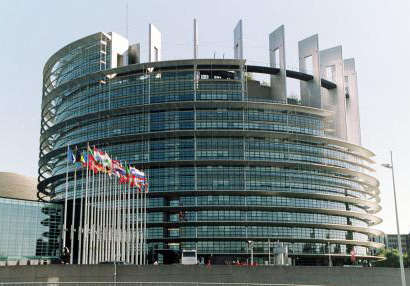
The ICJ today called on all MEPs to vote in favour of the draft resolution and report by rapporteur Judith Sargentini MEP, before the European Parliament, which would activate Article 7 of the Treaty of the European Union in respect of Hungary.
A vote for the resolution would mean that, under Article 7.1, the Council would determine whether there is a clear risk of serious breach by Hungary of the founding values of the EU.
Ultimately, if the situation persists, this would allow the Council to take more robust measures, including suspension of voting rights, to address the situation.
The vote, scheduled for 12 September, is crucial for the rule of law in Hungary and throughout the European Union.
The Parliament will vote on whether to activate the process under Article 7, by calling on the Council to identify a risk of serious breach by Hungary of the EU’s founding values, including the rule of law and respect for human rights.
The ICJ considers that the measures put in place by the Hungarian government since 2011 have led to a severe deterioration of the rule of law and human rights, by weakening Constitutional rights protection, limiting judicial independence, suppressing independent media, civil society and academic institutions, and imposing arbitrary laws that violate the human rights of marginalized sections of society.
Cumulatively, these measures pose a grave, systemic threat to the protection of the human rights of all people in Hungary.
“The European Parliament should respond to the critical situation in Hungary by using the powers available to it under Article 7 TEU to defend human rights and the rule of law. Not to do so would be to abandon Hungary to an increasingly dangerous path, and would set a damaging precedent for all of Europe,” said Róisín Pillay, Director of the ICJ Europe Programme.
Read the full statement and key concerns here: Hungary-triggering Art 7-Advocacy-2018-ENG (in PDF)
Sep 2, 2018 | News
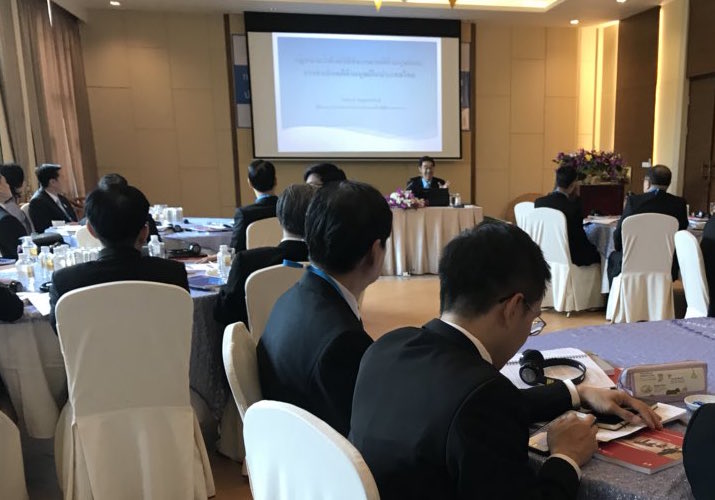
On 1 and 2 September, the ICJ held a “Workshop on the Independence of the Judiciary in the Context of the Inquisitorial Judicial System in Thailand” for members of the Thai judiciary in the north of the country.
Some 31 judges from 21 courts and the Administrative Office of the Court of Justice, Region V, attended the workshop, which was held in Chiang Mai.
The objective of the workshop was to discuss the role of judges and exercise of judicial power within the inquisitorial system, particularly in the context of adjudicating cases of human trafficking.
In an effort to combat human trafficking in Thailand, the Procedures for Human Trafficking Cases Act B.E. 2559 (2016) established inquisitorial system procedures for adjudication of cases of human trafficking.
With an increasing number of cases of human trafficking in Northern Thailand, judges in Northern Thailand are increasingly required to utilize inquisitorial processes in human trafficking cases.
Courts in Thailand generally adjudicate cases based on the adversarial judicial system.
In this context, the ICJ held the workshop in collaboration with the Administrative Office of the Court of Justice, Region V, in the North of Thailand, to share information and expand collaboration between Thai and international judges about inquisitorial processes.
Justice Aree Thecharuwichit, Chief Justice of the Office of the Chief Justice, Region V, Frederick Rawski, Regional Director of ICJ Asia and the Pacific, and Justice Radmila Dragicevic-Dicic, Vice-President of the ICJ, ICJ Commissioner, Acting President of the Belgrade Court of Appeals and Judge of the Supreme Court of Serbia delivered opening statements at the Workshop.
Justice Sittipong Tanyaponprach, Chief Judge of the Office of the Chief Justice, Region I, spoke about existing procedures in Thailand’s justice system to deal with human trafficking cases under the Procedures for Human Trafficking Cases Act 2016.
Justice Marcel Lemonde, Honorary President of Chamber in France’s Court of Appeal and an International Consultant in Judicial Matters, delivered an introduction to the inquisitorial system based on the French judicial system and spoke about existing challenges in inquisitorial processes.
Justice Radmila Dragicevic-Dicic, of the Supreme Court of Serbia and ICJ Vice-President spoke about judicial practice in cases involving human trafficking and shared her experience in adjudicating human trafficking cases in Serbia.
ICJ’s Senior Legal Adviser Kingsley Abbott moderated the workshop and provided an introduction to the ICJ’s resource materials on the independence of the judiciary and judicial accountability, including the ICJ’s Practitioners’ Guide No. 13 on Judicial Accountability.
The ICJ ended the Workshop with a statement reiterating its commitment towards working with Thailand’s judiciary to strengthen the rule of law and administration of justice in Thailand.
This Workshop is the second workshop held by the ICJ for Thailand’s judiciary in the North of Thailand.

Aug 21, 2018 | News
The ICJ and its Polish Section (ICJ Poland) today expressed their support for the actions of the Supreme Court to defend the rule of law and the independence of the judiciary in Poland, including by recourse to the European Court of Justice (CJEU).
This happened in the face of repeated attack by political figures and authorities.
Preserving and safeguarding the independence of the courts is essential for the protection of human rights in Poland, the organizations said.
The ICJ and ICJ Poland urged the Polish executive and legislative authorities to cease all interference with the conduct of the Supreme Court in the carrying out of its legitimate functions.
The law on the Supreme Court that has led to the forced “retirement” of one third of the Supreme Court, including the President of the Court, Małgorzata Gersdorf, must be repealed and the judges reinstated in office, the ICJ and ICJ Poland stressed.
On 2 August, the Supreme Court of Poland took the welcome step, in accordance with European Union law, of submitting a preliminary ruling request to the Court of Justice of the European Union (CJEU) seeking its interpretation on the compliance of the recent legislation on retirement ages of judges with EU law.
Specifically, the Supreme Court enquired as to the legislation’s compliance with the principle of irremovability of judges and the prohibition of discrimination on grounds of age under Directive 2000/78. The Supreme Court has suspended the implementation of the law during the proceedings before the CJEU.
The ICJ and ICJ Poland condemn the attacks against the Supreme Court by political authorities, including President Andrzej Duda, who claimed that the suspension of the law’s implementation has no legal basis.
On the contrary, the Supreme Court of Poland acted in compliance with its duties under article 267 of Treaty of the Functioning of the European Union to raise a question concerning the interpretation of the Treaties and, in conformity with the case-law of the CJEU, to suspend the application of such measures which may violate the law of the European Union, pending resolution of the question.
The legislation raises serious issues of EU law, both in regard to protection of the rule of law under Article 2 of the TFEU, and in regard to discrimination on grounds of age.
This attack against the actions of the Supreme Court occurs amid a systematic undermining of the independence of the judiciary in Poland by the Polish executive and legislative authorities, which the ICJ, ICJ Poland, and judges of the global ICJ network have repeatedly condemned.
The organizations emphasize that irremovability of judges is one of the main pillars of judicial independence and therefore of the rule of law. An ICJ letter of 11 July 2018, signed by 22 senior judges from all regions of the world, urged the Polish government to act immediately to reinstate the forcibly retired judges in office.