May 10, 2016 | News
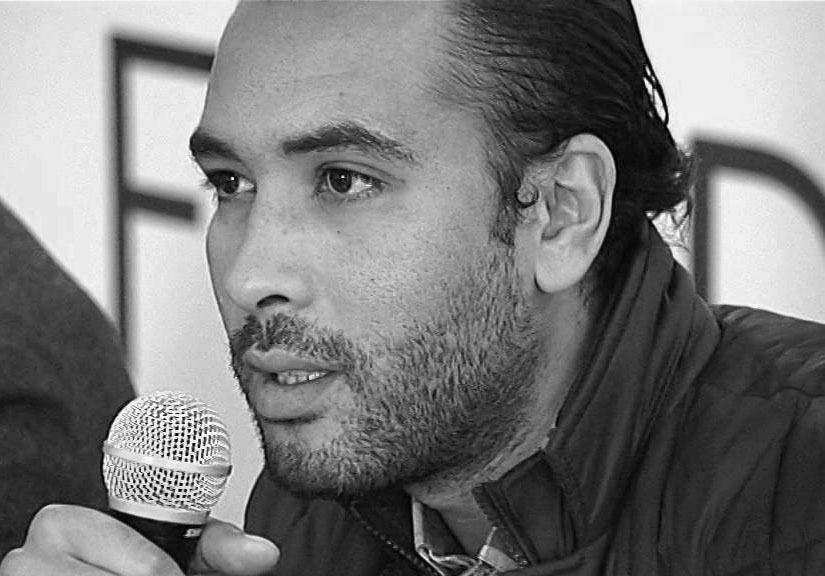
The ICJ today called on the Egyptian authorities to immediately release human rights lawyer Malek Adly and to drop all charges against him. He was arrested on Thursday 5 May 2016, pursuant to an arrest warrant.
Malek Adly has been charged with a number of offences, including “attempting to overthrow the regime,” “spreading false rumors,” and “using force against a public servant.”
The Prosecuting authorities have not provided information on specific behaviour that would constitute criminal conduct.
The ICJ is concerned that the charges may be in retaliation for Malek Adly’s work as a lawyer and human rights defender, and are aimed to chill him and others from engaging in work perceived as threatening to or disfavoured by Egyptian authorities.
They came at the backdrop of his work as a human rights lawyer, his critical views on the rule of law situation in Egypt, and his legitimate and peaceful exercise of freedom of expression and assembly in opposing transferring the sovereignty of Tiran and Sanafir islands from Egypt to Saudi Arabia, the ICJ says.
“Malek Adly’s arrest, detention and prosecution for carrying out his work as a lawyer and human rights defender and for peacefully expressing his views is yet another attempt by the Egyptian regime to muzzle lawyers, the last line of defence for victims of human rights violations in Egypt,” said Said Benarbia, Director of the ICJ Middle East and North Africa Programme.
“The regime’s crackdown on fundamental rights and freedoms has been worryingly extended to the very lawyers whose role is to challenge and protect against such crackdown,” he added.
Over the last three years, the ICJ has documented numerous cases of lawyers who have been subjected to human rights violations and reprisals in relation to the representation of their clients.
These include the cases lawyers Imam Afifi and Karim Hamdi who were allegedly subjected to torture and subsequently died while in police custody.
International standards aiming to safeguard the role of lawyers provide that States have a duty to ensure that lawyers are able to perform their functions “without intimidation, hindrance, harassment or improper interference” and that lawyers must not be subject to prosecution or other sanction for carrying out their professional responsibilities, the Geneva-based organization reminds.
International standards on human rights defenders require States protect human rights defenders from attacks, threats, retaliation and arbitrary action.
The Egypt 2014 Constitution guarantees the “independence of the lawyer’s profession and the protection of its interests as a guarantee to protecting the right to defence”. In addition, it prohibits the arrest of a lawyer while he or she is exercising the right to defence, except in flagrante delicto crimes.
“The Egyptian authorities must live up to their obligations under the Constitution and international law and put an immediate end to their attacks against lawyers,” concluded Benarbia.
Contact
Nader Diab, Associate Legal Adviser of the ICJ Middle East and North Africa Programme, t: +216 51727023; e: nader.diab(a)icj.org
Egypt-HR Lawyer MalekAdly-News-Press Releases-2016-ARA (full text in Arabic, PDF)
May 3, 2016 | News
The ICJ is concerned at the reported improper interrogation as a witness of lawyer Marina Moshko and searches of her apartment and office by investigators of the Investigative Committee of Russia together with officers of the St. Petersburg and Leningrad Region Federal Security Service.
The interrogation was in connection with a criminal case against her client, Natalia Koltsova, related to alleged criminal business activities.
Targeting a lawyer in the investigation of the lawyer’s client runs contrary to international law and standards, and to principles of lawyer-client confidentiality enshrined in both Russian and international law.
The ICJ therefore calls on the law enforcement authorities to refrain from any measures which obstruct access to a lawyer and the right to an effective defence, including improper interrogation of lawyers as witnesses, and searches of lawyers’ premises.
The Russian authorities must uphold Russian law and the country’s international legal obligations on this matter and must take steps to ensure that lawyers are effectively protected against any form of harassment or improper interference.
During the searches, authorized by the Basmannyi District Court of Moscow, the files Marina Moshko’s clients were examined and photographs were taken of one file, which contained evidence in the same criminal case in which Marina Moshko is acting for the defence (see additional information below).
In addition to the searches of the lawyer’s premises, the investigators conducted a “confrontation” (a form of investigatory interview) between the lawyer and her client’s mother.
Marina Moshko was thereafter excluded from representation of her client as she was herself considered to be a witness in the case.
This case is hardly the first of its kind.
In a recent report entitled Towards a Stronger Legal Profession in the Russian Federation, the ICJ expressed concern at “cases of interrogations of lawyers in order to exclude them from representing a party to the proceedings”.
The report concluded that “[i]nterrogation of a lawyer as a witness constitutes a serious interference with the work of lawyers in clear contradiction to Russian legislation and international standards on the role and independence of lawyers.”
The ICJ recalls that the Russian Federation Code of Professional Ethics of Lawyers prohibits lawyers from making witness statements about any facts known to him or her in the context of professional activities (Article 6 (6)).
Both the Law “On advocates’ activities and advokatura in the Russian Federation” (Article 8 (2)) and the Russian Criminal Procedure Code (article 56 (3)) prohibit summoning lawyers as witnesses in cases in which they represent clients.
Furthermore, searches of lawyers’ premises and interference with clients’ files are contrary to international law and standards on lawyer-client confidentiality, which is an element both of the right to respect for private life, and of the right to a fair trial.
In particular, the UN Basic Principles on the Role of Lawyers, in Principle 22, stipulate that: “[g]overnments shall recognize and respect that all communications and consultations between lawyers and their clients within their professional relationship are confidential”.
The UN Human Rights Committee has also underscored that such practices may breach the obligation of States to ensure the right to a fair trial under the International Covenant on Civil and Political Rights (ICCPR), particularly where “lawyers are released from their obligation of professional confidentiality and obliged to testify or face the risk of imprisonment”
This case apparently represents such an instance in which a lawyer is excluded from representing a party, and lawyer-client confidentiality is breached, through questioning her as a witness. Such exclusions interfere with a defendant’s access to effective legal representation and may damage the effectiveness of the defence, contrary to the right to fair trial protected, inter alia, by Article 6 of the European Convention on Human Rights and Article 14 of the ICCPR.
Contact:
Róisín Pillay, Director, Europe Programme, roisin.pillay@icj.org
Temur Shakirov, Legal Adviser, Europe Programme, temur.shakirov@icj.org
Additional information:
Marina Moshko represents Natalia Koltsova, a suspect in the case on a criminal group allegedly created by Dmitry Zarubin, owner of the Cartier boutique. Dmitry Zarubin was arrested in autumn 2015 and charged with creation of an organized criminal group which brought expensive electronic goods as cheap building materials. Natalia Koltsova is charged with heading one of the units of the alleged criminal group. These searches are reportedly related to the representation of Natalia Koltsova.
The ICJ understands that the Council of the Chamber of Lawyers of Leningrad Region has addressed a letter to the Prosecutor General of the Russian Federation regarding this problematic case of the searches of lawyers.
Read also ICJ’s Report Towards a Stronger Legal Profession in the Russian Federation
Russia-Marina Moshko statement-News-Web story-2016-RUS (story in Russian, PDF)
Apr 22, 2016 | News
The ICJ welcomes the decision of the Almaty City Court in favour of Ayman Umarova, a lawyer who received repetitive demands from the investigative authorities to testify as a witness in a case in which she represented a client.
The Court decided that those demands were contrary to the law of the Republic of Kazakhstan.
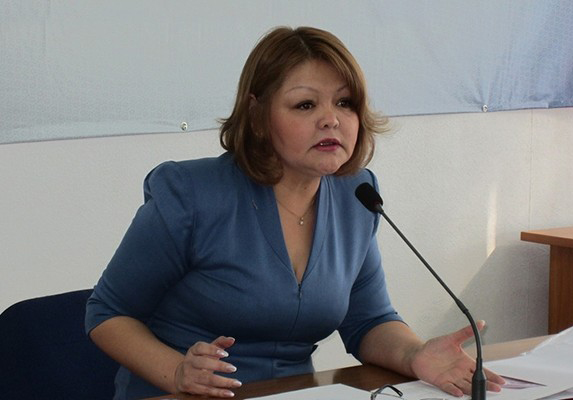
Earlier this month, on 8 April, Umarova (photo) had challenged the official summons of Baurzhan Muzhikov, the head of an investigative group of the Anti-Corruption Service of Almaty, to testify as a witness.
The Medeu Regional Court confirmed the lawfulness of such demands, concluding that it was not related to her professional activity.
On 18 April, the Appeals Collegium of the Almaty City Court overturned the decision of the Medeu Regional Court.
Umarova was represented in the case by 28 lawyers as a demonstration of solidarity by the profession.
“The matter concerns not only Ayman Umarova but the entire legal community. If the case sets a precedent, the rights of our citizens will be in jeopardy,” Anuar Tugel, the President of the Republican Collegium of Lawyers, was reported to have said.
“The decision of the Almaty City Court is an important step in protecting the independence of the legal profession,” said Temur Shakirov, Legal Adviser of the ICJ Europe Programmme.
“While it is welcome that the Court remedied the practice of a forced testimony contrary to the international standards on the role of lawyers, it is worrying that such instances of obstruction of the work of lawyers continue to occur,” he added.
The UN Basic Principles on the Role of Lawyers, in Principle 22, stipulate that: “Governments shall recognize and respect that all communications and consultations between lawyers and their clients within their professional relationship are confidential”.
The UN Human Rights Committee has expressed concerns where “lawyers are released from their obligation of professional confidentiality and obliged to testify or face the risk of imprisonment” (UN Doc CCPR/C/TUN/CO/5 (2008), para. 15).
The ICJ recalls that, in accordance with of the UN Basic Principles, lawyers should be able to perform their professional duties without intimidation, hindrance, harassment or improper interference (Principle 16) and should never be identified with their clients’ causes (Principle 18).
Contact:
Róisín Pillay, Director, Europe Programme, roisin.pillay(a)icj.org
Temur Shakirov, Legal Adviser, Europe Programme, temur.shakirov(a)icj.org
Additional information:
On 28 March 2016, Ayman Umarova started her representation of Sayat Nadirbayev in a criminal case related to Talgat Ermegiyaev, former head of the Astana EKSPO-2017 company, accused of embezzlement.
On 2 April, after a request on the phone by the head of the Investigative Department of the Anti-Corruption Service of Almaty Baurzhan Muzhikov, Ayman Umarova received an official demand to appear and testify as a witness in the case. Since then she was required to appear and testify several times.
On 6 April, the Chair of the Almaty Collegium of Lawyers received a letter signed by Baurzhan Muzhikov, the head of an investigative group of the Anti-Corruption Service of Almaty, asking it to “facilitate the appearance of lawyer Umarova Ayman … to question her as a witness”.
On the same day, the Republican Collegium of Lawyers issued a statement where it qualified this request as a “violation of the guarantees of advocates’ activities” and urged that “appropriate measures [be taken] in regard to the officers of the Anti-Corruption Service”.
Kazakhstan-Landmark decision-News-Web Stories-2016-RUS (full text in Russian, PDF)

Apr 7, 2016 | News
The Malaysian government should reject a proposal to make the Attorney General automatically the chair of the Bar Council of Malaysia, the ICJ said today.
The Malaysian Bar must remain independent and the government should not entertain this or any other measure that would compromise this independence, the ICJ says.
Yesterday, during the debate session at the Dewan Rakyat (Lower House of the Malaysian Parliament), parliamentarian Datuk Datu Nasrun Datu Mansur suggested that the Attorney General should be automatically appointed as the chairman of the Bar Council of Malaysia.
Datuk Datu Nasrun Datu Mansur made the suggestion while criticizing the Bar Council for its role in demanding greater government accountability.
“This latest proposal is just the most recent attempt by the government to silence all opposition and to weaken the rule of law,” said Emerlynne Gil, ICJ’s Senior Legal Adviser for Southeast Asia.
“First the government weakened the independence of the judiciary, and now it is going after the lawyers who are standing up for justice and accountability,” she added.
Responding to the suggestion, Law Minister Nancy Shukri said that the government will look into this, noting that amendments need to be made to the Legal Profession Act 1976 for this measure to be adopted.
“International standards on the independence of lawyers state very clearly that governments should not interfere with the work of professional associations of lawyers like the Malaysia Bar,” said Gil.
The United Nations Basic Principles on the Role of Lawyers stipulate that lawyers have the right “to form and join self-governing professional associations to represent their interests, promote their continuing education and training, and protect their professional integrity,” the ICJ reminds.
Furthermore, the Basic Principles distinctly state that “the executive body of the professional associations shall be elected by its members and shall exercise its functions without external interference.”
“An independent and self-regulated bar association is important to safeguard the professional interests and integrity of lawyers in Malaysia,” Gil said.
“It acquires specific importance especially now in Malaysia where there have been questions regarding the way justice is being administered in the country,” she added.
The Malaysia Bar is an essential agent in the administration of justice and hence, the lawyers belonging to it play a key role in supporting and calling for law and justice sector reform in the country, the ICJ further says.
Contact:
Emerlynne Gil, Senior International Legal Adviser for Southeast Asia, t: +66 840923575 ; e: emerlynne.gil(a)icj.org
Background:
The Malaysia Bar passed a motion last month during its 70th Annual General Assembly calling for the resignation of Attorney-General Tan Sri Mohamed Apandi Ali because he summarily ended the investigation of alleged corruption by Prime Minister Najib Razak.
The Prime Minister appointed Attorney-General Apandi on 27 July 2015, in the midst of the corruption investigation.
Attorney General Apandi subsequently cleared Prime Minister Najib Razak of any criminal wrongdoing and instructed the Malaysian Anti-Corruption Commission to close the investigations.
According to the ICJ, the motion passed by the Malaysia Bar calling for the resignation of the Attorney General was within its mandate as an independent professional association of lawyers, seeking as it did to draw attention to how administration of justice is being jeopardized right now.
The UN Basic Principles specifically recognize the right of lawyers to take part in public discussion of matters concerning the law, the administration of justice and the promotion and protection of human rights.
The UN Human Rights Council has unanimously affirmed that “an independent legal profession” is among the “essential prerequisites for the protection of human rights, the rule of law, good governance and democracy, and for ensuring that there is no discrimination in the administration of justice”. Such independence should be respected in all circumstances.
Apr 6, 2016 | News
Newly appointed Myanmar Attorney General U Tun Tun Oo must commit to strengthening the rule of law and respect for human rights in the country, said the ICJ today.
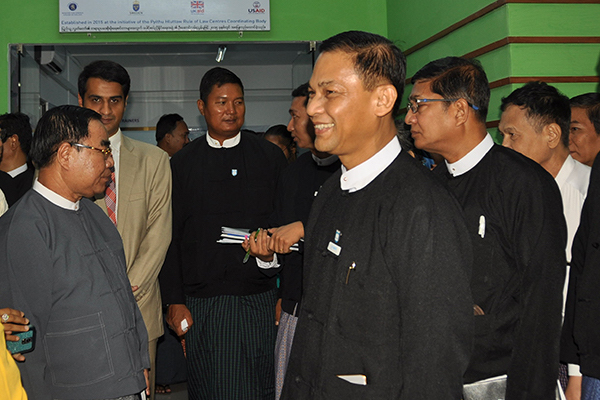
U Tun Tun Oo (photo) has been one of the Deputy Attorney-Generals in the Union Attorney General’s Office since 2006.
“U Tun Tun Oo is taking over a post that is Myanmar’s most powerful legal officer. He plays a complex role, at once a member of the Executive, adviser to the President and the Hluttaw, the authority drafting and amending laws,” said Sam Zarifi, ICJ’s Asia Director. “As an immediate matter, he should review all political cases and stop the harassment of human rights defenders.”
The Attorney General represents the government in judicial proceedings and advises the cabinet on the legality of its actions.
He also leads Prosecutors in the country, and thus has the authority to select, initiate and undertake investigations into criminal and politically sensitive cases.
The Attorney General is also the president of the country’s only officially recognized Bar Association.
The Attorney General is, in effect, the minister of justice, and as such has controlled much of the work of the judiciary, too.
The Union Attorney General’s Office has historically followed the interests of the military and impeded an independent judiciary, the ICJ notes.
It has been criticized for failing to tackle major problems such as corruption and human rights abuses while continuing to prosecute human rights defenders and political opponents.
“Within the Union Attorney General’s Office, prosecutors must act with integrity in an independent, impartial and objective manner and in the protection of the public interest”, said Zarifi.
“Prosecutors must exercise sound discretion in the performance of their functions. They must seek justice, without fear of favour, not merely convict.”
“The Attorney-General’s Office must not shy away from prosecutions that will combat impunity,” he added.
The Union Attorney General’s Office launched its Strategic Plan for 2015-2019, establishing important benchmarks for measuring the institution’s development.
The Strategic Plan acknowledges the public’s low confidence in the office and commits the office to the rule of law, human rights, fair trials, prosecutorial ethics and accountability, in accordance with international standards.
“The Union Attorney General’s Office must investigate and prosecute criminal offences, including gross human rights violations and abuses, with impartiality. The Union Attorney General’s Office must be free from unwarranted interference from the legislative and the executive branches of government. Likewise, it must not interfere with judges or lawyers in an independent judiciary,” Zarifi said.
Contact:
Sam Zarifi, ICJ Regional Director for Asia and the Pacific, t: +66807819002; e: sam.zarifi@icj.org
Vani Sathisan, ICJ International Legal Adviser for Myanmar, t: +95(0)9250800301; e: vani.sathisan@icj.org
Additional information:
Under international standards, prosecutors are required to “respect and protect human dignity and uphold human rights” and “give due attention to the prosecution of crimes committed by public officials, particularly corruption, abuse of power, grave violations of human rights and other crimes recognized by international law.” These principles are set out in the United Nations Guidelines on the Role of Prosecutors.
An exposition and analysis of international law and standards are available in English and Myanmar language in the ICJ’s authoritative Practitioners’ Guide on the Independence and Accountability of Judges, Lawyers and Prosecutors.