May 20, 2019 | News
The ICJ, the Geneva Bar Association and the Geneva legal community have joined forces to launch the ICJ-Geneva Lawyers International Cooperation Initiative. Under the Initiative, Geneva lawyers will join ICJ missions on the five continents to support the independence and integrity of lawyers and judges at risk, and to promote the Rule of Law.
The Initiative launches with a mission tomorrow, May 21st. A lawyer from the Geneva Bar Association will go to Guatemala to work the ICJ team and lawyers investigating and fighting the forced displacement of the indigenous community of La Laguna de El Petén.
Missions under the initiative will typically involve, among other things:
– Trial observations;
– Fact-finding missions;
– Support for the independence of lawyers and bar associations;
– Capacity building and training activities;
– Expertise and academic support.
Since its founding in 1952, the ICJ has played a unique and preeminent role as a non-governmental organization for the defense of the Rule of Law around the world, and the independence of judges and lawyers.
With the presence of its headquarters in Geneva for more than 60 years, through the Initiative the ICJ is further deepening its special bond with the city, to spread and share the spirit of Geneva.
“International support and solidarity are crucial to the work of lawyers defending the human rights of those who are often marginalized from power,” said Michaël Sombart, Director of Strategic Partnerships of the ICJ. “With this project the ICJ can help lawyers around the world benefit from the reputation and high standing of the Swiss legal community and bring the message of the Genève humanitaire beyond borders.”
“This initiative is welcome and we support it with commitment,” said Sandrine Giroud, member of the Geneva Bar Council and Chair of its Human Rights Commission. “The Rule of Law is under attack around the world and lawyers play a vital role in its defense and the impartiality of justice. Our support for the ICJ-Geneva Lawyers International Cooperation Initiative is in line with the lawyer’s mission as a bulwark against the arbitrariness and the defense advocacy tradition of the Geneva Bar Association. We welcome this collaboration, which is part of the fight for justice and respect for fundamental rights and guarantees. ”
Nicolas Gürtner, First Secretary of the Young Bar Association of the Geneva Bar Association, said: “This project offers a remarkable opportunity for young lawyers to work alongside the jurists of international repute of the ICJ in favour of the guarantee of Rule of Law.”
The Steering Committee for the Initiative includes:
– The ICJ;
– For the Geneva Bar Association: the Commission on Human Rights and the Young Bar Association;
– Representatives of the Geneva judicial and academic world, including Professor Robert Roth, former President of the Court of Cassation, former director of the Geneva Academy, Professor Emeritus of the University of Geneva
Contact :
Michaël W. Sombart, ICJ, Director of Strategic Partnerships, t: +41 22 979 38 31 ; m: +41 77 965 98 45 ; e: michael.sombart(a)icj.org
May 8, 2019 | News
The recommendations published today follow the Conference on the Independence of the Legal profession held by the International Commission of Jurists (ICJ), the Council of Europe (CoE) Office in Baku and the Azerbaijan Bar Association (ABA) in Baku, on 15-16 November 2018.
The Conference created much-needed space for a dialogue on the issue of independence of lawyers in Azerbaijan with both national and international stakeholders, as lawyers from Azerbaijan, Georgia, Kazakhstan, the Netherlands, the Russian Federation, Switzerland, Turkey, Ukraine, the United Kingdom and Uzbekistan shared their experiences and good practices in addressing challenges to the independence of lawyers. Drawing on the discussions at the Conference, and taking into account key findings of the ICJ report of 2016 “Defenceless Defenders: Systemic Problems in the Legal Profession of Azerbaijan” as well as more recent legislative and administrative developments, the ICJ makes recommendations aimed at strengthening the role and independence of lawyers and improving access to justice in Azerbaijan. The recommendations are informed by international law and standards on the role of lawyers and cover four main aspects: adequacy of the number of lawyers to ensure access to justice; the examination procedure for qualification as a lawyer; professional ethics of lawyers and disciplinary proceedings against lawyers.
Click to read the recommendations
May 4, 2019 | News
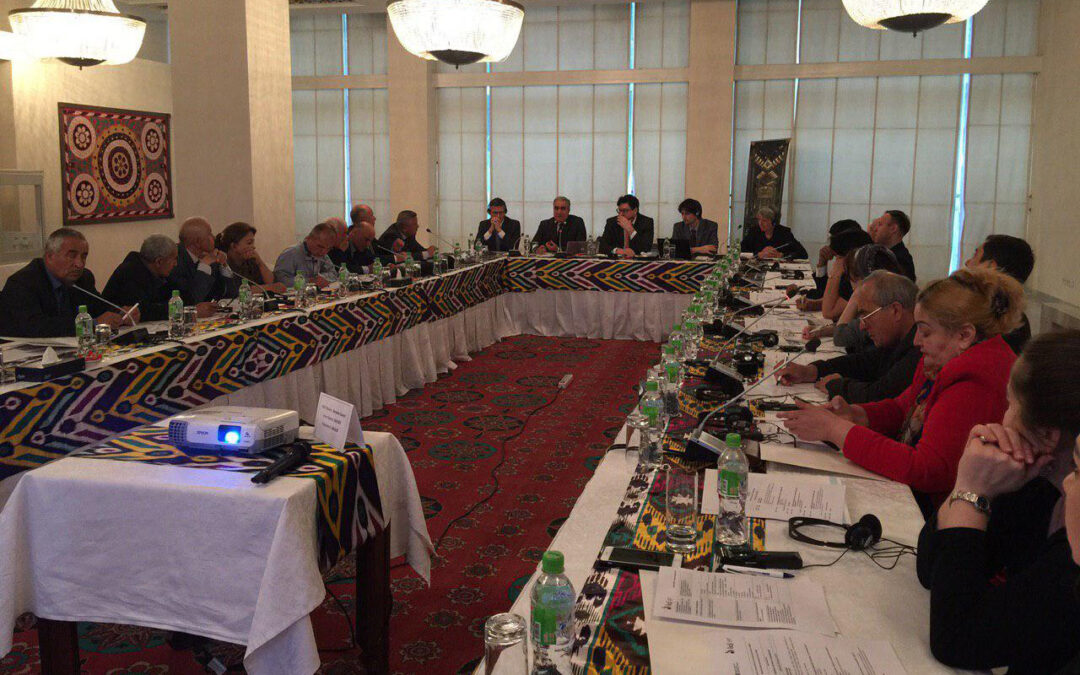
The ICJ concluded a research mission on the independence of the judiciary in Tajikistan on 3 May. Following the mission, the ICJ expressed concerns about the independence of individual judges as well as the functioning of judicial institutions and procedures in law and in practice.
The mission included ICJ Commissioner Justice (ret.) Martine Comte of the Orleans Court of Appeal (France) and ICJ Secretary General Saman Zia-Zarifi.
The ICJ spoke with a wide cross-section of stakeholders, including senior government officials, numerous former judges, senior advocates and working lawyers, as well as journalists and members of civil society. The ICJ will provide its findings in a final mission report that will set out include key recommendations to help Tajikistan meet its international obligations.
Among other things, the ICJ mission discussed recent initiatives to reform the judiciary, including the Judicial Reform Programme of 2019-2021 which has been recently been adopted by the President of Tajikistan, and which provides an opportunity to strengthen judicial independence.
The ICJ mission gathered information about the newly formed Qualification Commission for qualification and disciplinary procedures for judges. This replaced the Council of Justice, which had been criticized by international observers for its lack of independence.
Although formally established under the Supreme Court, the Qualification Commission consists predominantly of members of the executive with only two out of seven members being representatives of the judiciary.
Multiple lawyers and former judges expressed serious concerns about the right to a fair trial in criminal proceedings, pointing in particular to the extremely low acquittal rate for suspects. It appears that numbers of acquittals have declined over several decades and that acquittals are now extremely rare.
The ICJ also received complaints that pubic access to court hearings is impeded in practice despite clear legal provision for the public nature of court proceedings, with limited exceptions. Members of the public were said to be generally unable to attend court hearings freely where they are not parties to the proceedings.
Furthermore, the ICJ heard that judicial decisions are generally not available to members of the public unless they are participants in the proceedings.
The ICJ wishes to express its gratitude to everyone who contributed to the successful conduct of the mission, including State, inter-State and non-State organisations and bodies which the ICJ met and communicated with.
The ICJ wishes to stress its appreciation of the support provided by the OSCE Office in Dushanbe and the United Nationals Human Rights Office.
Mar 28, 2019 | Advocacy, Non-legal submissions
Today, the ICJ filed a submission to the Human Rights Council’s Working Group on the Universal Periodic Review in advance of its review of Kazakhstan’s human rights record in October-November 2019.
In its submission, the ICJ considered the situation with the independence of the legal profession in Kazakhstan and provided information on the status of international human rights treaties ratified by Kazakhstan.
The ICJ called on the Human Rights Council and the Working Group to recommend Kazakhstan:
• to amend the current legislation to ensure that representatives of the executive, such as the Ministry of Justice, are not included in the disciplinary bodies of the legal profession;
• to amend the current legislation to ensure that the qualification procedures are fully governed by the legal profession in Kazakhstan in line with international law and standards on the role of lawyers; in particular, the Qualification Commissions should be bodies of the Bar Association while their composition should predominantly consist of lawyers delegated by the Bar Association itself;
• to ensure that as the main stakeholder in any reforms affecting the legal profession, the Bar Association participates in such reforms in a meaningful way;
• to take effective measures to prevent further interference by the executive and law enforcement bodies in the exercise of lawyers’ professional duties, in particular prevent the practice of bringing disciplinary complaints against lawyers solely for their defence of their clients or legitimate exercise of their right of freedom of expression;
• to ensure that the right of lawyers to freedom of expression is respected, especially in regard to matters of public interest and law.
Furthermore the ICJ suggested:
• To ratify the Agreement on the Privileges and Immunities of the International Criminal Court.
• To ratify the Optional Protocol to the Covenant on Economic Social and Cultural Rights and International Convention on the Protection of the Rights of All Migrant Workers and Members of their Families as well as the Second Optional Protocol to the International Covenant on civil and Political Rights.
Kazakhstan-ICJ UPR 2019-Advocacy-Non legal submissions-2019-ENG (full text of submission, in PDF)

Mar 26, 2019 | News
The ICJ condemns the sentencing of Venezuelan Judge Maria Lourdes Afiuni to a further five years of imprisonment.
On 21 March, a court in Caracas sentenced Judge Afiuni on unfounded charges of “corruption”.
“This further five-year sentence against Judge Afiuni is both the latest in a long series of severe violations of her human rights, and also illustrates the grave extent to which independence of the judiciary in Venezuela has been more broadly undermined,” said Matt Pollard, ICJ Senior Legal Adviser and UN Representative.
Judge Afiuni was arbitrarily arrested and detained in 2009 after then-President Hugo Chavez publicly demanded she be imprisoned for 30 years, as she had released an accused person citing a decision by the UN Working Group on Arbitrary Detention that his detention was unlawful.
While in detention, she was subjected to torture and other ill-treatment.
In 2010, the UN Working Group on Arbitrary Detention issued an opinion declaring Judge Afiuni Mora’s detention arbitrary.
She was held in prison for 14 months before being transferred to house arrest for health reasons in 2011.
In 2013 she was granted parole but ordered not to leave the country or to use social media.
The UN Special Rapporteur on the Independence of Judges and Lawyers reacted earlier today to the latest sentencing by reaffirming the arbitrariness of her deprivation of liberty and the fact that her treatment amounts to reprisals for having implemented the UN Working Group’s decision.
The Rapporteur also said that the ruling “underscored his serious concerns about the independence of the judiciary in Venezuela, the impartiality of judges and prosecutors and the pressures they faced in handling politically sensitive cases.”
Further background on the situation for the judiciary in Venezuela, and Judge Afiuni’s case, is available here.