
May 12, 2016 | News
The ICJ is concerned at the reported resignations of federal judges in the Chechen Republic of the Russian Federation following apparent pressure by the acting Head of the Republic Ramzan Kadyrov who had suggested that resignation would be the “most correct decision of their lives”.
The ICJ considers these statements, which appear to have led directly to the resignations of federal judges, to be inappropriate interference with the functioning and independence of the judiciary.
The ICJ calls on the Russian Federation judicial authorities to take all measures within their power to ensure that all judges’ security of tenure is preserved and that any allegations of misconduct are addressed through appropriate disciplinary proceedings that respect the right to a fair hearing.
The ICJ further calls on the executive authorities to refrain from any comments which may undermine the independence of the judiciary.
On 5 May, Ramzan Kadyrov, currently acting Head of the Chechen Republic, recommended that several named judges should step down.
In his post on social media, Kadyrov identified as problems unfair decisions of courts, procrastination in criminal cases, decisions regarding housing and inconsistent decisions.
He mentioned that although examples of such decisions were sporadic, they did not help build trust in the judiciary.
He then recommended that the President of the Supreme Court of the Chechen Republic, Magomed Karatayev (photo) and three other judges, Takhir Murdalov, Sulyan Yandarov and Zayndi Khusainov, should resign “if they had a notion of honour and professional ethics”.
It was reported that two judges of the Urus-Martan City Court and Grozny District Court, Sulyan Yandarov and Zayndi Khusainov, submitted their resignations on the same day.
The President of the Supreme Court of Chechnya, Magomed Karatayev, and his deputy Takhir Murdalov, are reported to have already filed a request for resignation.
The resignations, apparently in direct response to criticism by the executive, undermine the separation of powers and the independence of the judiciary in the Russian Federation.
Under international law, including the right to a fair trial protected, inter alia, by Article 6 of the European Convention on Human Rights and Article 14 of the International Covenant on Civil and Political Rights, the independence of the judiciary must be guaranteed.
The UN Basic Principles on Independence of the Judiciary enshrines “the duty of all governmental and other institutions to respect and observe the independence of the judiciary” and provides the judiciary shall not be subject to “any restrictions, improper influences…pressures, threats or interferences, direct or indirect from any quarter or for any reason.”
While judges have an obligation to adhere to judicial ethics and should be held accountable for professional misconduct, the representatives of the executive must refrain from statements which jeopardize the independence of the judiciary.
The Council of Europe’s Recommendation on judges specifies that “the executive and legislative powers should avoid criticism that would undermine the independence of or public confidence in the judiciary.”
Public pressure from the executive on judges to resign can nullify the security of tenure of judges protected under national and international law and standards.
According to Principle 12 of the Basic Principles on the Independence of the Judiciary, “[j]udges, whether appointed or elected, shall have guaranteed tenure until a mandatory retirement age or the expiry of their term of office, where such exists.”
Under international standards, allegations of misconduct against judges should be dealt with by the self-governing institutions of the judiciary, through fair disciplinary procedures.
Under the Basic Principles, the only basis for removal of judges is “incapacity or behaviour that renders them unfit to discharge their duties.
The comments by Ramzan Kadyrov also run contrary to the legislation of the Russian Federation, which spells out in detail the procedure for disciplinary measures against judges in case of alleged professional misconduct.
RUSSIA-Chechen judges statement-News-web story-2016-RUS (full text in Russian, PDF)
Apr 2, 2016 | News
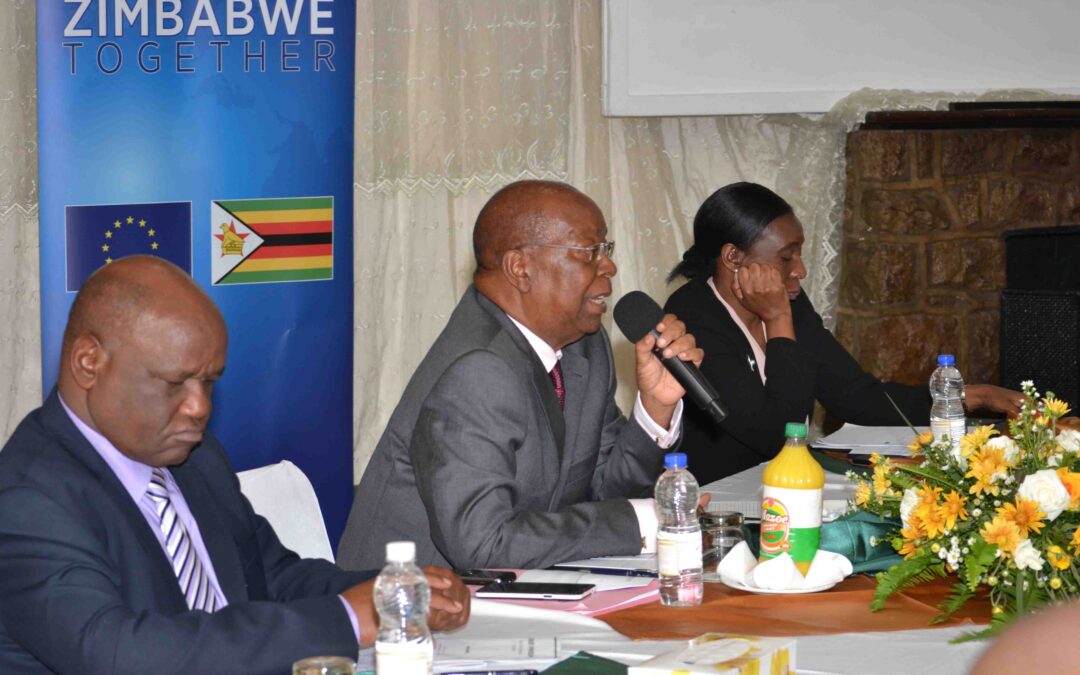
The ICJ and the Judicial Service Commission of Zimbabwe held the End of Term Symposium for the judiciary of Zimbabwe at the Troutbeck Inn in Nyanga, 31 March – 2 April 2016.
Chief Justice Chidyausiku in his opening remarks at the End of Term Symposium, stated that the Symposia are important because they give judges an opportunity to meet and engage with each other on various issues of interest or concern.
Additionally the purpose of the Symposium is to improve the quality of service in terms of judgments and the speedy outcome of cases.
In attendance at the Symposium were 72 delegates including judges from the Supreme Court, High Court and Labour Court, as well as representatives from the Law Society of Zimbabwe.
The programme included a joint session with all the courts in attendance, to discuss topics of judicial ethics and case management.

Mar 28, 2016 | News
The ICJ today calls for the reversal of the Supreme Disciplinary Board’s decisions to force into retirement 47 judges following two separate, mass proceedings known as the “July 2013 Statement Case” and the “Judges for Egypt Case”, which concern over 60 judges.
Today’s final decision in the “July 2013 Statement Case” forcibly removed 32 judges from their offices.
It comes after all of the 15 judges referred to disciplinary proceedings in the “Judges for Egypt” were forcibly removed from their offices last Monday.
In a third case on 7 March 2016, the Disciplinary Board removed from office Zakaria Abdel Aziz, a former President of the Judges Club (Egypt’s representative body of judges) and a leading advocate of judicial independence.
“The intensity of Egypt’s attacks against individual judges is reaching a frightening level,” said Said Benarbia.
“By removing judges from the office following mass, arbitrary and unfair disciplinary proceedings, the authorities are purging from the judiciary the very voices that have promoted its independence, and sending a chilling message to others who might challenge the ongoing crackdown on fundamental rights and freedoms in Egypt,” he added.
The ICJ had previously raised concerns about fairness of these proceedings as well as the nature of the charges against the concerned judges.
In the “July 2013 Statement Case” and the “Judges for Egypt Case,” the Disciplinary Board found that the judges had been involved in politics and were therefore “unfit” to carry out their functions.
Article 73 of Egypt’s Judicial Authority Law prohibits judges from engaging in “political activity”.
This prohibition was interpreted by the Disciplinary Board to include “discussing or commenting on legislative and governmental decisions as long as it does not pertain to a case that he [the judge] is looking into as part of his judicial function”.
The ICJ considers that the interpretation by the Disciplinary Board could result in arbitrary limitations to the judges’ right to freedom of expression, assembly and association, well beyond any restrictions that could possibly be justified as necessary to preserve the dignity of their office and the impartiality and independence of the judiciary.
Furthermore, these disciplinary proceedings have failed to meet international standards of fairness, the ICJ says.
The Geneva-based organization previously highlighted procedural flaws in the proceedings against the judges such as failure to be notified properly, to be represented before the Board and to be provided with adequate time and facility to prepare a defense.
“The Egyptian authorities must reinstate all judges that have been removed from their office as a result of unfair and arbitrary proceedings”, said Benarbia.
“Furthermore, they must amend the Judicial Authority Law to ensure that disciplinary offences are clearly and precisely defined within the law; that the exercise of the rights to freedom of expression, association and assembly in a manner consistent with the dignity of the office and the impartiality and independence of the judiciary does not constitute a disciplinary offence; and that the disciplinary procedure is fair and does not undermine the independence and impartiality of the judiciary,” he added.
Contact:
Nader Diab, Associate Legal Adviser of the ICJ Middle East and North Africa Programme, t: +216 51727023; e: nader.diab(a)icj.org
Background
The UN Basic Principles on the Independence of the Judiciary, which were adopted by the UN in 1985 and elaborate on states’ obligations under international law, include the following provisions:
- In accordance with the Universal Declaration of Human Rights, members of the judiciary are like other citizens entitled to freedom of expression, belief, association and assembly; provided, however, that in exercising such rights, judges shall always conduct themselves in such a manner as to preserve the dignity of their office and the impartiality and independence of the judiciary.
- Judges shall be free to form and join associations of judges or other organizations to represent their interests, to promote their professional training and to protect their judicial independence. (…)
- A charge or complaint made against a judge in his/her judicial and professional capacity shall be processed expeditiously and fairly under an appropriate procedure. The judge shall have the right to a fair hearing. The examination of the matter at its initial stage shall be kept confidential, unless otherwise requested by the judge.
- Judges shall be subject to suspension or removal only for reasons of incapacity or behaviour that renders them unfit to discharge their duties.
- All disciplinary, suspension or removal proceedings shall be determined in accordance with established standards of judicial conduct.
- Decisions in disciplinary, suspension or removal proceedings should be subject to an independent review. This principle may not apply to the decisions of the highest court and those of the legislature in impeachment or similar proceedings.
Egypt- removal of judges-press release-2016-ARA (full text, Arabic, in PDF)

Mar 21, 2016 | News
The Maldives must stop undermining the independence and integrity of the judiciary through arbitrary and politically motivated actions against judges, the ICJ said today.
“The ICJ visited the Maldives last month for the second time in a year, and we were dismayed to see that the Maldives government has continued to erode the rule of law and weaken the independence of the judiciary,” said Nikhil Narayan, ICJ’s Senior Legal Adviser for South Asia.
“The government must immediately stop targeting judges and other public officials with arbitrary criminal proceedings, threats, intimidation and harassment,” he added.
On 7 February, Magistrate Judge Ahmed Nihan was arrested, along with former Prosecutor General and former Criminal Court Judge Muhthaz Muhsin, in connection with an alleged ‘forged’ arrest warrant against President Yameen.
“The arrest of a judge for issuing a warrant, a function which is well within the ordinary powers and responsibilities of the judiciary, clearly violates basic principles of judicial independence,” Narayan further said. “The fact that the alleged warrant was against the President further suggests that Judge Nihan’s arrest was politically motivated.”
“Moreover, the severity of a charge of ‘terrorism’ for such an act, even if taken at face value, cannot reasonably be viewed as proportionate to the alleged offense,” he added.
On 16 March, more than a month after his arrest, Judge Nihan was charged under sections 4(a)(1)-(2) and 5(a)(2) of the Prevention of Terrorism Act, for attempting to unduly influence the state, attempting to create fear among the public, and attempting to forcefully disappear or hold a person hostage.
The Constitution of the Maldives does not provide immunity for the president from criminal accountability even while still in office.
The ICJ was also concerned to find during its visit that Maldivian authorities have continued to undermine the independence of the judiciary by using the threat of transfer or removal of judges as a tactic of political retribution, harassment and intimidation.
On 14 February, former Criminal Court Chief Judge Abdullah Mohamed was abruptly transferred from the Criminal Court to the Family Court following a sudden and late night meeting of the Judicial Service Commission (JSC), without being given an opportunity to appear on his own behalf during the meeting.
While the JSC has given no reasons for its decision, lawyers, human rights defenders and former government officials with whom the ICJ spoke suggested that the transfer had been taken in retaliation for Judge Abdullah’s failure to remand former Prosecutor General Muhsin following his arrest.
It was also suggested by those interviewed that a further motivation for the transfer was to ensure that Judge Abdullah could not indirectly influence the three-judge bench hearing the former Vice President’s criminal case in favor of the defendant. Judge Abdullah was reported to have close ties with both defendants.
In June 2015, Judge Azmiralda Zahir, one of only three female judges in the entire Maldivian judiciary and the only woman on the High Court, was arbitrarily and unexpectedly transferred by the Supreme Court from the Malé appellate bench to the southern regional bench, a transfer that amounts to a demotion, without formal notice or opportunity to challenge her transfer.
The Supreme Court has neither established clear criteria for its decision-making process in such matters nor informed Judge Zahir of the reasons for her transfer, of which she learned through media reports, despite repeated requests by her to both the Supreme Court as well as the JSC, the ICJ says.
“President Yameen’s government must quickly take genuine steps to restore the rule of law, strengthen the independence and integrity of the judiciary and restart the democratic transition process,” said Narayan.
Contact:
Nikhil Narayan, ICJ Senior Legal Adviser for South Asia, t: +977 9813187821 ; e: nikhil.narayan(a)icj.org
Read also:
Maldives: political crisis erodes rule of law and human rights
Maldives: arrest of Judge Ahmed Nihan further erodes judicial independence

Feb 24, 2016 | News
The ICJ today called on the Egyptian authorities to put an immediate end to their campaign to muzzle judges through unfair and arbitrary “unfitness” proceedings.
The Disciplinary Board, in hearings that tried dozens of judges at the same time, declared a total of 41 judges “unfit” for judicial office in 2015, forcing them into retirement.
The Supreme Disciplinary Board is currently reviewing these two cases.
The ICJ is concerned that many of the judges that have been subjected to these proceedings are leading advocates for judicial independence in Egypt and that the proceedings before both the Disciplinary Board and the Supreme Disciplinary Board were not fair.
Further, the cases stem from the judges’ exercise of freedom of association, belief, assembly and expression, and it appears that the Disciplinary Boards did not act in accordance with relevant international standards in this regard.
”Ending judges’ tenure following mass proceedings that are both arbitrary and unfair is inconsistent with Egypt’s obligations under international law,” said Said Benarbia, Director of the ICJ Middle East and North Africa Programme.
“With these assaults on individual judges, the Egyptian authorities are ensuring that their ongoing, sustained crackdown on fundamental rights and freedoms is extended to the very institution that is supposed to protect such rights and freedoms- the judiciary,” he added.
In the “July 2013 Statement Case”, 56 judges were subjected to disciplinary proceedings, following the Military seizure of power in July 2013, for endorsing a statement that called for the 2012 Constitution to be restored, for a dialogue between all stakeholders to be established within the framework of constitutional legitimacy, and for the right to peaceful demonstration to be respected.
The ICJ considers the statement to have been made consistent with the judges’ right to freedom of expression and association, exercised in a manner that preserved the dignity of their office and the impartiality and independence of the judiciary.
However, on 14 March 2015, the Disciplinary Board found that 31 of the 56 judges were not fit to hold judicial office and in effect removed them from office by forcing them into retirement.
The Board found there was not sufficient evidence that the other 25 judges had in fact endorsed the statement.
The ICJ is concerned that the procedures and hearings before the Disciplinary Board and the Supreme Disciplinary Board have not satisfied international standards of fairness.
In many instances, judges were not adequately notified of the dates of the hearings or of the courtrooms where such hearings took place.
In Egypt, judges facing disciplinary hearings are entitled to have another judge represent them; however, many of the judges were not permitted by Board officials to bring their representative to the hearings, without any reason being given for barring the representative, or because no representative could be secured as a result of fear of reprisals.
Further, many judges were not provided with adequate time and facilities to prepare their defense.
In another case, the “Judges for Egypt Case”, each judge had limited time to make his case before the Board during the hearings, though they were granted the right to submit at the final hearing written pleadings of no more than two pages .
At the final hearing in the case, while the judges waited all day in the Board’s premises, the hearing was held in the absence of all but one of them.
Furthermore, the Board refused to collect the written pleadings without giving any reasons.
On 22 February 2016, after protesting against the adjournment of his hearing, Judge Amir Awad was arrested and placed under detention for four days by the office of the prosecutor.
He is charged with insulting a public employee and forcibly entering his office.
“Both cases have been tainted by failures to ensure the fairness of the proceedings. The Egyptian authorities must nullify all decisions to remove judges resulting from these proceedings and put an immediate end to all forms of intimidation against and persecution of judges,” Benarbia added.
Contact:
Nader Diab, Associate Legal Adviser of the ICJ Middle East and North Africa Programme, t: +216 51727023; e: nader.diab(a)icj.org
Egypt-Attacks against judges-News-Web Stories-2016-ENG (full story in PDF, English)
Egypt-Attacks against judges- Press Release -2016- ARA (full story in PDF, Arabic)