
Nov 5, 2019 | News
The ICJ welcomed today’s ruling of the Court of Justice of the European Union finding that Poland violated the independence of the judiciary by lowering in 2017 the pension age of Polish judges and giving the power to maintain them in office to the Minister of Justice.
The Court also found that the new law creating widely disparate retirement ages between women and men who are ordinary court judges or prosecutors – 60 and 65 respectively – constituted unlawful discrimination
“The Court of Justice has upheld the cardinal principle of the rule of law that the terms of judges cannot be determined controlled on an ad hoc basis by political powers,” said Massimo Frigo, Senior Legal Adviser of the ICJ Europe and Central Asia Programme.
“This judgment confirms that these retirement laws were a direct blow to the principle of separation of powers, the bedrock of the rule of law,” he added.
The Court of Justice held as contrary to the principle of independence of the judiciary under article 19 of the Treaty on the Functioning of the EU as series of laws lowering the age of retirement for ordinary judges, prosecutors and Supreme Court judges from 70 to 65 years for men and 65 to 60 for women. These laws allowed the Minister of Justice to decide which judges are to be reinstated.
“Poland should scrap these laws entirely and reinstate fully the situation of the judiciary prior to their enactment,” Frigo said.
“These laws were but a part of the systemic attack to the independence of the judiciary that the Polish government should stop,” he added.
The ICJ also called on Poland to bring the retirement ages of men and women back into parity.
The case was brought by the European Commission in an infringement proceeding against Poland for violation of the obligation to provide access to justice for EU law violations under article 19 TFEU.
Contact:
Massimo Frigo, Senior Legal Adviser of the ICJ Europe and Central Asia Programme, t: +41 22 979 3805 ; e: massimo.frigo(a)icj.org
More information on Massimo Frigo’s blog
Oct 24, 2019 | News
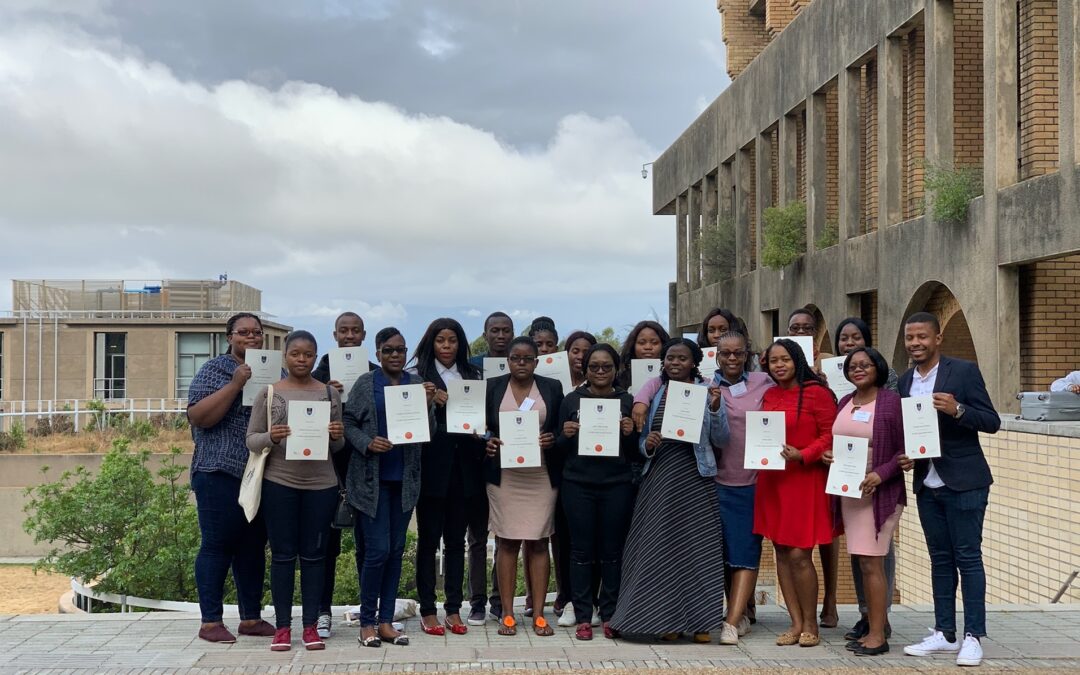
The ICJ in collaboration with the Judicial Institute of Africa (JIFA) and Democratic Governance and Rights Unit (DGRU) convened a three-day training workshop for Zimbabwe court researchers.
The training workshop was held from the 21 to 23 October 2019 at the University of Cape Town, South Africa.
The judicial research programme is an initiative that was established to increase the research capabilities of the researchers, which would in turn improve the jurisprudence emerging from the courts.
Court researchers play a crucial role in the development of Zimbabwean jurisprudence through the work they undertake on behalf of the judges.
Furthermore, the increased efficiency that they bring to the courts allows judges to expend more of their efforts on well-informed analysis and administration of cases.
This brings a better quality of justice and reduces waiting periods for judgments and case backlog.
Arnold Tsunga the Director of the Africa Regional Programme of the ICJ remarked that “given the importance of the space that these researchers occupy, it is important to ensure that their legal knowledge and skills continue to be relevant and comprehensive so that they can provide a service of quality that adequately responds to the needs of judges. This in turn will also contribute to attainment of the UN Strategic Develop Goal (SDG) 16 and 5 on access to justice for all as well as SDG 5 on leaving no one behind.”
The areas of discussion for the three-day training workshop focused on judicial ethics, accessing judgments, accessing research materials, judgment writing and memo writing.
The training workshop was facilitated by judges, university teaching staff, and external resources. Twenty researchers are took part in the training workshop, including 17 women.
Contact
Arnold Tsunga, t: +26377728 3248; e: arnold.tsunga(a)icj.org
Rumbidzai Muyendesi, t: +263771666579; e: rumbidzai.muyendesi(a)icj.org

Oct 22, 2019 | News
On 25 and 26 October, the ICJ in Central America will hold the VII Regional Conference on Judicial Independence, with the central theme of the protection and security of Judges.
The Conference will discuss the role that governments should play in the protection of judges, as well as the relationship between judicial independence and security of those who deliver justice.
Participants from outside the region include Radmila Dragicevic Justice of the Supreme Court of Cassation of Serbia and Vice-President of the ICJ; José Antonio Martín Pallín, Judge Emeritus of the Spanish Supreme Court of Justice and ICJ Commissioner, and Erland Flaterud and Finn Arne Schanche, both judges from Norway.
Nine other judges from Central America will attend, including Leonardo Ramírez of the Supreme Court of Justice of El Salvador Murcia and Fernando Cruz Castro, President of the Supreme Court of Justice of Costa Rica.
The ICJ regrets that the Supreme Court of Justice of Guatemala has not been in a position to receive this important delegation at its plenary on 23 October to address the issue of the security of judges.
The ICJ recalls that this Conference is held within the framework of a letter of cooperation and understanding agreed with the former President of the Judicial Branch and the Supreme Court of Justice, Ranulfo Rojas Cetina in 2015.
The ICJ is particularly concerned that there is presently an unfilled vacancy for Chief of Security for the judiciary, following the resignation of the former Chief who had allegedly engaged in conduct not consistent with his function.
Ramón Cadena, Director of the ICJ for Central America, said: “It is the duty of the Supreme Court of Justice to inform the Guatemalan public about the Judges Protection System, so that it does not become a source of corruption or in any way interferes with the work of independent, and impartial judges.”
In Guatemala, the international delegation will meet with judges such as Yassmín Barrios, Ericka Aifán, Miguel Ángel Gálvez, Carlos Ruano and Pablo Xitumul among others. They have been the subject of seemingly unfounded complaints which have posed risks to their personal security and independent judicial functioning.
Oct 11, 2019 | News
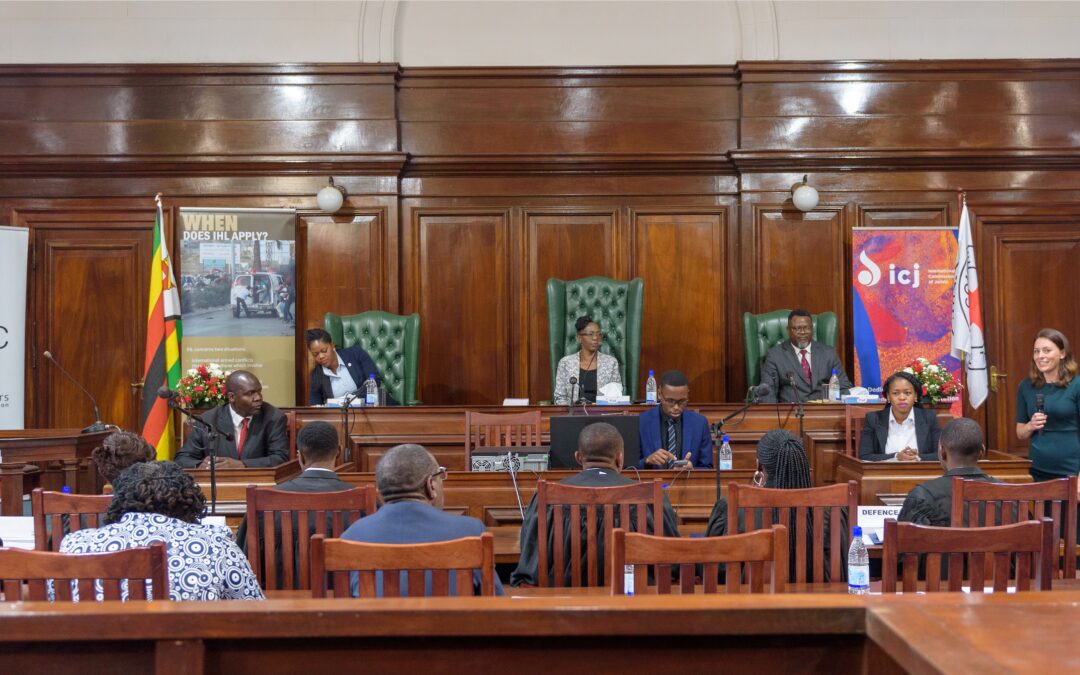
The ICJ in partnership with the International Committee of the Red Cross (ICRC) convened the 2019 International Humanitarian Law (IHL) moot court competition.
The IHL moot court competition brought together 12 law students from Great Zimbabwe University, Midlands State University, University of Zimbabwe and Zimbabwe Ezekiel Guti University; to engage with IHL issues.
The Great Zimbabwe University students won the competition and will participate in the All Africa Moot Court Competitions to be held in Arusha, Tanzania representing Zimbabwe.
Moot Court competitions are a part of the philosophy of developing a conscientious lawyer and contributing to law graduates who have an affinity for defending human rights and the rule of law. IHL incorporates human rights principles in times of war. As a result, understanding IHL allows students to have an understanding of the application and limitations of human rights during times of war. The moot court competitions additionally equip the students with an invaluable opportunity to develop key advocacy skills.
“The moot competition gives law students the opportunity to have experiential learning and can be one among an array of interventions that could be done to supplement the university education of lawyers in Zimbabwe that has not been very strong on human rights and humanitarian law,” said Arnold Tsunga, Director of ICJ’s Africa Regional Programme.
The competition was held from 8 October to 11 October 2019. On 8 October the law students underwent an advocacy boot camp which was a full training day on advocacy skills. The four law faculties participated in a preliminary round on 9 October. The top two, Great Zimbabwe University and Midlands State University qualified for the final round. The winning team, Great Zimbabwe University will participate in the All Africa Moot Court Competitions which brings together IHL national champions from all over Africa.
The competition was supported by the European Union.
Contact
Arnold Tsunga, t: +26377728 3248; e: arnold.tsunga(a)icj.org
Rumbidzai Muyendesi, t: +263771666579; e: rumbidzai.muyendesi(a)icj.org
Oct 7, 2019 | News
The apparent suicide attempt of a judge in southern Thailand highlights the need for urgent reform of the judiciary to improve its independence from political interference, the ICJ said today.
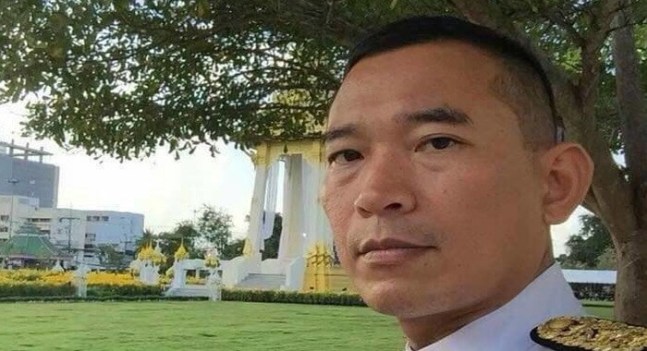
Judge Khanakorn Pianchana, Vice Presiding Judge of the Yala Provincial Court in Thailand’s restive southern region, reportedly shot himself in the chest following his delivery of a verdict on 4 October in a case in which he alleged political interference in his judicial functions. Judge Khanakorn is currently hospitalized in critical condition.
“This unfortunate incident again shows the need for sustained reforms of law enforcement and particularly of the independence of the judiciary in Thailand,” said Frederick Rawski, ICJ’s Asia director.
Judge Khanakorn had alleged in a 25-page note that he was ordered in confidence to rewrite his ruling exonerating five suspects of murder charges – a decision he had allegedly reached on the basis of lack of sufficient evidence. The five have had been detained and interrogated under special security laws in force in the Southern Border Provinces of Thailand.
Under Thai law, if a superior judicial officer disagrees with a ruling of any judge, he or she must express such disagreement in writing and is forbidden from speaking to a judge in confidence to reverse the ruling.
“The ICJ has worked for years with the judiciary in southern Thailand to improve the administration of justice, especially by addressing problems such as the improper admission of evidence and problematic evidence-gathering by security forces countering armed groups,” Rawski said. “This case again shows how misuse of emergency decrees in southern Thailand has aggravated the political pressure exerted on judges.”
Today, the case was submitted to the Office of the Judicial Commission for its consideration. The Commission, chaired by the President of the Supreme Court, comprises of qualified members who are judicial officers of each level of the Court. Consequently, the Commission passed a resolution to set up a Sub-Committee comprises three of its members to investigate into the allegations.
Particularly because Judge Khanakorn’s claim involves several senior judges in active services, the Sub-Committee set up by the Commission to investigate the allegations must therefore be independent institutionally and functionally, at all stages of the investigation. Their mandate should be broadened to look into whether there is wider pattern and practice of interference beyond this case.
Background
Judge Khanakorn presided over a trial involving the alleged murder of five people in Yala province in 2018. Following the killing, authorities arrested five suspects who were charged with murder, secret association, conspiracy and gun-related offences. If convicted, three out of five defendants could be sentenced to death.
The five suspects were reportedly detained and interrogated under much-criticized special security laws which remain in force in the Southern Border Provinces of Thailand – i.e Martial Law and Emergency Decree. The ICJ has repeatedly criticized how the Martial Law confers upon military authorities the powers to arrest and detain any person without a warrant for up to seven days for interrogation and questioning and does not require detainees to be brought before a court at any stage of their detention. The ICJ has also repeatedly analyzed and criticized the Emergency Decree, which breaches international law and standards, by allowing authorities to detain suspects, with the leave of the Court, for up to 30 days. The law does not require a detainee to be physically brought before the Court during this period.
Information submitted to the court as evidence in this case had reportedly been obtained from the suspects during detention periods prescribed under Martial Law and the Emergency Decree. Judge Khanakorn noted in his statement that he was of the view that any information obtained during this period should not be admissible because rights protections had not been afforded to the suspects who had been detained under security laws, as they are provided to suspects in other criminal trials. This position had reportedly led to the disagreements between the judge and his supervisor over the case ruling.
The ICJ has repeatedly expressed concern on the use as evidence of information obtained during interrogation under emergency laws in criminal proceedings of security-related cases, in the form of witness statements or inquiry reports from interrogation officials. The ICJ has called on Thailand to review existing standards in all special security laws and relevant articles in the Criminal Procedure Code regarding the admissibility of evidence that are not compatible with international fair trial standards.
Judge Khanakorn also described in his statement that certain evidence needed to have been ruled inadmissible as it had not been collected by competent authorities but by volunteers who were not competent or specialized in evidence collection.
Judge Khanakorn further asserted that interference in his judicial functions had also occurred in 2018 when he had been under pressure to reduce the sentence of three military officers who had been found to have shot villagers to death.
The right to a fair hearing in judicial proceedings before an independent and impartial court or tribunal is guaranteed in several human rights instruments, including the International Covenant on Civil and Political Rights (ICCPR), which Thailand is a party. The right is also enshrined in section 188 of the 2017 Constitution of Thailand.
International standards also reaffirm that judicial independence requires not only the independence of the judiciary as an institution from the other branches of government; it also requires judges being independent from each other. Such freedom from undue influence that might come from other judges is guaranteed in several internationally accepted standards, including Principle 1.4 of the Bangalore Principles of Judicial Conduct and its Commentary; article 3 of the Universal Charter of the Judge; and article 2 of the Basic Principles on the Independence of the Judiciary.
Further reading:
International principles on the independence and accountability of judges, lawyers and prosecutors – Practitioners’ guide, no. 1
Thailand: ICJ co-hosts lawyers’ meeting on admissibility of evidence in the national security context
Thailand : legal memorandum – hearsay evidence and international fair trial standards
Thailand : implementation of Thailand´s emergency decree
Contact:
Frederick Rawski, ICJ Asia-Pacific Director, t: +66 64 478 1121; e: frederick.rawski(a)icj.org
Download:
Thailand-Suicide of Judge-News-2019-THA (Thai version, in PDF)