Aug 6, 2021 | Advocacy, Open letters
The International Commission of Jurists (ICJ) and Equal Education Law Centre (EELC), in a
joint submission urged the South African Parliament to act to ensure that reading materials are made more widely accessible to persons with disabilities and that the country’s copyright laws are amended to advance rather than impede that objective.
Sep 25, 2020 | News
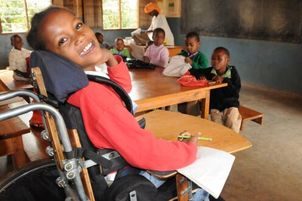
On 24 September 2020, the ICJ held a webinar in collaboration with the Lesotho National Federation of Organisations of the Disabled on the right to education for children with disabilities.
Presenters and participants included representatives from civil society organizations, teachers’ unions, teachers and the Lesotho Department of Education.
“Children with disabilities have a right to access to education on an equal basis with all other children. The COVID-19 pandemic must not hamper the Lesotho governments efforts to ensure access to inclusive education for all children,” said Kaajal Ramjathan-Keogh, ICJ’s Africa Director.
Participants highlighted accessibility-related problems faced by learners with disabilities in the context of the COVID-19 pandemic. Some examples include:
- Ordinary masks necessary to combat the spread of COVID-19 inhibit communication for learners with hearing disabilities who often communication in part by lip-reading. These require access to face visors and/or transparent masks. Some deaf students also had difficulty in understanding the COVID-19 pandemic and virus, despite efforts to explain it to them.
- Blind learners need more access to hand sanitizer as they need to touch their surroundings for mobility. This also makes social distancing more difficult for them.
- Teachers have trouble understanding how to comply with social distancing measures while assisting learners experiencing epileptic seizures.
- Many learners with disabilities have stayed at home during the pandemic, not understanding why they were not at school.
- Many children with disabilities are rendered more vulnerable to sexual violence and exploitation as they observe stay at home rules.
A representative of the Department of Education explained various measures which government had put in place to ensure that these obstacles could be overcome so that learners with disabilities could enjoy their right to education in the context of COVID-19. Learners’ health and safety would also remain a priority.
The Department noted the delays in the implementation of its inclusive education policy as a result of a lack of funding as government resources are diverted to COVID-19 responses.
The need for compliance with Lesotho’s global and regional international human rights obligations was also highlighted with participants agreeing about the importance of ensuring that there is “strength in numbers” in advocacy efforts toward the realization of children with disabilities’ right to education.
“Ensuring the right to education of persons with disabilities does not imply sacrificing and compromising their right to health. All human rights are interdependent and Lesotho should be guided by all of its human rights obligations as it continues to implement its domestic inclusive education policy during the COVID-19 pandemic,” Ramjathan-Keogh added.
Background
Article 24 of the Convention on the Rights of Persons with Disabilities (CRPD) and the Protocol to the African Charter on Human and Peoples’ Rights on the Rights of Persons with Disabilities in Africa require States parties to ensure that their education systems are inclusive and fully realize the right to education of all children with disabilities. The normative content of Article 24 of the CRPD and corresponding obligations of member States are expanded on in the General Comment No 4 of the Committee on the Rights of Persons With Disabilities.
For more information on the impact of COVID-19 on access to education, find the UN Special Rapporteur on the right to education’s report here.
Contact
Nokukhanya (Khanyo) Farisè, Legal Adviser (Africa Regional Programme), e: nokukhanya.farise(a)icj.org
Tanveer Jeewa, Communications Officer (Africa Regional Programme), e: tanveer.jeewa(a)icj.org
Aug 28, 2020 | News
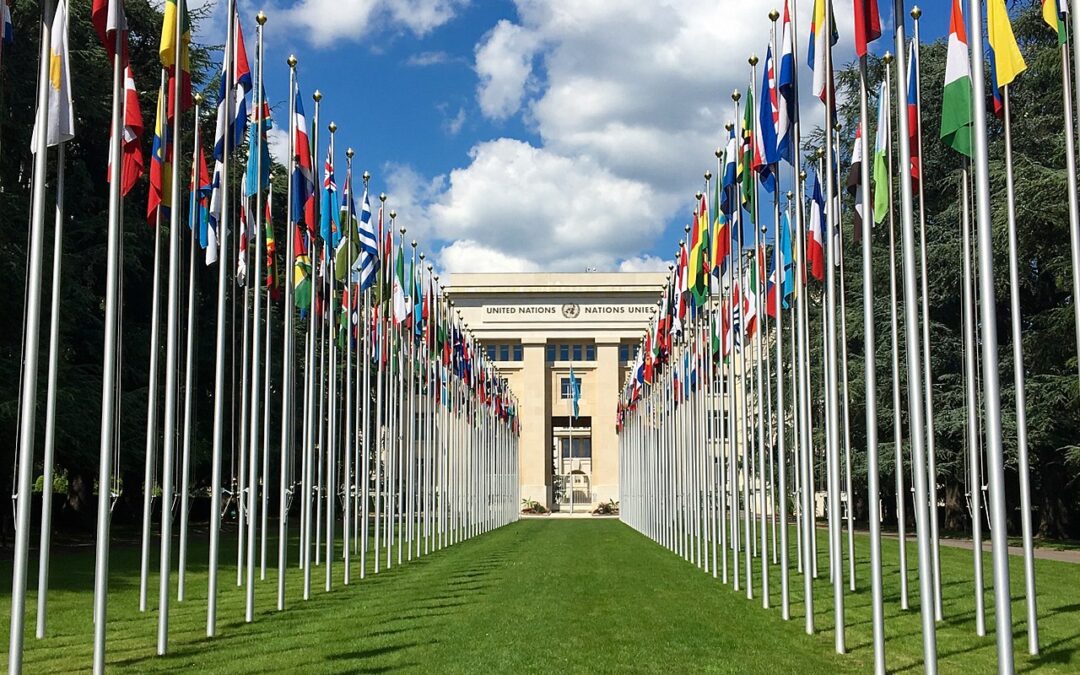
The ICJ contributed to and has endorsed a groundbreaking new UN standard aimed at ensuring effective access to justice for persons with disabilities, published today in Geneva.
Published today by the Office of the UN High Commissioner for Human Rights, the International Principles and Guidelines on Access to Justice for Persons with Disabilities were adopted jointly by the UN Special Rapporteur on the rights of persons with disabilities, the Committee on the Rights of Persons with Disabilities, and the Special Envoy of the UN Secretary-General on Disability and Accessibility. They have been endorsed by the ICJ and the International Disability Alliance.
The ICJ contributed to the development of the Principles and Guidelines, including through participation in expert consultations alongside disability rights experts, organizations of people with disabilities, State representatives, academics, and other judicial and legal practitioners. The ICJ also plans to assist with promotion and implementation of the Principles and Guidelines at the global and national levels.
Building on the provisions and interpretations of the Convention on the Rights of Persons with Disabilities and other international standards and best practices, the document affirms ten key principles of access to justice for people with disabilities and sets out detailed guidelines on how to implement each one.
The Principles and Guidelines are intended to be a practical tool to help inform the design and implementation of justice systems that provide equal access to justice for persons with disabilities, in line with international human rights standards.
The Principles and Guidelines can be downloaded by clicking here.
Further information about the process of their development is available here, and the UN press release announcing their publication is here.
Oct 3, 2019 | News
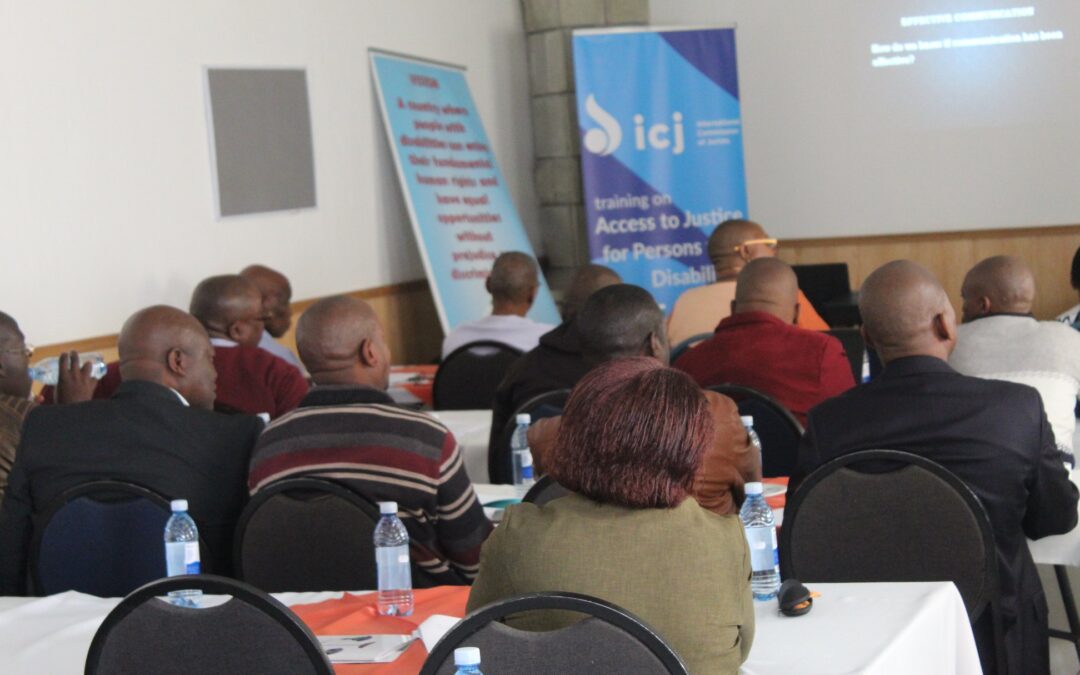
From 1 to 3 October, the ICJ and the Lesotho National Federation of Organizations of the Disabled (Lnfod), an umbrella body of organizations for persons with disabilities, held a judicial training in Lesotho on the rights and access just to persons with disabilities.
The workshop was attended by judges, magistrates, disability law and policy experts, Lnfod and ICJ legal advisers and ICJ Commissioner Justice Charles Mkandawire.
At the workshop, the ICJ Legal Adviser Associate Nokhukanya Farise discussed on the UN international legal framework on access to justice for persons with disabilities at both the universal and regional levels. In this regard, the ICJ highlighted provisions related to access to justice of the International Convention on the Rights of Persons with Disabilities (CRPD), as well as the Protocol to the African Charter on Human and Peoples’ Rights on the Rights of Persons with Disabilities in Africa.
These instruments provide for a substantive right to access to justice for persons with disabilities under article 13.
In addition, they expand on the rights to non-discrimination and equality of persons with disabilities, as well as their right to equality and access to the physical environment, facilities, services and infrastructure required under article 9 of the CRPD.
Justice Charles Mkandawire of the High Court of Malawi and ICJ Commissioner, who attended the workshop and facilitated a session on the role of the judiciary, said: “The judiciary should be functional independently of the executive and legislature, and the relationship between all three should be characterised by mutual respect. The judiciary should also be impartial and independent to prevent the abuse of power.”
Lnfod has been actively working to secure access to justice for persons with disabilities in the criminal justice system of Lesotho. In the workshop, independent law and policy expert Dianah Msipa discussed the case of Koali Moshoeshoe and Others v DPP and Others, where Lnfod successfully challenged the constitutionality of Section 219 of the Criminal Procedure & Evidence Act No.9 of 1981 in the High Court (Constitutional Division).
That provides that persons with intellectual/psychosocial disabilities are not competent witnesses, denying them equal access to justice.
Lnfod explained the Court’s ruling that the legal barrier violated the right to equality before the law and was discriminatory on the basis of disability. It also disproportionately affected women and girls with intellectual and psychosocial disabilities as this rendered them vulnerable sexual abuse.
Lnfod indicated it hoped that the Koali Moshoeshoe case would act as a reformative judicial precedent which will be disseminated and implemented by the courts of law across the country.
“The shift towards the realization of the right to legal capacity for persons with intellectual/psychosocial presents a remarkable opportunity towards overall enjoyment of all the rights provided for in the United Nations Convention on the Rights of Persons with Disabilities on an equal basis with others,” Lnfod said in a statement delivered before the workshop.
At the workshop, independent disability law and policy expert Dianah Msipa explored the issues of understanding disability, the rights of access to justice for persons with disabilities, barriers to effective participation in the criminal justice system, and the use of accommodations in access to justice.
“The training was well-received by all the delegates and I am encouraged by the word of the delegates who stated that they would start providing accommodations to persons with disabilities,” Dianah Msipa said.
Contact:
Khanyo Farise, e: Nokukhanya.Farise@icj.org
Mar 12, 2019 | Multimedia items, News, Video clips
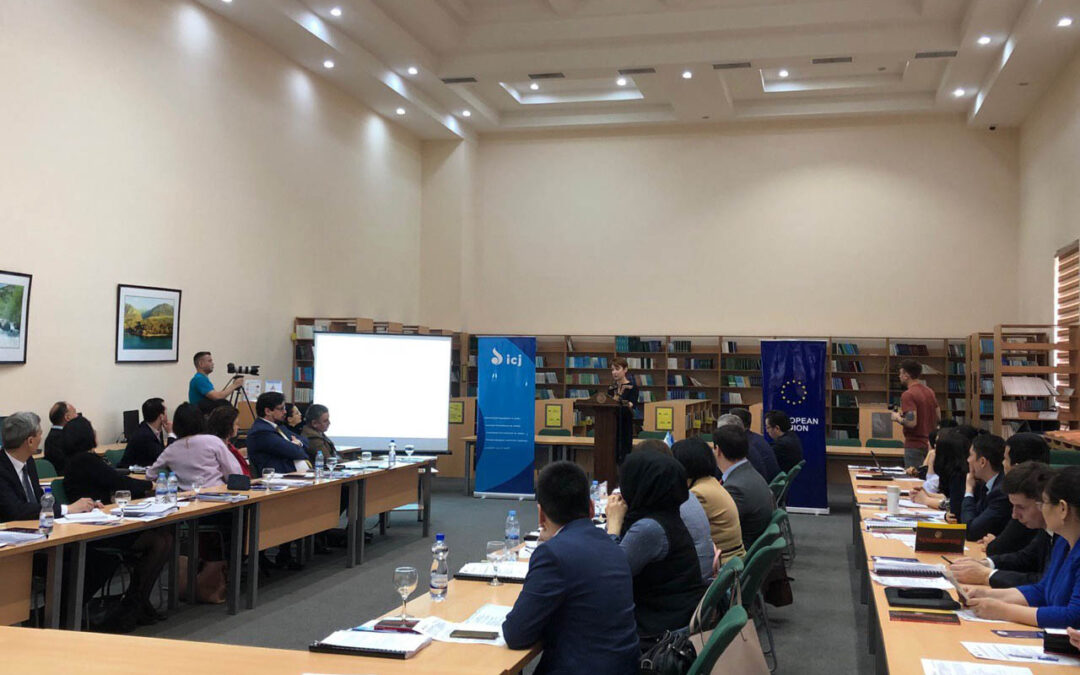
Today, the ICJ and the Tashkent State University of Law (TSUL) in partnership with the UN Human Rights Office in Central Asia are organizing this event. The topic of the Third Expert Discussion is rights of persons with disabilities.
The Expert Discussions are part of “Access to Justice in Economic, Social and Cultural Rights Project (ACCESS)” supported by the European Union.
The Expert Discussions are aimed at increasing awareness about the implementation of international law and standards on ESC rights by national courts, to facilitate access to justice in relation to ESC rights and effective use of international human rights law for ESC rights at the national level.
Each Expert Discussion is supported by presentations of international and national experts.
The first experts’ meeting was held in September 2018 on international standards in labour rights, and the second meeting – held in December 2018 – on the principle of non-discrimination in courts and court decisions.
The two events brought together lawyers, defense lawyers, individual experts, academia representatives and law students via interactive discussions, research papers, peer review articles and policy papers. Selected papers will be published in collection of scientific articles by the end of 2019.
Mansurkhon Kamalov, the Deputy Rector of TSUL, said: “We have already held two expert discussions on the right to work and the principle of non-discrimination in courts together with the ICJ with the support of the European Union. Each event touched upon international and national standards and legal regulation of specific ESC rights. Our meeting today is organized on the eve of celebrating the day when independent Uzbekistan became a full member of the UN; and it raises a very relevant topic not only for the country, but also for the international community as a whole. The TSUL is pleased to cooperate with the ICJ, which helps increase public awareness about international legal norms and standards in the field of ESC rights and practice of their implementation at the national and international level; access to justice with regard to ESC rights, as well as the effective use of international human rights law to protect these rights at the national level.”
Ryszard Komenda, Head of the UN Human Rights Office in Central Asia, said: “Today, about 10 per cents of the population are persons with disabilities. Persons with disabilities are the largest minority in the world. This figure is constantly increasing as a result of demographic growth, progress in healthcare systems, and the overall population aging patterns, according to WHO’s world data. In the framework of the Universal periodic review (UPR) of Uzbekistan, that was held for the third time in May 2018, a number of the UN Human Rights Council members called on Uzbekistan to ratify the Convention on the Rights of Persons with Disabilities and welcomed measures that have been already in the process of implementation with the aim to ensure the rights of persons with disabilities in the country. According to the UPR outcome document, the Republic of Uzbekistan accepted relevant recommendations and declared its intention to ratify the Convention. Ratification of the Convention on the Rights of Persons with Disabilities will be a significant step in further promoting and ensuring implementation of international human rights standards in the Republic of Uzbekistan.”
Dmitriy Nurumov, ICJ Legal Consultant, said: “Access to justice, which includes a fair trial and equality before the law, is of particular importance for people living with a disability, who often face inter-sectional and multiple barriers to access justice. The ICJ believes that inclusive societies in which all individuals have equal access to justice, require identifying and overcoming systemic and practical barriers that hamper equal access to justice, including in enjoyment of ESC rights. The ICJ hopes that today’s discussion will map out such existing barriers and the ways they can be overcome.”
Contact:
Dilfuza Kurolova, ICJ Legal consultant, t: +998 90 9050099 ; e: dilfuza.kurolova(a)icj.org
Watch the video here: