Sep 1, 2015 | News
Nepal’s Constituent Assembly must ensure that the new Constitution Bill contains strong and effective protections for all human rights in accordance with Nepal’s international legal obligations, said the ICJ today.
The Constituent Assembly endorsed a Constitutional Bill last week.
As per the CA Rules of Procedure, CA members have until 5 September to submit proposals for amendments.
“This draft includes some improvements from earlier versions, but it needs serious revisions to meet international standards regarding human rights protections,” said Nikhil Narayan, ICJ Senior Legal Adviser for South Asia.
“As an immediate matter, the Constituent Assembly must extend the 5 September deadline, and provide adequate time for public consultation and discussion of this essential legal text,” he added.
The ICJ released a detailed briefing paper in July 2015 analyzing provisions of the Draft Constitution on citizenship, fundamental rights and judicial independence, in light of Nepal’s international human rights obligations.
The ICJ also highlighted the non-inclusive and non-representative nature of the constitution-making process.
Many of those concerns still remain and must be addressed urgently, including:
- Non-citizens are excluded from key rights and protections. For example, Articles 18 (right to equality), 25 (right to property), 27 (right to information), 31 (right to education), 33 (right to employment), 35 (right to health), 36 (right to food), 37 (right to housing), and 43 (right to social security) are all restricted to citizens. These protections must be extended to all persons under Nepal’s jurisdiction, not only citizens, in accordance with Nepal’s international obligations;
- The right to gender equality under women’s rights (particularly in article 38) is not adequately protected. For example, the Constitution should include explicit guarantees for equal pay for work of equal value, and prohibit multiple, intersecting grounds of discrimination on basis of gender and sexual orientation, caste, religion, etc;
- Key economic, social and cultural rights – including in articles 33 and 34 (employment and labour), 35 (health), 37 (housing), and 43 (social security) – are not adequately protected;
- Restrictions and limitations on the rights to freedom of expression, association, assembly, movement, information and press freedom, are broad and vague and do not conform with international human rights standards (including articles 17 and 19 and 27);
- Provisions on remedy for human rights violations (articles 46 and 47) are inadequate;
- Provisions regarding the impeachment of judges (articles 101, 130 and 131) and composition of the Judicial Council (as in article 153, responsible for the appointment, disciplining and dismissal of judges) fail to safeguard judicial independence;
- Provisions on emergencies and consequent restriction of rights are overbroad (as in article 268(10)).
The ICJ noted some improvements in the current draft, such as:
- Making any person whose father or mother is a Nepali citizen eligible for citizenship through descent. Previous drafts required both parents to be Nepali citizens;
- Guaranteeing a broader range of women’s rights, including the right to reproductive health;
- Revising the understanding of victim’s rights to ensure that victims of crime are entitled to “justice including compensation and restitution”;
- Adding more rights to the list of those designated as non-derogable rights during emergencies – including the right to social justice (as contained in article 42 of the Constitution Bill, which amongst other things, guarantees the rights of marginalized groups to participate “in the state structure and public service on the basis of principle of proportional inclusion”), and the rights of dalits (as contained in article 40 of the Constitution Bill, which contains guarantees of equality and non-discrimination).
“While these amendments are welcome, more revisions are necessary,” said Narayan. “The CA must ensure that the constitution-making process is participatory and inclusive. It should provide enough time and opportunities to make necessary amendments and produce a Constitution that fully ensures human rights protections and judicial independence.”
Nepal’s major political parties have stated publicly that they hope to have the Constitution finalized and enacted in mid-September.
However, many political parities and communities have been protesting against the Constitution since the introduction of the new Bill.
On 9 August, three protestors were killed when police fired at protestors violating curfew in Birendranagar, Surkhet.
One protestor was killed and five others were injured when police opened fire during a strike on 18 August.
On 24 August, eight police officers were killed during protests in Kailali district, and over 40 members of the security forces were badly injured.
“The deadly violence that has accompanied escalating protests across Nepal against this Draft is a warning about the high stakes for the drafters of the Constitution,” said Narayan. “The new Constitution should be the platform for bringing the country together after years of conflict, not serve as a new cause for discontent and insecurity.”
The ICJ called on the government of Nepal to conduct prompt, impartial and thorough investigations into all protest-related deaths and injuries.
Where unlawful conduct is established, including by members of the security forces, those responsible must be brought to justice.
Contact:
Nikhil Narayan, Nepal Head of Office and ICJ Senior Legal Adviser, t: +977 9813187821, e: nikhil.narayan(a)icj.org
Jul 14, 2015 | Advocacy, Non-legal submissions
Today, the ICJ delivered an oral statement before the Human Rights Committee during a half a day of general discussion in view of the Committee’s ongoing elaboration of a new General Comment on Article 6 (Right to Life) of the International Covenant on Civil and Political Rights.
The ICJ’s oral statement focussed on the following:
- the principles of equality before the law, equal protection of the law and non-discrimination, as well as non-refoulment;
- State Parties’ duty to protect the right to life in respect of conduct of private actors;
- State Parties’ duty to take measures to protect and ensure the right to life in connection with acts of gender-based violence against women and violence against individuals based on their real or imputed sexual orientation and/or gender identity or expression;
- the relationship between the right to life and certain economic, social and cultural rights;
- the extraterritorial reach of the Covenant; and
- the application of Article 6 during situations of armed conflict.
Universal-ICJ oral statement HALF DAY GENERAL DISCUSSION ON GC-Advocacy-2015-ENG (full text in PDF)
Mar 3, 2015 | News
Myanmar’s parliament must reject or extensively revise a series of proposed laws that would entrench already widespread discrimination and risk fuelling further violence against religious minorities, Amnesty International and the ICJ said today.
A package of four laws described as aimed to “protect race and religion” – currently being debated in parliament – include provisions that are deeply discriminatory on religious and gender grounds.
They would force people to seek government approval to convert to a different religion or adopt a new religion and impose a series of discriminatory obligations on non-Buddhist men who marry Buddhist women.
“Myanmar’s parliament must reject these grossly discriminatory laws which should never have been tabled in the first place. They play into harmful stereotypes about women and minorities, in particular Muslims, which are often propagated by extremist nationalist groups,” said Richard Bennett, Amnesty International’s Asia-Pacific Director.
“If these drafts become law, they would not only give the state free rein to further discriminate against women and minorities, but could also ignite further ethnic violence,” he added.
The draft laws have been tabled at a time of a disturbing rise in ethnic and religious tensions, as well as ongoing systematic discrimination against women, in Myanmar.
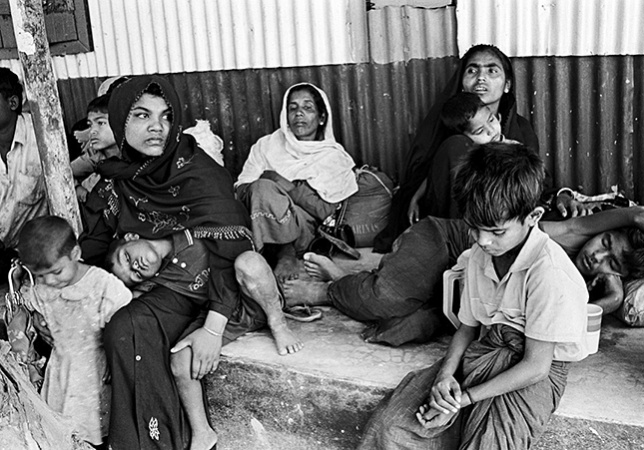
In this context, where minority groups – and in particular the Rohingya (photo) – face severe discrimination in law, policy and practice, the draft laws could be interpreted to target women and specific communities identified on a discriminatory basis.
“The passage of these laws would not only jeopardize the ability of ethnic and religious minorities in Myanmar to exercise their rights, it could be interpreted as signalling government acquiescence, or even assent, to discriminatory actions,” said Sam Zarifi, ICJ’s Asia Director. “The introduction of these discriminatory bills is distracting from the many serious political and economic issues facing Myanmar today.”
Of the four draft laws, two – the Religious Conversion Bill and the Buddhist Women’s Special Marriage Bill – are inherently flawed and should be rejected completely.
The remaining two – the Monogamy Bill and the Population Control Healthcare Bill – need serious revision and the inclusion of adequate safeguards against all forms of discrimination before being considered, let alone adopted.
These bills do not accord with international human rights law and standards, including Myanmar’s legal obligations as a state party to the UN Convention on the Elimination of all Forms of Discrimination against Women and the UN Convention on the Rights of the Child.
Amnesty International and the ICJ have conducted a legal analysis of the four laws and have found that:
- The Religious Conversion Bill stipulates that anyone who wants to convert to a different faith will have to apply through a state-governed body, in clear violation of the right to choose one’s own religion. It would establish local “Registration Boards”, made up of government officials and community members who would “approve” applications for conversion. It is unclear whether and how the bill applies to non-citizens, in particular the Rohingya minority, who are denied citizenship in Myanmar. Given the alarming rise of religious tensions in Myanmar, authorities could abuse this law and further harass minorities
- The Buddhist Women’s Special Marriage Bill explicitly and exclusively targets and regulates the marriage of Buddhist women with men from another religion. It blatantly discriminates on both religious and gender grounds, and feeds into widespread stereotypes that Buddhist women are “vulnerable” and that their non-Buddhist husbands will seek to forcibly convert them. The bill discriminates against Buddhist women as well as against non-Buddhist men who face significantly more burdens than Buddhist men should they marry a Buddhist woman.
- The Population Control Healthcare Bill – ostensibly aimed at improving living standards among poor communities – lacks human rights safeguards. The bill establishes a 36-month “birth spacing” interval for women between child births, though it is unclear whether or how women who violate the law would be punished. The lack of essential safeguards to protect women who have children more frequently potentially creates an environment that could lead to forced reproductive control methods, such as coerced contraception, forced sterilization or abortion.
- The Monogamy Bill introduces new provisions that could constitute arbitrary interference with one’s privacy and family – including by criminalizing extra-marital relations – instead of clarifying or consolidating existing marriage and family laws.
Contact
In Bangkok – Sam Zarifi, ICJ Regional Director for Asia and the Pacific, sam.zarifi(a)icj.org; m +66807819002
In London – Olof Blomqvist, Amnesty International Asia-Pacific Press Officer, olof.blomqvist(a)amnesty.org; t: +44 20 7413 5871, m +44 790 4397 956
An extensive legal analysis of the laws by Amnesty International and the ICJ can be found here:
Myanmar-Reject discriminatory race and religion draft laws-Advocacy-2015-ENG (full text in PDF)

May 20, 2014 | News
Thai authorities should revoke the declaration of Martial Law throughout the country and restore media freedom, the International Commission of Jurists said today.

Mar 20, 2014 | News
Thailand’s caretaker government must remove emergency measures throughout the country following the lifting of the Emergency Decree in the capital Bangkok and its surrounding provinces this week, the ICJ said today.
On 18 March, the caretaker government voted to lift the Emergency Decree (effective 19 March) that had been in place in Bangkok and surrounding provinces since 21 January 2014 in response to protests led by the People’s Democratic Reform Committee (PDRC).
At least 20 people have died in protest-related violence and hundreds have been injured.
The Emergency Decree was replaced by the Internal Security Act (ISA), which also does not fully comply with international standards, but provides better remedies for victims of human rights violations than the Decree.
“The imposition of the Emergency Decree creates an environment conducive to abuse of power and human rights violations such as arbitrary arrest and detention, torture and enforced disappearance,” said Sam Zarifi, ICJ’s Regional Director for Asia and the Pacific. “Lifting the Emergency Decree in Bangkok is a positive step, but it is crucial that the authorities remove the Emergency Decree and other measures of emergency rule, including martial law, that are in force in all or parts of at least 30 of Thailand’s 77 provinces.”
These measures should be replaced by law and action that are consistent with international human rights standards, Zarifi said, adding that martial law should not be used as a political tool.
The caretaker government must respond to demonstrations, unrest and emergencies in a manner which complies with its obligations under the International Covenant on Civil and Political Rights (ICCPR), and other international standards, including the Code of Conduct for Law Enforcement Officials, adopted by the UN General Assembly in 1979, and the Basic Principles on the Use of Force and Firearms by Law Enforcement Officials, adopted by the UN Congress on the Prevention of Crime and Treatment of Offenders in 1990.
These standards set out the circumstances in which resort to necessary and proportional force may be lawfully exercised. Article 8 of the Basic Principles on the Use of Force and Firearms states that “exceptional circumstances such as internal political instability or any other public emergency may not be invoked to justify any departure from these basic principles.”
In order to safeguard the rule of law and enhance the protection of human rights in Thailand, the ICJ calls on the caretaker government to repeal the Emergency Decree and other emergency measures including martial law, and to ensure accountability for violent acts through the thorough and effective investigation of criminal acts and prosecution of those reasonably suspected of committing them, in the course of fair, human rights-compliant criminal proceedings.
CONTACT: Sam Zarifi, ICJ Asia-Pacific Regional Director, (Bangkok), t:+66 807819002, e-mail: sam.zarifi(a)icj.org
Craig Knowles, ICJ Media & Communications, (Bangkok), t:+66 819077653, e-mail: craig.knowles(a)icj.org
For further reading on ICJ’s work on emergency laws in Thailand see: Thailand’s Internal Security Act, Risking the Rule of Law? (2010) https://www.icj.org/thailands-internal-security-act-risking-the-rule-of-law/ Implementation of Thailand’s Emergency Decree (2007) https://www.icj.org/thailand-implementation-of-thailand%C2%B4s-emergency-decree/ More Power, Less Accountability: Thailand’s New Emergency Decree (2005) https://www.icj.org/more-power-less-accountability/