Jun 24, 2019 | Advocacy, Non-legal submissions
At the UN, the ICJ today highlighted the rights and duties of judges and prosecutors to exercise their freedoms of expression, assembly and association to defend the rule of law and human rights.
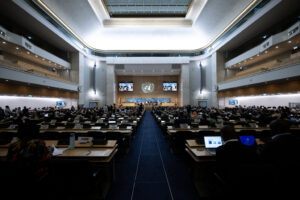
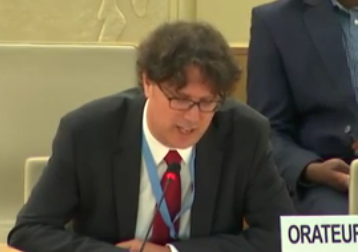
The oral statement was delivered in a Clustered Interactive Dialogue with the Independent Expert on Sexual Orientation and Gender Identity and the Special Rapporteur on the Independence of Judges and Lawyers, at the UN Human Rights Council in Geneva.
It read as follows:
“The International Commission of Jurists (ICJ) welcomes the report of the Special Rapporteur on the Independence of Judges and Lawyers on freedom of expression, association and peaceful assembly of judges and prosecutors.[1]
As the report acknowledges, exercise of these rights can be subject to restrictions arising from the fundamental need for judges and prosecutors to be perceived as independent and impartial. At the same time, as the report also emphasizes, any such restrictions must be provided by law and be demonstrably necessary to such legitimate aims, which in turn crucially requires proportionality.[2] These standards have been recognized both globally and in all regions of the world.[3] Any such restrictions on judges should be adopted and enforced by the judiciary itself.
We particularly welcome the recognition in the report that in situations where democracy and the rule of law are under threat, judges and prosecutors have not only the right, but potentially a duty, to speak out and organize in defence of democracy, the rule of law, and human rights, and that this can include participating in peaceful public demonstrations.[4]
Far too often in the ICJ’s work around the world, we see Executive and Legislative bodies, as well as compromised judicial hierarchies, arbitrarily or selectively targeting judges and prosecutors for removal, demotion or other disciplinary measures, precisely for exercising these rights to defend against threats to the rule of law. Examples highlighted in our submission to your study included Egypt, Morocco, Honduras, Hungary and Bulgaria.[5]
Mr. Rapporteur, how can judiciaries, governments, and civil society organisations (including international or regional legal professional associations) act internationally to support judges and prosecutors who are facing such abuse in another country?
The ICJ also welcomes the reports of the Independent Expert on protection against violence and discrimination based on sexual orientation and gender identity. We urge all States to strongly support the renewal of this essential mandate at the current session.
Thank you.”
[1] ICJ’s detailed submission to the Special Rapporteur’s consultation is available at: https://www.icj.org/judgesexpression2019/
[2] Paragraphs 39, 45, 46, 89.
[3] In addition to the global and European, Asian, and American standards cited in the report, see the African Commission on Human and Peoples’ Rights, Principles and Guidelines on the Right to a Fair Trial and Legal Assistance in Africa (2005), paras A(4)(s) and (t), and F(d) and (e).
[4] Paragraphs 61, 69, 90, 102.
[5] See for further information: https://www.icj.org/judgesexpression2019/

Jun 25, 2018 | Advocacy, Non-legal submissions
The ICJ today spoke at the UN on the role of judicial councils, judicial independence in Turkey and Poland, and on business and human rights in Peru.
The statement was made at the UN Human Rights Council during the interactive dialogue with the Special Rapporteur on Independence of Judges and Lawyers and the Working Group on Business and Human Rights.
The statement on judicial councils and independence was made jointly with the Commonwealth Magistrates’ and Judges’ Association. The whole statement read as follows:
“Mr President,
The International Commission of Jurists (ICJ) and Commonwealth Magistrates’ and Judges’ Association (CMJA) welcome the report of the Special Rapporteur on the Independence of Judges and Lawyers (A/HRC/38/38) on the role of judicial councils and similar bodies.
Based on many decades of relevant experience around the world, we urge that:
All countries should consider establishing an independent judicial council. Reliance on constitutional customs, cultures, and traditions alone often proves insufficient if a crisis arises.
To guarantee independence, a majority of members should be judges elected by their peers. Any other members must also be independent. The Head of State, executive or legislative officials, or political candidates, should not be members. Proactive measures should address under-representation of women or persons from minority or marginalized groups.
Such bodies should be responsible for all decisions relating to the selection, appointment, promotion, transfer, discipline, suspension and removal of judges.
As an example of concern, in Turkey following constitutional reform in 2017 no member of the Council of Judges and Prosecutors is elected by their peers, contributing to a lack of institutional independence of the judiciary. We also share the concerns for lawyers in Turkey already expressed by The Law Society and other colleagues today.
On the report on the visit to Poland (A/HRC/38/38/Add.1), we concur that reforms in the name of efficiency and accountability have undermined the independence of the Constitutional Tribunal, the Supreme Court and the National Council of the Judiciary, and effectively placed the entire judiciary under “control of the executive and legislative branches” (para 74). Mr Special Rapporteur, how can other States assist in securing full implementation of your recommendations on Poland?
The findings of the Working Group on Business and Human Rights report on its mission to Peru (A/HRC/38/48/Add.2) are of great concern, that “large number of human rights defenders and local leaders” were reportedly killed, attacked or threatened for defending the environment and land rights, legitimate social protest is criminalized, and wide use of states of exception and the armed forces have lead to serious abuses. The ICJ urges Peru to implement the recommendations and asks the Working Group what it will do to follow up?
Thank you.”
Feb 14, 2018 | Advocacy, Non-legal submissions
The ICJ has set out key principles and sources on judicial councils and other national mechanisms for selecting, appointing, promoting, transferring, suspending or removing judges, in a submission to the UN Special Rapporteur on the independence of judges and lawyers.The submission was made in response to a call by the Special Rapporteur for input to a report he will present at the June 2018 session of the Human Rights Council.
The ICJ submission highlights that judicial councils are a proven means of safeguarding judicial independence and ensuring judicial accountability. It recommends that, even in countries where judicial independence and accountability have traditionally been secured by other means, consideration should be given to the establishment of a judicial council.
The submission stresses that judicial councils must be fully independent of the executive and legislative branches of government, and notes several key safeguards to help secure such independence.
The ICJ recommends that such judicial councils should in principle be responsible for all decisions relating to the selection, appointment, promotion, transfer, discipline, suspension and removal of judges.
The submission also highlights the need for diversity of membership of such councils to ensure its representativeness of the society the judiciary is to serve, that it reflects a cross-section of the judiciary as a whole, and that it has the experience and expertise needed to be effective.
The full submission can be downloaded in PDF format here: Global-UN-SRIJL-JudicialCouncils-2018
Most of the sources cited in the submission are available here.
Related and more detailed guidance is available in the ICJ’s 2016 Practitioners’ Guide no. 13 on Judicial Accountability, as well as the 2007 Practitioners’ Guide no. 1 on Independence and Accountability of Judges, Lawyers and Prosecutors.
More information about the Special Rapporteur is available here.
For more information about the ICJ and judicial councils and similar mechanisms, contact Matt Pollard (matt.pollard(at)icj.org)
Jun 22, 2017 | News
The ICJ welcomes the adoption today, by consensus, of two UN Human Rights Council resolutions on the independence of judges & lawyers.
The Human Rights Council adopted the biannual resolution on independence of judges and lawyers, including a number of new elements on the theme of independence of lawyers and the legal profession. In particular, the resolution highlights the ongoing threats against and interference with the independence of lawyers and the ability of lawyers to fulfil their professional functions, including in relation to human rights.
The resolution reaffirms and builds on the UN Basic Principles on the Role of Lawyers.
The Human Rights Council also unanimously renewed the mandate of the Special Rapporteur on Independence of Judges and Lawyers for a further period of three years.
The unofficial text of the two resolutions are available in PDF format below:
Official versions will eventually appear on the UN website, at this location.
Jun 12, 2017 | Advocacy, Non-legal submissions
Speaking at the UN Human Rights Council, the ICJ today highlighted judicial corruption and threats to judges and lawyers in Turkey and Azerbaijan, as well as regressive steps on violence against women in the United States of America and Russian Federation.
The statement, delivered during the interactive dialogue with the UN Special Rapporteur on Independence of Judges and Lawyers and the UN Special Rapporteur on Violence against Women, was as follows:
“The ICJ warmly welcomes the new Special Rapporteur on Independence of Judges and Lawyers. As he has highlighted, ensuring judges are accountable for corruption and human rights violations, while respecting judicial independence, should be a global priority. Our Practitioners’ Guide on Judicial Accountability, published last year, should be of particular use to the Rapporteur and other actors in this regard.
Several situations serve as stark examples of other issues raised in his report. In Turkey, recent constitutional amendments give the President and Parliament control over the judiciary’s governing body. This has undermined the judiciary’s independence, already threatened by the mass dismissal of judges and the state of emergency. Lawyers and legal scholars, among others, are routinely dismissed or threatened by the authorities.
In Azerbaijan, the Bar Association is not independent and does not protect its members against undue interference with the exercise of their professional duties. Rather, it often serves as a tool of retaliation against independent human rights lawyers, including through disbarment proceedings that contravene international standards.
We would ask the Special Rapporteur for his views on the role his mandate can play in these and similar situations.
The ICJ also welcomes the report of the Special Rapporteur on violence against women.
Despite increasing global acknowledgement of the grave and systemic nature of violence against women, some States continue to introduce regressive legislation undermining protections for women. For example, the Russian Federation’s decriminalization of certain forms of domestic violence, and attempts in some parts of the United States of America to restrict availability of sexual and reproductive healthcare, particularly impact on victims of sexual violence. The Philippines’ President’s public statements disregarding the gravity of sexual violence are another example. The ICJ would ask the Special Rapporteur what can be done to prevent such backsliding?”