Jul 9, 2018 | News
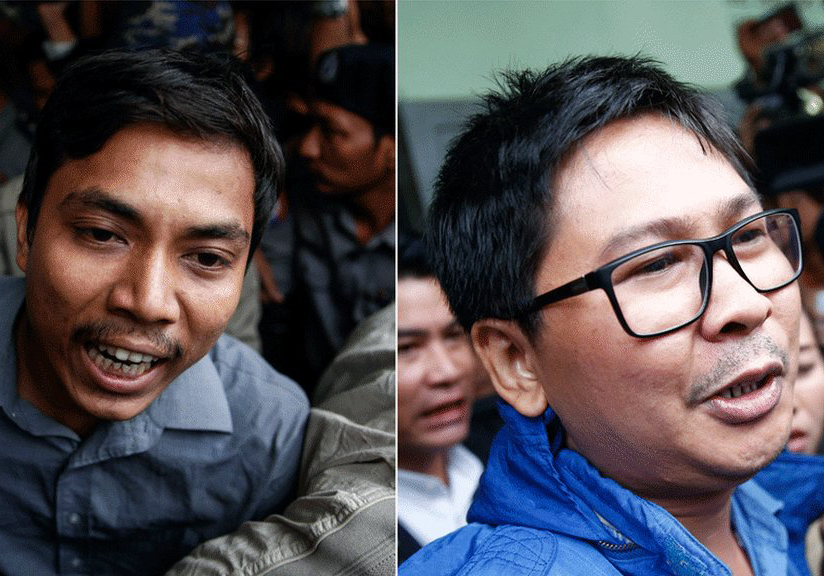
Today the ICJ called on Myanmar’s prosecutorial authorities to immediately end the prosecution of Reuters journalists Wa Lone and Kyaw Soe Oo.
The two have been subject to prosecution solely for doing their job as journalists and for exposing human rights violations in Rakhine State, including unlawful killings in Inn Dinn Village admitted to by the military.
In Yangon this morning a Northern District Court Judge accepted charges filed under the 1923 Official Secrets Act.
This decision permits ongoing prosecution of the journalists and extends their detention.
“The prosecution has failed to provide credible evidence of any wrongdoing throughout six months of hearings. It is therefore hard to imagine a valid legal rationale for allowing ongoing prosecution of the journalists,” said Mr Sean Bain, legal adviser for the ICJ in Yangon.
Section 253(1) of Myanmar’s Code of Criminal Procedure requires a judge to dismiss charges against accused persons if the evidence presented fails to warrant a conviction.
A motion for charges to be dismissed on this basis, submitted by defense lawyers, was effectively rejected by the decision today.
“Today’s decision raises real concerns about the independence and impartiality of the judiciary and prosecution when confronted with politically sensitive cases,” Bain said.
“The case significantly undermines the government’s stated commitments to reforming and building public confidence in judicial process,” he added.
ICJ legal advisers have monitored the case and were present in Court today. The journalists were first detained on 12 December 2017 and had no access to legal representation for almost two weeks.
“The case is also emblematic of the lack of adherence to fair trial rights in Myanmar,” Bain said.
“Their confinement remains unlawful given an initial period of incommunicado detention without access to lawyers, and other flagrant violations of the fair trial rights guaranteed in the Constitution, statues and international law.”
“Authorities should immediately end criminal proceedings against these men who appear to have been lawfully doing their job as investigative journalists,” he added.
The detention and prosecution of anyone, including journalists, based solely on the collection and publication of evidence relevant to serious human rights violations, is inconsistent with international law and standards on freedom of expression and on human rights defenders.
Article 14 of the 1990 UN Guidelines on the Role of Prosecutors states that prosecutors are obliged to discontinue prosecution when the investigation shows the charges to be unfounded.
Myanmar’s new Code of Ethics for Law Officers, launched in 2017, requires prosecutors to protect rights enshrined in the Constitution and to “provide a proper and fair administration of justice.”
The right to legal counsel is a bedrock rule of law principle that is set out in a range of international human rights laws and standards, including in article 11 of the Universal Declaration of Human Rights. Sections 19 and 375 of the Myanmar Constitution guarantee the right of legal defense, as does Myanmar’s Code of Criminal Procedure (section 340), Courts Manual (section 455(1)), the Police Manual (section 1198c) and the Prisons Act (section 40).
Fair trial rights, freedom of expression, and the right to liberty are also recognised by the Universal Declaration of Human Rights.
Also relevant are the UN Declaration on Human Rights Defenders, and the Global Principles on National Security and the Right to Information (The Tshwane Principles).
Contact:
Sean Bain, ICJ legal adviser, e: sean.bain(a)icj.org
Read also:
ICJ (May 2016), Handbook on Habeas Corpus in Myanmar – English and Burmese
ICJ (December 2017), Reuters Journalists in Myanmar: respect their rights, end their incommunicado detention – English and Burmese
Full text in Burmese (PDF): Myanmar-drop-charges-against-Reuters-journalists-News-Press-releases-2018-BUR
Jan 16, 2018 | News, Publications, Reports, Thematic reports
Myanmar’s government must take concrete action to counteract decades of military impunity for human rights violations, the ICJ concluded in a report published today.
The report Achieving Justice for Gross Human Rights Violations in Myanmar finds that gross human rights violations in Myanmar rarely go punished, particularly in conflict areas.
Justice remains elusive for victims and their families as a result of laws, institutions and investigative practices that protect members of security forces from prosecution, the ICJ says.
“Decades of denial of justice for victims of gross human rights violations in Myanmar, and impunity for the perpetrators, particularly when involving the military, have severely eroded the rule of law,” said Sam Zarifi, the ICJ’s Secretary General.
“The Myanmar government must now take concrete steps to combat impunity, especially for the military,” he added.
The release of the ICJ’s report follows last week’s statement from the Office of the Commander in Chief of the Tatmadaw, Myanmar’s military, acknowledging that security forces had participated in the killing of ten Rohingya Muslims in Rakhine State’s Inn Dinn Village.
It is the Tatmadaw’s first admission of serious crimes perpetrated by security forces during its ‘clearance operations’, which have resulted in mass displacement and human rights violations, following attacks on police posts by the Arakan Rohingya Salvation Army on 25 August 2017.
Military and security personnel in Myanmar seldom face justice for human rights violations, because they are protected by legal provisions of the 2008 Constitution, the 1959 Defence Services Act and the 1995 Police Force Maintenance of Discipline Law, which include immunities and special courts that shield soldiers, police and officials from public criminal prosecutions for serious crimes, the ICJ notes.
The ICJ’s report finds that investigations into allegations of rights violations rarely result in effective prosecutions or redress.
Eight case studies – from Kachin, Karen, Mon and Rakhine states – illustrate how victims and their families, as well as journalists and human rights defenders, lack access to justice and are even harassed for seeking it.
“Admission of culpability for this one incident is an important first step and must be followed by a full and proper investigation, and justice for the victims and their families,” said Zarifi.
“The dire human rights situation in northern Rakhine State, and in conflict areas such as in Shan and Kachin states, necessitates credible, independent and impartial investigations with a view to publicly prosecute those responsible for unlawful acts and their commissioning.”
“Options available to the parliament and to the executive include addressing barriers to accountability, by reforming laws that protect security forces involved in serious crimes, and by aligning investigative procedures with international standards,” he added.
Contact
Alex Conte, ICJ Global Accountability Coordinator (Geneva), t: +41 79 957 2733; e: alex.conte(a)icj.org
Frederick Rawski, ICJ Asia Pacific Regional Director (Bangkok), t: +66 6 4478 1121 ; e: frederick.rawski(a)icj.org
Background
Special inquiries commissioned by the Government of Myanmar into allegations of human rights violations generally fail the test of independence and impartiality, or are severely undermined by inadequate resources and or restricted mandates.
These inquiries rarely result in effective prosecutions or access to remedies and reparation.
Members of security forces, when prosecuted, usually appear in military or special police courts, which generally impose low or meaningless sanctions that are wholly inconsistent with penalties applicable in Myanmar’s Penal Code.
Laws governing military and police acts are inadequate for the victims of human rights violations because they do not contemplate the provision of remedies and reparation.
There is very limited precedent or established practice for the provision of effective remedies or reparation for victims of criminal acts in Myanmar, particularly when such crimes involve human rights violations by State actors.
Wittingly or unwittingly, relevant authorities routinely violate national laws that prescribe procedures for the conduct of criminal investigations and prosecutions, particularly in politically sensitive cases involving human rights violations.
Violations of basic fair trial rights, included in national laws, are commonplace.
State authorities continue to exert improper influence on politically-sensitive court cases including those involving allegations of gross human rights violations.
Courts tend to not intervene where human rights violations are occurring nor do they guarantee non-repetition where they have occurred.
Prosecutors rarely, if ever, accept petitions from victims of gross human rights violations to initiate criminal proceedings.
The judicial harassment of victims of human rights violations is commonplace in Myanmar when victims, their families or lawyers seek remedies or reparation through the courts or other mechanisms.
Defamation and unlawful association are among the criminal charges commonly instituted by authorities, including against journalists investigating human rights violations or working in conflict areas.
Overall, Myanmar’s prosecutors lack the independence to effectively prosecute acts involving human rights violations.
Interference with and intimidation of lawyers, particularly in politically sensitive cases involving human rights violations, undermines their to effectively represent clients and to pursue effective remedies and reparations.
Download
Myanmar-GRA Baseline Study-Publications-Reports-Thematic reports-2018-ENG (full report in English)
Myanmar-GRA-Baseline Study-Publications-Reports-Thematic-reports-2018-BUR (full report in Burmese)
Myanmar-Accountability Baseline report-News-Press releases-2018-BUR (Burmese translation)
Read also
Questions & Answers on Human Rights Law in Rakhine State
Reuters journalists detained in Myanmar: respect their rights, end their incommunicado detention

Dec 18, 2017 | News
The ICJ today called on Myanmar authorities to immediately disclose the whereabouts of two journalists who have been detained incommunicado for nearly one week, and to grant prompt access to lawyers and families.
Reuters reporters Wa Lone and Kyaw Soe Oo have not been heard from since they were arrested by police in Yangon on Tuesday 12 December.
“Fair trial rights violations seriously undermine the rule of law in Myanmar. All detainees must be allowed prompt access to a lawyer and to family members,” said Frederick Rawski, the ICJ’s Asia-Pacific Regional Director.
“Authorities are bound to respect these rights in line with Myanmar law and the State’s international law obligations,” he added.
The right to legal counsel is a bedrock rule of law principle that is set out in a range of international human rights laws and standards, including in article 11 of the Universal Declaration of Human Rights.
Sean Bain, Legal Adviser for the ICJ, said that jurists should assess if the journalists’ detention conforms to applicable laws.
“Their situation appears to constitute arbitrary detention,” he said. “The judiciary should immediately review the lawfulness of detention and demand their release if it is indeed unlawful.”
“Judges and lawyers in Myanmar have an opportunity to assert their independence by challenging the unlawful actions of officials. Such blatant violations of fair trial rights should not go unanswered,” he added.
State media reports the journalists were charged under the 1923 Official Secrets Act in connection with their work investigating actions of security forces in Rakhine State.
More than 650,000 people, mostly Rohingya Muslims, fled to Bangladesh as a result of military operations following attacks on police posts in August by the Arakan Rohingya Salvation Army.
Reuters has reported from both sides of the Myanmar-Bangladesh Border.
“The treatment of these reporters threatens freedom of expression. The harsh penalties they face sends a clear message to other journalists that they could face the same consequences for doing their job,” said Rawski.
In Myanmar, colonial-era laws were invoked to bring criminal charges against journalists in at least three jurisdictions in 2017.
Offences in these laws are often broadly defined, carry harsh penalties, and are open to abuse by authorities.
Journalists who received ten-year jail terms in 2014 under the Official Secrets Act were later released in a Presidential amnesty.
Amendments proposed at the time in parliament were rejected.
“The abuse of archaic laws like the Official Secrets Act must end. It is within the power of the National League for Democracy-dominated legislature to review these laws with a view to aligning them with the rights reflected in Myanmar’s constitution and in international law,” Rawski added.
Contact
Frederick Rawski, ICJ Asia Pacific Regional Director, t: +66 6 4478 1121 ; e: frederick.rawski(a)icj.org
Sean Bain, ICJ International Legal Adviser, e: sean.bain(a)icj.org
Background
The UN Basic Principles on the Role of Lawyers emphasize that, “Governments shall further ensure that all persons arrested or detained, with or without criminal charge, shall have prompt access to a lawyer, and in any case not later than 48 hours from the time of arrest or detention.”
Sections 19 and 375 of the Myanmar Constitution also guarantee the right of legal defense, as does Myanmar’s Code of Criminal Procedure (section 340), Courts Manual (section 455(1)), the Police Manual (section 1198c) and the Prisons Act (section 40).
Sections 21(c) and 376 of the Constitution and section 61 of the Code of Criminal Procedure state that persons cannot be detained for more than 24 hours without a judge’s order.
The right to legal defense implies the right to access legal counsel during this 24-hour period.
Under section 403 of the Courts Manual, a detainee can be remanded only once he or she has appeared before a judge. It is unknown if the two Reuters journalists have appeared in court.
Competent judges are empowered to compel a search for a detainee if they have reason to believe the person is confined unlawfully, as per section 100 of the Criminal Procedure Code.
Lawyers and family members may also request the courts to review the lawfulness of detention, by submitting a habeas corpus petition to the High Court and or to the Supreme Court.
The Tshwane Principles on National Security and the Right to Information, which address the right to access and to share information, as an aspect of freedom of expression in the context of national security, affirm that journalists “should not be prosecuted for receiving, possessing or disclosing classified information to the public, or for conspiracy or other crimes based on their seeking or accessing classified information.”
Read also
Handbook on Habeas Corpus in Myanmar
Right to Counsel: The Independence of Lawyers in Myanmar
Myanmar-Reuters Journos-News-Press releases-2017-BUR (Story in Burmese, PDF)

Jun 29, 2017 | Advocacy, News, Non-legal submissions
The ICJ, together with other 60 national and international human rights organizations urged today the Myanmar authorities, and in particular the Ministry of Transport and Communication and the Parliament, to ensure the repeal of the offence of criminal defamation.
Myanmar-JointStatement-CriminalDefamation-2017-ENG (joint statement in English)
Myanmar-JointStatement-CriminalDefamation-2017-BUR (joint statement in Burmese)
Jul 1, 2016 | Feature articles, News
A feature article by U Hayman Oo, ICJ Legal Researcher in Yangon, Myanmar.
In a recent meeting with Chinese ambassador to Myanmar and villagers, organized in Kyauk Phyu, a villager from Gone Shein Village asked the ambassador to help address the damages caused to their farmland by the Shwe Gas Pipeline Project that began five years ago.
She also expressed doubts that the Kyauk Phyu Special Economic Zone (Kyauk Phyu SEZ) would benefit villagers amid all the unresolved disputes.
Given such disputes, local people are not optimistic about the upcoming development of the Kyauk Phyu SEZ.
They perceive that the project will be a ‘loss’ rather than a ‘gain’ for them.
Most of the local population of farmers fear that the project will be a disaster to their livelihood along with massive land losses.
On a recent trip to Kyauk Phyu by the International Commission of Jurists (ICJ), community members, including local MPs and lawyers, reported their concerns that a second round of such abuses will be experienced, this time even worse, during development of the Special Economic Zone planned for the area, despite promises from the Government that the development will be environmentally sustainable and bring socio-economic benefits to the region.
In fact, Special Economic Zone can contribute to the country’s economy and help benefit the welfare of its people – but only if sound policies of sustainable development in compliance with human rights are in place.
Otherwise, massive economic projects of this kind risk large-scale adverse environmental, social and human rights impacts.
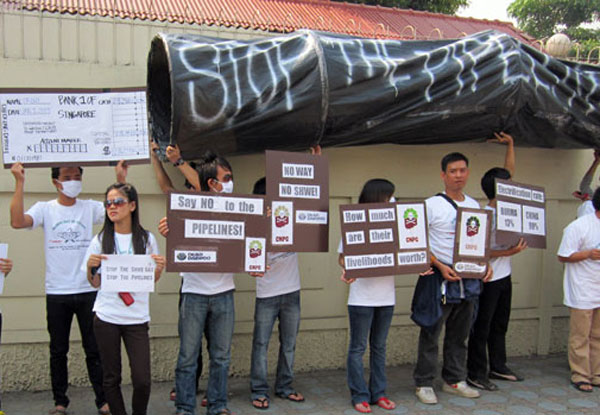
Kyauk Phyu residents know very well how foreign investments can be harmful for the community when investors fail to comply with local laws as well as international standards, because of their experience with the Shwe Gas Project, a Myanmar-China pipeline.
The Gas Pipeline project was notorious for reported labour abuses, and claims of inadequate compensation for land confiscation, arrest and detention of community leaders and loss of community livelihoods and environmental degradation.
Villagers still frequently take to the street demanding for the damages caused to their farmland to be addressed, in the absence of a proper grievance mechanism.
With these prevailing experiences in mind, local residents were alarmed when authorities reportedly measured about 250 acres for the SEZ around Kathapray, Krat Tein, and Thaing Chaung village tracts in Kyauk Phyu, raising more concerns of land acquisition and compensation.
Locals complain that there was no transparent discussion over compensation for this potential land acquisition.
Villagers from Pyai Sate Kay village reportedly lost about 40 acres of farmland to the construction of a reservoir.
Although, the compensation were made for 5.1 acre of farmland, the rest of grazing land was not compensated according to a report from a villager.
There were also complaints that the compensation was neither a current market price nor a sufficient amount of money for them to be able to buy a similar size of land for cultivation.
He also complained that the Government promised to provide replacement land, but that this has not yet happened.
A total of over 70 acres of land was also apparently acquired for another reservoir under construction near Thai Chaung village.
Compensation was only paid for the farmland acreas occupied for the construction excluding land affected by the access to the reservoir.
“We were compensated but the land we lost were not measured properly. The amount paid was only on the basis of approximation. The land we lost should have been measured carefully to pay for the compensation,” said Ko Tun Nu from Thaing Chaung village.
It is reported that these reservoirs were constructed with the purpose of water supply for the SEZ project.
Furthermore, villagers from Ohn Taw and Pyai Sate Kay also reportedly lost a total of 220 acres of land when it was allocated for construction of a police station between the villages.
Although generally the purpose of the security force stationed there is for the security of the township, local people suspect that this increased security presence is instead in preparation to meet the security demands for the planned SEZ project.
There has apparently been no discussion over compensation. It is also questionable whether this volume of land is necessary for the construction of a police station.
According to the Special Economic Zone Law 2014, the Ministry of Home Affairs is responsible for land acquisition in the area of a SEZ in accordance with existing laws and regulations.
It also imposes duties on the investors and developers to bear the expenses of compensation and relocation and to ensure that the standard of living of affected persons does not fall below their original living standard.
The new NLD-led Government has inherited ample land-related problems and has prioritized dealing with these issues.
On May 5th, the Government formed the ‘Central Committee for the Review of the Acquisition of Farmland and Other Land’ in order to combat nation-wide land disputes.
The Committee’s responsibilities include investigation of compliance with existing laws by relevant authorities.
The President has also instructed that all land acquisition cease until all existing land disputes are resolved.
In addressing those issues, it is important that international standards such as Basic Principles and Guidelines on Development Based Eviction and Displacement are integrated into national policies and regulations.
Only then will such projects ensure the protection of the rights and livelihood of communities and the promotion of responsible business in the country.
Myanmar-Kyauk Phyu SEZ-News-Op-eds-2016-BUR (Full text in Burmese, PDF)