Feb 6, 2014 | News
The ICJ calls on the Government of Malaysia to stop the execution of death row prisoner Chandran, apparently scheduled to take place on Friday 7 February.
Chandran was convicted for murder and sentenced to death on 16 April 2008.
While the Government of Malaysia has not publicly released the date, according to the Malaysian Bar Council, his execution is planned to take place on 7 February 2014.
Despite the prohibition of mandatory death sentences under international human rights law, the laws in Malaysia maintain the mandatory death sentence for offences such as murder, treason and drug trafficking.
The Malaysian Bar Council, a partner organization of the ICJ, has noted that there have been several instances in the past when the Government of Malaysia indicated that it would review the mandatory death penalty, with a view to its possible abolition or the possible reintroduction of a discretionary death penalty. It has also indicated its intention of reviewing the penalty of death for drug-related offenses.
“Considering prohibition of the mandatory death penalty in international human rights law and the past indications made by the Government of Malaysia that it intends to review the imposition of mandatory death penalty, it is deeply concerning that it still aims to proceed with the execution of Chandran on Friday,” said Sam Zarifi, ICJ Regional Director for Asia and the Pacific.
In October 2013, Malaysia underwent their second Universal Periodic Review where it was urged by several countries to review the mandatory nature of death penalty, maintain a moratorium, and ultimately move to abolish the death penalty.
Malaysia is set to respond to these recommendations in March 2014.
The Malaysian Bar Council estimates that there are approximately 900 prisoners in death row in Malaysia awaiting execution.
The ICJ considers that the use of the death penalty constitutes a violation of the right to life and the right not to be subjected to cruel, inhuman or degrading punishment.
In addition to calling a halt to the execution of Chandran, the ICJ urges the Government of Malaysia to amend its laws and take steps towards the abolition of the death penalty in the country, including the implementation of a moratorium.
Contact:
Emerlynne Gil, ICJ International Legal Adviser for Southeast Asia, t +66 2 619 8477; email: emerlynne.gil(a)icj.org
Craig Knowles, ICJ Media Consultant, t +66 81 9077653; email: craig.knowles(a)icj.org

Feb 4, 2014 | E-bulletin on counter-terrorism & human rights, News
Read the 79th issue of ICJ’s monthly newsletter on proposed and actual changes in counter-terrorism laws, policies and practices and their impact on human rights at the national, regional and international levels. The E-Bulletin on Counter-Terrorism and Human...
Jan 23, 2014 | News
The ICJ criticized the Phnom Penh Municipal Court’s decision to deny bail to 23 people who were arrested and detained earlier this month following protests by garment factory workers seeking a higher minimum wage.
The detainees’ lawyers told the ICJ that the court denied bail for the first nine detainees, arrested on 2 January 2014, in order to “guarantee their presence for further legal proceedings”, “to preserve public order” and “to prevent instability that results from the commission of crimes”.
The remaining 13 detainees, arrested on 3 January 2014, were denied bail in order to “end crime”, “prevent new crime” and “ensure detainees are available for trial”.
The decision to deny bail to the 22 detainees followed the Court’s decision on 13 January 2014 to deny bail to Vorn Pao, President of the Independent Democracy of Informal Economy Association (IDEA).
Considering his application separately from the others, the court, similarly, provided the same reasons as in the case of the first nine detainees.
“International law is clear that pre-trial detention could only be exercised in exceptional situations, and avoided if suitable alternatives are possible,” said Sam Zarifi, ICJ’s Regional Director for Asia and the Pacific. “The reasons presented by the Court don’t justify holding these activists in prison right now.”
All 23 of those whose bail applications have been denied have been charged with causing intentional violence and damage to property. Three face additional charges for violent resistance against a public official, as well as a traffic offence.
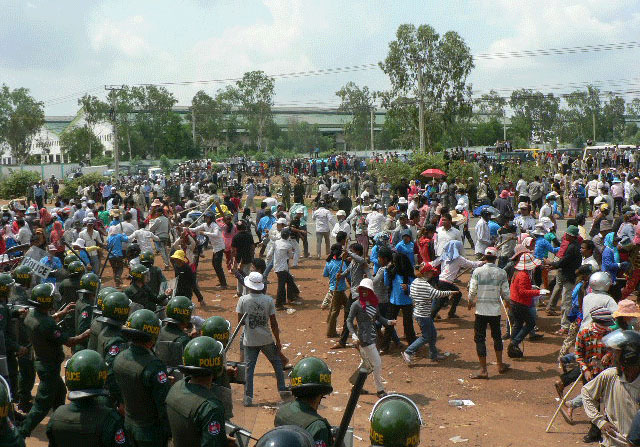
They were arrested as part of the government’s response to striking garment workers and demonstrators protesting the 28-year-rule of Prime Minister Hun Sen (photo).
Security forces shot and killed at least four protesters on 3 January. The government has banned further protests.
Article 9(3) of the International Covenant on Civil and Political Rights (ICCPR), to which Cambodia is a party, guarantees the right to liberty. It states, “It shall not be the general rule that persons awaiting trial shall be detained in custody, but release may be subject to guarantees to appear for trial”. Such guarantees include bail.
“There are alternatives to the detention, such as bail or other conditions the court could impose on these 23 detained activists if the Court is concerned, on the basis of substantiated and objective grounds that there is a risk that each of them will abscond before the trial or interfere with the investigation,” said Zarifi. “In the absence of such proof and the serious consideration of alternatives the continued pre-trial detention of each of the 23 individuals would amount to arbitrary detention under international human rights standards.”
Vorn Pao’s lawyers filed an appeal on 14 January 2014 and the Court is expected to issue a decision on his appeal by 3 February 2014.
According to the Cambodian Centre for Human Rights, Vorn Pao appears weak and continues to suffer pain from the head injuries he sustained.
Lawyers for the other 22 detainees have also expressed their intention to appeal the Court’s decision to deny them bail.
Contact:
Sam Zarifi, ICJ Asia-Pacific Regional Director, (Bangkok), t:+66 807819002, e-mail: sam.zarifi(a)icj.org
Craig Knowles, ICJ Media & Communications, (Bangkok), t:+66 819077653, e-mail: craig.knowles(a)icj.org

Jan 21, 2014 | Advocacy, Non-legal submissions, Position papers
The ICJ submitted today its contribution to the public consultation of the European Commission on the future of home affairs policies in the European Union.
In its contribution, the ICJ highlighted the need to increase human rights protection in EU home affairs legislation and in its implementation.
The ICJ submission recommends an increased monitoring of the human rights compliance of draft legislation; calls for increased transparency in the legislative process; and for a better use of infringement proceedings by the European Commission to ensure the effective implementation of EU home affairs legislation with particular attention to the protection of human rights.
The ICJ addressed, in its contribution, the importance of a correct and human rights compliant implementation of the new Common European Asylum System, and the need of further reforms in the EU legislation on asylum, migration and border control.
Finally, the ICJ stressed the poor record of the EU institutions, besides the European Parliament, in ensuring accountability for human rights violations committed in countering terrorism, for example in the cases of the National Security Agency (NSA) surveillance programme scandal and in the cases of alleged complicity of European States in the US-led system of renditions and secret detentions.
EU-PublicConsultation-ICJ-FutureHomeAffairs-2014-Final (download the contribution)

Jan 21, 2014 | News
The ICJ is deeply concerned by reports that the President of Nauru has prevented the island nation’s Chief Justice from returning to the country and expelled the sole Resident Magistrate in violation of international standards on the independence of the judiciary.
According to media reports, Nauru President Baron Waqa on January 19 removed Resident Magistrate Peter Law in violation of an injunction issued by Chief Justice Geoffrey Eames. Subsequently, Chief Justice Eames, who was in Australia at the time, had his visa cancelled. Both judicial officials are Australian citizens.
Australia administered Nauru as a dependent territory until 1968 and the two countries retain strong bilateral relations. Australian judges and magistrates often serve on Nauru Courts.
“Removing judges from office, without any process whatsoever, breaches clear international standards on the independence of the judiciary,” said Sam Zarifi, ICJ’s Regional Director for Asia and the Pacific. “It also jeopardizes the right of people in Nauru, especially those currently engaged in legal proceedings, to have a fair trial.”
Nauru is an island state in Micronesia in the South Pacific.
The ICJ’s Centre for the Independence of Judges and Lawyers (CIJL) is monitoring developments.
Contact:
Sam Zarifi, ICJ Asia-Pacific Regional Director, (Bangkok), t:+66 807819002, e-mail: sam.zarifi(a)icj.org
Craig Knowles, ICJ Media & Communications, (Bangkok), t:+66 819077653, e-mail: craig.knowles(a)icj.org