Dec 10, 2014 | News
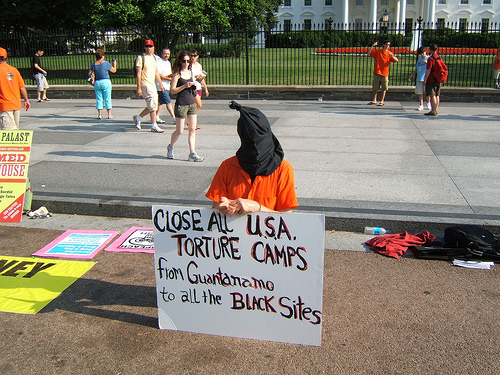
The ICJ repeated its call for the United States to take immediate measures to hold accountable officials for acts of torture, enforced disappearance and other gross human rights violations committed in the course the CIA’s rendition and secret detention programs between 2001 and 2006.
The call follows the release yesterday of a redacted summary of the United States Senate Intelligence Committee’s report on the programs, which highlights appalling abuses committed against at least 119 persons.
The ICJ has also called for the United States to provide access to effective remedies and reparation for the victims of the violations, some of whose identities or whereabouts remain unknown.
The report exposed numerous acts of torture and cruel, inhuman or degrading treatment, including, among others: forced rectal feeding; extreme sleep deprivation for up to a week; sensory disorientation; near drowning through “waterboarding”; confinement in boxes; dousing with cold water; prolonged subjection to painful stress positions; and threats of extreme violence against family members. Some detainees were held in secret detention for years, without any contact with the outside world.
“With the partial release of the Intelligence Committee’s report, the US has finally begun to take the first steps towards acknowledging the truth of the lawless and criminal conduct in which it engaged systematically over the course of years”, said Ian Seiderman, the ICJ’s Legal and Policy Director. “It is now time for the United States to fulfill its international legal obligations and hold the responsible officials criminally accountable and ensure full reparation for the victims.”
To date, no officials have been subject to prosecution for participation in the abuses and all attempts by victims to access justice through judicial and administrative channels have been thwarted by claims of state secrecy.
The report draws attention to the complicity of a number of other States in the rendition and secret detention programs, possibly up to 54 countries according to a study by the Open Society Foundation.
The European Court of Human Rights has already found the former Yugoslav Republic of Macedonia and Poland responsible for violations in this connection, with further cases pending against Lithuania and Romania.
The ICJ also called for the United States to release the entire Senate Committee report, said to number 6700 pages, with only those very minimal redactions of personal data strictly necessary to protect serious threats, such as to children and the privacy interests of victims and their families if they so request.
“Responsibility for these criminal abuses extends not only to the CIA agents who directly carried them out, but also to officials at the highest levels of the executive, who approved and facilitated the practices, and Justice Department lawyers who provided spurious legal cover for them,” said Ian Seiderman.
Torture and enforced disappearance are crimes under international law.
United States treaty obligations, including under the UN Convention against Torture and the International Covenant on Civil and Political Rights require the prosecution of officials responsible for such acts and provision of effective remedies and reparation the victims.
Dec 5, 2014 | Multimedia items, News, Video clips
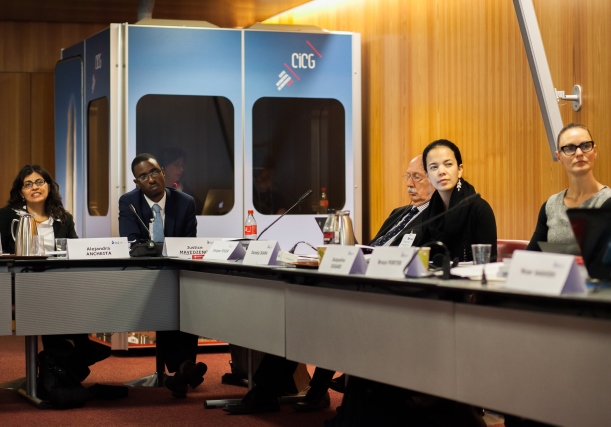
Jacqueline Dugard, Hina Jilani, Rodrigo Uprimny Yepes, Gilles Badet, Alejandra Ancheita and Harsh Mander talk about their experience and the situation of economic, social and cultural rights in their respective countries.
These prominent participants in ICJ’s Geneva Forum 2014 give their views on judicial protection of economic, social and cultural rights (ESCR) as well as on what needs to be changed to address obstacles to guarantee an effective remedy for victims of violations of their socio-economic rights.
They also tell about the main opportunities and key challenges for the realization of ESCR in their respective countries.
The 2014 Geneva Forum of Judges and Lawyers is a joint initiative of the ICJ Center for the Independence of Judges and Lawyers (CIJL) and the ICJ Programme on Economic, Social and Cultural Rights.
It has been made possible with the support of the République et Canton de Genève, the Permanent Mission of Germany to the United Nations in Geneva, and the Taipei Bar Association.
Dec 1, 2014 | News
The ICJ expresses deep concern that the Legislative Assembly of Bolivia continues to threaten three Constitutional Court judges with removal, and possibly criminal punishment, based solely on legislators’ disagreement with a legal opinion and ruling issued by the judges.
A “trial” of the three judges conducted by the Senate is scheduled to begin on 4 December 2014.
The ICJ has previously condemned the proceedings as fundamentally flawed and in violation of international standards for the independence of judges.
The legislature and government now appear to accept some of the ICJ’s criticisms.
Last-minute legislative amendments would apparently specify that the legislative assembly process is disciplinary in character and that the only sanction the assembly can directly impose is permanently to remove judges from office; if a disciplinary violation is found, the case would be referred onward for criminal prosecution before the ordinary courts. (Legislators were previously reported to be seeking for the Senate itself to impose a sentence of 10 years’ imprisonment.)
The ICJ reaffirms, however, that the case against these three judges remains inherently flawed because the allegations on which the proceedings are based cannot be a valid basis for any removal from office or criminal punishment.
“It is fundamental to the independence of the judiciary, and the rule of law, that judges must be able to decide cases without fear of punishment for their legal opinions and rulings, including those that the government or legislature may not like,” said Matt Pollard, Head of the Centre for Independence of Judges and Lawyers at the ICJ.
“The procedural amendments under consideration could be an improvement for other kinds of cases in the future,” said Pollard. “However, the stated reason for pursuing these three judges – disagreement with the content of their legal opinion and ruling – cannot form a valid basis for their removal from office or criminal punishment under any procedure.”
“The case against these three judges cannot be cured by legislative ‘quick fixes’ and must simply be dropped immediately,” Pollard added.
The ICJ is also concerned that the legislature has said it will press ahead immediately with the “trial” on 4 December, a few days from now, while fundamental changes to the procedure are still underway.
Further, the media has reported that Chamber of Deputies President Marcelo Elío has stated that the judges could avoid trial by “voluntarily” resigning before 4 December.
It would be unacceptable to use the threat of unjust or unclear procedures to pressure a judge to resign.
The ICJ welcomes the decision by the legislature to review and potentially reform judicial accountability procedures in Bolivia.
At the same time, reform of procedures that are of such fundamental importance to the rule of law and democracy should be based on a process of broader consultation with all concerned stakeholders, and more considered, comprehensive and detailed assessment and analysis in relation to international standards.
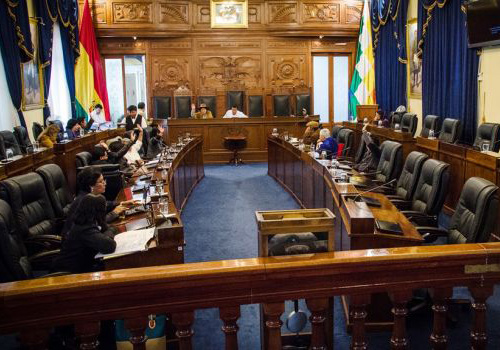
For instance, under the new amendments, it would appear that the Senate (photo) has no option in any case to impose a disciplinary penalty less than permanent removal from office, even if this would be disproportionate.
Placing all responsibility for disciplinary proceedings with an independent Judicial Council should also be considered.
In October, the ICJ sent an open letter and analysis brief to members of the Legislative Assembly, explaining why the proceedings violate international law and standards, urging that proceedings against the three judges immediately be ended, and recommending a process of longer-term reform of judicial accountability processes in Bolivia.
Contact:
English: Matt Pollard, Head of the Centre for Independence of Judges and Lawyers at the ICJ, t: +41 79 246 54 75; e: matt.pollard(a)icj.org
Spanish: Carlos Ayala, ICJ Commissioner, t: +58 212 952 8448; e: carlos.ayala(a)icj.org
Bolivia-Procedimento magistrados-News-Press Release-2014-SPA (full text in PDF)
(Update: the proceedings were suspended on 4 December, and are to continue on 9 December)

Nov 19, 2014 | Events, News
On 18 November, the ICJ presented and discussed, in a meeting at the European Parliament in Brussels, its two reports on special economic regimes and their impact on social rights in Peru and Morocco.
MEP Richard Howitt, Member of the Subcommittee on Human Rights at the Parliament, and ICJ Commissioner Olivier De Schutter led the discussions.
The reports highlight the impact on rights, including labour and social security, land and water rights, of special economic regimes that aim at facilitating exports and investment in areas such as agriculture and textile.
The meeting enabled discussion of the role that the EU and its member states can and should play in its general dialogue and cooperation with the two countries, particularly in regard to trade relationships and agreements and also the regulation of the EU based business enterprises benefiting from these special regimes.
The presentation of the ICJ research and reports comes at an important moment in the relationships of the EU with both Peru and Morocco.
As to the latter, the ICJ report will feed into the Human Rights dialogue between the Subcommittee on Human Rights of the European Parliament and Morocco that is taking place today in Brussels.
Reports:
Peru-Social Rights for Export Promotion-Publications-thematic report-2014-ENG (Full report in English – PDF)
Peru-Regimenes especiales exportacion-Publications-thematic report-2014-SPA (Full report in Spanish – PDF)
Morocco-Droits sociaux et regimes speciaux-Publications-thematic report-2014-FRE (Full Report in French – PDF)
Contacts:
Carlos Lopez, Senior Legal Advisor, Business and Human Rights Programme, t +41 22 979 3816, carlos.lopez(a)icj.org
Sandra Ratjen, Senior Legal Advisor, Economic, Social and cultural Rights Programme, t +41 22 979 3835, sandra.ratjen(a)icj.org
Nov 15, 2014 | News
La Comisión Internacional de Juristas, a través de su representante para Suramérica, Federico Andreu-Guzmán, intervino como perito en el procedimiento interamericano, a solicitud de los representantes de las víctimas.
Nov 6, 2014 | News
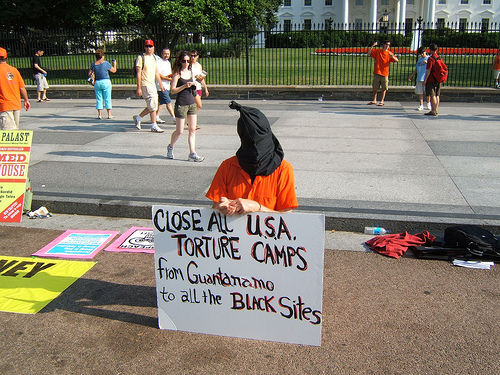
The ICJ, REDRESS and OMCT submit report to the UN Committee Against Torture in Geneva ahead of its 12-13 November session on the USA.