Mar 26, 2015 | News
The conviction of the Maldives’ former president, Mohamed Nasheed, on terrorism charges after a grossly unfair trial marks a significant deterioration of the independence and impartiality of the country’s judiciary, said the ICJ.
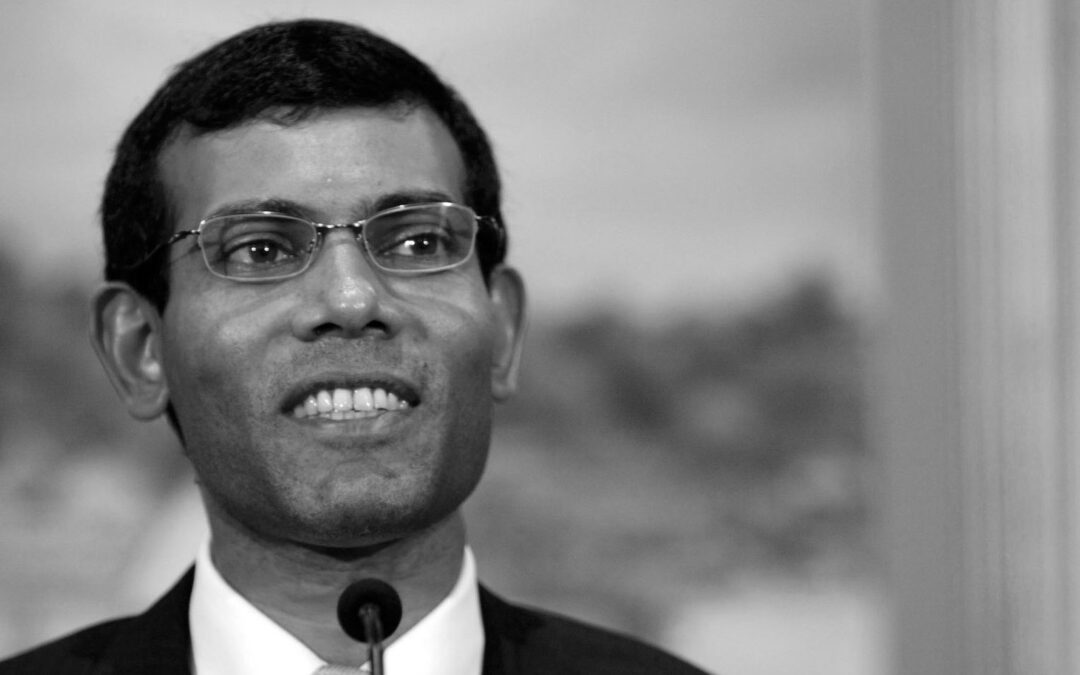
On 13 March, Mr. Nasheed (photo) was sentenced to 13 years in prison for the dismissal and alleged unlawful detention of the Chief Judge of the Criminal Court, Mr. Abdullah Mohamed, in 2012, when Mr. Nasheed was president.
He was convicted of an “act…of kidnapping or abduction of person(s) or of taking hostage(s)” under Section 2(b) of the Prevention of Terrorism Act 1990.
“The Maldivian judiciary’s independence has been compromised for years by serious pressure from the government, and this grossly unfair conviction highlights the numerous problems with the politicization of the judiciary in the country,” said Sam Zarifi, the ICJ’s Regional Director for Asia and the Pacific. “It is crucial for Maldivian authorities to allow Mr. Nasheed to appeal his case effectively, with transparency and monitoring by Maldivian and international observers.”
The case’s pre-trial phase and trial were marked by gross violations of international standards of fair trial, including Article 14 of the International Covenant on Civil and Political Rights, to which the Maldives acceded in 2006.
Two of the judges on the three-judge bench testified as witnesses against Mr. Nasheed in the 2012 investigation; these statements were submitted as evidence in the present trial.
Mr. Nasheed’s defense team was not allowed to be present on his behalf during the first proceeding, nor was he given the opportunity to seek bail.
The defense team was repeatedly denied full access to prosecution evidence and witnesses or to regularly consult with Mr. Nasheed during the course of the trial.
When Mr. Nasheed’s defense team recused itself in protest of the lack of fairness, the court proceeded with the trial without legal representation present for Mr. Nasheed rather than granting him the opportunity to obtain new counsel. The defense was also denied the opportunity to call its own witnesses.
Mr. Nasheed now has the right to appeal the conviction, but his right to appeal has been infringed by the unprecedented amendment of the statutory period for appeal from 90 days to 10 days, via Supreme Court circular six weeks prior to the trial.
In addition, the court has still not released to Mr. Nasheed’s defense team the full court record required to prepare and present an effective appeal within this accelerated timeframe.
The ICJ has previously documented the politicization of the judiciary and the polarized political climate in the Maldives, calling attention to a justice system characterized by vested interests and political allegiances rooted in the country’s authoritarian past (See Maldives: Securing an Independent Judiciary in a Time of Transition (February 2011)).
“Recent events reflect a justice system that still remains deeply politicized along the same lines of entrenched political loyalties that pre-date the transition period,” Zarifi said. “The Maldivian judiciary must allow a proper appeal in this case if it is to establish itself as a separate and equal branch of the government dedicated to supporting the rule of law.”
The ICJ urged Maldivian authorities to ensure Mr. Nasheed’s defense team full access and adequate opportunity to prepare an effective appeal, and to ensure that the appeal proceeding is conducted fairly and transparently, with full access to media and domestic and international observers, in compliance with fair trial and due process standards under both Maldivian and international law.
The Maldives must also take effective measures to ensure that such violations do not reoccur in this or future cases.
Background information can be downloaded here:
Maldives-Background Brief Nasheed Trial-Advocacy-Anylysis brief-2015-ENG (full text in PDF)

Mar 12, 2015 | News
Pakistan’s decision to fully reinstate the death penalty puts at imminent risk of execution more than 500 people on death row who have exhausted all avenues of appeal, with another 8000 facing death penalties, said the ICJ today.
“The total abandonment of the moratorium on the death penalty is a disaster for human rights in Pakistan,” said Sam Zarifi, ICJ’s Asia director. “We fear a major acceleration in the flow of executions we have seen over the past few months—none of which do anything to protect the rights of the Pakistani people.”
25 people have been executed since 16 December 2014, when Pakistan lifted a moratorium on executions in cases of capital punishment related to terrorism. The decision to partially lift a six-year unofficial moratorium on executions was in response to an attack on a school in Peshawar, killing 150 people, almost all of them children. Pakistan Tehreek-e-Taliban claimed responsibility for the attack.
In January, Pakistan also amended the Constitution and the Army Act, 1952, empowering military courts to try civilians for terrorism related offences.
“The Pakistani people face a very real threat from terrorist attacks, but there is no indication that the death penalty will decrease this threat,” said Zarifi. “Instead, the government is targeting hundreds of people on death row whose convictions had nothing to do with terrorism-related offenses.”
In Pakistan, capital punishment is prescribed for 27 different offences, including blasphemy, sexual intercourse outside of marriage, kidnapping or abduction, rape, assault on the modesty of women and the stripping of women’s clothes, smuggling of drugs, arms trading and sabotage of the railway system. Many of these crimes do not meet the threshold of ‘most serious crimes’ stipulated by Article 6 of the International Covenant on Civil and Political Rights (ICCPR).
Pakistan ratified the ICCPR in 2010. Article 6 of the ICCPR, guaranteeing the right to life, requires that states restrict capital punishment to only the ‘most serious crimes’. The UN Special Rapporteur on extrajudicial, summary or arbitrary executions has clarified that in the context of the death penalty, the definition of the ‘most serious crimes’ is limited to those cases in which there was an intention to kill, which resulted in the loss of life.
In December 2014, the UN General Assembly adopted a resolution, that emphasizes that that the use of the death penalty undermines human dignity and that calls on countries that maintain the death penalty to establish a moratorium on its use with a view to its abolition. An overwhelming majority of 117 UN Member States voted in favor of the call for a worldwide moratorium on executions, as a step towards abolition of the death penalty.
Pakistan should reinstate a moratorium on the death penalty, with a view to definitively abolishing the practice in law,” said Zarifi.
ICJ opposes capital punishment in all cases without exception. The death penalty constitutes a violation of the right to life and the right not to be subjected to cruel, inhuman or degrading punishment.
Contact
Sam Zarifi, ICJ Asia Pacific Regional Director (Bangkok), t: +66 807819002; email: sam.zarifi(a)icj.org
Reema Omer, ICJ International Legal Advisor for Pakistan (London), t: +447889565691; email: reema.omer(a)icj.org
Feb 27, 2015 | News
The Nepali government must fully implement yesterday’s decision of the Supreme Court rejecting the possibility of amnesties for perpetrators of serious human rights abuses during the country’s civil war, said today the ICJ.
The decision, by a three-person special constitutional bench, composed of Justice Kalyan Shrestha, Justice Baidhya Nath Upadhyay and Justice Cholendra Shumsher JB Rana, struck down the amnesty provision of the Commission on Investigation of Disappeared Persons, Truth and Reconciliation Act 2014 (TRC Act) promulgated last May 2014.
The Court also ruled that only the judiciary, and not the Commissions established by the TRC Act, can determine the criminality of any violations committed in the context of the country’s decade-long conflict.
“Nepal’s Supreme Court has once again firmly reasserted the right of the victims of human rights violations to seek justice,” said Sam Zarifi, ICJ’s Asia Director. “This bold and principled decision should finally end the cynical attempts by politicians from all Nepal’s major parties, as well as the military, to legislate impunity and shield themselves from accountability.”
The decision distinguished between the jurisdiction of the courts and the criminal justice system, and the non-judicial reconciliation and truth-seeking mechanisms established by the TRC Act.
In the months before the decision, the government had essentially frozen the prosecution of claims already before various courts, and had blocked the filing of First Information Reports (FIRs) by victims trying to lodge new complaints.
“Now, the government must not only remove obstacles to these cases, it must commit itself to prosecuting such claims,” Zarifi added. “The Government must immediately take all necessary steps to implement the court ruling including to ensure criminal investigation of FIRs, and address the concerns raised by the victims on the formation of the Truth and Reconciliation Commission and Commission of Inquiry on Enforced Disappearance.”
This is the second time that the Nepali Supreme Court has rejected the amnesty scheme introduced by the Nepali government.
On 2 January 2014, the Supreme Court had declared unconstitutional the Ordinance on the Truth and Reconciliation Commission (TRC Ordinance).
However, the Government effectively ignored the Court order and introduced a slightly modified version of the 2013 Ordinance replicating almost all of the provisions of the TRC Ordinance, including many of its problematic aspects, such as the ‘amnesty’ provision.
“The Government, with the help of the international community, must now dedicate itself to meeting the promise of the political parties to provide justice, truth and reparations to the victims and survivors of the conflict,” said Zarifi. “Only doing so will help end the country’s cycle of impunity.”
Contact:
Sam Zarifi, ICJ Asia Pacific Regional Director (Bangkok), t: +66 807819002; email: sam.zarifi(a)icj.org
Feb 3, 2015 | News
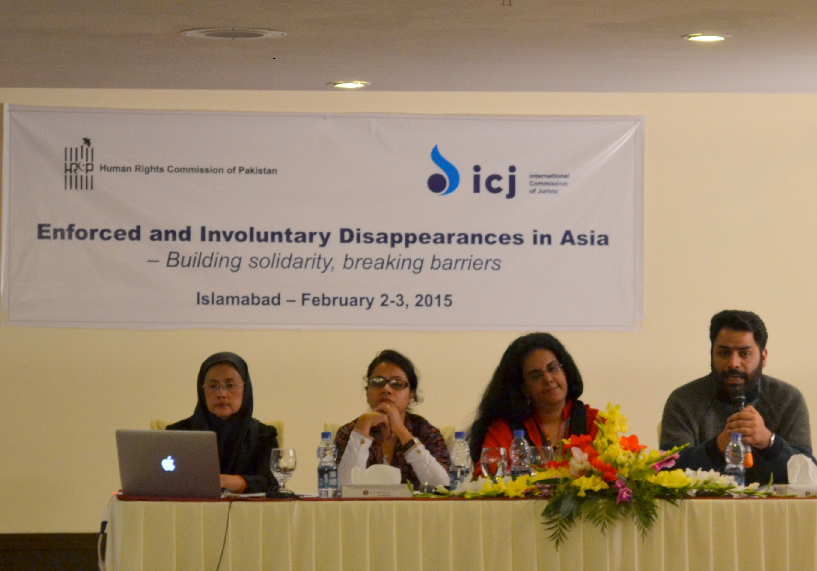
In partnership with the Human Rights Commission of Pakistan (HRCP), the ICJ convened a two-day conference in Islamabad on 2-3 February 2015.
The conference brought together civil society activists, lawyers and journalists from across Asia, including Thailand, the Philippines, Sri Lanka, India, Nepal and Pakistan with experience of working on enforced disappearances in the their national contexts as well as regional and international forums.
The participants expressed alarm at the continuing practice of enforced disappearances in the region and regretted that a culture of moral, political and legal impunity prevented perpetrators to be brought to justice.
They also urged their respective states to promptly ratify the International Convention for the Protection of all Persons from Enforced Disappearance, criminalize enforced disappearances, and meet their obligations under international law to provide remedy and reparations for human rights violations.
At the end of the two-day event, the participants of the conference adopted a resolution (download below) resolving to work together to address the common challenges and hurdles they encounter in their work on enforced disappearances.
Asia-Enforced disappearances Resolution final-Advocacy-2015-ENG (full text in PDF)
Asia-Enforced disappearances Resolution final-Advocacy-2015-URD (full text in PDF)

Jan 6, 2015 | News
The Pakistan Parliament’s legislation allowing civilians to be tried by military tribunals is a serious blow to human rights and rule of law in the country, the ICJ said today.

Dec 20, 2014 | News
Pakistan should immediately halt carrying out the death penalty, said the ICJ today after two people were executed in the wake of the horrific attack on a school in Peshawar that killed 149 people, nearly all of them children