Dec 19, 2014 | News
The Nepal government should ensure more victim participation and improve transparency when selecting candidates for two independent commissions on the country’s decade-long conflict, the ICJ and other groups said today.
The ICJ, Amnesty International, Human Rights Watch and five local human rights and conflict-era victims groups sent an open letter to Prime Minister Sushil Koirala.
The groups, reiterating concerns about the act, said Koirala should narrow the scope of the amnesty powers vested in the commissions and bring them in line with international standards.
The Truth and Reconciliation Commission and the Commission on Enforced Disappearances are being established under a 2014 law, the Commission on Investigation of Disappeared Persons, Truth and Reconciliation Act, 2071 (TRC Act).
“A consultative and transparent process for selecting commissioners is critical if the commissions are going to win the trust of conflict-era survivors as well as local and international observers,” the rights groups said in their letter. “The TRC Act is fundamentally flawed, and the government should take these steps to ensure that this important exercise in transitional justice remedies the flaws.”
Contact:
Sam Zarifi, ICJ Asia Pacific Regional Director (Bangkok), t: +66 807819002; email: sam.zarifi(a)icj.org
Nepal-TRCCommission-Advocay-Open Letter-2014-ENG (full text in PDF)
Dec 18, 2014 | News
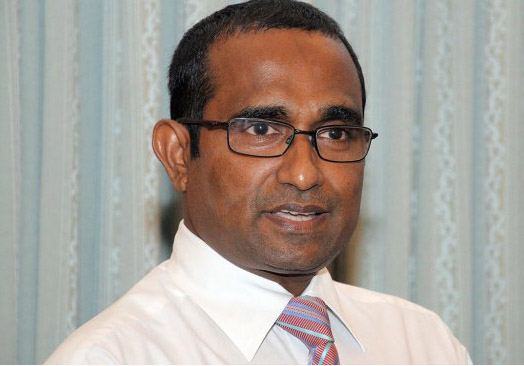
The arbitrary and unlawful removal of the Chief Justice Ahmed Faiz Hussain (photo) and Supreme Court judge Justice Muthasim Adnan, constitutes an assault on the independence of the judiciary, the ICJ said today.

Dec 9, 2014 | News
On the eve of the 64th annual world Human Rights Day, the ICJ urges the Pakistani Government to promptly constitute a strong and effective National Human Rights Commission that is compliant with the UN Principles relating to the Status of National Institutions (Paris Principles).
“Independent and credible national human rights institutions can be helpful for protecting and promoting human rights,” said Sam Zarifi, ICJ’s Director for Asia and the Pacific. “The Pakistan Government has been inexplicably dragging its feet despite repeated promises to constitute the Commission.”
In South Asia, India, Sri Lanka, Nepal and Bangladesh have established National Human Rights Institutions (NHRIs), making Pakistan a regional exception.
“A properly constituted national human rights commission will not by itself fix any country’s human rights problems, but it can be part of the solution,” said Zarifi. “Pakistan can and should learn from the lessons of failed NHRIs in the region and constitute an institution that can address the real needs of all people in the country.”
Pakistan passed the National Commission for Human Rights Act in 2012. The law provides for an independent commission with broad powers to promote human rights and to investigate human rights violations.
However, the law significantly limits the Commission’s mandate where the armed forces are accused of committing human rights violations.
In such cases, the Commission is only authorized to seek a report from the Government, and make recommendations if it sees fit.
The law further emphasizes that the functions of the Commission “do not include inquiring into the act or practices of the intelligence agencies”.
“The proposed Commission’s restricted mandate over the armed forces, and especially the intelligence agencies, is of grave concern given that Pakistan’s military and intelligence services are accused of perpetrating gross human rights violations, including enforced disappearances, extrajudicial killings, and torture and ill-treatment,” Zarifi added.
“A human rights commission that does not have jurisdiction over abuses by these actors risks being toothless and ineffective—and worst, a cover for continuing government inaction in response to these violations.”
Contact:
Sam Zarifi, ICJ Asia Pacific Regional Director (Bangkok), t: +66 807819002; e: sam.zarifi(a)icj.org
Reema Omer, ICJ International Legal Adviser (London), t: +44 7889565691; e: reema.omer(a)icj.org
Background:
Section 3 (a) (ii) of the Paris Principles, which provide the minimum standards required by national human rights institutions to be considered credible and effective, states that a NHRI should have the power to hear a matter without higher referral over “any situation of violation of human rights which it decides to take up”.
Because of the proposed Commission’s limited mandate over the military, it is questionable whether the proposed National Human Rights Commission is compliant with the Paris Principles.
During its 2012 Universal Periodic Review, Pakistan accepted multiple recommendations to speedily operationalize the National Commission for Human Rights.
Over two years since the Review, there has been little progress in constituting the Commission, let alone amending the law establishing the Commission to ensure that it complies with the Paris Principles.
Dec 5, 2014 | Multimedia items, News, Video clips
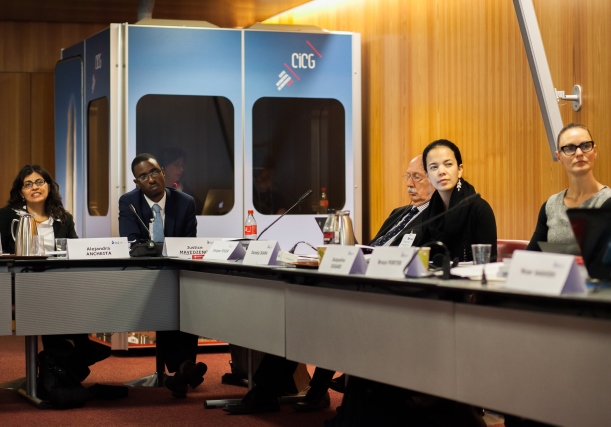
Jacqueline Dugard, Hina Jilani, Rodrigo Uprimny Yepes, Gilles Badet, Alejandra Ancheita and Harsh Mander talk about their experience and the situation of economic, social and cultural rights in their respective countries.
These prominent participants in ICJ’s Geneva Forum 2014 give their views on judicial protection of economic, social and cultural rights (ESCR) as well as on what needs to be changed to address obstacles to guarantee an effective remedy for victims of violations of their socio-economic rights.
They also tell about the main opportunities and key challenges for the realization of ESCR in their respective countries.
The 2014 Geneva Forum of Judges and Lawyers is a joint initiative of the ICJ Center for the Independence of Judges and Lawyers (CIJL) and the ICJ Programme on Economic, Social and Cultural Rights.
It has been made possible with the support of the République et Canton de Genève, the Permanent Mission of Germany to the United Nations in Geneva, and the Taipei Bar Association.

Dec 3, 2014 | News
The December 2 conviction of journalist David Bergman on contempt charges by the International Crimes Tribunal (ICT) further shrinks the narrowing space for observers to comment on the war crimes proceedings, the ICJ, Amnesty International and Human Rights Watch said.
Bergman (photo) was sentenced to a symbolic “simple imprisonment till the rising of the court” and a fine of Taka 5,000 (about US$56) for comments he made in three separate blog postings regarding legal proceedings before the ICT.
The ICT is a specially constituted court set up to bring to account those responsible for grave violations of international law during the country’s 1971 war of independence.
Concerns over its statute, rules of procedure, and practices have been raised since its inception, including by international monitors and legal experts.
“The ICT is dealing with incredibly complex factual and emotional issues of tremendous interest to people in Bangladesh and across the world, and part of this process is establishing public confidence in the legal system,” said Sam Zarifi, ICJ’s Director for Asia. “Holding a credible and highly regarded journalist in contempt for raising important questions doesn’t end the debate surrounding the ICT’s performance, in fact it undermines confidence in the court’s commitment to justice.”
Download the full story in PDF here:
Bangladesh-Conviction of Journalist-News-Press release-2014-ENG
Nov 25, 2014 | Advocacy, Analysis briefs, News
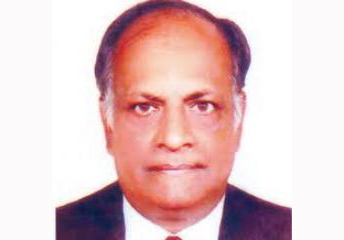
Bangladesh must immediately launch a thorough investigation into alleged attacks on a prominent human rights lawyer, the ICJ said today. The government appears to have taken no real action in the year since the events.
Rabindra Ghosh (photo), advocate at the Supreme Court of Bangladesh and President of the non-governmental organization Bangladesh Minority Watch, has made credible allegations that he was subjected to acts of violence, intimidation and other interference with his functioning as a lawyer.
”The authorities in Bangladesh seem not to have taken Rabindra Ghosh’s allegations seriously, in breach of international standards,” said Matt Pollard, head of ICJ’s Centre for the Independence of Judges and Lawyers. “In addition to his complaints, our own letters to the authorities simply went unanswered.”
Rabindra Ghosh, among other incidents, alleges that he was physically attacked by six of his peers on 25 November 2013, while he was at work in the Gopalgonj District Court.
He further alleges that on 14 January 2014 he was subjected to physical violence, threats, and verbal abuse at the hands of police officers.
He reports that there has been no substantive investigation of his complaints and that he has received no response from the responsible authorities.
“Lawyers play an essential role in protecting human rights and the proper administration of justice,” Pollard added. “International standards require State authorities to prevent attacks and harassment of lawyers and to take effective measures to protect their security.”
The ICJ requested the Prime Minister, the Ministry of Law, Justice and Parliamentary Affairs, the Ministry of Home Affairs and the President of the Bar Association to provide further information and a response to these allegations, but has received no response.
In addition to its call on the authorities of Bangladesh to immediately launch a thorough and independent investigation of the allegations made by Rabindra Ghosh, the ICJ calls on the authorities to take concrete measures to ensure that he and other lawyers are able to discharge their professional duties without any interference or intimidation of any kind. If the investigation confirms the allegations, those responsible must be held accountable.
“The ICJ has observed a general erosion of the rule of law and respect for the ability of lawyers to carry out their duties in Bangladesh,” said Pollard. “Lawyers play a crucial role in ensuring that people whose rights have been violated can demand their right to a remedy. When lawyers themselves become victims simply for carrying out their work, it signals a serious problem for the legal system.”
Rabindra Ghosh’s allegations come against the backdrop of a series of recent attacks on human rights defenders in Bangladesh, including among others the harassment of human rights defenders including Adilur Rahman Khan, secretary of Odhikar; the promulgation of a constitutional amendment that empowers the Parliament to impeach Supreme Court judges; and the amendment of the Information and Communication Technology Act, which is being used to assault freedom of expression and freedom from arbitrary detention.
Contact:
Matt Pollard, ICJ Senior Legal Adviser, +41 22 979 3812, matt.pollard(a)icj.org
A brief background note on the case is available here in PDF:
Bangladesh-Ghosh backgrounder-Advocacy-2014-ENG