Dec 3, 2014 | News
The December 2 conviction of journalist David Bergman on contempt charges by the International Crimes Tribunal (ICT) further shrinks the narrowing space for observers to comment on the war crimes proceedings, the ICJ, Amnesty International and Human Rights Watch said.
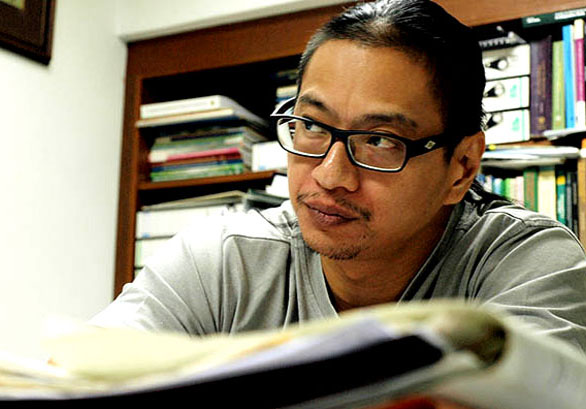
Bergman (photo) was sentenced to a symbolic “simple imprisonment till the rising of the court” and a fine of Taka 5,000 (about US$56) for comments he made in three separate blog postings regarding legal proceedings before the ICT.
The ICT is a specially constituted court set up to bring to account those responsible for grave violations of international law during the country’s 1971 war of independence.
Concerns over its statute, rules of procedure, and practices have been raised since its inception, including by international monitors and legal experts.
“The ICT is dealing with incredibly complex factual and emotional issues of tremendous interest to people in Bangladesh and across the world, and part of this process is establishing public confidence in the legal system,” said Sam Zarifi, ICJ’s Director for Asia. “Holding a credible and highly regarded journalist in contempt for raising important questions doesn’t end the debate surrounding the ICT’s performance, in fact it undermines confidence in the court’s commitment to justice.”
Download the full story in PDF here:
Bangladesh-Conviction of Journalist-News-Press release-2014-ENG
Nov 27, 2014 | News
The ICJ today strongly condemned the decision by Prime Minister Najib Razak to retain and even strengthen the country’s 1948 Sedition Act despite having made a commitment in 2012 to repeal the Act.
The ICJ has repeatedly expressed its concern that the Sedition Act has been used to stifle and criminalize the exercise of freedom of expression and to silence human rights defenders, lawyers, political activists, among others.
The ICJ considers the Act as it stands to be incompatible with international human rights standards and to be made still more repugnant by the politically loaded manner in which it is typically applied.
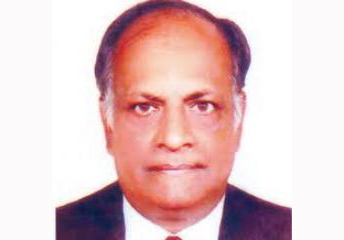
In early September, the ICJ denounced the use of sedition against two members of the legal profession, Dr. Azmi Sharom (photo) and N. Surendran for commenting on questions of law and public policy.
On 20 September 2014, Edmund Bon a prominent human rights and constitutional lawyer, was questioned by the police regarding comments made in a based on the decision of a Malaysian Federal Court.
On 30 September 2014, Dr. Abdul Aziz Bari, a law professor at the University of Selangor, was summoned for a police interview over comments made about the selection process of the new Chief Minister by the Sultan of Selangor.
Background:
The 1948 Sedition Act, originally enacted by the British colonial government and amended several times over the years, criminalizes speech and publications considered to have “seditious tendencies”.
The term “seditious tendencies” is ambiguously defined to mean any kind of speech or publication that causes “hatred or contempt, or excite disaffection” against any ruler or the government or promotes “ill will and hostility between the different races or classes”.
The law also considers “seditious” any speech or publication that questions the special privileges of the Malay people, as provided in the Constitution.
Furthermore, sedition is a strict liability offence in Malaysia, which means that the intention of a person allegedly making seditious statements is irrelevant.
For instance, a person making a statement may not have the intent to cause “hatred or contempt” towards the government, but may nonetheless be held liable for sedition if authorities believe that the person in fact incited such feelings.
The ICJ considers that the Act, by its very terms, contemplates restrictions on the exercise of freedom of expression that are grossly overbroad and inconsistent with basic rule of law and human rights principles.
Nov 25, 2014 | Advocacy, Analysis briefs, News
Bangladesh must immediately launch a thorough investigation into alleged attacks on a prominent human rights lawyer, the ICJ said today. The government appears to have taken no real action in the year since the events.
Rabindra Ghosh (photo), advocate at the Supreme Court of Bangladesh and President of the non-governmental organization Bangladesh Minority Watch, has made credible allegations that he was subjected to acts of violence, intimidation and other interference with his functioning as a lawyer.
”The authorities in Bangladesh seem not to have taken Rabindra Ghosh’s allegations seriously, in breach of international standards,” said Matt Pollard, head of ICJ’s Centre for the Independence of Judges and Lawyers. “In addition to his complaints, our own letters to the authorities simply went unanswered.”
Rabindra Ghosh, among other incidents, alleges that he was physically attacked by six of his peers on 25 November 2013, while he was at work in the Gopalgonj District Court.
He further alleges that on 14 January 2014 he was subjected to physical violence, threats, and verbal abuse at the hands of police officers.
He reports that there has been no substantive investigation of his complaints and that he has received no response from the responsible authorities.
“Lawyers play an essential role in protecting human rights and the proper administration of justice,” Pollard added. “International standards require State authorities to prevent attacks and harassment of lawyers and to take effective measures to protect their security.”
The ICJ requested the Prime Minister, the Ministry of Law, Justice and Parliamentary Affairs, the Ministry of Home Affairs and the President of the Bar Association to provide further information and a response to these allegations, but has received no response.
In addition to its call on the authorities of Bangladesh to immediately launch a thorough and independent investigation of the allegations made by Rabindra Ghosh, the ICJ calls on the authorities to take concrete measures to ensure that he and other lawyers are able to discharge their professional duties without any interference or intimidation of any kind. If the investigation confirms the allegations, those responsible must be held accountable.
“The ICJ has observed a general erosion of the rule of law and respect for the ability of lawyers to carry out their duties in Bangladesh,” said Pollard. “Lawyers play a crucial role in ensuring that people whose rights have been violated can demand their right to a remedy. When lawyers themselves become victims simply for carrying out their work, it signals a serious problem for the legal system.”
Rabindra Ghosh’s allegations come against the backdrop of a series of recent attacks on human rights defenders in Bangladesh, including among others the harassment of human rights defenders including Adilur Rahman Khan, secretary of Odhikar; the promulgation of a constitutional amendment that empowers the Parliament to impeach Supreme Court judges; and the amendment of the Information and Communication Technology Act, which is being used to assault freedom of expression and freedom from arbitrary detention.
Contact:
Matt Pollard, ICJ Senior Legal Adviser, +41 22 979 3812, matt.pollard(a)icj.org
A brief background note on the case is available here in PDF:
Bangladesh-Ghosh backgrounder-Advocacy-2014-ENG
Nov 23, 2014 | Events
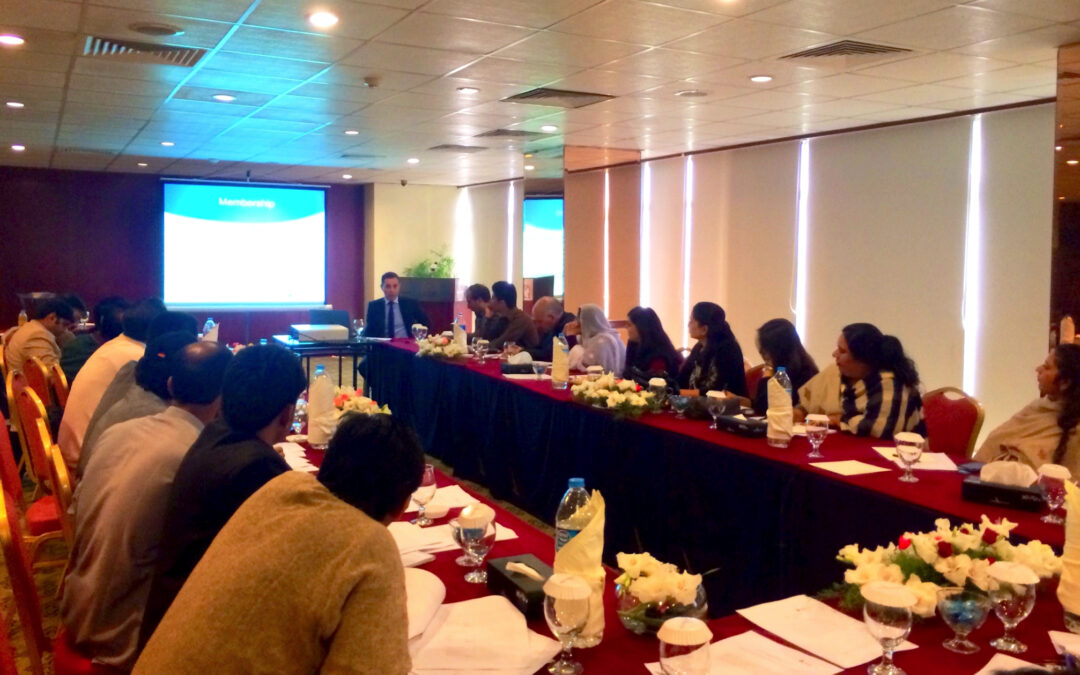
In partnership with the Human Rights Commission of Pakistan (HRCP), the ICJ convened and participated in a one-day workshop on the Universal Periodic Review (UPR) mechanism of the UN Human Rights Council, held in Lahore on 22 November 2014.
The workshop was convened by the ICJ and HRCP as a follow up to, and in response to requests by participants at, training workshops held in Pakistan in February 2014. Now half way between Pakistan’s second and third periodic reviews under the UPR mechanism, the workshop brought together representatives from civil society from throughout Pakistan working on a wide range of human rights issues. It drew from the experience of national and international advocates and human rights lawyers and defenders to discuss:
- The importance of international human rights law at the national level;
- The UPR as a mechanism for human rights protection and how it fits within the broader framework of UN human rights mechanisms;
- Opportunities for NGO engagement in the UPR, especially in the development of a mid-term civil society evaluation report and in preparation for Pakistan’s third cycle UPR in 2017; and
- Weaknesses in Pakistan’s engagement with the UPR.

Nov 19, 2014 | News
Thailand must end immediately the prosecution of civilians in military tribunals and transfer all remaining cases to the civilian courts, said the International Commission of Jurists (ICJ) today.
On 18 November 2014, the Bangkok Military Tribunal convicted a political broadcaster, Khathawut B., of lese majeste under article 112 of the Thai Criminal Code and Article 14 of the Computer Crimes Act, and sentenced him to five years in jail following a plea of guilty. The court barred observers and the public from the proceedings on the ground that they “concerned matters of national security.”
There is no appeal possible under article 61 of the Thai Act for the Organization of the Military Court so long as Thailand remains under Martial Law, which has been in force nationwide since May 22.
“Under international standards, civilians should not be subject to the jurisdiction of military tribunals, particularly where, like in military-ruled Thailand, military tribunals lack the institutional independence from the executive required by international law regarding fair trials. Thus, civilians convicted before such tribunals should have the right to a new trial before a civilian court,” said Wilder Tayler, Secretary General of the ICJ. “This case also highlights another very serious problem with the state of human rights in Thailand: Thailand’s misuse of criminal defamation laws to imprison people exercising their right to freedom of expression.
The National Council for Peace and Order (NCPO) extended the jurisdiction of military tribunals over civilians after it took power by a coup d’etat and imposed Martial Law throughout Thailand. Prior to this, civilians had not been subject to military jurisdiction in Thailand for crimes not directly involving the military for decades, including during the state of emergency in place in southern Thailand since 2004.
Among crimes now within the jurisdiction of military tribunals in Thailand is lese majeste – criminalizing the making of statements that could be construed as defaming or insulting the Thai Monarchy. Such broad restrictions violate the right to freedom of expression guaranteed under article 19 of the International Covenant on Civil and Political Rights (ICCPR), to which Thailand is a state party.
Since the coup, at least 69 civilians have faced prosecution before military tribunals in Thailand on charges ranging from breaching NCPO orders, to planning a terrorist act and lese majeste.
Under article 14 of the ICCPR, everyone has the right to a “fair and public hearing by a competent, independent and impartial tribunal established by law.” The imposition of Martial Law, and the State’s suspension of some of its obligations under the ICCPR, including the right to appeal guaranteed by article 14(5) for cases heard by military tribunals, does not affect the applicability of this provision.
“All prosecutions of civilians before military tribunals must be transferred to civilian courts immediately, if Thailand is to comply with its international obligations,” said Tayler. “There is absolutely no excuse or justification for the use of military tribunals to prosecute civilians in Thailand, and especially not for simply exercising the right to freedom of expression.”
The Draft Principles Governing the Administration of Justice through Military Tribunals, set out principles that apply to state use of military tribunals.
Principle 5 states “Military courts should, in principle, have no jurisdiction to try civilians. In all circumstances, the State shall ensure that civilians accused of a criminal offence of any nature are tried by civilian courts.”
Further, Principle 2 states “Military tribunals must in all circumstances apply standards and procedures internationally recognized as guarantees of a fair trial.” Military tribunals must in all circumstances respect the principles of international law relating to a fair trial, even in times of crisis.
Thailand-military courts-news-press release-2014-THAI (full text, PDF)