UN investigation offers hope to victims in Sri Lanka

UN investigation offers hope to victims in Sri Lanka

The UN Human Rights Council resolution to establish an international investigation into allegations of human rights violations and abuses committed by both sides in Sri Lanka’s civil war gives hope to tens of thousands of victims who continue to be denied truth and justice.

Sri Lanka: the need for an international inquiry

Sri Lanka: the need for an international inquiry

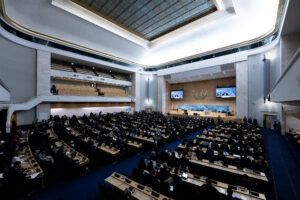
The ICJ emphasised the need for an international inquiry to monitor and investigate human rights violations in Sri Lanka, during discussion at the UN Human Rights Council.

The ICJ stated that an international investigation mechanism such as a Commission of Inquiry is needed in part because the Sri Lankan justice system today simply cannot be relied upon to function as an independent and impartial institution.

  • The judicial appointment process is subject to political interference.
  • Judges and lawyers are subjected to threats and intimidation.
  • Security of tenure for the judiciary is not protected by an independent, impartial and fair procedure for the removal or discipline of judges.

The UN High Commissioner for Human Rights has repeatedly expressed concern about “the continuing high levels of harassment and intimidation meted out to human rights defenders, lawyers and journalists”. Further incidents against human rights defenders occurred during the Human Rights Council session itself.

The ICJ urged the Council to establish an international independent and impartial investigation mechanism to give a glimmer of hope to victims and families, that their rights under international law to truth, justice and reparation will ultimately be upheld.

A number of delegations have jointly presented a draft resolution that would establish an international investigation with the backing of the Human Rights Council. A vote on the resolution is expected later in the week.

The full statement can be downloaded in PDF: Advocacy-UN-HRC25-SriLanka-OralStatement-26032014-rev

Video of the discussion of the report, including the ICJ oral statement, is available in the UN webcast archive.

See also:

Briefing note on independence of judges and lawyers in Sri Lanka


Nepal: Lack of progress on ending impunity

Nepal: Lack of progress on ending impunity

The ICJ spoke at the UN Human Rights Council on the lack of progress in Nepal on ending impunity.The oral statement was delivered during the general debate on the Universal Periodic Review (UPR).

Nepal has failed to take concrete action to implement key UPR recommendations, including those crucial to implementing the right to an effective remedy and reparation, creating effective mechanisms for transitional justice and ending impunity.

The Government continues to try to force through a Truth and Reconciliation Commission that is not human rights complicant and has already been ruled invalid by the Supreme Court of Nepal.

Nepal has also failed to take meaningful measures to investigate human rights violations and abuses that arose during the armed conflict.

The ICJ called on Nepal to take specific measures towards ending impunity.

The full written statement can be downloaded, in PDF format: Advocacy-UN-HRC25-Nepal-OralStatement-2103214

The representative of Nepal exercised the right of reply in response to ICJ’s oral statement.

Video of the oral statement, and Nepal’s statement in reply, via the official UN webcast.

Thailand: ICJ calls for lifting of all emergency rule measures

Thailand: ICJ calls for lifting of all emergency rule measures

Thailand’s caretaker government must remove emergency measures throughout the country following the lifting of the Emergency Decree in the capital Bangkok and its surrounding provinces this week, the ICJ said today.

On 18 March, the caretaker government voted to lift the Emergency Decree (effective 19 March) that had been in place in Bangkok and surrounding provinces since 21 January 2014 in response to protests led by the People’s Democratic Reform Committee (PDRC).

At least 20 people have died in protest-related violence and hundreds have been injured.

The Emergency Decree was replaced by the Internal Security Act (ISA), which also does not fully comply with international standards, but provides better remedies for victims of human rights violations than the Decree.

“The imposition of the Emergency Decree creates an environment conducive to abuse of power and human rights violations such as arbitrary arrest and detention, torture and enforced disappearance,” said Sam Zarifi, ICJ’s Regional Director for Asia and the Pacific. “Lifting the Emergency Decree in Bangkok is a positive step, but it is crucial that the authorities remove the Emergency Decree and other measures of emergency rule, including martial law, that are in force in all or parts of at least 30 of Thailand’s 77 provinces.”

These measures should be replaced by law and action that are consistent with international human rights standards, Zarifi said, adding that martial law should not be used as a political tool.

The caretaker government must respond to demonstrations, unrest and emergencies in a manner which complies with its obligations under the International Covenant on Civil and Political Rights (ICCPR), and other international standards, including the Code of Conduct for Law Enforcement Officials, adopted by the UN General Assembly in 1979, and the Basic Principles on the Use of Force and Firearms by Law Enforcement Officials, adopted by the UN Congress on the Prevention of Crime and Treatment of Offenders in 1990.

These standards set out the circumstances in which resort to necessary and proportional force may be lawfully exercised. Article 8 of the Basic Principles on the Use of Force and Firearms states that “exceptional circumstances such as internal political instability or any other public emergency may not be invoked to justify any departure from these basic principles.”

In order to safeguard the rule of law and enhance the protection of human rights in Thailand, the ICJ calls on the caretaker government to repeal the Emergency Decree and other emergency measures including martial law, and to ensure accountability for violent acts through the thorough and effective investigation of criminal acts and prosecution of those reasonably suspected of committing them, in the course of fair, human rights-compliant criminal proceedings.

CONTACT: Sam Zarifi, ICJ Asia-Pacific Regional Director, (Bangkok), t:+66 807819002,  e-mail: sam.zarifi(a)icj.org

Craig Knowles, ICJ Media & Communications, (Bangkok), t:+66 819077653, e-mail: craig.knowles(a)icj.org

For further reading on ICJ’s work on emergency laws in Thailand see: Thailand’s Internal Security Act, Risking the Rule of Law? (2010) https://www.icj.org/thailands-internal-security-act-risking-the-rule-of-law/ Implementation of Thailand’s Emergency Decree (2007) https://www.icj.org/thailand-implementation-of-thailand%C2%B4s-emergency-decree/ More Power, Less Accountability: Thailand’s New Emergency Decree (2005) https://www.icj.org/more-power-less-accountability/

Myanmar: International treaty status

Myanmar: International treaty status

The following table sets out the status of a range of international treaties in Myanmar as of 15 June 2014. [table] ,Ratification accession or succession International Covenant on Civil and Political Rights,No signature or ratification Optional Protocol to the...
Translate »