Nov 3, 2019 | News
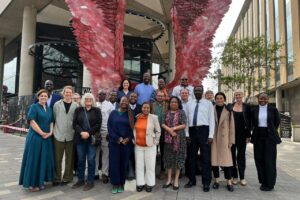
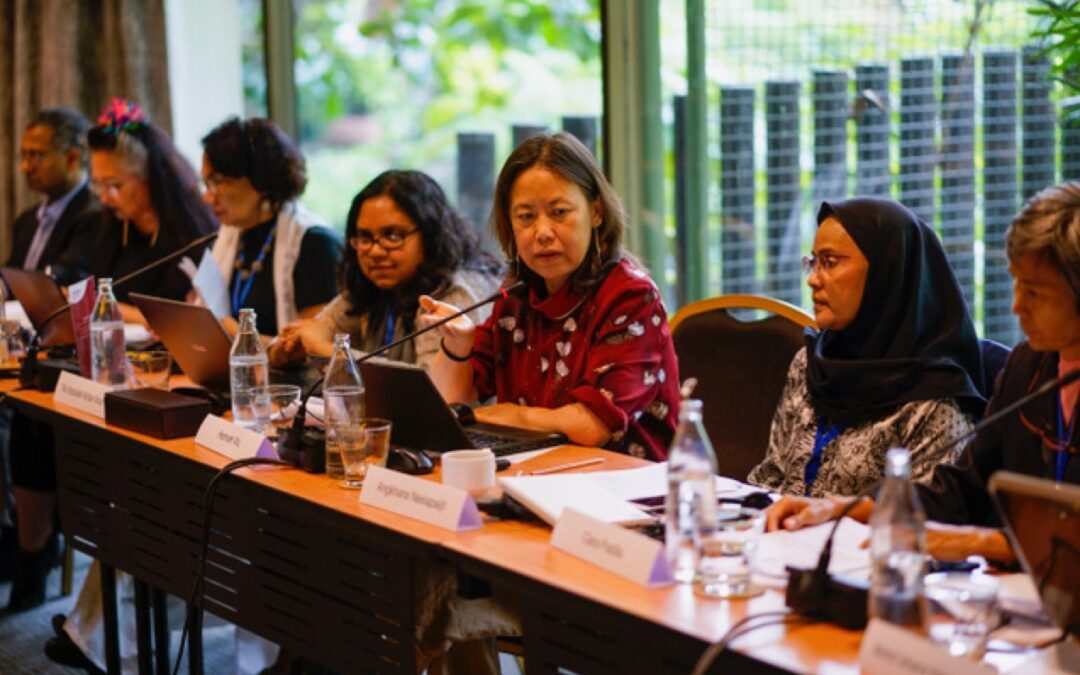
Bangkok, Thailand – From 1 to 2 November 2019, ICJ in collaboration with the UN Office of the High Commissioner for Human Rights (OHCHR) and the Ralph Bunche Institute for International Studies, hosted a consultation on gender and the right to freedom of religion or belief with the UN Special Rapporteur on Freedom of Religion or Belief, Dr. Ahmed Shaheed.
The primary objective of the consultation was to provide a forum for human rights defenders, particularly women and human rights defenders belonging to sexual orientation, gender identity, gender expression and sex characteristics (SOGIESC) minorities to share their perspectives on laws, practices and anti-rights strategies based on religion or belief that discriminate against women and SOGI groups and individuals in Asia. The consultation was attended by at least fifty-two (52) human rights defenders from all over Asia.
Emerlynne Gil, ICJ’s Senior International Legal Adviser, in her opening address, emphasized that gender equality and the right to freedom of religion or belief should not be viewed as inimical to each other. She said, “Women and individuals belonging to sexual orientation and gender identity minorities should also be able to being to a faith or religion of their choice, or religion into which they are born and they should continue to belong to the religion or belief without being discriminated against by the faith or religious community.”
The consultation included discussions on the domestic contexts and legal frameworks in relation to freedom of religion and the rights of women and SOGIESC minorities, including in relation to the right to health. The participants considered challenges faced by women and SOGIESEC minorities when religious leaders act as justice actors were also discussed. The consultation, while highlighting the good practices in advancing the rights of women and SOGIESC minorities, also explored existing challenges and tensions in respect of achieving gender equality.
At the conclusion of the consultation, Dr. Shaheed noted the diversity of the participants in the room, who came from all over Asia. He emphasized that “in order to engage more effectively and strategically, it is imperative that we improve our literacy in relation to the human rights framework and of religion in order to better understand its intersectionality.”
Contact
Sushmitha Thayanandan, National Legal Advisor, Sri Lanka (ICJ) e: sushmitha.thayanandan(a)icj.org
Oct 22, 2019 | Advocacy, News
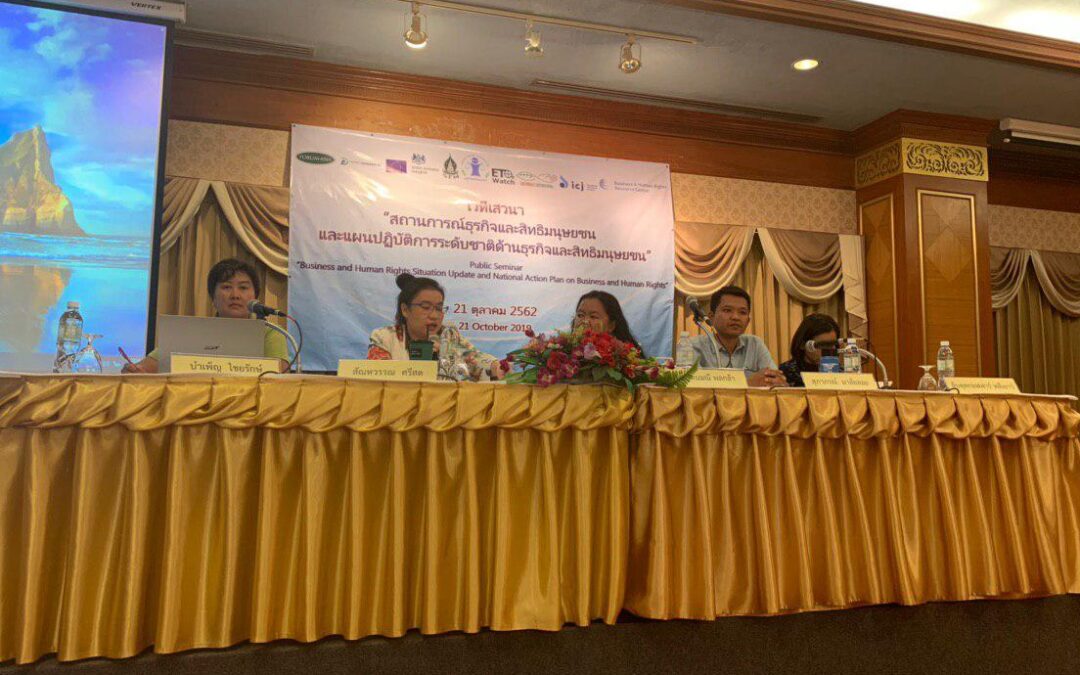
On 21 October 2019, the ICJ co-hosted an event on “Business and Human Rights and Thailand’s National Action Plan on Business and Human Rights” at Mido Hotel in Bangkok.
The discussion surrounded the evolution of business and human rights in Thailand and concerns arising with respect to the National Action Plan on Business and Human Rights (‘NAP’)’s key priority issues.
Notably, on the same day of this event, the NAP was being considered by the Cabinet for approval.
Participants included 37 individuals representing affected populations from all regions of Thailand, members of civil society organizations, and representatives from international organizations.
Sanhawan Srisod, ICJ’s Legal Adviser, spoke at a panel on ‘Land, Environment and Natural Resources’, addressing key concerns arising with respect to environmental laws in Thailand. These included the lack of adequate consultations with affected stakeholders before implementing development projects, inadequate assessment of environmental impacts prior to policy determination, inadequate protections under relevant laws on the environment, problems arising from Environmental Impact Assessment (EIA) and Environmental and Health Impact Assessment (EHIA) processes, and obstacles in accessing remedy for environment-related cases. She also facilitated another panel on judicial harassment of human rights defenders.
Saovanee Kaewjullakarn, ICJ’s Legal Consultant, facilitated a panel on Thai outbound investment and challenges with respect to access to justice for victims of human rights abuses committed by Thai corporations in the context of their business activities abroad.
The event was co-hosted with the Community Resource Centre Foundation (CRC), Spirit in Education Movement (SEM), Thai Extra-Territorial Obligations Working Group (Thai ETOs Watch), EarthRights International (ERI), Asian Forum for Human Rights and Development (FORUM-ASIA), Business and Human Rights Resource Center (BHRRC) and the British Embassy in Thailand.
Background
After the event, on 29 October 2019, the Cabinet approved and adopted the First National Action Plan on Business and Human Rights (2019-2022), making Thailand the first country in Asia to adopt the stand-alone NAP.
The NAP sets out plans to be followed by several public and private stakeholders in order to ensure the state’s and business’s duty to protect and respect human rights, and the general obligation of the State and businesses to provide for access to remedy in the case of business-related human rights violations and abuses. NAP has determined four key priority issues, including (1) Labor; (2) Land, environment and natural resources; (3) Human rights defenders; and (4) Cross border investment and multi-national enterprises.
Subject to these four key priority issues, the NAP emphasizes the duties of the relevant State agencies to, inter alia, review and amend certain laws, regulations and orders that are not in compliance with human rights laws and standards and ensure their full implementation, ensure mechanisms for redress and accountability for damage done to affected communities and individuals, overcome the barriers to meaningful participation of communities and key affected populations, and strengthen the role of businesses to “respect” human rights on a variety of key priority issues.
Its effectiveness in term of implementation is yet to be assessed because the NAP does not have the status of a law, but is merely a resolution from the executive branch. Under Thai law, a Cabinet Resolution is considered a “by-law” in accordance with section 3 of the Act on Establishment of Administrative Courts and Administrative Court Procedure, B.E. 2542 (1999).
In March 2019, the ICJ and Human Rights Lawyers’ Association (HRLA) had also submitted recommendations to the Ministry of Justice on Thailand’s draft NAP and expressed concern on the removal of a commitment that had been included in earlier versions of the NAP to “push for an Anti- Strategic Litigation against Public Participation (SLAPP) law”.
Further reading:
Thailand: ICJ hosts discussion on human rights consequences of Special Investment Zones
Thailand’s Legal Frameworks on Corporate Accountability for Outbound Investments
Thailand: ICJ and HRLA express concern about inadequate protections for human rights defenders in draft National Action Plan on Business and Human Rights
Oct 10, 2019 | Advocacy, News
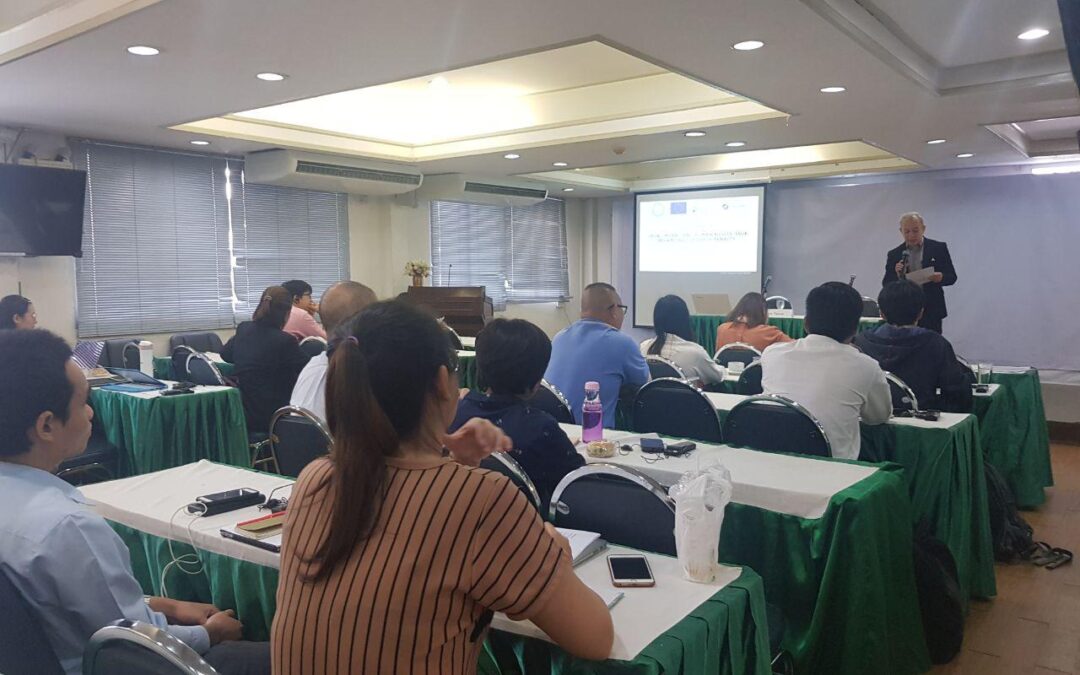
On 9 October 2019, in commemoration of the World Day against the Death Penalty (10 October), the ICJ, Thai Journalists Association (TJA), Internews, and the Delegation of the European Union in Thailand held a workshop on “Legal, Moral and Human Rights Issues in Death Penalty” at the Thai Journalists’ Association.
The participants included 35 journalists from various news agencies in Thailand and journalism and human rights students.
The course aimed to help strengthen the capacity of journalists to write informatively and critically about death penalty issues in Thailand. Through this course, journalists learned about the abolition of death penalty in other regions of the world and reviewed cases which have transformed public opinion on capital punishment around the world.
Sanhawan Srisod, the ICJ’s Legal Adviser, held a session to discuss capital punishment in Thailand’s criminal justice system. She underscored that there is no perfect justice system and as the risk of miscarriage of justice is always present, the death penalty should not be retained. She further encouraged journalists to help strengthen calls for an effective criminal justice response to serious crimes, as an alternative to the death penalty. She further pointed out current domestic investigation and prosecution practices which risk breaching international law and standards. These, she noted, may hamper the legality and efficiency of investigations and prosecutions, and pose a risk of rendering an innocent person eligible for capital punishment.
Other speakers at the Workshop included:
- E. Mr Pirkka Tapiola, Ambassador of the European Union to Thailand
- E. Mr Emilio de Miguel Calabia, Ambassador of Spain to Thailand
- Judge Hanne Sophie Greve, Commissioner, the International Commission against the Death Penalty (ICDP)
- Representative from Thailand’s Ministry of Justice
- Toshi Kazama, Photographer and anti-death penalty advocate
- Orasom Suthisakorn, Author and prison writing course instructor
Background
The ICJ categorically opposes the death penalty in all situations and considers it a violation of the right to life and a form of cruel, inhuman or degrading punishment.
Thailand has repeated commitments on the international stage to work towards abolition and has committed to becoming an abolitionist state in its master plan for human rights.
In June 2018, however, 26-year-old Teerasak Longji was executed by lethal injection for aggravated murder. It was Thailand’s first execution in nine years. The last previous execution occurred in 2009 when two men were executed for drug-related crimes.
The UN General Assembly, has repeatedly adopted Resolutions supported by very wide majorities, calling on all retentionist states to observe a moratorium on the death penalty with a view to full abolition.
Thailand is a State party to the International Covenant on Civil and Political Rights (ICCPR). Thailand has not become party to the Second Optional Protocol to the ICCPR, aiming at the abolition of the death penalty in law and practice.
In March 2017, the UN Human Rights Committee, the body mandated to interpret and monitor compliance with respect to the ICCPR, issued Concluding Observations after reviewing Thailand’s 2nd country report on the implementation of its obligations under the ICCPR. The Human Rights Committee recommended that Thailand “consider abolishing the death penalty and acceding to the Second Optional Protocol to the ICCPR”, and if the death penalty is maintained, to “take all measures necessary… to ensure that it is limited to the most serious crimes, such as acts carried out with the intention of killing.”
There are reportedly 55 crimes punishable by death in Thailand, including crimes relating to corruption, bribery and drugs, which do not meet the threshold of the “most serious crimes” within the meaning of the ICCPR.
Oct 7, 2019 | News
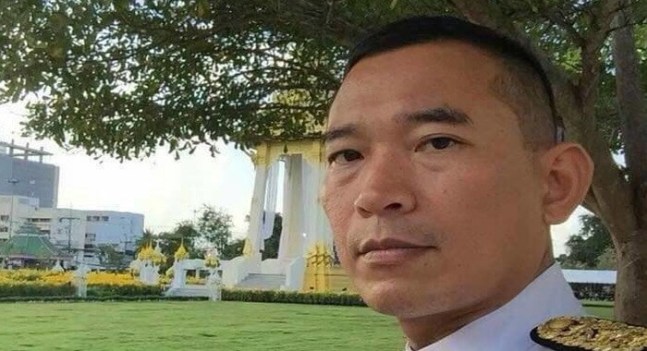
The apparent suicide attempt of a judge in southern Thailand highlights the need for urgent reform of the judiciary to improve its independence from political interference, the ICJ said today.
Judge Khanakorn Pianchana, Vice Presiding Judge of the Yala Provincial Court in Thailand’s restive southern region, reportedly shot himself in the chest following his delivery of a verdict on 4 October in a case in which he alleged political interference in his judicial functions. Judge Khanakorn is currently hospitalized in critical condition.
“This unfortunate incident again shows the need for sustained reforms of law enforcement and particularly of the independence of the judiciary in Thailand,” said Frederick Rawski, ICJ’s Asia director.
Judge Khanakorn had alleged in a 25-page note that he was ordered in confidence to rewrite his ruling exonerating five suspects of murder charges – a decision he had allegedly reached on the basis of lack of sufficient evidence. The five have had been detained and interrogated under special security laws in force in the Southern Border Provinces of Thailand.
Under Thai law, if a superior judicial officer disagrees with a ruling of any judge, he or she must express such disagreement in writing and is forbidden from speaking to a judge in confidence to reverse the ruling.
“The ICJ has worked for years with the judiciary in southern Thailand to improve the administration of justice, especially by addressing problems such as the improper admission of evidence and problematic evidence-gathering by security forces countering armed groups,” Rawski said. “This case again shows how misuse of emergency decrees in southern Thailand has aggravated the political pressure exerted on judges.”
Today, the case was submitted to the Office of the Judicial Commission for its consideration. The Commission, chaired by the President of the Supreme Court, comprises of qualified members who are judicial officers of each level of the Court. Consequently, the Commission passed a resolution to set up a Sub-Committee comprises three of its members to investigate into the allegations.
Particularly because Judge Khanakorn’s claim involves several senior judges in active services, the Sub-Committee set up by the Commission to investigate the allegations must therefore be independent institutionally and functionally, at all stages of the investigation. Their mandate should be broadened to look into whether there is wider pattern and practice of interference beyond this case.
Background
Judge Khanakorn presided over a trial involving the alleged murder of five people in Yala province in 2018. Following the killing, authorities arrested five suspects who were charged with murder, secret association, conspiracy and gun-related offences. If convicted, three out of five defendants could be sentenced to death.
The five suspects were reportedly detained and interrogated under much-criticized special security laws which remain in force in the Southern Border Provinces of Thailand – i.e Martial Law and Emergency Decree. The ICJ has repeatedly criticized how the Martial Law confers upon military authorities the powers to arrest and detain any person without a warrant for up to seven days for interrogation and questioning and does not require detainees to be brought before a court at any stage of their detention. The ICJ has also repeatedly analyzed and criticized the Emergency Decree, which breaches international law and standards, by allowing authorities to detain suspects, with the leave of the Court, for up to 30 days. The law does not require a detainee to be physically brought before the Court during this period.
Information submitted to the court as evidence in this case had reportedly been obtained from the suspects during detention periods prescribed under Martial Law and the Emergency Decree. Judge Khanakorn noted in his statement that he was of the view that any information obtained during this period should not be admissible because rights protections had not been afforded to the suspects who had been detained under security laws, as they are provided to suspects in other criminal trials. This position had reportedly led to the disagreements between the judge and his supervisor over the case ruling.
The ICJ has repeatedly expressed concern on the use as evidence of information obtained during interrogation under emergency laws in criminal proceedings of security-related cases, in the form of witness statements or inquiry reports from interrogation officials. The ICJ has called on Thailand to review existing standards in all special security laws and relevant articles in the Criminal Procedure Code regarding the admissibility of evidence that are not compatible with international fair trial standards.
Judge Khanakorn also described in his statement that certain evidence needed to have been ruled inadmissible as it had not been collected by competent authorities but by volunteers who were not competent or specialized in evidence collection.
Judge Khanakorn further asserted that interference in his judicial functions had also occurred in 2018 when he had been under pressure to reduce the sentence of three military officers who had been found to have shot villagers to death.
The right to a fair hearing in judicial proceedings before an independent and impartial court or tribunal is guaranteed in several human rights instruments, including the International Covenant on Civil and Political Rights (ICCPR), which Thailand is a party. The right is also enshrined in section 188 of the 2017 Constitution of Thailand.
International standards also reaffirm that judicial independence requires not only the independence of the judiciary as an institution from the other branches of government; it also requires judges being independent from each other. Such freedom from undue influence that might come from other judges is guaranteed in several internationally accepted standards, including Principle 1.4 of the Bangalore Principles of Judicial Conduct and its Commentary; article 3 of the Universal Charter of the Judge; and article 2 of the Basic Principles on the Independence of the Judiciary.
Further reading:
International principles on the independence and accountability of judges, lawyers and prosecutors – Practitioners’ guide, no. 1
Thailand: ICJ co-hosts lawyers’ meeting on admissibility of evidence in the national security context
Thailand : legal memorandum – hearsay evidence and international fair trial standards
Thailand : implementation of Thailand´s emergency decree
Contact:
Frederick Rawski, ICJ Asia-Pacific Director, t: +66 64 478 1121; e: frederick.rawski(a)icj.org
Download:
Thailand-Suicide of Judge-News-2019-THA (Thai version, in PDF)
Sep 4, 2019 | News
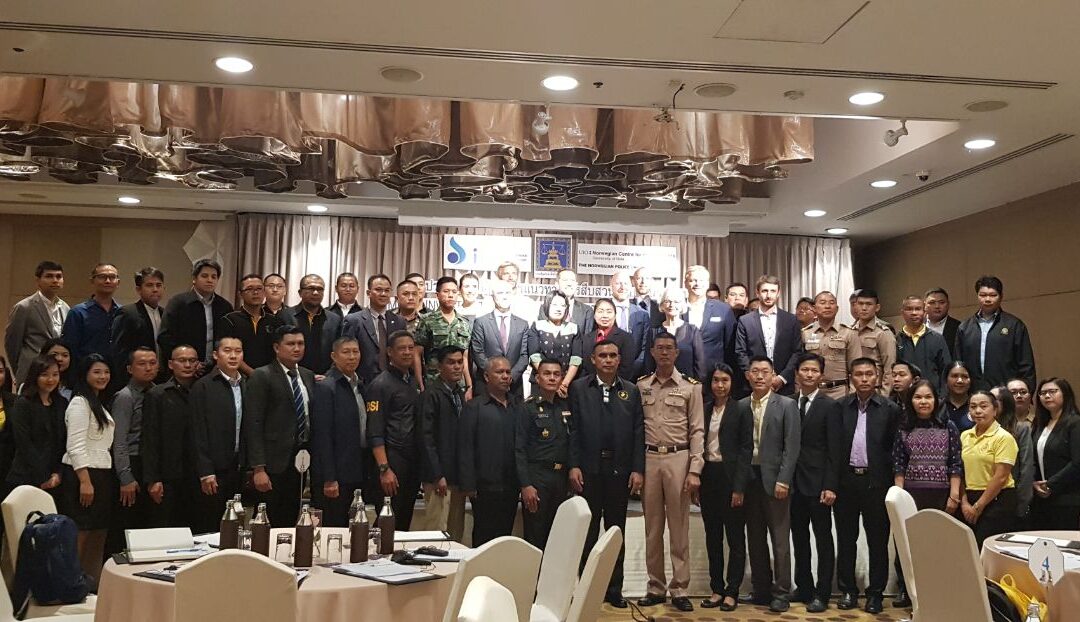
From 2 to 3 September 2019, the ICJ co-hosted a workshop in Bangkok for justice sector authorities from Thailand on ‘Human Rights Compliant Criminal Investigation and Investigative Interviewing’. The event focused on international law and standards regarding investigative interviewing of victims, witnesses and suspects in criminal cases.
The workshop was co-hosted with Thailand’s Ministry of Justice and the Norwegian Centre of Human Rights, University of Oslo.
The participants included 50 criminal investigators, public prosecutors, representatives of the Ministry of Justice’s Department of Special Investigation (DSI), the Internal Security Operations Command, Ministry of Defense’s Judge Advocate General’s Office, the National Anti-Corruption Commission, the Office of the Narcotics Control Board and the Royal Police Cadet Academy.
A primary objective of the workshop was to promote and explain the principle that interviews which are conducted in compliance with human rights standards produce much more effective results without resort to torture, ill-treatment or coercion. The workshop also addressed the problem of a ‘confession culture’ and looked into how unlawful interrogations threatened the quality and legitimacy of justice sector officials and bodies in meting criminal justice. Participants also conducted discussions and participated in group activities on human memory, investigative management and the conducting of interviews grounded in fundamental principles of international human rights law.
Speakers at the Workshop included:
- Aim-orn Siangyai, Deputy Director General of Thailand’s Rights and Liberties Protection Department, Ministry of Justice;
- Frederick Rawski, Asia Pacific Regional Director, ICJ;
- Gisle Kvanvig, Programme Director for ASEAN/Vietnam, Norwegian Center for Human Rights;
- Asbjørn Rachlew and Dr. Ivar A. Fahsing, experienced investigators from the Norwegian Police Department;
- Lilian M. Stein, Professor at the Psychology Postgraduate Department, Pontifical Catholic University of Rio Grande do Sul; and
- Mary Schollum, a criminologist and lead drafter of the Universal Guidelines on Investigative Interviewing.
Background
This workshop is part of the ICJ’s ongoing efforts to ensure the domestic implementation of international law and standards in crime investigation.
Previous ICJ workshops on the above topic have included:
Regional Workshops
National Workshops