Jun 28, 2017 | Advocacy, Non-legal submissions
The ICJ has joined other leading human rights NGOs in setting out a range of specific measures to increase the effectiveness of UN Special Procedures – independent experts appointed by the Human Rights Council to address particular themes or countries.
The written submission was made in the context of the Annual Meeting of the Special Procedures, in Geneva.
Coordinated by the International Service for Human Rights (ISHR), the document assesses current practices against a range of recommendations made in an earlier joint civil society submission in 2016.
The 2017 submission welcomes progress on a number of the recommendations, but also highlights issues where little or no progress has been made. It also offers several new recommendations.
Among the positive developments are the enhanced role of the Coordination Committee, action taken to combat reprisals, the creation of a database where details of individual communications (i.e. complaints) can be accessed, and engagement of Special Procedures with international and regional forums.
The full 2017 submission, entitled “The Special Procedures: Developments in Institutional Strengthening and Working Methods”, can be downloaded in PDF format here: UN-Submission-AnnualMeetingSpecialProcedures-2017
Jun 23, 2017 | Advocacy, Non-legal submissions
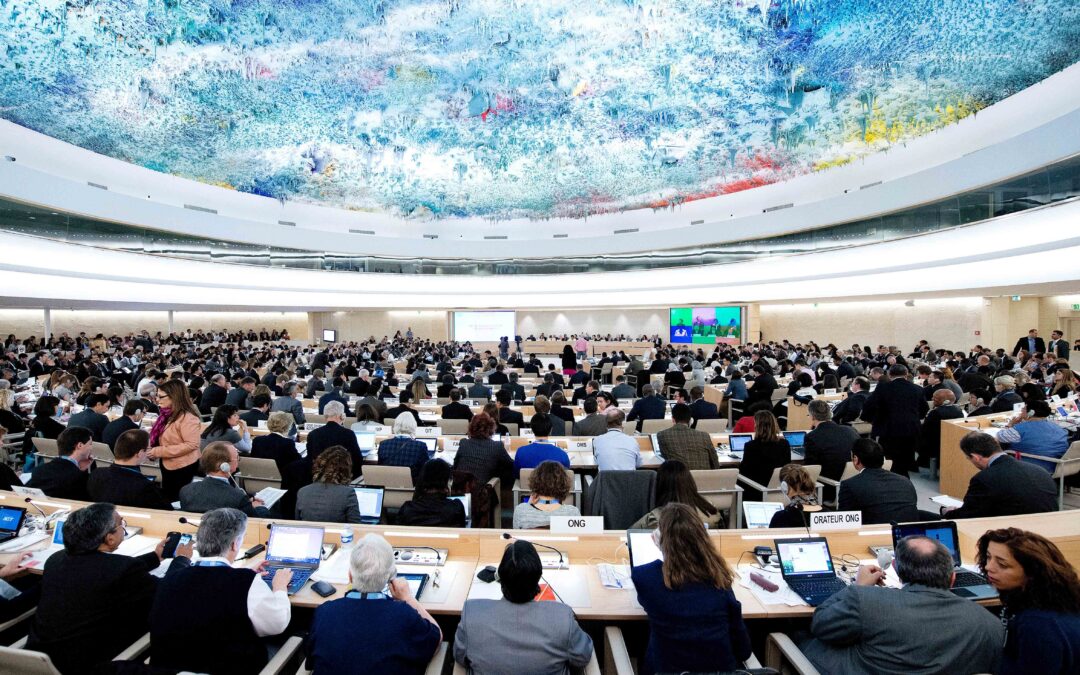
The ICJ has joined other NGOs in highlighting some of the achievements and failures of the June 2017 session of the UN Human Rights Council in a statement at the end of the session.
The statement, delivered on behalf of the group of NGOs by the International Service for Human Rights (ISHR), read as follows:
At the close of this session, we welcome the commitment by many States from all regions to enhance the Council’s success and effectiveness, and the performance of Human Rights Council (HRC) members through a series of concrete actions. The steps outlined by the Netherlands, such as more competitive HRC elections and the application of objective human rights based criteria to determine whether and how to act on situations of concern, would go a long way in making the Council more accessible, effective, and protective.
The leadership shown by States in the development of joint statements on killings in the Philippines‘ so-called ‘war on drugs’ and threats against human rights defenders, and on the increasingly dire situation in the Maldives are examples of this. We regret the lack of such leadership on other States including China and Egypt.
Although we’d hoped for a more robust response on the Democratic Republic of the Congo (DRC) from the Council, the international team of experts brings hope of uncovering the truth about the horrific violence in the Kasai. The UN, this Council, and the DRC itself must now ensure unhindered access for and support to the team, for it to independently produce a robust and credible report, which will constitute a step towards accountability.
We congratulate Cote d’Ivoire for its six years of cooperation with the UN and the mandate of the Independent Expert. We urge the Council to continue to pay attention to the human rights situation, particularly in the context of recent mutinies, and to assist the country in the implementation of the Independent Expert’s recommendations, including by striving for A-status for its National Human Rights Institution (NHRI).
We also echo the joint call by several States urging you to create a publicly accessible register of alleged acts of intimidation and reprisals and to provide short oral updates on cases at the start of every Item 5 general debate giving States concerned the opportunity to respond.
We also welcome the joint statement of the core group on civil society space together with some NGOs, and its reaffirmation that the “substantive participation of civil society makes this Council’s debates and work, including the UPR, richer and more meaningful”.
Mr President,
We are pleased that both resolutions on discrimination and violence against women were adopted by consensus, and that adverse amendments designed to remove language on comprehensive sexuality education and women human rights defenders were defeated. We regret that the Russian Federation and others systematically seek to remove reference to human rights defenders in all resolutions at each session. Denial of the existence of defenders is absurd, given the long history of formal recognition of the concept by the Commission on Human Rights, Council and General Assembly.
We regret that the resolution on the “protection of the family” fails to fully recognise that older persons are individual rights holders entitled to self-determination and autonomy, and ignores a significant UN process, the General Assembly Open-Ended Working Group on Ageing. The resolution also fails to acknowledge that diverse forms of the family exist. The entire initiative is implicated in an effort to subvert the aims of our human rights system and the universality of rights.
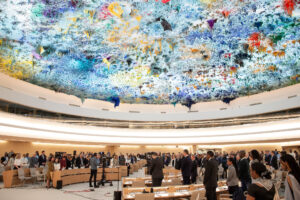
In closing, Mr President, we are dismayed at the lack of progress in terms of ensuring the most effective participation of civil society, in accordance with established rules and practice of the Council. Although symbolic, the massive reduction of reserved NGO desk space in this room is illustrative of this.
We are concerned about the lack of formal engagement by you and your Bureau with civil society, the absence of visible steps to curb and respond to intimidation or reprisals, and the abusive interruptions of NGO statements, including in some instances by the chair. And we look forward to engaging with your office to reverse this trend.
Thank you.
Among the NGOs joining the statement were the following:
- Amnesty International
- CIVICUS
- Human Rights Watch
- International Commission of Jurists
- International Lesbian, Gay, Bisexual, Trans and Intersex Association (ILGA)
- International Longevity Center Global Alliance
- International Platform Against Impunity
- International Service for Human Rights
The joint statement may be downloaded in PDF here: UN-HRC35-EndSessionStatement-2017
* For additional information on ICJ priorities and activities at the session, see the following:
Refugees and migrants: the role of judges and lawyers
Business responsibility to protect human rights
Corporate impunity; legal protection of refugees and migrants
Discrimination against women in access to justice
Threats to independence of judges and lawyers; backsliding on violence against women
Ensuring women’s access to justice for gender based violence
Turkey: judicial independence and freedom of expression
Civil society space in the Human Rights Council
Call for strong action on Egypt at the Human Rights Council
Continuing lack of accountability for rendition and secret detention
“Protection of the Family”: concerns regarding the resolution
UN Human Rights Council adopts resolutions on independence of judges and lawyers
Jun 22, 2017 | News
The ICJ welcomes the adoption today, by consensus, of two UN Human Rights Council resolutions on the independence of judges & lawyers.
The Human Rights Council adopted the biannual resolution on independence of judges and lawyers, including a number of new elements on the theme of independence of lawyers and the legal profession. In particular, the resolution highlights the ongoing threats against and interference with the independence of lawyers and the ability of lawyers to fulfil their professional functions, including in relation to human rights.
The resolution reaffirms and builds on the UN Basic Principles on the Role of Lawyers.
The Human Rights Council also unanimously renewed the mandate of the Special Rapporteur on Independence of Judges and Lawyers for a further period of three years.
The unofficial text of the two resolutions are available in PDF format below:
Official versions will eventually appear on the UN website, at this location.
Jun 13, 2017 | Advocacy, Non-legal submissions
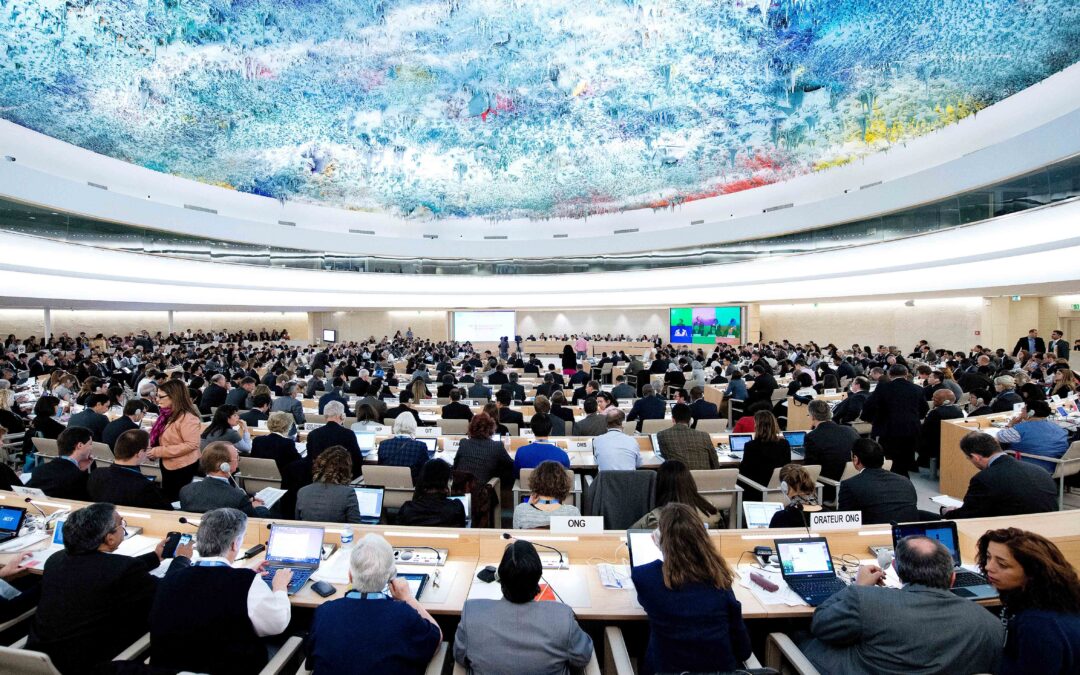
The ICJ today spoke on behalf of a number of NGOs, drawing the attention of the Human Rights Council to the fact that the Council is permitting civil society space to shrink within its own chamber.
The statement was as follows:
Mr President,
We thank States for their commitment to address the shrinking space for civil society.
We draw the Council’s attention to the fact that since 2013, the number of desks reserved for NGOs in room XX for Human Rights Council sessions has been reduced from 24 to 2, leaving only the two speaking seats we are now sitting in.
This has been drawn to the attention of successive Presidents of the Council but the space has continued to shrink.
We invite all delegations to reflect on the impression this gives to civil society, not to mention States and other international actors, about the Council’s commitment to addressing shrinking civil society space.
I thank you Mr President.
The statement was delivered by the ICJ on behalf of the following NGOs:
- Article 19
- Asian Forum for Human Rights and Development (Forum-Asia)
- Bahá’í International Community
- CIVICUS – World Alliance for Citizen Participation
- DefendDefenders (the East and Horn of Africa Human Rights Defenders Project)
- FIAN International
- Franciscans International
- International Bar Association
- International Commission of Jurists (ICJ)
- International Federation for Human Rights Leagues (FIDH)
- International Lesbian and Gay Association (ILGA)
- the International Movement against All forms of Discrimination and Racism (IMADR)
- International Platform Against Impunity
- International Service for Human Rights (ISHR)
- Minority Rights Group International
- Peace Brigades International (PBI)
- Universal Rights Group (URG)
- Women’s International League for Peace and Freedom (WILPF).
The statement can be downloaded in PDF format here: HRC35-OralStatement-GDItem3-CivilSocietySpace-2017
Jun 12, 2017 | Advocacy, Non-legal submissions
Speaking at the UN Human Rights Council, the ICJ today highlighted judicial corruption and threats to judges and lawyers in Turkey and Azerbaijan, as well as regressive steps on violence against women in the United States of America and Russian Federation.
The statement, delivered during the interactive dialogue with the UN Special Rapporteur on Independence of Judges and Lawyers and the UN Special Rapporteur on Violence against Women, was as follows:
“The ICJ warmly welcomes the new Special Rapporteur on Independence of Judges and Lawyers. As he has highlighted, ensuring judges are accountable for corruption and human rights violations, while respecting judicial independence, should be a global priority. Our Practitioners’ Guide on Judicial Accountability, published last year, should be of particular use to the Rapporteur and other actors in this regard.
Several situations serve as stark examples of other issues raised in his report. In Turkey, recent constitutional amendments give the President and Parliament control over the judiciary’s governing body. This has undermined the judiciary’s independence, already threatened by the mass dismissal of judges and the state of emergency. Lawyers and legal scholars, among others, are routinely dismissed or threatened by the authorities.
In Azerbaijan, the Bar Association is not independent and does not protect its members against undue interference with the exercise of their professional duties. Rather, it often serves as a tool of retaliation against independent human rights lawyers, including through disbarment proceedings that contravene international standards.
We would ask the Special Rapporteur for his views on the role his mandate can play in these and similar situations.
The ICJ also welcomes the report of the Special Rapporteur on violence against women.
Despite increasing global acknowledgement of the grave and systemic nature of violence against women, some States continue to introduce regressive legislation undermining protections for women. For example, the Russian Federation’s decriminalization of certain forms of domestic violence, and attempts in some parts of the United States of America to restrict availability of sexual and reproductive healthcare, particularly impact on victims of sexual violence. The Philippines’ President’s public statements disregarding the gravity of sexual violence are another example. The ICJ would ask the Special Rapporteur what can be done to prevent such backsliding?”