Oct 2, 2017 | Advocacy, Non-legal submissions
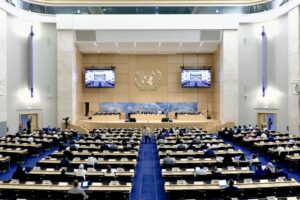
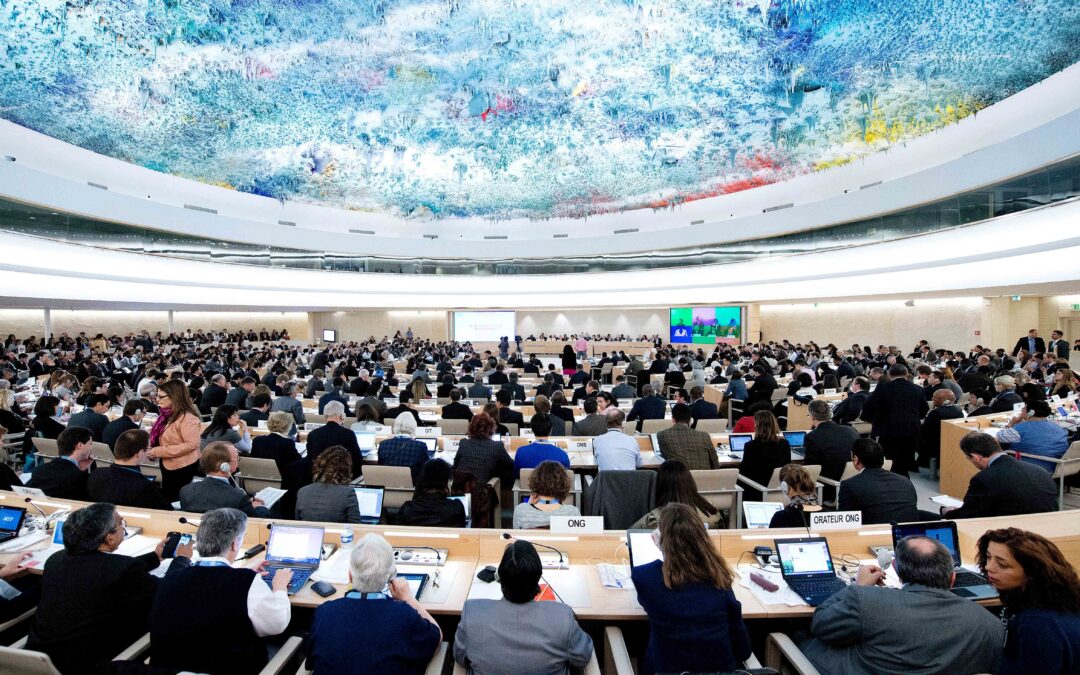
The ICJ has joined other NGOs in welcoming action by the HRC on Yemen, Burundi, and DRC, as well as on reprisals and intimidation against civil society and human rights defenders, and the death penalty, while expressing disappointment about lack of adequate action on other matters.
The full statement is as follows:
Joint statement by International Service for Human Rights on behalf of Amnesty International, Asian Forum on Human Rights and Development (Forum Asia), Cairo Institute for Human Rights Studies (CIHRS), CIVICUS, Human Rights House Foundation, International Commission of Jurists and the International Lesbian, Gay, Bisexual, Trans and Intersex Association (ILGA).
We welcome the adoption of the resolution intended to end acts of intimidation or reprisals. However, we regret that a small group of States – most of them regular perpetrators of acts of intimidation or reprisals – have tried to undermine the Council’s efforts to end reprisals. We thank the majority of the Council members for resisting these efforts.
We are concerned that there were attempts to dilute several resolutions at this Council with the insertion of so-called “sovereignty” clauses. While we welcome the fact that they were ultimately defeated, we are concerned that a significant number members seek to use the concept of Sovereignty to shield themselves and other States from international scrutiny.
We also welcome that the resolution on the death penalty urges States to not impose it as a sanction for specific forms of conduct such as apostasy, blasphemy, adultery and consensual same-sex relations.
We applaud the creation by consensus of an international investigative body on Yemen, and the broad State leadership on this issue. It sends a message that the people of Yemen have not been abandoned, and that accountability for international crimes is urgently required. We call on all parties to the conflict to fully cooperate with this mandate.
On Burundi, we welcome the extension of the mandate of the Commission of Inquiry (COI). This was the only credible response to the CoI’s concerns that crimes against humanity may have been committed, and the persistent non-cooperation of Burundi with both the COI and the OHCHR presence in the country. We urge Burundi to follow through on its promises to start cooperating with the UN system, in line with duties as HRC member, and – failing that – call on the General Assembly to take appropriate action.
On Myanmar, while we welcome the extension of the fact-finding mission’s mandate, we are disappointed that the Council did not do more to address the gravity of the situation on the ground, in particular acknowledging the disproportionate campaign of violence by Myanmar’s security forces in Rakhine State, which have forced around half a million Rohingya to flee to Bangladesh since 25 August. We urge States to use the ongoing UN General Assembly session to address what the High Commissioner for Human Rights described to the Council as a “textbook example of ethnic cleansing.”
On Cambodia, while the Council missed an opportunity for robust scrutiny of the worsening situation, the pre-election reporting in March should put authorities on notice.
On the Democratic Republic of the Congo (DRC), we welcome the Council’s decision to boost scrutiny of the human rights crisis for another year, which shows how horrific the situation has become. The DRC must now cooperate with all Council mechanisms, and the Council needs to keep its eyes on the country until all actors stop committing violations and abuses, and justice for victims has been obtained.
Finally, we regret the increasing effort spent on procedural tricks and manoeuvers by States in an attempt avoid scrutiny – including by abusing the privilege of being a member to seek to avoid scrutiny of their own situation – instead of spending diplomatic time and capital on ending human rights violations, which is the Council’s core mandate. A renewed commitment to addressing situations based on objective criteria is now more urgent than ever.
Oct 2, 2017 | News
The ICJ, APT, OMCT, FIACAT, Redress, Amnesty, IRCT, and Alkarama have constructed a checklist for membership to guide the States parties to the Convention against Torture and Other Cruel, Inhuman or Degrading Treatment or Punishment in selecting five new members later this month.
See Checklist here:
Universal-CriteriaMembership-News-2017-ENG
Sep 13, 2017 | Advocacy
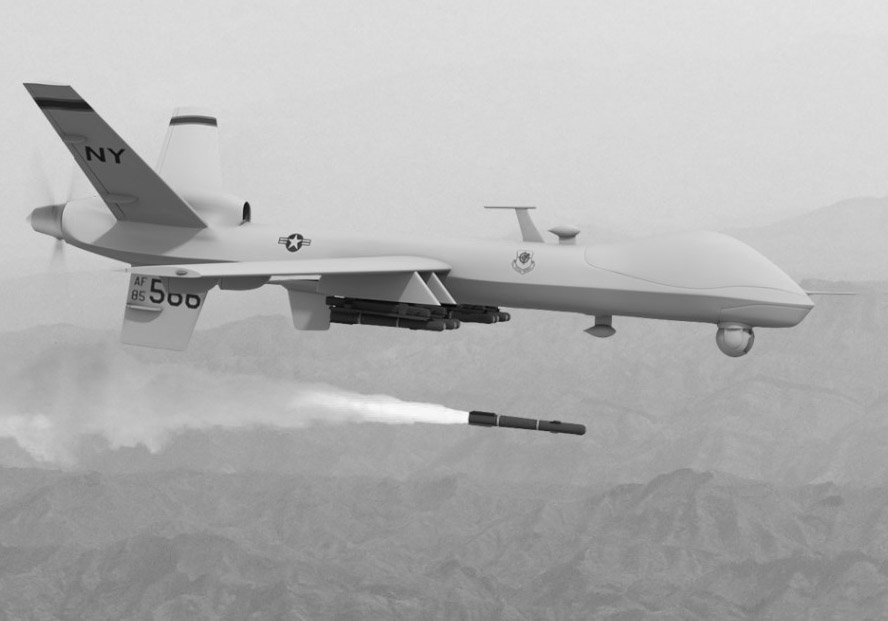
The ICJ joined 17 other organizations in calling for robust and human rights compliant international standards to regulate the use of “Unmanned Aerial Vehicles” , developed through fully inclusive and consultative processes.
Universal-DroneStandards-Advocacy-2017-ENG (full PDF)
Sep 5, 2017 | Events, News
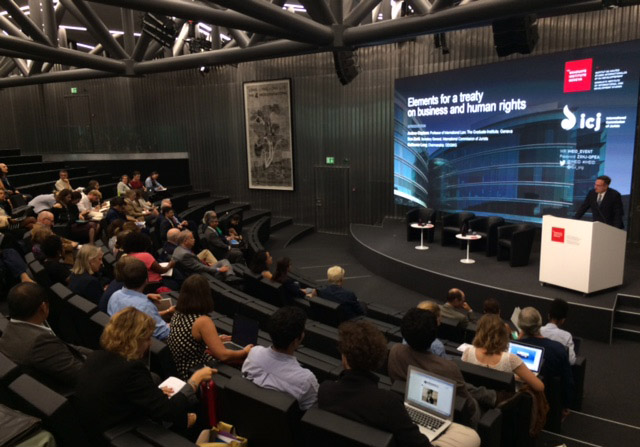
Today the ICJ and the Graduate Institute of International and Development Studies co-organized a public conference: Elements of a treaty on Business and Human Rights.
In June 2014, the United Nations Human Rights Council established an inter-governmental working group to “elaborate an international legally binding instrument to regulate, in international human rights law, the activities of transnational corporations and other business enterprises”.
The third session of the working group will take place from 23-27 October 2017 at the Palais des Nations.
Today’s event took place at a critical moment to inform the process of elaboration by the working group.
It fosters the exchange of views among international actors, with the aim of creating the basis for consensus on possible contents of a legally binding instrument in the field of business and human rights.
The prospective treaty is expected to contribute to fill some accountability gaps in the international normative framework, in relation to the operations of business enterprises in terms of human rights.
The treaty should also enhance States’ action to ensure effective remedies and reparations for the victims of abuses.
This treaty will be the first in the international human rights law framework to address directly activities of business corporations.
The issue of human rights impacts by business enterprises has reached the top of the international agenda, and several non-treaty instruments have been developed, foremost among them the Guiding Principles on Business and Human Rights.
The process towards a treaty in this field is expected to build on the achievements so far, filling remaining gaps and enhancing rules for and action by states and businesses alike.
For additional information & registration click here
See also the photo of the week on Genève Internationale
Jul 20, 2017 | News
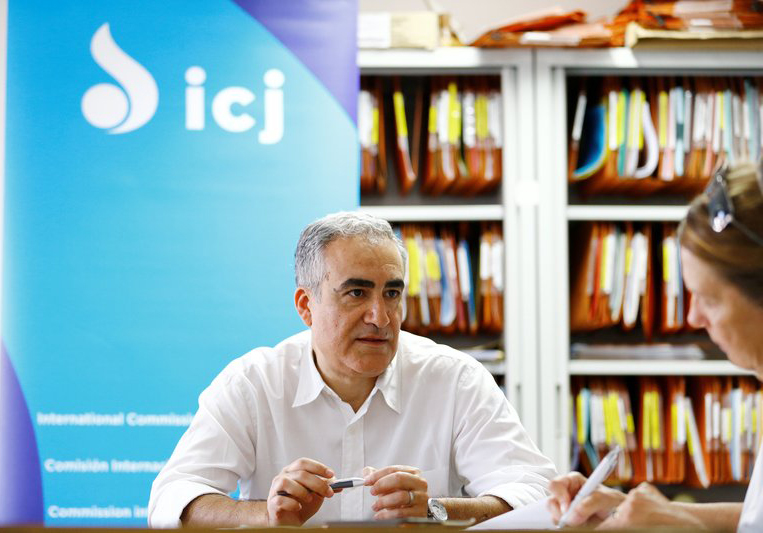
An interview of ICJ Secretary General Sam Zarifi with Reuters journalist Stephanie Nebehay.
GENEVA (Reuters) – Donald Trump is one of a new breed of leaders around the world who seek to use their democratic mandate to undermine the rule of law, the head of a legal and human rights watchdog said on Wednesday.
Branding the U.S. president an “authoritarian populist”, Saman Zia-Zarifi, secretary-general of the Geneva-based International Commission of Jurists (ICJ), compared him to the leaders of Turkey, the Philippines, Hungary and Venezuela.
Zarifi cited as an example Trump’s travel ban on nationals from six Muslim-majority countries, a policy that he called “highly problematic” under the U.S. constitution and international law.
“What is different now is that a certain kind of populism is being used to actually counter the notion of the rule of law,” Zarifi said in an interview at the headquarters of the ICJ, which is composed of 60 eminent judges and lawyers from all regions who seek to protect human rights and the rule of law.
“The new populism has a certain shamelessness about it that is new. It’s not that people are denying that they are violating rights, what they are saying is they can violate rights because somehow they are empowered by the people,” he said.
Zarifi, who took over at the ICJ in April, said the new breed of populists included Turkey’s President Tayyip Erdogan, Venezuela’s Nicolas Maduro, the Philippines’ Rodrigo Duterte, Hungary’s Prime Minister Viktor Orban and Jaroslaw Kaczynski, head of Poland’s ruling party.
“I would say that in the U.S., Trump is an authoritarian populist. He has authoritarian tendencies but he still is facing checks and balances,” Zarifi said. “So he is not a full-blown authoritarian figure.”
The U.S. Supreme Court revised parts of Trump’s executive order banning travellers from Iran, Libya, Somalia, Sudan, Syria and Yemen, a policy Trump says is aimed at tackling terrorism.
“Looking at it again from the point of view of U.S. law – I’m an American lawyer – it seems highly problematic,” said the Iranian-born Zarifi, who moved to the United States as a teenager and holds a law degree from Cornell University.
Supreme Court rulings would be, he said, “a test for the health of the system of checks and balances in the U.S.”
Turkish Judiciary “Politically Compromised”
A crackdown by Erdogan’s government has led to the arrest of 50,000 people and the suspension of 150,000 in the year since a failed military coup in Turkey where the judiciary is “now politically compromised”, Zarifi said.
The Turkish government has said the action is justified by the gravity of the threat to the state from the coup attempt.
On Monday, the state prosecutor asked a court to remand the local Amnesty International director and nine other activists in custody pending trial for membership of a terrorist organisation.
Erdogan was quoted by Turkish media this month as saying they were detained on the basis of intelligence and that the judiciary would make its own decision.
But Zarifi said the judiciary should have thrown the case out.
“The handling of the case highlights the very serious concerns – and alarm in fact at this point – that we have raised about the independence of the judiciary and the legal system in Turkey over the last few years.”
Photo Credit: Reuters / Pierre Albouy