Sep 29, 2020 | Advocacy, News
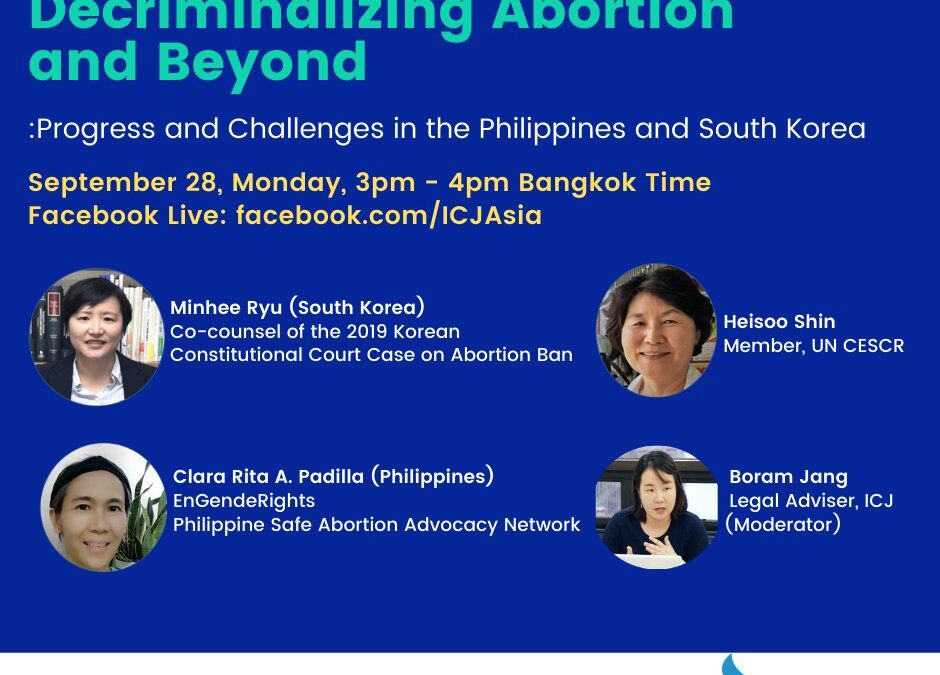
On the International Safe Abortion Day, the ICJ held a webinar on the decriminalization of abortion in the Philippines and the Republic of Korea.
The webinar focused on the legal provisions criminalizing abortion and on women human rights defenders’ struggle to decriminalize abortion in the Philippines and in the Republic of Korea. In addition, the participants highlighted States’ legal obligation to guarantee access to legal, safe and affordable abortion and post abortion care for all persons under international human rights law and standards.
Ms. Clara Rita A. Padilla from the Philippines’ Safe Abortion Advocacy Network; Ms. Minhee Ryu, Co-counsel in the 2019 Korean Constitutional Court case on the country’s criminal ban on abortion; and Dr. Heisoo Shin, member of the UN Committee on Economic, Social and Cultural Rights (CESCR) participated as speakers.
“The law imposing penalties on women who have an abortion and those assisting them only endangered the lives of women forced to seek unsafe abortion,” said Ms. Padilla. “Today, the Philippine Safe Abortion Advocacy Network introduced a draft bill, An Act Decriminalizing Induced Abortion to Save the Lives of Women, Girls, and Persons of Diverse Gender Identities, and we will continue advocating the repeal of the current discriminatory law against women and eliminate harmful stigma against women due to the restrictive abortion law and imposition of judgmental religious beliefs.”
Ms. Minhee Ryu talked about the women human rights defender’s movement in the Republic of Korea, including the work of the Joint Action for Reproductive Justice. She also highlighted the legal strategy to draw the Constitutional Court’s attention to the experience of girls, migrant women and women with disabilities in the context of the case that resulted in the Court holding that the criminalization of abortion was unconstitutional in April 2019.
“It is the core obligations of States to ensure the repeal of laws, policies and practices that criminalize, obstruct or undermine access by individuals or a particular group to sexual and reproductive health facilities and services,” said Dr. Heisoo Shin. “Denial of abortion often leads to maternal mortality and morbidity, which, in turn, constitute violations of the rights to life, dignity, autonomy, security, equality and non-discrimination, equality before the law and equal protection of the law without discrimination, privacy, physical and mental health, and the right to freedom from ill-treatment.”
The participants agreed that international human rights law and standards, such as the Human Rights Committee’s General Comment 36 on the right to life, and the CESCR’s General Comment 22 on the right to sexual and reproductive health, are instrumental in worldwide efforts to ensure access to legal, safe and affordable abortion and in advocating for its complete decriminalization.
Contact
Boram Jang, International Legal Adviser, e: boram.jang(a)icj.org
Sep 22, 2020 | Advocacy, News
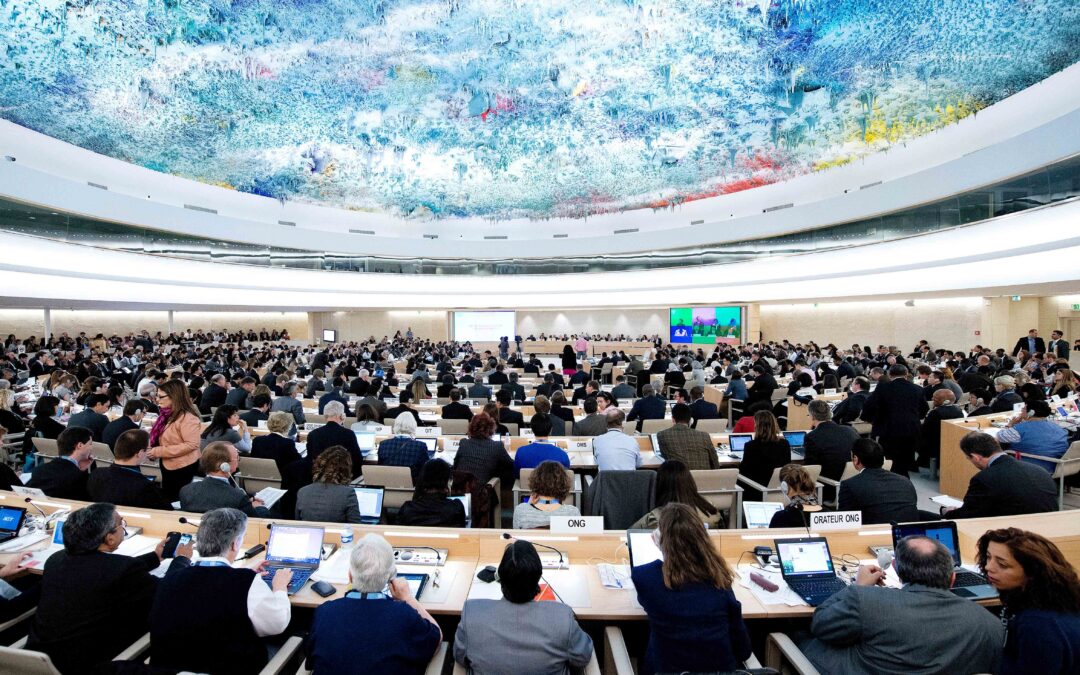
States should help pave the way towards credible accountability and redress for the people of Yemen by renewing and strengthening international investigations into war crimes, other serious violations of international humanitarian law, and grave human rights abuses during this 45th Session of the HRC, the ICJ and 23 other organizations said today.
Yemen is suffering from an “acute accountability gap,” according to the UN Group of Eminent Experts (GEE) on Yemen, which released its third report on September 9, 2020.
With COVID-19 threatening the lives and livelihoods of millions across Yemen, peace talks floundering, and airstrikes, shelling and attacks impacting civilians once again increasing, the reality for millions of Yemeni civilians is growing ever more bleak.
This session, the Human Rights Council has the opportunity to pave the way towards credible accountability and redress for victims and survivors in Yemen.
People in Yemen have experienced grave abuses since the conflict began in 2014, when Ansar Allah (the Houthi armed group) and military units loyal to former president Ali Abdullah Saleh took control of the capital, Sana’a, and escalated in 2015 when the Saudi/UAE-led coalition militarily intervened on the side of the Yemeni government.
With the conflict in its sixth year, millions of Yemenis are without adequate food, water, shelter or healthcare. The parties to the conflict impede the flow of life-saving goods into and around the country, attack critical infrastructure, and misdirect goods and their revenues to their own coffers and loyalists.
Thousands of civilians have been killed, wounded and otherwise harmed by airstrikes that violate international humanitarian law, indiscriminate shelling and the use of banned anti-personnel landmines.
The societal fabric has torn, with expression, speech, peaceful protest and movement increasingly restricted, and political and other identity-based divisions weaponized by those in power.
The human rights and humanitarian catastrophe in Yemen is man-made, and was avoidable. The parties to the conflict continue to hold the vast majority of power in and over Yemen.
For Yemen’s trajectory to change, the behavior of the parties to the conflict and their backers needs to change. As of September 2020, perpetrators have gone unpunished, states responsible for violations have faced no real consequences, parties have rarely acknowledged fault or taken measures to protect civilians, suppliers keep the arms used for international humanitarian law violations, and victims have been denied justice and redress.
In 2017, the Council established the GEE to report on violations of international law in Yemen and, where possible, to identify those responsible. The Council renewed the GEE’s mandate in 2018 and 2019, despite opposition from the Saudi/UAE-led coalition.
In its third report, the UN experts found the international community “can and should” do more to “help bridge the acute accountability gap” in Yemen.
The experts provided a list of specific recommendations, including for the Security Council to refer the situation in Yemen to the International Criminal Court and to expand the list of persons subject to Security Council sanctions.
The GEE supported the establishment of an investigative body, similar to the International, Impartial and Independent Mechanism for Syria, and specifically called on the Council to ensure the situation of human rights in Yemen remains on its agenda, including by ensuring adequate resources are provided to the GEE for the collection, preservation and analysis of information related to violations and crimes.
In the longer term, the Group encouraged “further dialogue about the creation of a special tribunal such as a ‘hybrid tribunal’ to prosecute cases of those most responsible,” reiterated the importance of victims’ right to a remedy, including reparations, and called for human rights to be “at the heart of any future peace negotiations,” including that “no steps are taken that would undermine respect for human rights and accountability, such as granting blanket amnesties.” 2
The GEE also reiterated concerns that states supplying arms to parties to the conflict, including to Saudi Arabia and the UAE, may be violating their obligations under the Arms Trade Treaty, and that this support may amount to aiding and assisting internationally wrongful acts.
Today, 24 Yemeni, regional, and international civil society organizations, including the ICJ, came together to call on the Council to endorse the GEE’s report, including its findings on accountability, and to take concrete steps this Council session to pave the way towards credible justice for Yemen.
The 24 organizations are calling on the Council to renew and strengthen the GEE’s mandate this September, including to collect, consolidate, preserve and analyze evidence related to, and clarify responsibility for, the most serious crimes under international law and violations of international law committed in Yemen since 2014.
The organizations are also calling on the Council to task the GEE with issuing a special report advising states on practical steps they can take to help ensure justice and redress for the tens of thousands of Yemeni civilians unlawfully harmed by the warring parties throughout this conflict.
Sep 18, 2020 | Advocacy, Non-legal submissions
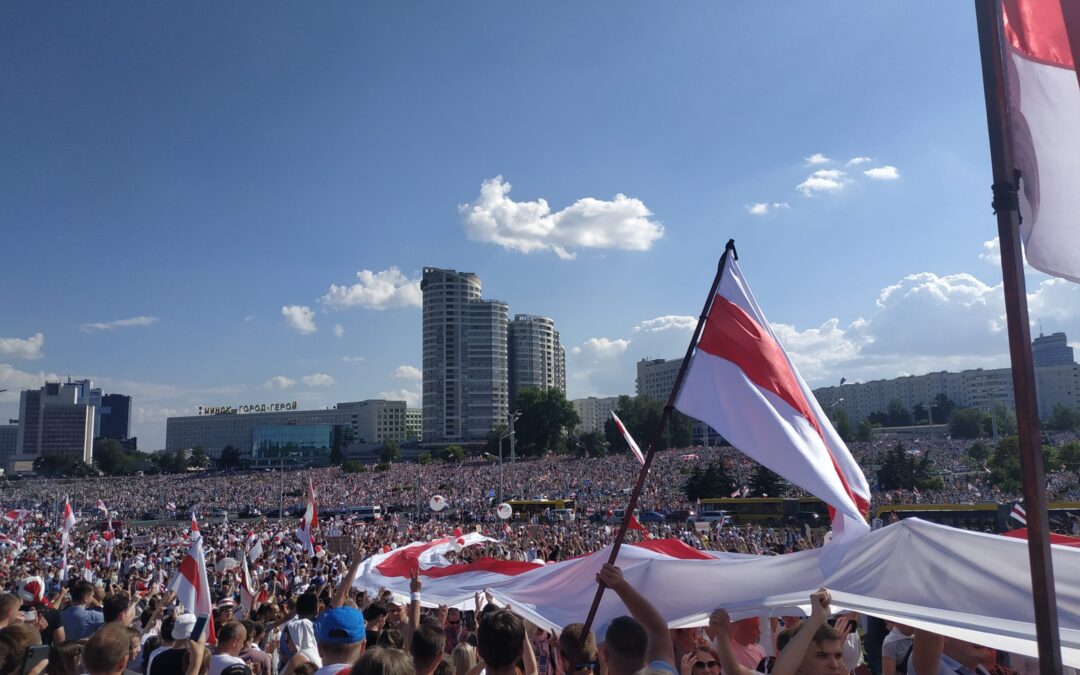
At a special session of the UN Human Rights Council in Geneva, the ICJ and IBAHRI have called on Belarus to comply with its international human rights obligations, including by releasing those arbitrarily detained and ceasing abusive prosecutions as well as harassment of lawyers.
The oral statement read as follows:
“Madame President,
The International Commission of Jurists (ICJ) and the International Bar Association’s Human Rights Institute (IBAHRI) are concerned at the continuing human rights violations in Belarus following the Presidential election. Widespread arbitrary arrests, police violence against peaceful protesters, torture and other ill-treatment of detainees and allegations of enforced disappearances, violate Belarus’s international law obligations, and require accountability.
Our organizations are particularly concerned about reports that these violations are accompanied by widespread denial of detainees’ access to a lawyer. Lawyers face harassment and obstacles in carrying out their professional duties.
We highlight the recent arrests and detention of two prominent lawyers, Ilya Salei and Maxim Znak, on politically motivated charges on 9 September 2020. According to official information, the lawyers are charged with the crime of “calls for actions aimed at causing harm to the national security of the Republic of Belarus”.
We urge the Council to call on Belarus to:
- comply with its international human rights obligations, including by releasing those arbitrarily detained and ceasing abusive prosecutions;
- provide detainees with confidential access to lawyers of their choice;
- end harassment of lawyers and ensure accountability and reparations for those whose human rights have been violated; and
- request OHCHR to monitor and report to the Human Rights Council on the human rights situations in Belarus.
Thank you”
Sep 18, 2020 | News
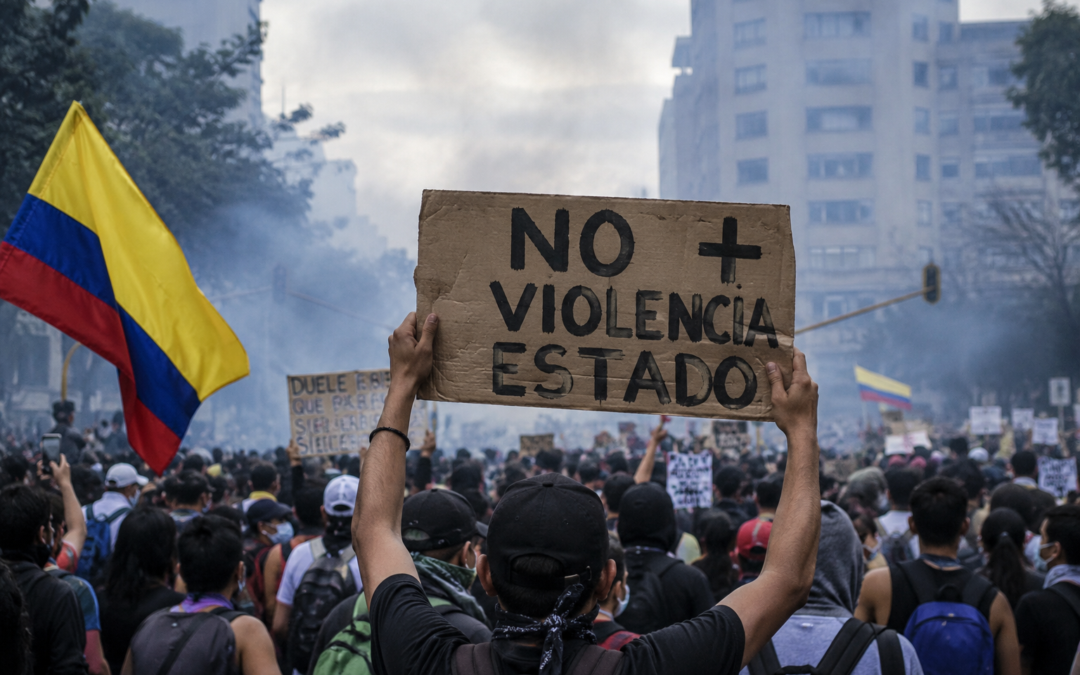
Today, the ICJ called upon the responsible authorities to ensure that prompt, transparent, thorough, impartial and effective investigations are carried out of allegations of extrajudicial killings and other serious human rights violations by the Colombian police during recent street protests.
The ICJ stressed that any official responsible should be prosecuted and brought to justice and victims of any violations be provided an effective remedy and reparation.
From 9 September to 10 September 2020, mass protests against serious human rights violations by Colombian police took place in Bogota, following the death of Javier Ordóñez. Ordoñez died in police custody after he had been subjected to severe ill-treatment, including by prolonged taser shock.
The protests were met with acts of unlawful, unnecessary and disproportionate use of force by police. The protests left 13 people dead, and more than 200 injured.
The incidents have been condemned by the Inter-American Commission on Human Rights (IACHR), which pointed to allegations of unlawful detention and ill-treatment of persons arrested following the demonstrations. The UN High Commissioner for Human Rights has also expressed concern at the allegations the use of excessive force during the protests.
According to witness accounts, police opened fire against people who were protesting peacefully. Some of the victims killed were said to be people who had not taken part in the protests and died due to stray bullets. Some videos of police conduct have been circulated on social media.
Similarly, Bogota Mayor, Claudia López Hernández, has affirmed that she had handed over videos of police shooting indiscriminately against people during the protests to the Office of the Attorney General and other authorities. In addition, she shared part of the videos on her Twitter account.
The ICJ recalls that under international standards governing the use of force by law enforcement officials, lethal force may never be used unless strictly necessary to protect life.
The ICJ stresses that investigations must be impartial and the need for investigators to be independent of the police. Equally important, the investigations must take place within the civilian rather than the military justice system.
The ICJ is also concerned at the threats received by human rights lawyers who have been working working to document possible human rights violations during the protests.
Background
The protests were triggered by the death of Javier Ordoñez, who died at a police facility (Comando de Acción Inmediata, CAI), on the early morning of 9 September.
A video shows that before being transferred to the facility, Ordoñez was repeatedly shocked by policemen with a stun gun while on the ground and did not represent any threat to life or safety the police or other persons. Initial results of the investigation, including the autopsy report, indicate that Ordoñez was hit in the head, neck, shoulders, and chest inside the police facility.
On 11 September 2020, the Police and the Ministry of Defence offered an “apology” for any violation of the law that may have been committed by the police, without acknowledging any specific wrongdoing.
Subsequently, on 16 September, the Minister of Defence recognized that Javier Ordóñez was murdered by the police. Although he stated that the Police respect peaceful protests, he also said the protests of September 9 and 10 were a massive and systematic attack against the police.
Along the same lines, on 13 September 2020, the office of the Mayor of Bogotá held a ceremony of “forgiveness and reconciliation”. The ceremony had the participation of some of the victims, who demanded justice.
On 17 September 2020, the Office of the Attorney General filed arrest warrants against two policemen involved in the murder of Ordóñez. The warrants have been granted by a judge. Both policemen had been arrested.
In accordance with Colombia’s obligations under the International Covenant on Civil and Political Rights, investigations “must always be independent, impartial, prompt, thorough, effective, credible and transparent”.
The UN Basic Principles on the Use of Force and Firearms by Law Enforcement Officials require that any the use of force is exceptional, necessary, and proportional and that lethal force may only be used when strictly necessary to protect life.
Colombia has been recently facing a significant increase in serious human right violations and abuses, including unlawful killings. For example, since the Peace Agreement was signed in November 2016, there has been an upward trend in the killings, death threats, and harassments against human rights defenders.
As of December 2019, the UN Verification Mission in Colombia verified 303 killings of human rights defenders and social leaders since the signature of the Peace Agreement. So far, during 2020, the Office of the United Nations High Commissioner for Human Rights in Colombia has documented 47 killings of human rights defenders and is reviewing other potential 44 cases.
Contact:
Carolina Villadiego, Legal and Policy Adviser, Latin America. Email: carolina.villadiego(a)icj.org
Rocío Quintero M, Legal Adviser, Latin America. Email: rocio.quintero(a)icj.org
Sep 14, 2020 | Advocacy, Cases, Legal submissions
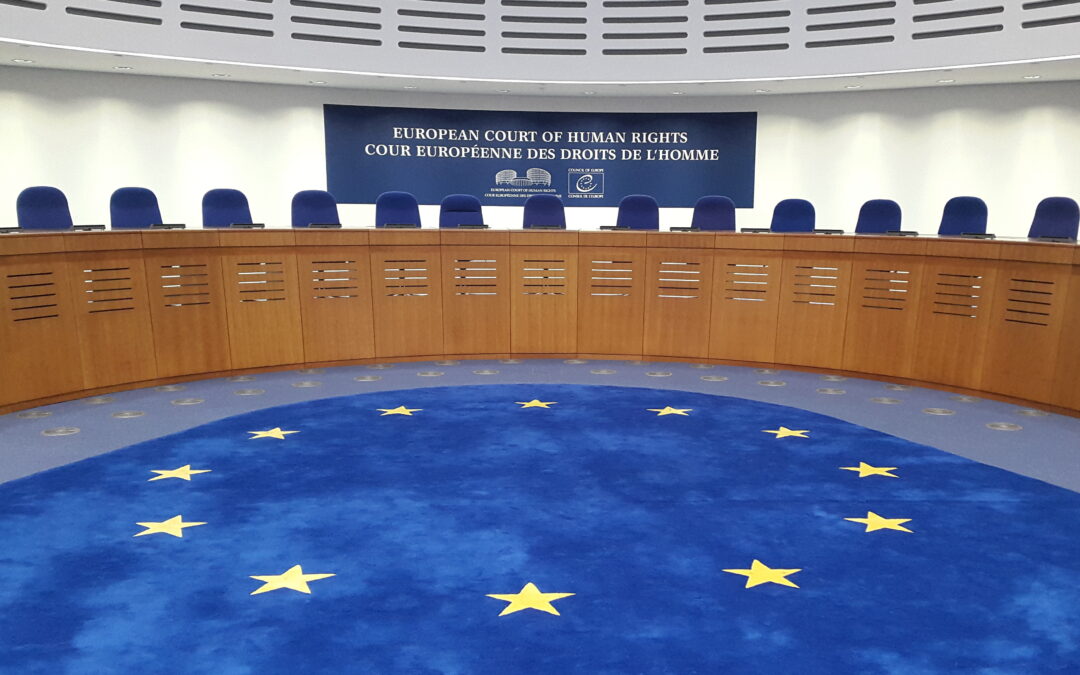
The ICJ and ECRE intervened today before the Grand Chamber of the European Court of Human Rights in the case of the extradition of a Kyrgyz national of Uzbek ethnicity back to his country of origin where he would be at risk of torture or other forms of ill-treatment .
In their submissions, the ICJ and the European Council on Refugees and Exiles (ECRE) analysed thenon-refoulement obligations of the Russian Federation under international human rights law in relation to the consideration of evidence to assess the substantial grounds to believe that a concerned person will face real risk of a serious human rights violation; and the use of diplomatic assurances purportedly to protect against torture and other serious human rights violations in light of international law.
The two NGOs also provided the Court with an update on the legal framework governing extraditions from the Russian Federation to Central Asian States, in particular Kyrgyzstan, as well as Russia’s extradition practice. They concluded that the analysis of the law and practice revealed a number of critical human rights deficits.
They submitted that the lack of respect for the procedural aspect of the principle of non-refoulement, the consequent ineffectiveness of domestic remedies in this regard, in the Russian Federation, and the abysmal record of Kyrgyzstan in upholding its obligation to respect and protect the prohibition of torture or other ill-treatment mean that extraditions from the Russian Federation to Kyrgyzstan entail a high risk of violations of both substantive and procedural aspects of the principle of non-refoulement.
These submissions are an update of the third party intervention submitted by the ICJ before the Chamber of the European Court of Human Rights on 22 September 2016. The Chamber had ruled that no risk of breach of the principle of non-refoulement existed in the case but the judgment is now subject to the review of the Grand Chamber.
ECtHR-TK and others v Russia-GC-ICJECRE-Final (download the third party intervention)