Dec 10, 2014
An opinion piece by Reema Omer, ICJ Legal adviser in Pakistan.
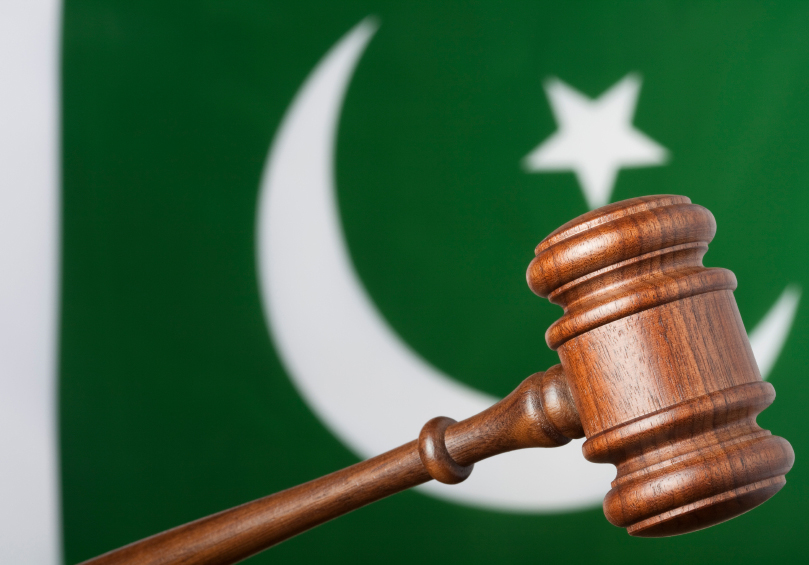
The 64th world Human Rights Day held 10 December marked thirty months since Pakistan passed the National Commission for Human Rights Act, providing for the establishment of a National Commission for Human Rights (NCHR) for the promotion and protection of human rights in the country.
The Government’s failure to constitute the legally mandated Commission is another indictment of its commitment to human rights.
A NCHR by itself will not fix all of Pakistan’s serious human rights problems, but if constituted properly, the NCHR can be an important step forward.
In South Asia, Pakistan is the only country that has not established a National Human Rights Institution (NHRI) -India constituted a National Human Rights Commission in 1993, Sri Lanka in 1996, Nepal in 2000, and Bangladesh in 2008.
This deficiency was manifest when Pakistan accepted multiple recommendations during the 2012 review of its human rights record by the Untied Nations (the Universal Periodic Review) that called on Pakistan to speedily operationalize the National Commission for Human Rights.
It is critical – for at least three reasons – that Pakistan swiftly establishes a NCHR compliant with the UN Principles relating to the Status of National Institutions (Paris Principles), which provide the minimum standards required by national human rights institutions to be considered credible and effective.
First, a major function of a national human rights commission is to ensure access to remedies to victims of human rights violations and accountability for perpetrators.
Pakistan has long faced a crisis of impunity, with perpetrators of the gravest human rights violations, especially those belonging to state security agencies, escaping accountability with ease.
Questionable political will, lack of legal aid and a judicial system fraught with delays are some of the reasons why victims have little chance at getting justice.
An independent and effective NCHR, with powers of investigation and quasi-judicial authority, can provide an additional avenue for redress.
In India, for example, the NCHR played an integral role in ensuring compensation for victims of the anti-Muslim Gujarat riots in 2002, and fake “encounter killings” in Manipur in 2014.
Second, another important function of NHRIs is to advise on existing laws, policies and proposed legislation, as well as their implementation, particularly on their compliance with international human rights laws and standards.
In the last couple of years alone, Pakistan has passed multiple laws that violate its international human rights obligations.
The Fair Trial Act, 2013 and the Protection of Pakistan Act, 2014, are just two examples.
In addition, Pakistani is currently debating on a bill that aims to incorporate the Convention against Torture and Other Cruel, Inhuman or Degrading Treatment or Punishment (CAT), which Pakistan ratified in 2010, into domestic law.
The proposed bill has many deficiencies, which could benefit from a detailed analysis by a competent body familiar with international human rights law.
And finally, NHRIs have the responsibility to promote human rights, including by organizing public awareness and education programs as well as trainings public officials.
Disturbingly, human rights continue to be thought of as “Western propaganda” in Pakistan, including by some public officials.
NGOs working in the human rights field as often demonized as working on a “foreign agenda” for personal enrichment.
In such a climate, it is essential that a national administrative body counters the negative propaganda, and makes the public and public officials more aware of their rights as well as their human rights obligations.
However, for a NCHR to be effective in all these areas, it must comply with the Paris Principles, which require independence and pluralism, and the capacity to participate in essential human rights work, including engaging with the Government on “any situation of violation of human rights which it decides to take up”.
The NCHR Act, 2012, significantly limits the Commission’s mandate where the armed forces are accused of committing human rights violations.
In such cases, the Commission is only authorized to seek a report from the Government, and make recommendations if it sees fit.
The law further emphasizes that the functions of the Commission “do not include inquiring into the act or practices of the intelligence agencies”.
As the NCHR law stands, it seems questionable that the Commission will get accreditation by the International Coordinating Committee of NHRIs, which is a requirement for an NHRI to be recognized internationally.
Also, unless its mandate is broadened to include intelligence and security agencies –accused of the gravest violations –it risks being toothless, or even worse, a cover for government inaction.
It is therefore paramount that the Pakistani Government meet the commitments made to the people of Pakistan and the international community by swiftly establishing the NCHR after amending the NCHR Act, 2012, to give the Commission mandate to investigate human rights violations committed by the military, including the intelligence agencies.

Dec 9, 2014 | News
On the eve of the 64th annual world Human Rights Day, the ICJ urges the Pakistani Government to promptly constitute a strong and effective National Human Rights Commission that is compliant with the UN Principles relating to the Status of National Institutions (Paris Principles).
“Independent and credible national human rights institutions can be helpful for protecting and promoting human rights,” said Sam Zarifi, ICJ’s Director for Asia and the Pacific. “The Pakistan Government has been inexplicably dragging its feet despite repeated promises to constitute the Commission.”
In South Asia, India, Sri Lanka, Nepal and Bangladesh have established National Human Rights Institutions (NHRIs), making Pakistan a regional exception.
“A properly constituted national human rights commission will not by itself fix any country’s human rights problems, but it can be part of the solution,” said Zarifi. “Pakistan can and should learn from the lessons of failed NHRIs in the region and constitute an institution that can address the real needs of all people in the country.”
Pakistan passed the National Commission for Human Rights Act in 2012. The law provides for an independent commission with broad powers to promote human rights and to investigate human rights violations.
However, the law significantly limits the Commission’s mandate where the armed forces are accused of committing human rights violations.
In such cases, the Commission is only authorized to seek a report from the Government, and make recommendations if it sees fit.
The law further emphasizes that the functions of the Commission “do not include inquiring into the act or practices of the intelligence agencies”.
“The proposed Commission’s restricted mandate over the armed forces, and especially the intelligence agencies, is of grave concern given that Pakistan’s military and intelligence services are accused of perpetrating gross human rights violations, including enforced disappearances, extrajudicial killings, and torture and ill-treatment,” Zarifi added.
“A human rights commission that does not have jurisdiction over abuses by these actors risks being toothless and ineffective—and worst, a cover for continuing government inaction in response to these violations.”
Contact:
Sam Zarifi, ICJ Asia Pacific Regional Director (Bangkok), t: +66 807819002; e: sam.zarifi(a)icj.org
Reema Omer, ICJ International Legal Adviser (London), t: +44 7889565691; e: reema.omer(a)icj.org
Background:
Section 3 (a) (ii) of the Paris Principles, which provide the minimum standards required by national human rights institutions to be considered credible and effective, states that a NHRI should have the power to hear a matter without higher referral over “any situation of violation of human rights which it decides to take up”.
Because of the proposed Commission’s limited mandate over the military, it is questionable whether the proposed National Human Rights Commission is compliant with the Paris Principles.
During its 2012 Universal Periodic Review, Pakistan accepted multiple recommendations to speedily operationalize the National Commission for Human Rights.
Over two years since the Review, there has been little progress in constituting the Commission, let alone amending the law establishing the Commission to ensure that it complies with the Paris Principles.
Dec 5, 2014 | Multimedia items, News, Video clips
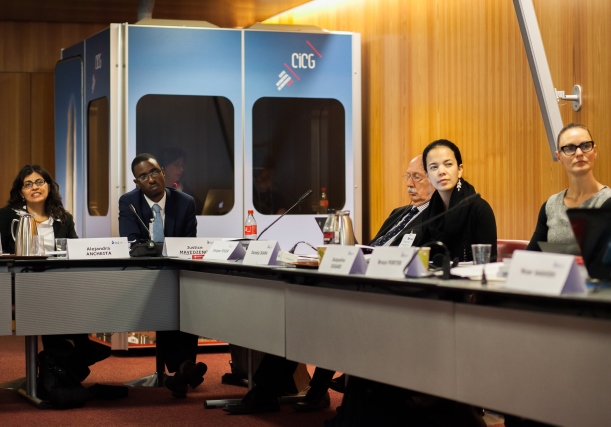
Jacqueline Dugard, Hina Jilani, Rodrigo Uprimny Yepes, Gilles Badet, Alejandra Ancheita and Harsh Mander talk about their experience and the situation of economic, social and cultural rights in their respective countries.
These prominent participants in ICJ’s Geneva Forum 2014 give their views on judicial protection of economic, social and cultural rights (ESCR) as well as on what needs to be changed to address obstacles to guarantee an effective remedy for victims of violations of their socio-economic rights.
They also tell about the main opportunities and key challenges for the realization of ESCR in their respective countries.
The 2014 Geneva Forum of Judges and Lawyers is a joint initiative of the ICJ Center for the Independence of Judges and Lawyers (CIJL) and the ICJ Programme on Economic, Social and Cultural Rights.
It has been made possible with the support of the République et Canton de Genève, the Permanent Mission of Germany to the United Nations in Geneva, and the Taipei Bar Association.
Dec 4, 2014 | Articles, Événements, Nouvelles
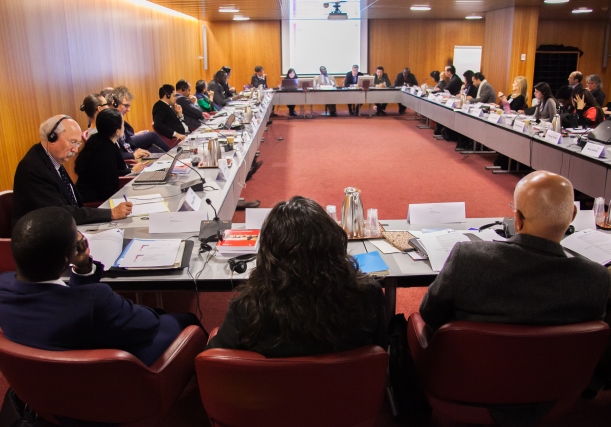
Le Forum 2014 de la CIJ accueille des juges et des avocats de toutes les régions du monde pour discuter de “l’application judiciaire des droits économiques, sociaux et culturels”. Gilles Badet parle de son expérience au Bénin, son pays (vidéo).
Les participants au Forum 2014 de Genève échangent leurs vues sur les progrès accomplis durant les deux dernières décennies, et notamment sur l’entrée en vigueur du Protocole facultatif se rapportant au Pacte international sur les droits économiques, sociaux et culturels (PF-PIDESC) de mai 2013.
Dans la vidéo, Gilles Badet donne sa vision de la protection judiciaire des droits économiques, sociaux et culturels (ESCR) ainsi que sur les changements nécessaires pour garantir des réparations effectives aux victimes de violations de leurs droits socio-économiques.
Le Forum de Genève des juges et avocats est une initiative du Centre pour l’Indépendance des Magistrats et Avocats de la CIJ (CIMA).
Compte rendu et programme du forum:
Universal-Programme GVA Forum 2014-Events-2014-FRA (Compte rendu complet en PDF)
Voir l’interview de Gilles Badet:
Dec 4, 2014 | Events, News
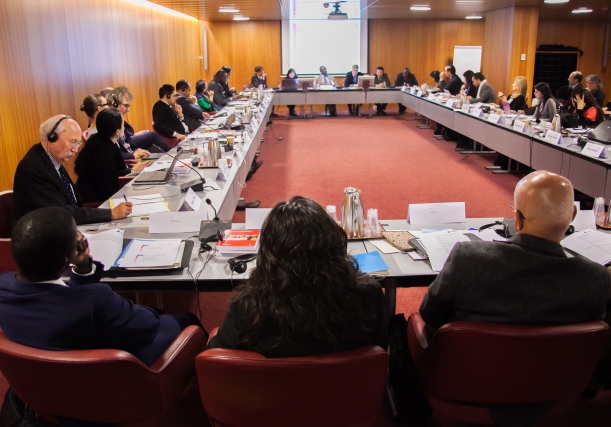
Today and tomorrow, the ICJ welcomes judges and lawyers from all regions of the world to discuss the “Judicial Enforcement of Economic, Social and Cultural Rights”.
The 2014 Geneva Forum of Judges and Lawyers is a joint initiative of the ICJ Center for the Independence of Judges and Lawyers (CIJL) and the ICJ Programme on Economic, Social and Cultural Rights.
Participants are exchanging views on the progress made over the past two decades, including the entry into force of the Optional Protocol to the International Covenant on Economic, Social and Cultural Rights in May 2013.
The Protocol allows individuals to bring complaints of violations of such rights to an independent international body of experts for adjudication.
Discussions are held also in relation to challenges to the justiciability of these rights, including as regards the principle of separation of powers between the judicial, executive and legislative branches of government.
Managing potential implications for public human and financial resources of judicial orders for enforcement of ESCR, and the conflicts that may arise between state development plans, public interest and the interests and rights of the individuals, will also be topics of discussion.
Participants are invited to ground the discussion of conceptual issues in examples from their own actual experience and practice in their national jurisdictions.
Alejandra Ancheita, recent winner of the Martin Ennals Award 2014 – The Nobel Prize of Human Rights – is among the guest speakers.
A report of the discussions will be published in 2015.
The draft agenda for the 2014 Geneva Forum is available here:
Universal-Programme GVA Forum 2014-Events-2014-ENG (English)
Universal-Programme GVA Forum 2014-Events-2014-ESP (Español)
The 2014 Geneva Forum has been made possible with the support of the République et Canton de Genève, the Permanent Mission of Germany to the United Nations in Geneva, and the Taipei Bar Association.
The Geneva Forum has been convened annually by the CIJL since 2010.
Information on, and reports of, the previous Geneva Forums can be found here:
Geneva Forum 2013 (photo)
Geneva Forum Series no. 1: Women and the Judiciary
Geneva Forum 2012
Third Geneva Forum for Judges and Lawyers: the report is published
Geneva Forum 2011
2nd ICJ Geneva Forum of Judges and Lawyers: final report
Geneva Forum 2010
1st ICJ Geneva Forum of Judges and Lawyers: accountable national security policies – the role of judges and legal practitioners