Mar 9, 2020 | Advocacy, Non-legal submissions
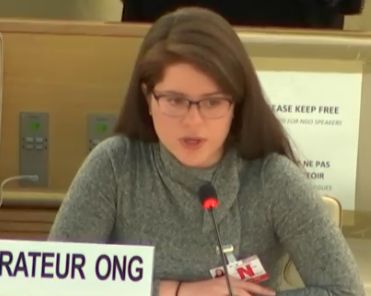
The ICJ and Lawyers’ Rights Watch Canada have highlighted the link between human rights violations and corporate accountability in South Sudan, at the Human Rights Council in Geneva.
The statement, delivered in an interactive dialogue with the Commission on Human Rights in South Sudan, read as follows:
“The International Commission of Jurists (ICJ) and Lawyers’ Rights Watch Canada thank the Commission on Human Rights in South Sudan for its report (A/HRC/43/56).
We underline the Commission’s ongoing concerns about lack of access to justice, entrenched impunity for serious crimes and human rights violations; continued threats against human rights defenders, journalists, and dissidents; and corruption in oil and non-oil sectors.
We appreciate the Commission’s continued investigation into enforced disappearances, including the 2017 enforced disappearances and extrajudicial killings of human rights lawyer Dong Samuel Luak and opposition politician Aggrey Idri.
We remain concerned by the lack of effective oversight of oil and non-oil enterprises and revenue misappropriation that has fueled violations. In the light of the findings by the Commission’s 2019 report (A/HRC/40/69, A/HRC/40/CRP.1) pointing to the oil industry as a “major driver” in the continuation of the armed conflict and resulting human rights violations, we would like to ask what follow up to those findings does the Commission intend to conduct in the future?
Potential corporate complicity with crimes under international law demands investigation and a strong monitoring mechanism for the use of oil revenues should be established.”
Mar 9, 2020 | Advocacy, Non-legal submissions
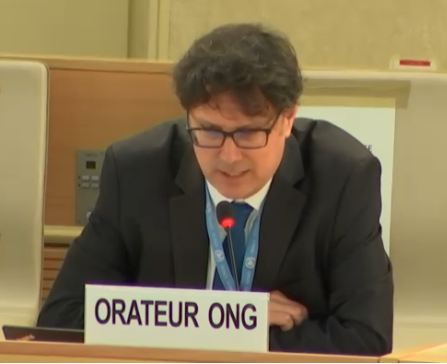
The ICJ today urged the UN to more effectively protect and promote human rights in Myanmar, and the Human Rights Council to monitor implementation of the Rosenthal Inquiry recommendations to this end.
The statement, delivered in a discussion of the Secretary-General’s oral update on the involvement of the United Nations in Myanmar, read as follows:
“The ICJ welcomes the report of Mr. Gert Rosenthal entitled, ‘A Brief and Independent Inquiry into the Involvement of the United Nations in Myanmar from 2010 to 2018.’
The ICJ concurs with the conclusions, including that the UN suffered from ‘systemic and structural failures’ that effectively prevented it from stopping or mitigating the atrocities in Rakhine State in 2016 and 2017.
We welcome the initiative to brief the Council on the report, which the ICJ and other non-governmental organizations recommended to the Secretary-General in a letter last year.
The ICJ further urges that concrete steps be taken to:
1) improve coordination at all levels of the UN, including the adoption of a common strategy and agenda among agencies at the country level to promote accountability for human rights violations, which would also advance the Call to Action by the Secretary General;
2) hold UN officials responsible for failures to mitigate or prevent acts of violence constituting crimes under international law; and
3) publish annual progress reports until the recommendations are fully implemented.
The need for a concerted and system-wide commitment to promote and protect human rights in Myanmar is as urgent as ever given the intensification of armed conflict in Rakhine State and the potential for conflict as national elections approach.
We urge the Council to monitor implementation of the reforms identified in the Rosenthal report.”
Mar 8, 2020 | News
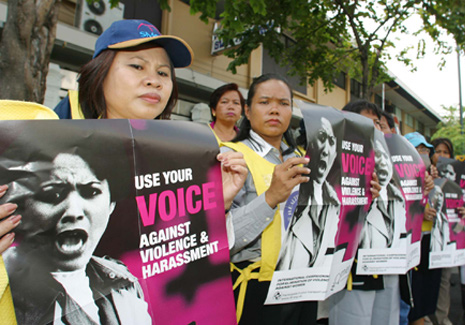
The ICJ commemorates International Women’s Day by calling on States all over the world to take decisive steps to abolish or amend laws, policies and practices that discriminate against women and girls, including those belonging to Sexual Orientation, Gender Identity and Expression and Sex Characteristics (SOGIESC) minorities.
“All over the world, we are facing increasing attacks on the rule of law, which intensify existing inequalities resulting in compounded and intersecting forms of discrimination against women and girls, especially women from SOGIESC minorities,” said Emerlynne Gil, ICJ’s global focal point on gender.
The ICJ also calls on frontline justice actors, such as judges, lawyers and law enforcement officers, to take proactive steps in eliminating gender discriminatory practices in their work to further enhance access to justice for women.
Such action includes an open and inclusive discourse on regressive interpretations of religious and customary laws that discriminate against women.
The ICJ also urges States to acknowledge the diverse voices of women in this discourse, including those of women who belong to SOGIESC minorities.
“Women and girls, including those from SOGIESC minorities, are at a heightened risk of human rights abuses, most especially because a greater number among them is now living in poverty and is unable to access information about their rights, as well as justice for the violations they suffer,” added Emerlynne Gil.
.International Women’s Day is a symbolic acknowledgement of women’s struggle for gender equality in all spheres of life.
While celebrating the recognition of women’s legal rights and entitlements, the ICJ also notes with deep concern the growing trend around the world to push back on these advances in a manner that fundamentally violates the rights of women.
In 2019, the ICJ adopted the Tunis Declaration on Reinforcing the Rule of Law and Human Rights (Tunis Declaration), wherein it highlighted how “culture, tradition, or religion are being used to justify laws, policies, and practices that discriminate against women and girls”.
The proliferation of these discriminatory laws, policies and practices “come at a time when there is growing inequality, accelerating climate change, conflict, and large-scale displacement of people.”
Upholding cultural practices is often invoked as a convenient excuse to justify the continued existence of laws, policies, and practices that discriminate against women and girls, including those belonging to SOGIESC minorities.
While the ICJ affirms the importance of respecting cultural rights, these must be exercised in a manner consistent with core rule of law principles of non-discrimination, equality and equal protection of the law.
The ICJ notes that claims of cultural preservation are often based upon harmful gender stereotypes and deeply problematic patriarchal norms and attitudes that undergird the sanctification of discriminatory cultural, religious, traditional, and customary norms.
In the Tunis Declaration, the ICJ recognized “the persistent, deep entrenchment of patriarchal culture that perpetuates gender stereotypes in many national and international institutions, including those of the legal profession and judiciary.”
Harmful gender stereotypes, in turn, severely hamper women from enjoying their human rights and from equal access to justice, including for crimes of sexual and gender-based violence perpetrated against them.
Contact
Emerlynne Gil, ICJ Senior International Legal Adviser, email: emerlynne.gil(a)icj.org
Mar 6, 2020 | Advocacy, Non-legal submissions
The ICJ, speaking in a general debate at the UN Human Rights Council in Geneva, urged all States to work together towards adoption of a treaty on business and human rights, and highlighted threats to the independence of the judiciary in Europe.
The statement, delivered in the general thematic debate at the Council, read as follows:
“The International Commission of Jurists (ICJ) welcomes the report of the 5th session of the Intergovernmental Working Group (A/HRC/43/55) in charge of the elaboration of a treaty on business and human rights and notes the consensual nature of its conclusions and recommendations. Abuses of human rights and environmental degradation caused with the involvement of business enterprises have so far been met with very limited action by businesses and States.
The ICJ considers that the revised draft treaty is a serious and advanced proposal that is suitable for negotiations and thanks the Chair-Rapporteur for its efforts and leadership in this process.
The ICJ urges States that are not yet actively involved in the negotiations to join the growing number of States that are active for a final push.
The ICJ also draws the attention of the Council to serious threats to independence of judges and lawyers in European countries.
In Poland, judges are being disciplined merely for applying EU law, under legislation curtailing their freedom of expression and independence.
In Turkey, independence of lawyers and judges continues to be seriously compromised, as demonstrated by the disciplinary proceedings against the Gezi trial judges launched after critical comments by the President of Turkey.
The ICJ urges the Council to give attention to these developments of extreme concern.”
Mar 6, 2020 | Advocacy, Non-legal submissions
Speaking at the UN Human Rights Council, the ICJ today urged States to decriminalize consensual sexual relations, including between people of the same sex.
The statement, delivered during an interactive dialogue with the UN Special Rapporteur on the Right to Privacy, read as follows:
“The ICJ welcomes the report of the Special Rapporteur on privacy, particularly the recommendation to repeal laws criminalizing consensual sexual activity, cluding between people of the same sex.
The ICJ agrees that criminalization of consensual same-sex relations violates international law and standards, including the rights to privacy, non-discrimination and equal protection.
The ICJ advocates for the abolition of laws that criminalize consensual sexual relations – including between people of the same sex – that still exist in many countries around the world.
In Indonesia, for example, a draft Penal Code currently includes a provision that would criminalize “extramarital” sexual acts between consenting persons, including persons of the same sex. We note that the draft provision may superficially appear to be gender neutral because it would penalize both men and women, but studies have shown that, in practice, criminalization of “adultery” and extramarital sexual relations typically results in disparate, discriminatory impacts against women and girls. Malaysia and other States that are former British colonies in Asia, likewise, have similar provisions in their criminal laws penalizing consensual sexual relations.
Like the Special Rapporteur, the ICJ in urges States to repeal laws that criminalize consensual sexual activity – including between people of the same sex.”