Jul 11, 2019 | News
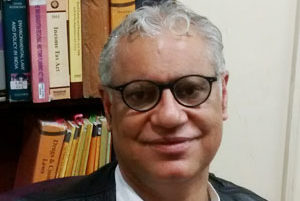
The ICJ today condemned the raids on 11 July by India’s Central Bureau of Investigation (CBI) on the homes and offices of Anand Grover and Indira Jaising, two lawyers prominent for frequently challenging the Indian government’s failures to respect and promote the rights of all people in India.
Grover and Jaising are both Supreme Court lawyers and co-founders of the Lawyers Collective, a non-governmental organization.
These raids were reportedly conducted pursuant to CBI’s registration of criminal charges into alleged violations of Foreign Contribution (Regulation) Act (FCRA), a much criticized law frequently used to target human rights defenders and critics of the Indian government.
“This raid seems designed to harass and intimidate two tireless advocates of Constitutional and international rights in India,” said Sam Zarifi, Secretary-General of the ICJ.
“The Indian government must immediately cease harassment of the Lawyers Collective and its founders Anand Grover and Indira Jaising,” he added.
The CBI raids appears to be based on a 2016 Ministry of Home Affairs report, now under appeal in the Bombay High Court, and without any material change in circumstances since its release.
The raid has also been conducted notwithstanding a National Human Rights Commission statement seeking a status report from the CBI by 21 July 2019 to ensure that the investigation is “non-discriminatory and to avoid arbitrariness”.
The attack is emblematic of a broader pattern of official threats to and harassment of Indian civil society in general, and the Lawyers Collective in particular.
Lawyers Collective’s FCRA license was cancelled in November 2016, a decision that is under appeal in the Bombay High Court. The action relied upon overly broad and vague legal provisions of the FCRA that violate India’s legal obligation to respect and protect the rights to freedom of expression, association and peaceful assembly.
“The repeated use of the FCRA to target civil society including Lawyers Collective has had a devastating chilling effect on public comment about the government,” said Zarifi.
“The law should be repealed, or substantially amended to include safeguards against arbitrary use of its provisions, and to protect freedom of expression and association,” he added.
The ICJ supports the 2016 call by three United Nations Special Rapporteurs to the Indian Government to repeal FCRA, which decried the FCRA’s use to “silence organisations involved in advocating civil, political, economic, social, environmental or cultural priorities, which may differ from those backed by the Government”.
Jul 9, 2019
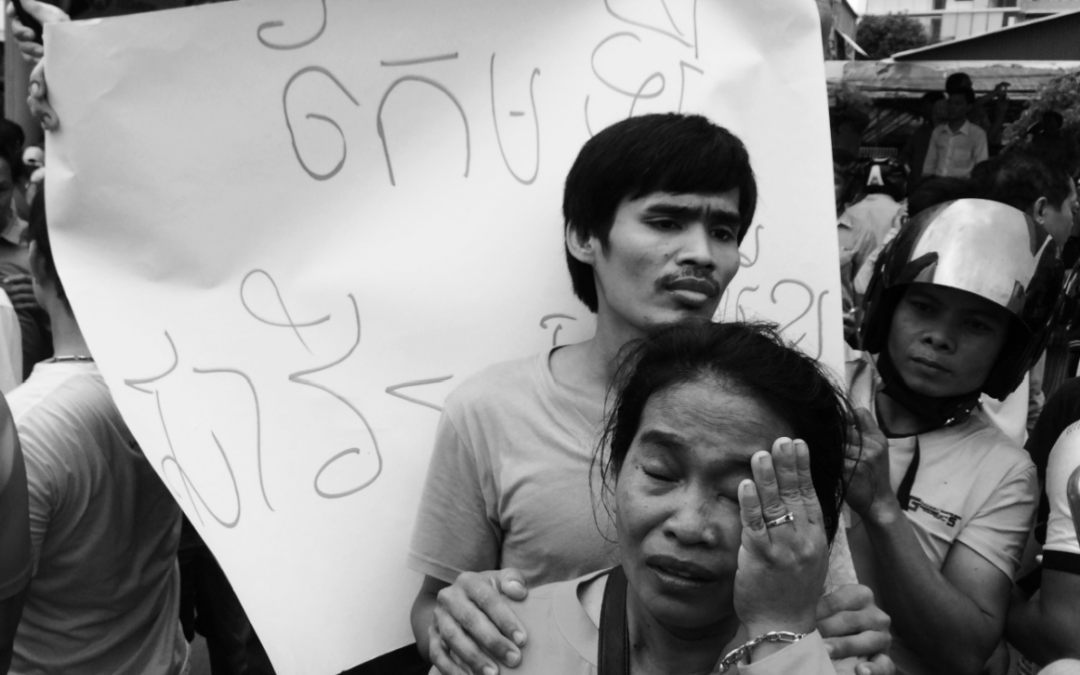
Today, on the third anniversary of the killing of prominent political commentator and human rights defender Kem Ley, the ICJ and 21 other civil society organizations renewed their call on the Cambodian government to establish an independent and impartial Commission of Inquiry to conduct a thorough and effective investigation into his killing.
“It has been three years since significant gaps were highlighted in the investigation and trial of Kem Ley’s case, which need to be remedied through an independent, impartial and effective investigation,” said Frederick Rawski, ICJ’s Director for Asia and the Pacific.
“The lack of progress reflects a clear lack of political will by the Cambodian government towards meeting its obligations under international law to fully and impartially investigate a potentially unlawful death and protect the rights to life and to effective remedy,” he added.
On 10 July 2016, Kem Ley was shot and killed while having a morning coffee at a gas station on Monivong Boulevard in central Phnom Penh. On 23 March 2017, after a half-day trial hearing, the Phnom Penh Municipal Court found Oeuth Ang – the suspect arrested by authorities who identified himself as “Choub Samlab” or ‘Meet to Kill’ – guilty of Kem Ley’s murder, and sentenced him to life imprisonment.
On 24 May 2019, Cambodia’s Supreme Court rejected Oeuth Ang’s appeal against his sentence and upheld his life imprisonment term.
On 23 March 2017, the ICJ, Human Rights Watch and Amnesty International highlighted eight specific issues that had been inadequately investigated during the trial of Oeuth Ang, and called for an investigation in line with international standards, including the International Covenant on Civil and Political Rights (ICCPR) and the Revised United Nations Manual on the Effective Prevention and Investigation of Extra-legal, Arbitrary and Summary Executions, known as the Minnesota Protocol (2016).
The upholding of Oeuth Ang’s sentence by Cambodia’s highest court in May 2019 – despite the failure of lower courts to sufficiently address shortcomings in his trial – also raises serious concern as to the lack of independence of the judiciary in Cambodia.
The lower courts that considered the case were the Phnom Penh Municipal Court and then the Court of Appeal, which rejected Oeuth Ang’s first appeal, before he then appealed to the Supreme Court, where his appeal against his sentence was also dismissed.
These courts did not address the clear shortcomings that had marred the investigation and the original trial before the municipal court.
In October 2017, an ICJ report found that the lack of independent judges and prosecutors was the “single largest problem facing the Cambodian justice system” – where “the rule of law is virtually absent” and political interference and corruption in cases are endemic.
Given the lack of trust and confidence in the impartiality, independence and competence of the Cambodian judicial system, the civil society organizations have urged the Cambodian authorities to request that an appropriate body with independent experts, such as a Commission of Inquiry, be established under the auspices of the United Nations into Kem Ley’s case.
Cambodia-Kem Ley 3rd year-Advocacy-open letter-2019-ENG (full call in PDF)
Read also
Cambodia: Commission of Inquiry into killing of Kem Ley should be established without further delay
Cambodia: request to create a commission of inquiry into the killing of Kem Ley
Cambodia: significant questions remain after guilty verdict in Kem Ley trial
Cambodia: Kem Ley’s killing demands immediate credible and impartial investigation
Contact
Kingsley Abbott, ICJ Senior Legal Adviser, e: kingsley.abbott(a)icj.org
Jul 9, 2019
The ICJ today published a legal briefing (3 pages in Burmese and 2 pages in English) on Myanmar’s Child Rights Bill, which is under consideration by the Union Parliament.
The stated objectives of the Child Rights Bill are welcomed, particularly the commitment to implement Myanmar’s obligations under the Convention on the Rights of the Child (CRC).
However, based on drafts of the Bill that the ICJ has reviewed, the organization is concerned that if passed into law as presently formulated, the Union Parliament would miss a significant opportunity to protect the rights of those children throughout Myanmar who face discrimination based on race or ethnicity, and who experience human rights violations as a result.
Because the Bill does not sufficiently protect the right of a child to acquire citizenship of Myanmar, the Bill fails to meet its stated objectives, and also fails to comply with and implement the State’s international human rights law obligations under the CRC.
The ICJ provides a recommendation for legislators to amend the Bill before it is passed into law, in order to sufficiently protect the rights of a child to acquire citizenship/nationality, and to implement the State’s obligations under the CRC.
Contact:
Sean Bain, Legal Adviser for the ICJ, sean.bain@icj.org
Myanmar-Child Bill-Advocacy-Analysis brief-2019-ENG (full analysis, English, in PDF)
Myanmar-ChildBill-Advocacy-Analysis brief-2019-BUR (full analysis, Burmese, in PDF
Jul 8, 2019 | News
The ICJ welcomes the report issued today by the United Nations Office of the High Commissioner for Human Rights (OHCHR) documenting human rights violations and abuses in Indian administered Kashmir and Pakistan administered Kashmir.
The ICJ called upon both India and Pakistan to take immediate measures to implement the Report’s main recommendations, and to hold security forces as well as non-state actors accountable for human rights violations and abuses.
The Report follows a June 2018 report that documented similar violations, as well as the widespread impunity for human rights violations by Indian security forces and armed groups allegedly supported by Pakistan. The Indian Government has rejected both reports as a violation of its “sovereignty and territorial integrity”. The Pakistan government has welcomed the report and called for the establishment of a United Nations Commission of Inquiry.
“It is unfortunate that India has again refused to acknowledge the facts set out in the OHCHR report, or to pledge action on its recommendations,” said Frederick Rawski, Asia Pacific Director for the ICJ.
“This is an opportunity for India, a member of the Human Rights Council, to lead by example. It can start by repealing the Armed Forces Special Powers Act and launching an investigation into rights abuses in line with international standards and the guidelines set out by the Indian Supreme Court,” he added.
The Report documents human rights violations by Indian security forces including extrajudicial killings, arbitrary detentions, unlawful custodial deaths, enforced disappearances, and ill-treatment and torture, including rape and sexual violence, in Indian-administered Kashmir.
According to the Report, based on data from civil society organization Jammu and Kashmir Coalition of Civil Society (JKCCS), 71 extrajudicial killings were allegedly committed by security forces in 2018 (for a total of 1081 between 2008 and 2018). Between 2016 and 2018, 1253 people have been blinded by pellet guns.
The Report highlights how the extraordinary powers granted to security forces by the Armed Forces (Jammu and Kashmir) Special Powers Act, 1990 has been wielded arbitrarily and led to near total impunity from prosecution. In addition, it documents human rights abuses committed by non-state armed groups in Indian-administered Kashmir including kidnappings, killings and rape.
The Report also documents rights violations in Pakistan-administered Kashmir, including restrictions on freedom of expression and opinion, assembly and association, and the abuse of vague and overbroad anti-terrorism laws in contravention of international human rights law.
The Report documents cases of arbitrary arrest by local authorities and intelligence agencies, including charging 19 activists with treason for organizing a rally in November 2018, and the arbitrary detention of 30 members of the Jammu Kashmir National Students Federation in March 2019 by Pakistani law enforcement. The Report notes the particular vulnerability of journalists to threats, harassment and arbitrary arrest.
“While we commend Pakistan for welcoming the Report, the fact remains that the Government has done little to prevent the continuation of human rights violations by its security forces, or to implement the recommendations of the previous report,” Rawski said.
“Pakistan must take action to hold perpetrators of rights violations accountable, and take action to end threats and violence targeted at human rights defenders and journalists,” he added.
The ICJ called on both Pakistan and India to grant unconditional access to the OHCHR and Special Procedures of the UN Human Rights Council, and to ensure that human rights defenders and journalists can carry out their work without threats or reprisals from security forces and non-State armed groups.
The ICJ also underscores the importance of the OHCHR recommendation that the United Nations set up an independent commission of inquiry into allegations of rights violations by all parties to the conflict.
The ICJ urged both the Indian and Pakistan governments to respect, protect and fulfill their international human rights obligations in Kashmir, to accept the Report’s findings and take immediate and effective action to implement its recommendations.
Jul 3, 2019 | Advocacy, Non-legal submissions
The ICJ today joined other NGOs in urging the UN Human Rights Council to take action on the Philippines.
The joint oral statement was delivered by the World Organisation Against Torture (OMCT) on behalf of OMCT, Amnesty International, the International Commission of Jurists (ICJ), Franciscans International, Swiss Catholic Lenten Fund, the International Federation for Human Rights (FIDH), FORUM-Asia. It read as follows:
“In March 2019, the UN High Commissioner for Human Rights noted that several sources “estimate that up to 27,000 people may have been killed in the context of the campaign against illegal drugs since mid-2016.”
Unlawful killings, including of children, carry on, and President Rodrigo Duterte and his administration continue to explicitly encourage these acts. In June 2019, the scale and seriousness of the reported human rights violations prompted 11 UN human rights experts to call on the Council to establish an independent investigation into such violations.
Intimidations by government officials at the highest levels against politicians, human rights defenders, journalists, and several Special Procedures mandate holders have also been rising.
At the 35th, 36th, and 38th sessions of the Council, Iceland, on behalf of a group of States, explicitly called on the government “to take all necessary measures to bring killings associated with the campaign against illegal drugs to an end and cooperate with the international community to investigate all related deaths and hold perpetrators accountable.”
In light of the failure of the government to effectively investigate and bring to justice those responsible, we urge all States to support the adoption of a resolution on the Philippines at this session, mandating the OHCHR to monitor and provide regular updates on the human rights situation to the Council, as the first step toward establishing an independent international investigation into extrajudicial killings and other human rights violations committed in the government’s ‘war on drugs.’.
Such a response is all the more important given the Philippines obligations to uphold the highest standards in human rights as a member of the Council.”