Dec 10, 2019 | News
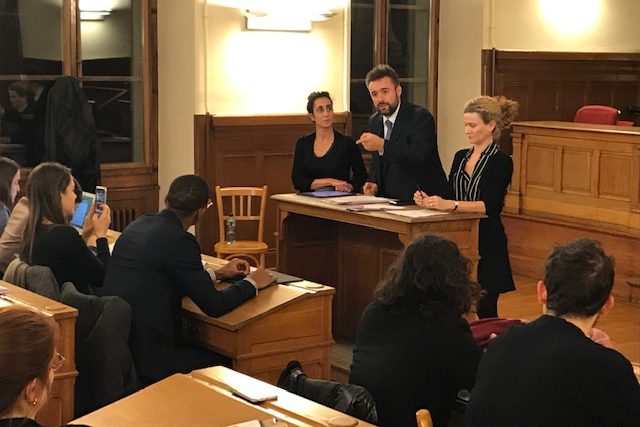
Part of the active ‘International Cooperation Initiative’ between the ICJ and the Geneva Bar Association, a full house conference, attended by Geneva Lawyers, took place tonight at the Palais de Justice of Geneva. The theme was the criminalization of helping migrants for humanitarian motives.
Massimo Frigo, Senior Legal Adviser of the ICJ’s Europe and Central Asia Programme presented this complex issue with regard to the existing protocols of European directives and the reluctance of EU states to respect them.
The conference Le délit de solidarité en droit Suisse, européen et mondial was the first of many collaborations to come on subjects of common interest between the ICJ and the Geneva legal community.
Dec 4, 2019 | News
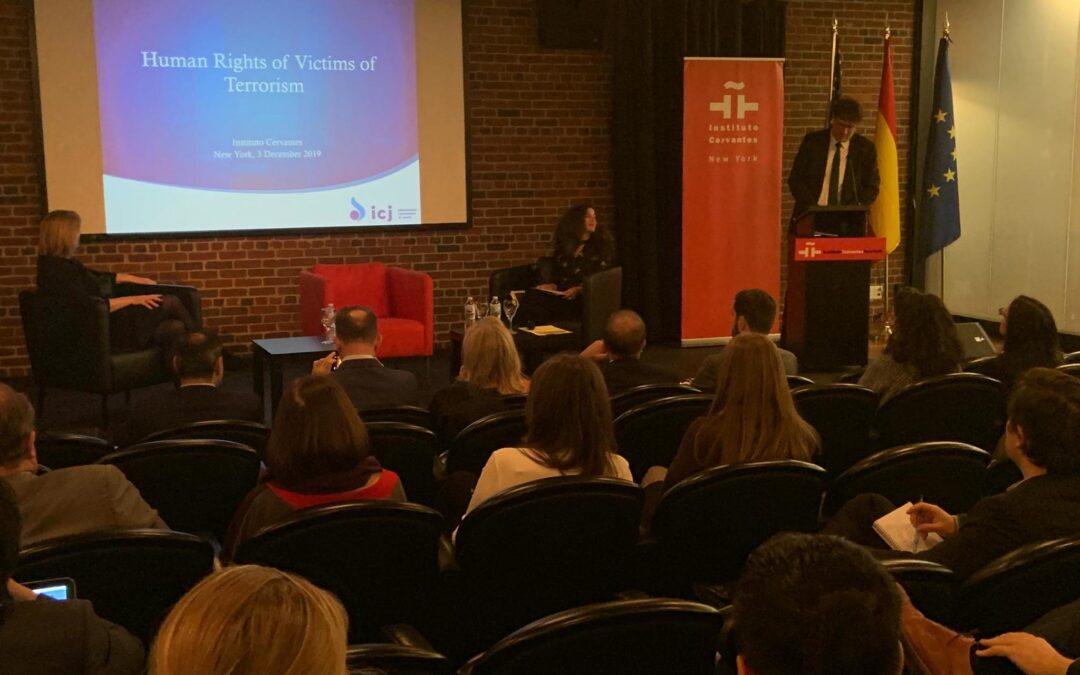
The ICJ has highlighted the human rights of victims of terrorism in a presentation to States’ delegations to the UN in New York.
On 3 December 2019, ICJ Senior Legal Adviser Matt Pollard presented ICJ’s compilation, Human Rights of Victims of Terrorism, at an event organized by the Permanent Missions of Spain and Afghanistan and the UN Office on Counter-Terrorism (UNOCT), with participation by the UN Special Rapporteur on the promotion and protection of human rights and fundamental freedoms while countering terrorism.
In the presentation, the ICJ recognised the achievements of Spain and Afghanistan in establishing a Group of Friends of Victims of Terrorism, and in achieving consensus for a ground-breaking General Assembly resolution in June, and UNOCT’s ongoing work including the UN victims of terrorism support portal.
The ICJ also emphasised key elements such as: the essential role of victims’ associations and other civil society actors; the need to move beyond expressions of solidary to implement concrete measures of assistance; and the need for a human-rights based approach to victims of terrorism.
Among key issues, the ICJ highlighted: effective, rapid and simple access to assistance; access to justice and the truth; recognition and remembrance; avoiding exploitation and re-traumatization; preventing further attacks or violence, while respecting the rule of law and human rights; ensuring involvement of victims’ representatives in designing, implementing and assessing measures for victims; and the importance of international cooperation.
The presentation also looked forward to next steps towards concrete realization of the human rights of victims of terrorism, including through State’s responses to the call in the General Assembly resolution to develop and implement National Action Plans.
For more information contact matt.pollard(a)icj.org
Nov 29, 2019
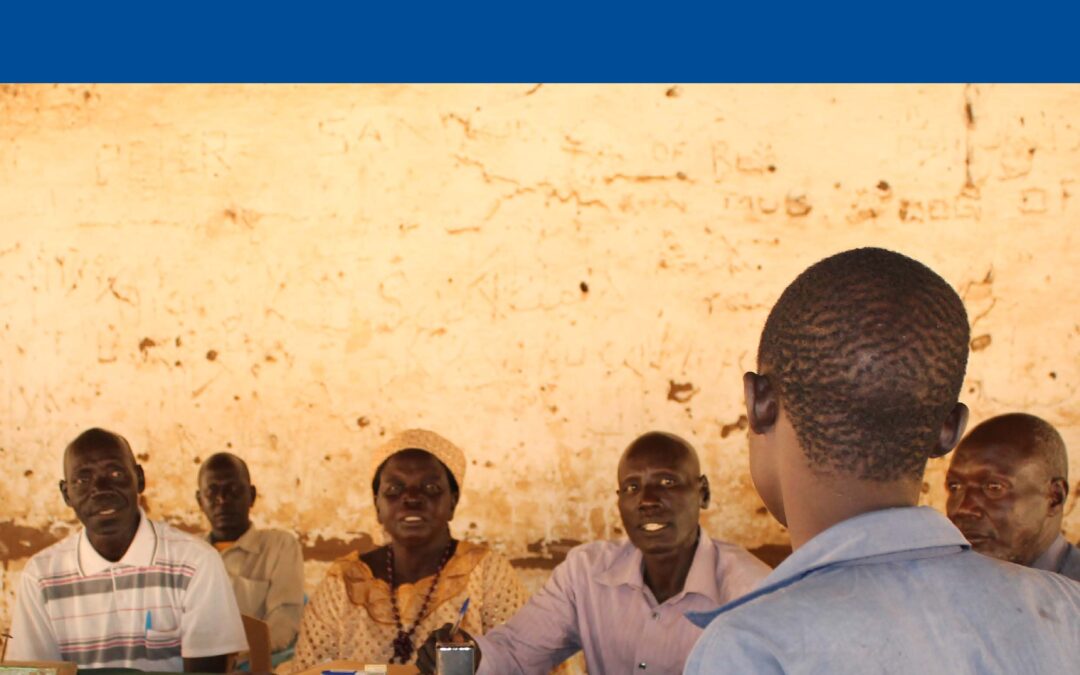
The ICJ today publishes an expanded and updated version of Indigenous and Other Traditional or Customary Justice Systems: selected international sources.
The compilation is a unique practical resource for practitioners in official State justice systems and indigenous, traditional or customary systems.
It is also intended to assist other community members, government officials, development practitioners, civil society organizations, and academic and other professionals who engage with such justice systems.
The compilation is being published as part of an ongoing project on the relationship between indigenous and other traditional or customary justice systems and human rights, access to justice, and the rule of law.
Among the sources included in the compilation are global and regional treaty provisions, UN and other declarations, and the jurisprudence and recommendations of Committees and Special Procedures established by treaties and the UN Human Rights Council.
The sources are organized by themes including the rights of women, rights of children, the role of judges and lawyers and the administration of justice, the rights of indigenous peoples, the rights of minorities, and transitional justice.
This revised edition incorporates new developments since 2018, including the landmark report of the UN Special Rapporteur on the Rights of Indigenous Peoples, and expands to cover certain topics more comprehensively, particularly with respect to indigenous rights.
The ICJ’s multi-year project has included global and Asia-Pacific and Africa regional consultations, and continues in 2020 with a concluding Global Forum in Geneva, and culminating with the publication by ICJ of detailed legal and practical guidance.
The guidance will seek to assist all actors involved in implementation and assessment of relevant targets of Sustainable Development Goal 16 on access to justice for all and effective, accountable and inclusive institutions, as well as Goal 5 on gender equality, including: decision-makers and other participants in traditional and customary justice systems; judges, lawyers and prosecutors operating in official justice systems; other government officials; development agencies; United Nations and other inter-governmental organizations; and civil society.
The initial version of the compilation was published in January 2018 under the title Traditional and Customary Justice Systems: Selected International Sources.
Contact
Matt Pollard, Senior Legal Adviser, matt.pollard@icj.org
Download
Universal-Trad Custom Justice Compil updated-Publications-2019-ENG (updated and expanded version of the compilation, in PDF)
Cover Photo: Traditional leaders preside over a case in B-Court, Nyang Payam, Torit County, South Sudan. Photo Credit: UNDP South Sudan2016Angelique Reid ©2016 United Nations
Nov 26, 2019 | News, Publications, Reports, Thematic reports
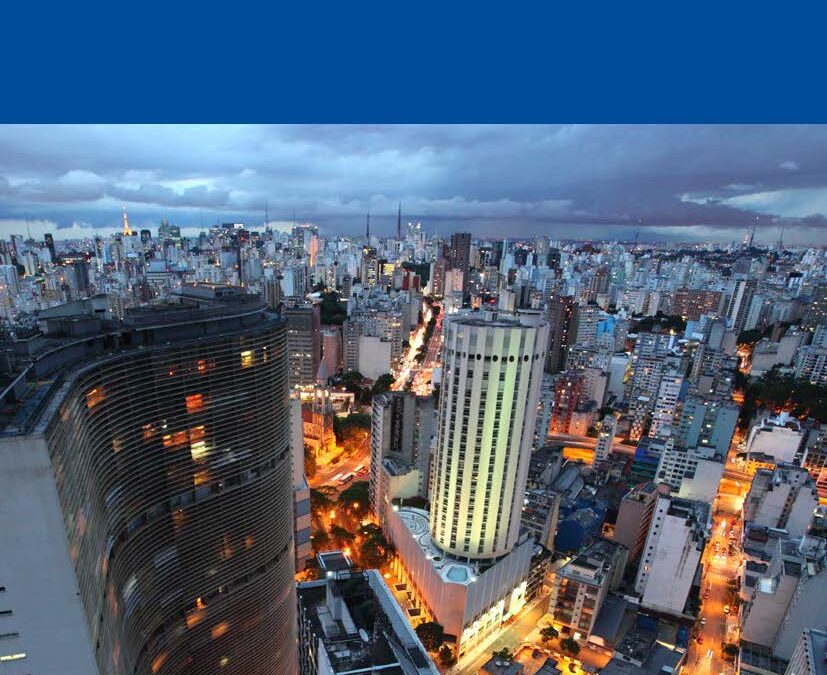
At the launch of a report on companies’ practices to address complaints relating to their negative impacts on human rights, the ICJ said that many companies have failed to establish and implement effective operational-level grievance mechanisms (OGMs).

Nov 7, 2019 | News
Today, the ICJ published an Arabic translation of Practitioners’ Guide N°12 on Women’s Access to Justice for Gender-based Violence.
The Guide is designed to support legal practitioners and human rights defenders involved or interested in pursuing cases of gender-based violence.
It provides information about regional and international law and standards relevant to gender-based violence, advice on implementing these standards as part of domestic law reform and examples of existing good practice in seeking protection for women.
The Guide (Arabic version here) also addresses the practical issues that are faced by women who have been subject to gender-based violence and the steps that are necessary to secure their access to justice in practice. It considers women’s experiences of the criminal justice system and reflects on how the justice system deals with women’s safety and need for access to services beyond legal assistance.
Download
Universal-Womens accesss to justice-Publications-Practitioners’ Guide Series-2019-ARA (full guide, in PDF)