Mar 8, 2019 | Advocacy, Non-legal submissions
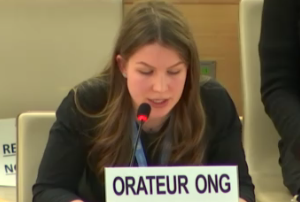
Speaking at the UN, the ICJ today urged all States from all regions to participate actively in the process towards a treaty on business and human rights.
The statement, delivered during a general debate on thematic issues at the UN Human Rights Council in Geneva, read as follows:
“Mr President,
The report on the Fourth session of the Intergovernmental Working Group to establish a legally binding instrument in the field of business and human rights opens opportunities for States and the international community to build a multilateral legal framework in this field.
We continue to urge all States from all regions – especially those that have been reluctant to engage- to actively participate in this process.
The ICJ considers that this draft should be based on transparent consultation and participation and respect standards of clarity and precision.
Recent dramatic events in Brazil and South Sudan show the central place that a system of legal responsibility for businesses, including for complicit participation in abuses, should have in an international treaty.
The dam collapse in the Brazilian locality of Brumadhino and the evidence pointing to oil industry complicity with serious human rights violations in South Sudan show the global scale of the problem and the involvement of companies from all corners of the world.
A treaty should also provide to all states a set of common standards effective collective action to guarantee access to justice in a transnational setting.
The creation of an international legally binding framework for States to maximize action and cooperation regarding human rights abuses in the context of business operations remains a compelling necessity of our times.
I thank you.”
The statement may be downloaded in PDF format here: HRC40-OralStatement-GDitem3-2019
Mar 7, 2019 | Events, News
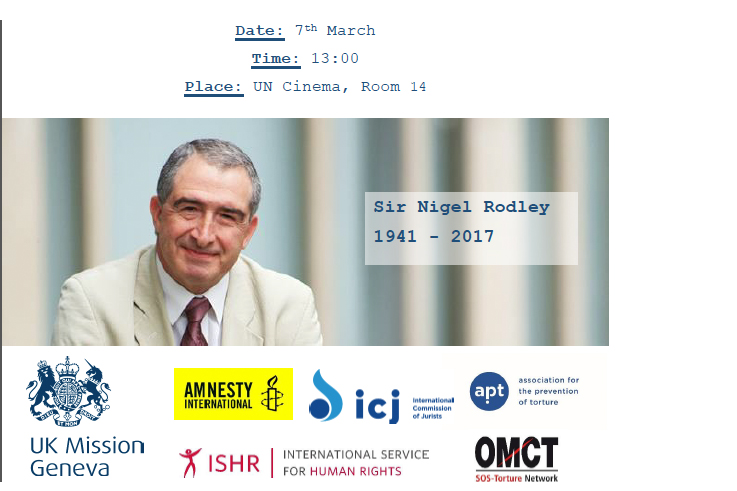
The ICJ is proud to join in presenting the documentary film The Long Haul, to be screened during the UN Human Rights Council session in Geneva.
Inspired by the life of the late Nigel Rodley—one of the principal architects of the modern human rights framework— the documentary The Long Haul addresses the current backlash on human rights and how best to respond.
Sir Nigel’s remarkable life story is an inspiration to stand up against wrongdoing and to continue fighting for equality and justice. At the same time, his family history is a reminder of the WWII tragedies that gave birth to the modern human rights regime and what could happen if we fail to honour these basic rights.
Nigel Rodley dedicated his career to the protection of those most at risk, including as Amnesty International’s first legal adviser and later as UN Special Rapporteur on Torture as then as a member and eventually Chair of the Human Rights Committee. He had a longstanding association with the ICJ as Commissioner and in other roles, and was President of the ICJ at the time he passed away.
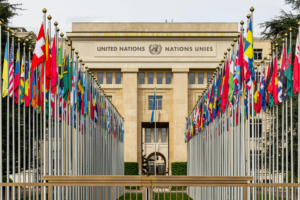
The film will be screened at a side event to the UN Human Rights Council session, at 13h00 on Thursday 7 March, in Room XIV (UN Cinema) of the Palais des Nations in Geneva. Access is available only to those who already hold grounds passes for the UN in Geneva, or accreditation for the Council session.
The event is organised by the Permanent Mission of the United Kingdom in Geneva, with participation of the International Commission of Jurists (ICJ), Amnesty International, the World Organisation against Torture (OMCT), Association for the Prevention of Torture (APT), and International Service for Human Rights (ISHR).
For more information contact un(a)icj.org
A flyer for the event can be downloaded in PDF format here: Events-NigelRodleyFilm-2019-En
Mar 4, 2019 | Events, News
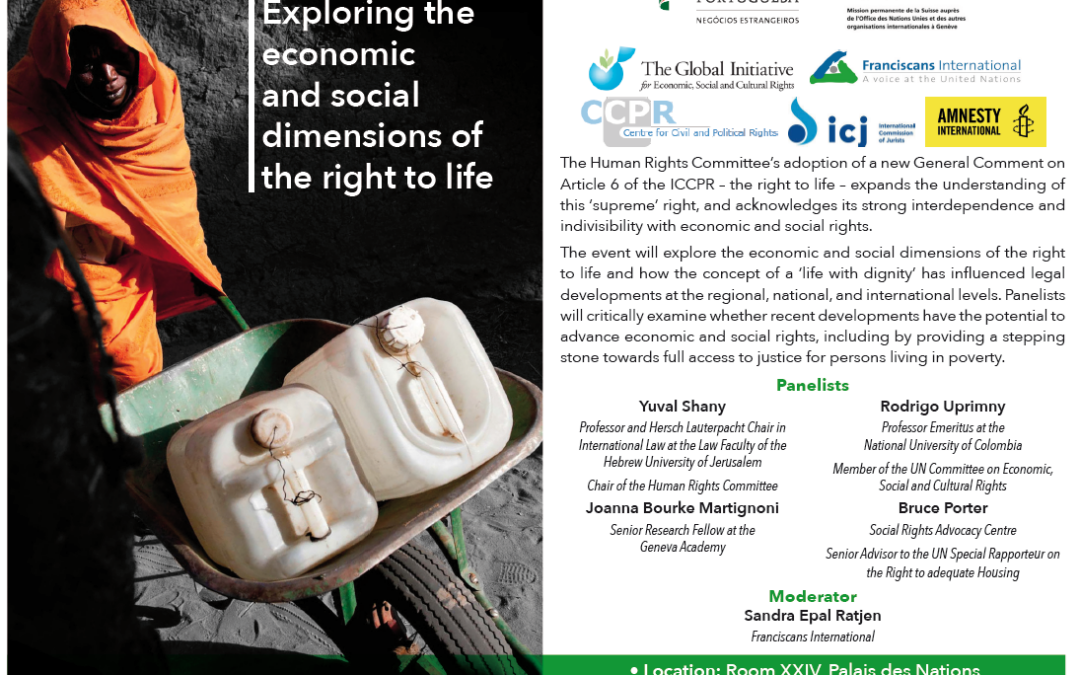
This side event will take place on 6 March, from 13.30-15.00, in Room XXIV of the Palais des Nations in Geneva.
The Human Rights Committee’s adoption of a new General Comment on Article 6 of the ICCPR – the right to life – expands the understanding of this ‘supreme’ right, and acknowledges its strong interdependence and indivisibility with economic and social rights.
The event will explore the economic and social dimensions of the right to life and how the concept of a ‘life with dignity’ has influenced legal developments at the regional, national, and international levels. Panelists will critically examine whether recent developments have the potential to advance economic and social rights, including by providing a stepping stone towards full access to justice for persons living in poverty.
Speakers:
Yuval Shany, Professor and Hersch Lauterpacht Chair in International Law at the Law Faculty of the Hebrew University of Jerusalem, Chair of the Human Rights Committee and Rapporteur for General Comment 36.
Rodrigo Uprimny, Professor Emeritus at the Professor Emeritus at the National University of Colombia, Member of the Committee on Economic, Social and Cultural Rights, ICJ Commissioner.
Bruce Porter, Executive Director, Social Rights Advocacy Centre, Chief Advisor to the UN Special Rapporteur on the right to adequate housing.
Joanna Bourke-Martignoni, Senior Research Fellow, Geneva Academy of International Humanitarian Law and Human Rights.
Moderator:
Sandra Epal Ratjen, International Advocacy Director and Deputy Executive Director, Franciscans International.
Universal-R2Life and ES rights-News-events-2019-ENG (Concept note in PDF)

Feb 15, 2019
The ICJ has published an overview of international standards on judges’ and prosecutors’ freedoms of expression, association and assembly, in a submission to the UN Special Rapporteur on the Independence of Judges and Lawyers.The document responds to the Special Rapporteur’s call for input for an upcoming report to the UN Human Rights Council in Geneva.
The submission outlines the relevant international standards and key regional jurisprudence and standards, as well as illustrative national cases and practice and several academic sources.
The ICJ concludes, among other things, that:
- Judges and prosecutors are like other citizens entitled to freedom of expression, belief, association and assembly, subject only to necessary and proportionate restrictions for valid purposes.
- In principle any such restrictions that are specifically related to their judicial functions, should be established by the judiciary itself or another independent body with majority membership of judges.
- Any proceedings against a judge or prosecutor related to their exercise of these freedoms should comply fully with international human rights law and standards in terms of the grounds and procedures, including as set out in standards on independence of the judiciary and prosecutors.
- Judges and prosecutors should be required to recuse themselves from any case where they have previously exercised these freedoms in a way that would give rise to a reasonable apprehension of bias in their subsequent conduct of the case.
- At the same time, the above considerations do not mean that a judge or prosecutor can never engage in expression, association or assemblies that touch on issues or parties that could speculatively come before the courts at some future point. Total isolation from the community and society is neither realistic nor desirable.
- In general, involvement in or comment on matters of party politics carry particularly high risks of giving rise to perceptions of lack of independence and there is relatively wide scope to enact restrictions on this ground.
- It is particularly important that judges (and prosecutors) can exercise their freedoms of expression, association and assembly in order to address: threats to the independence of the judiciary; threats to judicial integrity; fundamental aspects of the administration of justice; or to otherwise promote and protect universally recognized human rights and fundamental freedoms and the rule of law. As such, there is very limited scope for any authority to restrict exercise of these freedoms for these purposes.
- The relevant standards and principles apply to online forms of expression and association (including social media) in an equal or analogous manner to their application to offline forms. However, judges and prosecutors should be aware of and take into account practical aspects of online forms of expression and association.
The full submission can be downloaded in PDF format here: Universal-SRIJL Judges-Advocacy-non legal submission-2019-ENG
Jan 25, 2019
The ICJ has issued “A primer on international human rights law and standards on the right to freedom of thought, conscience, religion or belief” in which the organization outlines and analyses international human rights law and standards relevant to the right to freedom of religion or belief.
The primer is part of a series of ICJ publications on this theme.
The right to freedom of thought, conscience, religion or belief is a wide-ranging right encompassing a large number of distinct, and yet interrelated entitlements.
International human rights law provides for and guarantees the right to freedom of thought, conscience, religion or belief broadly, encompassing the right to freedom of thought and personal convictions in all matters, and protecting the profession and practice of different kinds of beliefs, whether theistic, non-theistic or atheistic, and the freedom not to disclose one’s religion or belief.
International law also guarantees and protects the right not to have a religious confession.
Among other things, the Primer describes in detail certain key aspects of the right to freedom of religion or belief, including the freedom to adopt, change or renounce a religion or belief; the right to manifest a religion or belief; as well as the relationship between the right to freedom of religion or belief and other human rights, including the principle of non-discrimination, and the right to freedom of expression.
Finally, the primer concludes with a number of recommendations addressed to States in light of its analysis of international human rights law and standards on the right to freedom of religion or belief.
Download
To download the Executive Summary in English, click here.
To download the full primer in English, click here.
To download the full primer in Burmese, click here.