Mar 6, 2018 | News
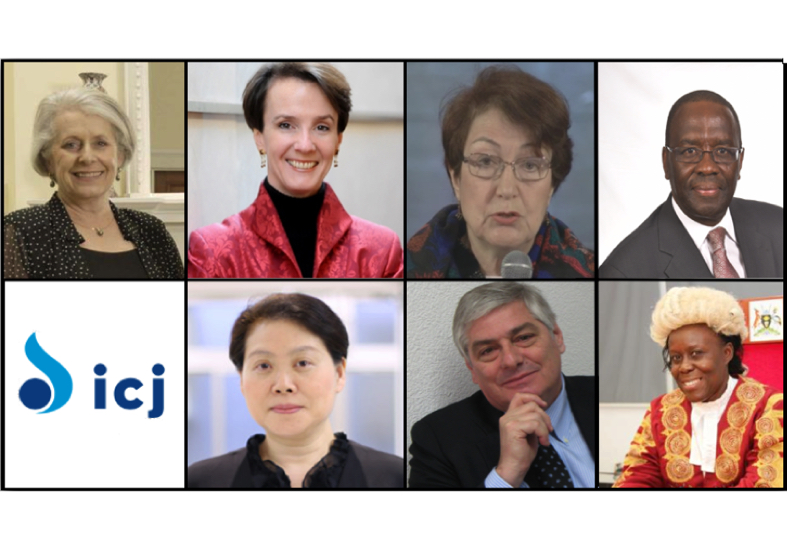
The ICJ is pleased to announce the addition of seven new members to the Commission.
They are Dame Silvia Cartwright (New Zealand), Professor Sarah Cleveland (USA), Justice Martine Comte (France), Justice Willy Mutunga (Kenya), Ms Mikiko Otani (Japan), Mr Wilder Tayler (Uruguay) and Justice Lillian Tibatemwa-Ekirikubinza (Uganda).
“The ICJ is pleased to welcome seven new Commissioners, five of whom are women, whose wealth of experience and expertise from a diverse range of legal backgrounds will greatly add to the Commission,” said the ICJ’s Acting President, Professor Robert Goldman.
“The addition of such strong new Commissioners helps ensure that we can carry out our fundamental work in defence of the rule of law and universal human rights at a time when we are witnessing a worldwide attack on respect for human rights and dignity,” he added.
The ICJ is also pleased to announce the appointment of Professor Carlos Ayala (Venezuela) as a new Vice-President.
Professor Ayala has shown a great deal of dedication to the ICJ since his initial election to the Commission in 2012.
Amongst other roles, he has served as chairman of the Inter-American Commission of Human Rights and taught constitutional, administrative and human rights law at a number of universities around the world.
“The ICJ’s ability to promote and protect human rights through the rule of law would not be possible without the dedicated Commissioners that make this organization what it is. The newly-appointed Commissioners and Vice-President will greatly enhance the ICJ and I look forward to working with them,” said Goldman.
In addition to the new appointments, Commissioners Roberta Clarke and Justice Sanji Monageng were elected to serve on the Executive Committee.
Eight Commissioners were also re-elected to serve second terms: Justice Radmila Dragicevic-Dicic (Serbia), Mr Shawan Jabarin (Palestine), Justice Egbert Myjer (Netherlands), Justice Qinisile Mabuza (Swaziland), Professor Victor Rodriguez Rescia (Costa Rica), Professor Marco Sassoli (Switzerland), Justice Stefan Trechsel (Switzerland) and Professor Rodrigo Uprimny Yepes (Colombia).
Further information on the new Commissioners
Dame Silvia Cartwright (New Zealand) was Governor-General of New Zealand from 2001-2006 and the first woman appointed to the High Court in New Zealand. She was also a judge on the Extraordinary Chambers in the Courts of Cambodia. Amongst others, she has the following honours: Dame Commander of the British Empire (DBE) and Principal Companion of the New Zealand Order of Merit (PCNZM). Dame Cartwright has served on the Committee on the Elimination of Discrimination against Women and played a role in drafting the optional protocol to the Convention on the Elimination of Discrimination against Women (CEDAW).
Professor Sarah Cleveland (USA) is the Louis Henkin Professor of Human and Constitutional Rights and faculty director of the Human Rights Institute at Columbia Law School. She is currently a member of the UN Human Rights Committee, the US member of the Venice Commission, and former counsel to the US State Department legal adviser. She also serves as coordinating reporter of the American Law Institute’s project on the Restatement (Fourth) of the Foreign Relations Law of the United States.
Justice Martine Comte (France) has been a judge in France for more than 30 years, including having served as President of the Orléans Court of Appeal from 2011-2014. Prior to this her judicial career has been extensive and amongst other roles she has served as President of the Pontoise Tribunal of First Instance, President of the Bourgoin-Jallieu Court of First Instance and as Head of the Regional Administrative Department of Paris. She has also served as an Inspector of Judicial Services. Justice Comte is an Officer of the National Order of Merit and Knight of the Légion d’Honneur.
Justice Willly Mutunga (Kenya) served as Chief Justice & President of the Supreme Court, Republic of Kenya, 2011- 2016. He was the Commonwealth Secretary-General’s Special Envoy to the Maldives, 2016-17. He is an active member of the Justice Leadership Group. He has a previous career as an academic and in human rights movements in East Africa and Canada, and served as Executive Director of the Eastern Office of the Ford Foundation, 2004-2011.
Ms Mikiko Otani (Japan) Mikiko Otani is a member of the United Nations Committee on the Rights of the Child (CRC) (2017-) and a former Chair of the Committee on International Human Rights of the Japan Federation of Bar Associations. Prior to being elected as a member of the CRC, she was actively involved in the reporting process for Japan under the CRC and the CEDAW, representing NGOs.
Mr Wilder Tayler (Uruguay) is a Director of the National Institution of Human Rights and Ombudsman’s Office in Uruguay. He was Secretary-General of the International Commission of Jurists from 2008-2017. Between 2007 and 2014 he was a member and Vice-Chairperson of the UN Sub-Committee on the Prevention of Torture. Mr Tayler was Legal Director of Human Rights Watch from 1997 to March 2007 and before that he worked with Amnesty International as Director of the Americas Programme and a Legal Advisor.
Justice Lillian Tibatemwa-Ekirikubinza (Uganda) is a Justice of the Supreme Court of Uganda. Prior to joining the Court, she served on Uganda’s Constitutional Court for two years. Before joining the Judiciary, Tibatemwa-Ekirikubinza served as Deputy Vice-Chancellor in charge of Academic Affairs at Makerere University, Uganda, where she was also a Professor of Law. She is an author of law textbooks currently in use as reference texts in East African Law Schools.
More information about all the Commissioners can be found on the Commission page.
Mar 1, 2018 | Events, News
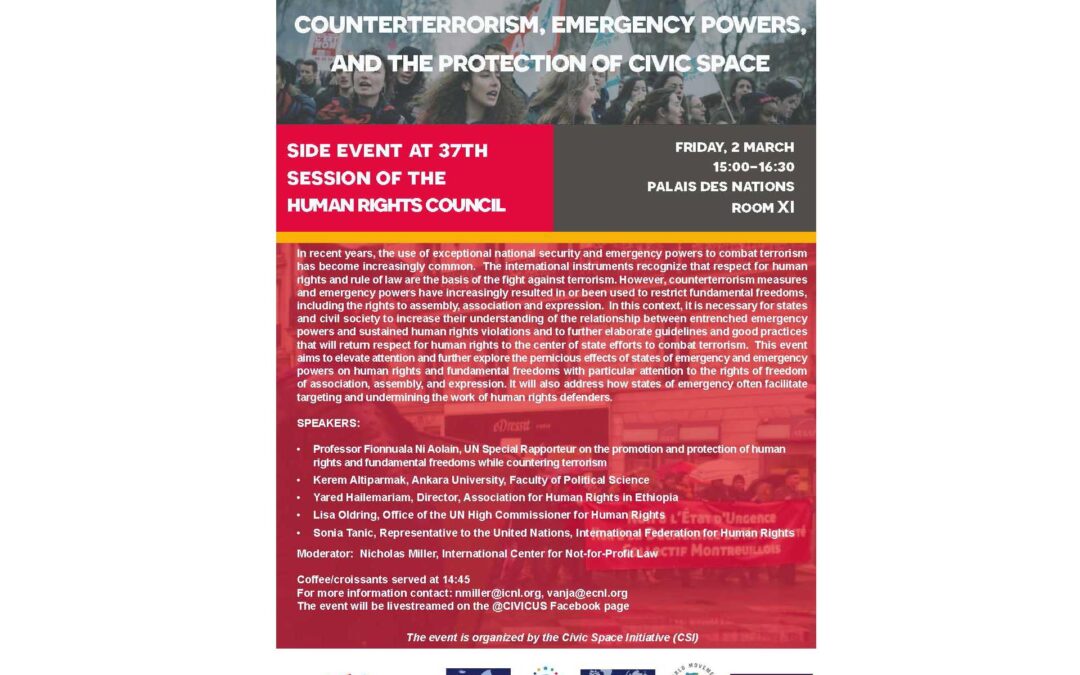
This side event at the 37th session of the Human Rights Council takes place on Friday, 2 march, 15:00-16:30, room XI of the Palais des Nations. It is organized by the Civic Space Initiative (CSI) and co-sponsored by the ICJ.
In recent years, the use of exceptional national security and emergency powers to combat terrorism has become increasingly common.
The international instruments recognize that respect for human rights and rule of law are the basis of the fight against terrorism.
However, counterterrorism measures and emergency powers have increasingly resulted in or been used to restrict fundamental freedoms, including the rights to assembly, association and expression.
In this context, it is necessary for states and civil society to increase their understanding of the relationship between entrenched emergency powers and sustained human rights violations and to further elaborate guidelines and good practices that will return respect for human rights to the center of state efforts to combat terrorism.
This event aims to elevate attention and further explore the pernicious effects of states of emergency and emergency powers on human rights and fundamental freedoms with particular attention to the rights of freedom of association, assembly, and expression. It will also address how states of emergency often facilitate targeting and undermining the work of human rights defenders.
Speakers:
- Professor Fionnuala Ni Aolain, UN Special Rapporteur on the promotion and protection of human
rights and fundamental freedoms while countering terrorism
- Kerem Altiparmak, Ankara University, Faculty of Political Science
- Yared Hailemariam, Director, Association for Human Rights in Ethiopia
- Lisa Oldring, Office of the UN High Commissioner for Human Rights
- Sonia Tanic, Representative to the United Nations, International Federation for Human Rights
Moderator:
- Nicholas Miller, International Center for Not-for-Profit Law
Coffee/croissants served at 14:45
For more information contact: nmiller@icnl.org, vanja@ecnl.org
The event will be livestreamed on the @CIVICUS Facebook page
Universal – Counterrorism and Civic Space – News – Events – 2018 – News (Event flyer in PDF)
Feb 27, 2018 | Advocacy, News, Non-legal submissions
The head of the ICJ’s Centre for the Independence of Judges and Lawyers, Matt Pollard, highlighted the role of judges, lawyers and prosecutors in preventing human rights abuses, at a UN expert workshop in Geneva.The Office of the UN High Commissioner for Human Rights (OHCHR) organised the expert workshop, 21 to 22 February 2018, to discuss the role and contribution of civil society organizations, academia, national human rights institutions and other relevant stakeholders in the prevention of human rights abuses, drawing on the conclusions and recommendations of OHCHR’s study on the prevention of human rights violations.
The workshop, mandated by the Human Rights Council resolution 33/6, covered topics such as: a framework approach to prevention; human rights education; abuses by private actors, national and regional practices, planning and monitoring tools; human rights impact assessments; and the role of UN institutions.
The presentation on the role of judges and lawyers can be downloaded in PDF format here: UN-ExpertMeeting-JudgesLawyersPrevention-2018
More information about the expert workshop is available by clicking here.
Feb 8, 2018
The ICJ has today published a compilation of international human rights standards relevant to Traditional and Customary Justice Systems.
The compilation is being published as part of an ongoing project on the relationship between traditional and customary justice systems, including indigenous justice, and human rights, access to justice, and the rule of law.
Among the sources included in the compilation are global and regional treaty provisions, UN and other declarations, and the jurisprudence and recommendations of Committees and Special Procedures established by treaties and the UN Human Rights Council.
The sources are organised by themes including the rights of women, rights of children, the role of judges and lawyers and the administration of justice, the rights of indigenous peoples, and the rights of minorities.
The 2017 ICJ Geneva Forum of Judges and Lawyers brought together judges and lawyers from around the world to discuss traditional and customary justice systems, and the ICJ is currently planning for continuing work on the theme over the next three years with the aim of producing practical global legal and policy guidance to assist actors within traditional systems, actors within State justice systems, and others to best ensure that everyone enjoys their rights of access to justice and other human rights. A report of the Forum is also available.
Contact
Matt Pollard, Senior Legal Adviser, matt.pollard@icj.org
Universal-Trad Custom Justice Compil updated-Publications-2018-ENG (Full publication in PDF)
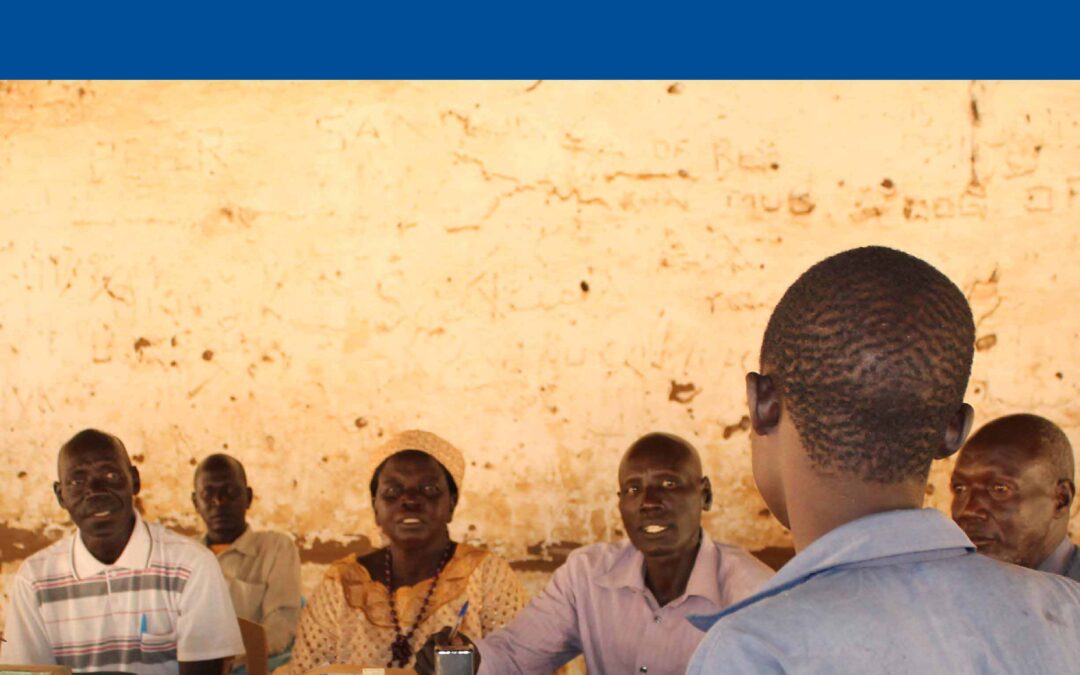
Cover Photo: Traditional leaders preside over a case in B-Court, Nyang Payam, Torit County, South Sudan. Photo Credit: UNDP South Sudan2016Angelique Reid ©2016 United Nations
Dec 18, 2017 | Multimedia items, News, Video clips
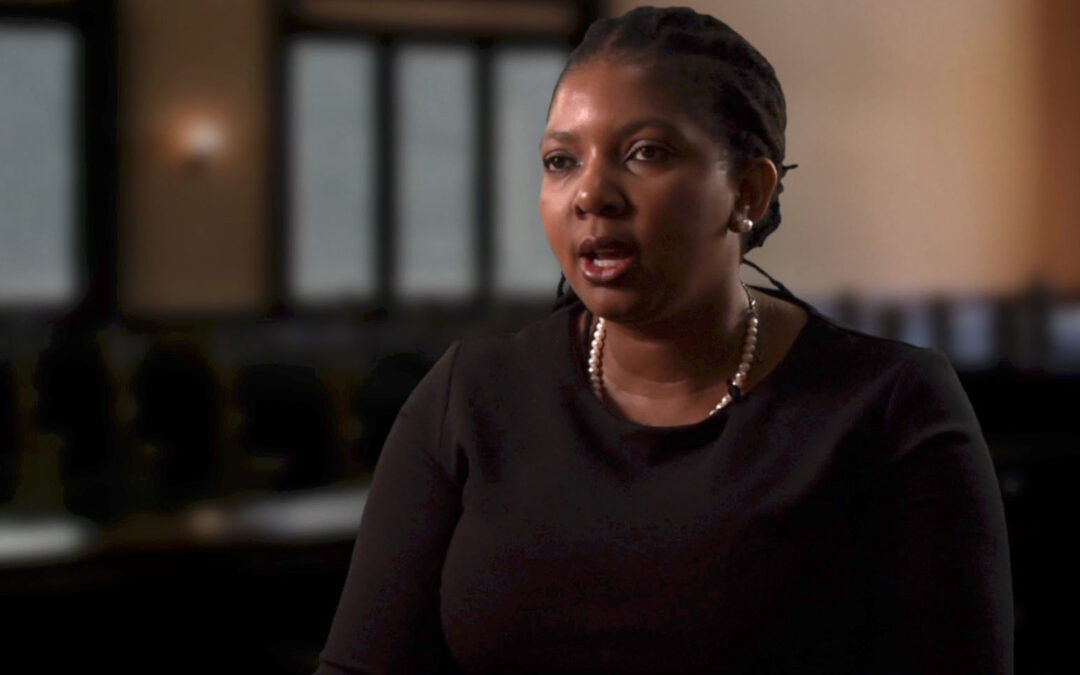
Raquel Yrigoyen Fajardo, Karabo Ozah and Charles Dinda talk about traditional justice systems in video interviews recorded at the 2017 ICJ Geneva Forum.
Dr. Raquel Yrigoyen Fajardo, Lawyer and Professor at the Law Faculty of the Pontifical Catholic University of Peru, and founding member of the International Institute on Law and Society (IIDS), describes the survival and contemporary recognition of justice systems of indigenous peoples in the Americas, despite the history of colonial domination.
She argues that indigenous justice systems often already reflect many international human rights standards, and where there may be discrepancies change should be sought through respectful engagement and consultation rather than coercive imposition.
In contrast, Ms Karabo Ozah, Deputy Director of the Centre for Child Law at the University of Pretoria in South Africa, argues that it is crucially important to ensure that customary and traditional courts respect domestic legislation and international standards on human rights.
Otherwise she warns, based on her experience, customary courts too frequently fail to protect the rights of marginalized groups, children, LGBTI, and women.
Charles Dinda, Senior Legal Adviser with the Danish Institute for Human Rights in Zambia, points out that while traditional and customary justice institutions are the most easily accessible and in many respects most credible institutions for some populations, their decisions are too often inconsistent or unfair.
To avoid this, he insists on the importance of understanding and studying the way these systems operate and on the need to engage with them to learn about their practices and to build their capacities so that they have better knowledge of international human rights standards and indeed of the national laws in the countries where they operate.
Watch the interview with Dr. Raquel Yrigoyen Fajardo
Watch the interview with Karabo Ozah
Watch the interview with Charles Dinda
NOTE:
The views expressed by the participants do not necessarily reflect those of the ICJ.
For more information about the 2017 Geneva Forum on Customary and Traditional Justice Systems, click here or contact matt.pollard(a)icj.org .