Oct 3, 2014 | Agendas, Events
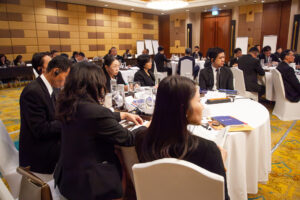
Today, the International Commission of Jurists (ICJ) held its second expert roundtable on asylum claims based on sexual orientation and/or gender identity.
Participants included asylum judges, lawyers, and academics, as well as officials from the Office of the UN High Commissioner for Refugees and staff members from a number of civil society organizations.
Prof. Hathaway, Director of the Program in refugee and asylum law at the University of Michigan Law School, Prof. Anker, Director of the Harvard Law School’s Immigration and Refugee Clinical Program, and Judge Lars Bay Larsen, judge of the Court of Justice of the European Union, were the main speakers at the roundtable. Each delivered a presentation focussing on different normative aspects of asylum claims based on sexual orientation and/or gender identity.
The programme of the second expert roundtable, including a list of all participants, can be downloaded here.
This roundtable forms part of a broader ICJ’S project on international protection claims based on sexual orientation AND/OR gender identity. The programme of the first roundtable organised in Brussels last June can be downloaded here. The ICJ’s commentary on the related CJEU judgment in X, Y and Z v. the Netherlands can be downloaded here.
Oct 2, 2014
The ICJ published today the 2014 update of its Practitioners Guide no. 6 on Migration and International Human Rights Law.
The Practitioners Guide on Migration and International Human Rights Law analyses the protection afforded to migrants by international law and the means to implement it at national and international levels.
The Guide synthesises and clarifies international standards on key issues, in particular:
- the rights and procedures connected to the way migrants enter a country and their status in the country of destination;
- human rights and refugee law constraints on expulsion;
- the human rights and refugee law rights linked to expulsion procedures;
- the rights and guarantees for administrative detention of migrants;
- rights connected to work and labour; and
- rights to education, to the highest attainable standard of health, to adequate housing, to water, to food, and to social security.
Universal-MigrationHRlaw-PG no 6-Publications-Practitioners’Guide-2014-eng (full text of the second edition in English, PDF)
universal-pg-6-migration-publications-practitionners-guides-series-2016-rus (full text of the second edition in Russian, PDF)
Universal-migration and international human rights law-practitioners guide-2014-gre (full text of the second edition in Greek, PDF)
Universal-PG 6 Migration-Publications-Practitionners’ Guides Series-2016-ser (full text of the second edition in Serbian, PDF)
Universal-migration and international human rights law-practitioners guide-2011-ita (full text of the first edition in Italian, PDF)
Universal-migration and international human rights law-practitioners guide-2011-eng (full text of the first edition in English, PDF)
Oct 1, 2014
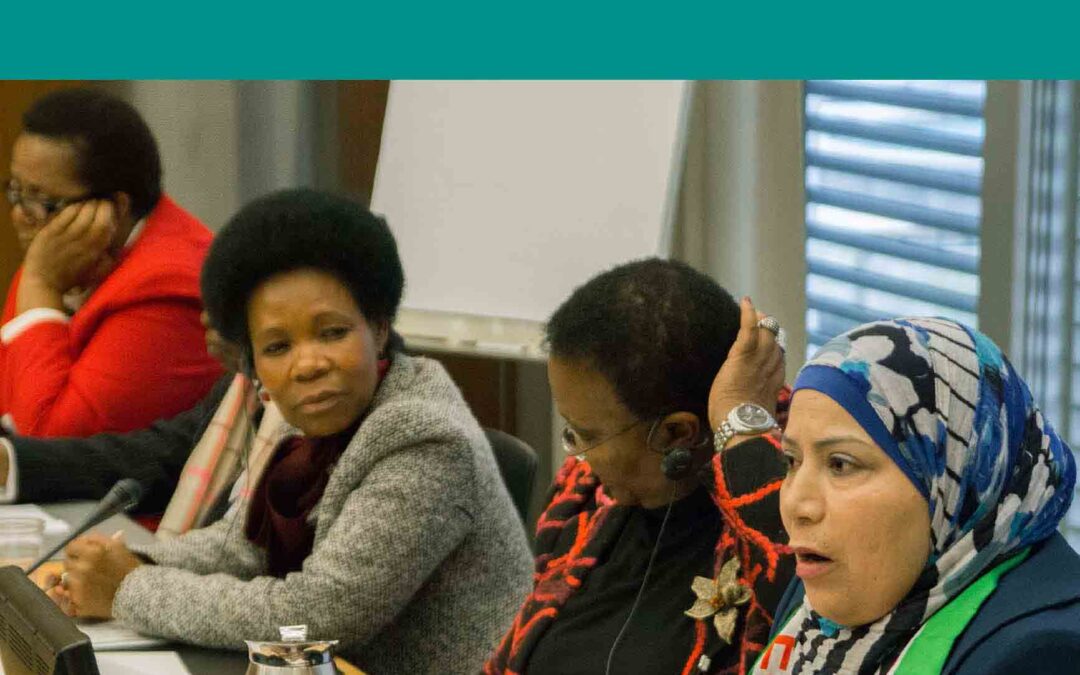
The present publication, no. 1 in the “Geneva Forum Series”, brings together materials related to the 2013 Geneva Forum on women and the judiciary.
Discussions focused on overcoming obstacles to women’s full and equal participation in the judiciary, and possible links to the better protection of women’s human rights by the judiciary.
The publication opens with highlights of the discussions in Geneva.
A second paper integrates the insights of the Geneva discussions together with findings from earlier regional colloquia in Tanzania and Tunisia. Finally, short snapshots are provided of the situation for women and the judiciary in six jurisdictions: Jordan, Kenya, Saudi Arabia, Tanzania, Tunisia and Uganda.
The ICJ has convened the Geneva Forum of Judges and Lawyers each year since 2010.
Organized by the ICJ’s Centre for the Independence of Judges and Lawyers, the Forum gathers legal practitioners from around the world for dialogue aimed at identifying and finding practical solutions to the challenges their professions face.
Improved judicial protection of human rights is the underlying motivation and theme for the Forums.
The ICJ plans to publish further entries in the “Geneva Forum Series” following future Forums.
The Series seeks to provide a permanent record of the discussions.
The summaries of the proceedings at the previous Geneva Forums can be consulted here:
1st Geneva Forum
2nd Geneva Forum
3rd Geneva Forum
Download the full text of the Geneva Forum Series no 1:
Universal-Women and Judiciary Gva For 1-Publications-Conference Report-2014-ENG
Sep 25, 2014
El 23 y 24 de septiembre, en Lima (Perú), la Comisión Internacional de Juristas y el Equipo Peruano de Antropología Forense (EPAF) realizaron un seminario sobre la impunidad y las graves violaciones a los derechos humanos.
Con ocasión a este Seminario la CIJ hizo el lanzamiento de su nueva Guía para profesionales No. 7 “Derecho internacional y lucha contra la impunidad”.
El Seminario abordó, desde la perspectiva del Derecho internacional, diferentes aspectos de la cuestión de la impunidad en materia de graves violaciones a los derechos humanos y crímenes internacionales, de relevancia para el Perú.
Para ello, el Seminario contó con la participación, entre otros, de Robert K. Goldman (Vicepresidente de la CIJ), César Landa (Comisionado peruano de la CIJ), Wilder Tayler (Secretario General de la CIJ) y José Pablo Baraybar (Director del EPAF). Al evento asistieron magistrados, jueces, fiscales, representantes de la Defensoría del Pueblo, miembros de las organizaciones no gubernamentales de derechos humanos y de asociaciones de víctimas, representantes de la comunidad diplomática y periodistas.
Universal-Lucha contra la Impunidad PG7-Publications-Practitioners’ guide series-2014-SPA (descargar el pdf)

Sep 24, 2014
The ICJ today joined 42 other NGOs to express deep concern regarding proposed amendments to the draft resolution on civil society space at the UN Human Rights Council.
The draft resolution on civil society space identifies key elements required to ensure that civil society can exercise its critical role in strengthening democracy, providing essential services, and promoting human rights.
It reaffirms States’ existing obligations under international human rights law to guarantee the rights to freedom of expression, assembly and association, and public participation, among other rights, and to protect civil society space and actors from threats, attacks or reprisals. The Resolution, if adopted, would be an important contribution to efforts to bridge implementation gaps and overcome obstacles in protecting civil society space.
However, in the days before the resolution is to be considered for adoption by the Council, some States have presented amendments that seek to undermine the spirit of the resolution and to detract from States’ obligations to protect and promote civil society space.
In a joint open letter, the 43 NGOs explain why each of the proposed amendments is unacceptable, and calls on all member States of the Council to support the draft resolution as tabled, and vote against the proposed amendments should they be brought to a vote.
The joint open letter may be downloaded in PDF format here: Universal-CivilSocietySpaceLetter-Advocacy-OpenLetter-2014-ENG