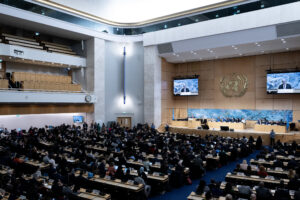
Jul 12, 2017 | News
The ICJ is alarmed at ongoing attacks on the rule of law in Poland.
On 12 July 2017, the Government tabled in Parliament draft bill no. 1727, that, if approved, would automatically dismiss all judges of the Supreme Court and let the Minister of Justice decide which judges are to be reinstated or newly appointed.
“This draft law is a direct blow to the principle of separation of powers, the bedrock of the rule of law,” said Massimo Frigo, Legal Adviser with the ICJ Europe Programme.
“The security of tenure and conditions of service of individual judges are essential to judicial independence,” he added.
Draft bill no. 1727 follows another piece of legislation, recently approved by Parliament, by which the Parliament empowered itself to appoint the majority of the members of the National Council of the Judiciary, the body which selects and governs the judiciary.
That law gives political powers in the Polish legislature and executive, which have increasingly demonstrated deep disregard for human rights and the rule of law, undue influence over the judiciary.
Such deficiencies were also highlighted by the Office for Democratic Institutions and Human Rights of the OSCE in May 2017.
“These series of legislative attacks to the independence of the judiciary in Poland must stop. These actions are inconsistent with the international obligations of Poland to ensure the independence of judges,” said Massimo Frigo.
“The European Union must intervene. A EU Member State that directly undermines the checks and balances of its own legal system threatens the founding values of the EU of the rule of law and respect for human rights,” he added.
Contact
Massimo Frigo, ICJ Legal Adviser, t: +41 22 979 3805 ; e: massimo.frigo(a)icj.org
International standards
Particularly in a context like present day Poland, mass removal of all judges from a court, by another branch of government, without a fair and evidence-based individual process for each judge, is incompatible with international standards such as the UN Basic Principles on the Independence of the Judiciary (See, ICJ Practitioners Guide no 13 on Judicial Accountability, pp. 99-104). The UN Basic Principles affirm, among other things, that:
1. The independence of the judiciary shall be guaranteed by the State and enshrined in the Constitution or the law of the country. It is the duty of all governmental and other institutions to respect and observe the independence of the judiciary.
2. The judiciary shall decide matters before them impartially, on the basis of facts and in accordance with the law, without any restrictions, improper influences, inducements, pressures, threats or interferences, direct or indirect, from any quarter or for any reason.
10. …Any method of judicial selection shall safeguard against judicial appointments for improper motives. …
12. Judges, whether appointed or elected, shall have guaranteed tenure until a mandatory retirement age or the expiry of their term of office, where such exists.
18. Judges shall be subject to suspension or removal only for reasons of incapacity or behaviour that renders them unfit to discharge their duties.
19. All disciplinary, suspension or removal proceedings shall be determined in accordance with established standards of judicial conduct.
20. Decisions in disciplinary, suspension or removal proceedings should be subject to an independent review. This principle may not apply to the decisions of the highest court and those of the legislature in impeachment or similar proceedings.
Similar mass removals with politicization of the procedure for reinstatement and new appointments have been condemned as violations of States’ international human rights obligations by, for instance, the UN Human Rights Committee acting under the International Covenant on Civil and Political Rights, to which Poland is also party (see Busyo, Wongodi, Matubaka et al v. Democratic Republic of the Congo, UN Doc CCPR/C/7878/D/933/2000 (2003), and the Inter-American Court of Human Rights (see e.g. Supreme Court of Justice (Quintana Coelle et al) v. Ecuador, Series C No. 266 (2013) and Constitutional Tribunal (Camba Campos et al) v. Ecuador, Series C No. 268 (2013).
Council of Europe standards, in the form of Recommendation CM/Rec(2010)12 of the Committee of Ministers to member states on judges: independence, efficiency and responsibilities, provide among other things as follows:
26. Councils for the judiciary are independent bodies, established by law or under the constitution, that seek to safeguard the independence of the judiciary and of individual judges and thereby to promote the efficient functioning of the judicial system.
27. Not less than half the members of such councils should be judges chosen by their peers from all levels of the judiciary and with respect for pluralism inside the judiciary.
44. Decisions concerning the selection and career of judges should be based on objective criteria pre-established by law or by the competent authorities. Such decisions should be based on merit, having regard to the qualifications, skills and capacity required to adjudicate cases by applying the law while respecting human dignity.
45. There should be no discrimination against judges or candidates for judicial office on any ground such as sex, race, colour, language, religion, political or other opinion, national or social origin, association with a national minority, property, disability, birth, sexual orientation or other status. A requirement that a judge or a candidate for judicial office must be a national of the state concerned should not be considered discriminatory.
46. The authority taking decisions on the selection and career of judges should be independent of the executive and legislative powers. With a view to guaranteeing its independence, at least half of the members of the authority should be judges chosen by their peers.
47. However, where the constitutional or other legal provisions prescribe that the head of state, the government or the legislative power take decisions concerning the selection and career of judges, an independent and competent authority drawn in substantial part from the judiciary (without prejudice to the rules applicable to councils for the judiciary contained in Chapter IV) should be authorised to make recommendations or express opinions which the relevant appointing authority follows in practice.
48. The membership of the independent authorities referred to in paragraphs 46 and 47 should ensure the widest possible representation. Their procedures should be transparent with reasons for decisions being made available to applicants on request. An unsuccessful candidate should have the right to challenge the decision, or at least the procedure under which the decision was made.
49. Security of tenure and irremovability are key elements of the independence of judges. Accordingly, judges should have guaranteed tenure until a mandatory retirement age, where such exists.
50. The terms of office of judges should be established by law. A permanent appointment should only be terminated in cases of serious breaches of disciplinary or criminal provisions established by law, or where the judge can no longer perform judicial functions. Early retirement should be possible only at the request of the judge concerned or on medical grounds.
69. Disciplinary proceedings may follow where judges fail to carry out their duties in an efficient and proper manner. Such proceedings should be conducted by an independent authority or a court with all the guarantees of a fair trial and provide the judge with the right to challenge the decision and sanction. Disciplinary sanctions should be proportionate.
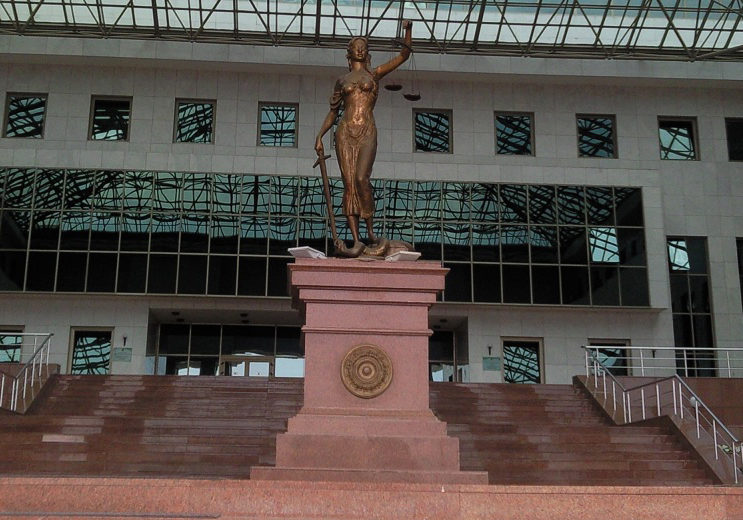
Jun 28, 2017 | News
Government moves to amend the regulatory framework of the legal profession in Kazakhstan may undermine its independence and are contrary to the principle of self-regulation of the profession, the ICJ said today.
The ICJ called on the authorities of Kazakhstan to refrain from interference in the governance of the independent legal profession and step back to allow the collegia of lawyers to continue to take responsibility for such matters.
The ICJ stressed that any proposals for reform put forward by the governing bodies of the profession should be developed in consultation with and enjoy the consent of the members of advokatura in accordance with international law and standards on the independence of lawyers.
The ICJ was responding to proposals put forward by the Justice Minister Marat Beketayev for reform of the legal profession in Kazakhstan.
In a statement to Parliament on 29 May 2017 (Report of the Minister of Justice on the issues of further development and reform of the institutes of notary and advokatura on 29 May 2017), the Minister outlined plans to:
- lower training and entrance fees to the profession “in order to simplify access to the profession”;
- broaden the powers of the Republican Collegium to regulate the disciplinary system for lawyers, in light of the Minister’s view that lawyers were avoiding disciplinary responsibility in many cases under the current system;
- require lawyers to undergo annual training followed by exams, which would be set not by the collegia themselves, but by universities or external training centres;
- require lawyers, in addition to the participation in state-funded legal aid scheme, to provide mandatory legal assistance without financial support from the Government, which the Minister described as “pro bono” service
The importance of an independent legal profession which is self-regulating is well recognized and accepted under international standards and by international authorities.
One of the means by which such independence may be guaranteed is the governance of the profession by an organization independent from the State or other national institutions.
International standards provide that it is an important function of the lawyer’s association “[t]o maintain the honour, dignity, integrity, competence, ethics, standards of conduct and discipline of the profession” (Singhvi Declaration, para.99).
In this context, comments by the Justice Minister Marat Beketayev on the need to change the disciplinary system due to lawyers avoiding disciplinary responsibility “for violations committed” is of serious concern, the ICJ said.
While it is important that lawyers who act against the interests of their clients, or otherwise violate standards of lawyers’ ethics are subject to disciplinary responsibility, it is the function of the profession itself to decide on such matters. Disciplinary proceedings should never be used to undermine lawyers’ independence.
Lowering entrance fees for qualifying lawyers may be a positive measure that can enhance access to the profession for qualifying lawyers, in circumstances where such fees are inaccessibly high.
However the initiating and design of such proposals should not be in the hands of the executive, as this may limit the independence and effectiveness of the legal profession.
Financial sustainability of an independent legal profession largely depends on its members’ fees.
The advokatura should be able to regulate and finance its regular operations, including administration and training, the ICJ added.
As noted by the former UN Special Rapporteur on the Independence of Judges and Lawyers in his report of 2009: “… the legal profession is best placed to determine admission requirements and procedures and should thus be responsible for administering examinations and granting professional certificates. This would further help in preserving its independence and self-governance, as advised in the Basic Principles.”
The ICJ is also concerned at suggestions that, as part of continuing legal education, lawyers will be subject to examinations by institutions outside the profession.
While it remains unclear what role or effect such examinations would have, the proposal raises concerns regarding the legal profession’s self-regulation and would risk undermining its independence, the ICJ said.
It should be recalled that, Kazakhstan is required take measures to remove obstacles to the independence of lawyers.
Regarding the proposals on so called ‘pro bono legal assistance’, while it is welcome when any State adopts measures to make legal aid more accessible, such measures should not place an unreasonable burden on lawyers to provide mandatory legal assistance.
The scheme proposed by the Minister for Justice whereby lawyers become responsible for providing legal services without financial compensation for their work is of concern, and appears unlikely to ensure a high quality of legal advice, the ICJ added.
It should be the role of the government to provide regular and sufficient funding for such services, ensuring that legal aid is available for indigent clients in line with international standards.
Kazakhstan-Interference legal profession-News-2017-RUS (Russian version, in PDF)

Jun 22, 2017 | News
The ICJ welcomes the adoption today, by consensus, of two UN Human Rights Council resolutions on the independence of judges & lawyers.
The Human Rights Council adopted the biannual resolution on independence of judges and lawyers, including a number of new elements on the theme of independence of lawyers and the legal profession. In particular, the resolution highlights the ongoing threats against and interference with the independence of lawyers and the ability of lawyers to fulfil their professional functions, including in relation to human rights.
The resolution reaffirms and builds on the UN Basic Principles on the Role of Lawyers.
The Human Rights Council also unanimously renewed the mandate of the Special Rapporteur on Independence of Judges and Lawyers for a further period of three years.
The unofficial text of the two resolutions are available in PDF format below:
Official versions will eventually appear on the UN website, at this location.

Jun 22, 2017 | News
Pakistani authorities need to ensure a prompt, impartial and effective investigation into a barrage of assaults and threats against lawyers in the premises of the Lahore High Court, the ICJ, Human Rights Watch and Amnesty International said today.
The Government needs to defend the rule of law and prosecute those responsible for any criminal conduct.
On 20 June, during proceedings of a case involving the alleged abduction and subsequent “disappearance” of a 26-year old woman and her two-year old son, supporters of the accused, a prominent lawyer, physically assaulted the complainant’s counsel Shabbir Hussain and Usama Malik, and made abusive remarks and threats against another member of the complainant’s legal team, Noor Ejaz Chaudhry.
The attackers were mostly lawyers and members of the local bar association.
The attackers also made abusive and threatening remarks against Asma Jahangir (photo), a notable human rights lawyer, Honorary Commissioner of the ICJ, and former President of the Supreme Court Bar Association.
Asma Jahangir was not present in the court but was represented by her legal team comprising of Shabbir Hussain, Usama Malik, Mian Liaquat Ali and Noor Ejaz Chaudhry.
“The legal profession is one of the pillars of the administration of justice. It is deeply worrying that instead of discharging their responsibility to uphold the rule of law, certain lawyers would resort to threats and violence in a clear attempt to obstruct justice,” said Ian Seiderman, ICJ’s Legal and Policy Director.
Under international standards, including the UN Basic Principles on the Role of Lawyers, Pakistan has an obligation to ensure that lawyers are able to perform all of their professional functions without intimidation, hindrance, harassment or improper interference.
Where lawyers are threatened as a result of discharging their functions, authorities must ensure they are adequately safeguarded.
“Lawyers must be able to go to court without fearing violent assaults and abuse,” Brad Adams, Asia director at Human Rights Watch said. “That such assaults take place with increasing frequency in Pakistan and without accountability represents a serious failure of the Pakistani authorities to ensure rule of law.”
It is the responsibility of the bar councils and associations to ensure that allegations of professional misconduct against their members are promptly, independently and impartially investigated, and if lawyers are found in breach of their codes of conduct after a fair hearing, disciplinary action is taken against them.
Any disciplinary action must be subject to an independent judicial review.
Threatening and assaulting opposing counsel is not just against the law, but also in breach of lawyers’ professional code of ethics,” said David Griffiths, Amnesty International’s Senior Adviser on South Asia. “The respective Bar Councils must take notice of the allegations, and use this condemnable incident as an opportunity to tackle the culture of impunity which impacts even the legal profession in Pakistan.”
Background
In May 2017, Bilquis Zareena filed a habeas corpus petition in the Lahore High Court for the recovery of her daughter Ayesha and grandson Alyan Ali, who have allegedly been missing since November 2016.
According to Bilquis Zareena, her daughter had secretly been married to Maqsood Buttar, a prominent lawyer and member of the Pakistan Bar Council, the highest regulatory body for lawyers in the country.
Bilquis Zareena claims her daughter and grandson’s lives could be in danger as Maqsood Buttar had previously threatened and even attempted to kill Ayesha.
The next hearing in the case is on Friday, 23 June 2017.
Contact:
Ian Seiderman, ICJ Legal and Policy Director, e: ian.seiderman(a)icj.org
Reema Omer, ICJ International Legal Adviser (South Asia), e: reema.omer(a)icj.org
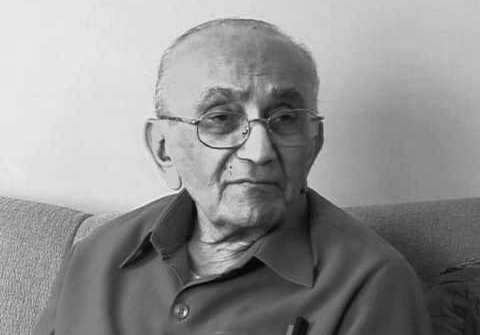
Jun 16, 2017 | News
Justice Prafullachandra Natwarlal Bhagwati, former ICJ Commissioner and Honorary Member and Chief Justice of the Supreme Court of India, passed away at the age of 95, on 15 June 2017, following a brief illness.
“The International Commission of Jurists benefited greatly from Justice Bhagwati’s engagement and leadership. He was a giant of the human rights movement, dedicated to enlarging and ensuring access to justice for everyone, including those who couldn’t seek and receive justice due to their economic or social status,” said Sam Zarifi, ICJ’s Secretary-General.
“His dedication and ground-breaking approach to human rights accountability inspired many within and outside of the ICJ, and the values he represented will continue to inspire and inform our work,” he added.
Justice Bhagwati had a long history of promoting and protecting human rights, both at home and on the international stage, particularly for the most marginalized and vulnerable individuals and groups.
Former Chief Justice of India, Justice P.N. Bhagwati held a long and illustrious career within the Indian judiciary.
He introduced many innovative reforms within the Indian judicial system that increased access to justice for the poorest and most disadvantaged, including as a pioneer of public interest litigation and absolute liability.
Outside of India, Justice P.N. Bhagwati played a prominent role in the international human rights movement, for example as a member of the Committee of Experts of the International Labour Organization and Chair of the United Nations Human Rights Committee.
He was also actively involved in a number of non-governmental organizations, including the ICJ, where he committed to a high number of missions, seminars, publications and other activities on behalf of the organization.
He also served as a long-standing Chair of the Advisory Board for the ICJ’s Centre for the Independence of Judges and Lawyers.