Mar 26, 2015 | News
The conviction of the Maldives’ former president, Mohamed Nasheed, on terrorism charges after a grossly unfair trial marks a significant deterioration of the independence and impartiality of the country’s judiciary, said the ICJ.
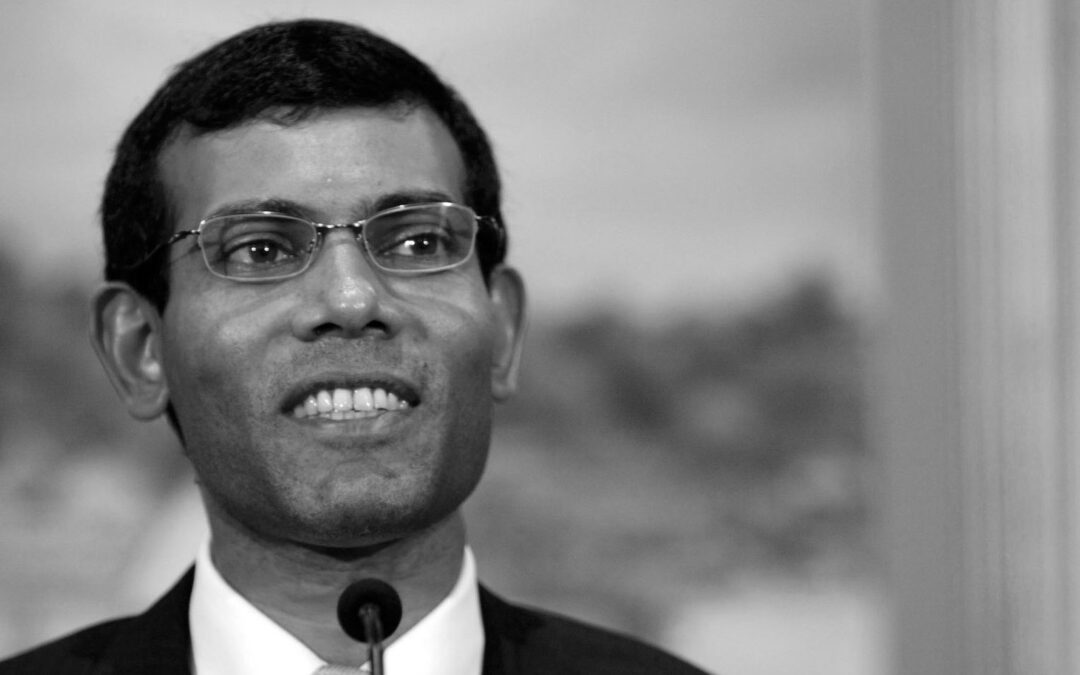
On 13 March, Mr. Nasheed (photo) was sentenced to 13 years in prison for the dismissal and alleged unlawful detention of the Chief Judge of the Criminal Court, Mr. Abdullah Mohamed, in 2012, when Mr. Nasheed was president.
He was convicted of an “act…of kidnapping or abduction of person(s) or of taking hostage(s)” under Section 2(b) of the Prevention of Terrorism Act 1990.
“The Maldivian judiciary’s independence has been compromised for years by serious pressure from the government, and this grossly unfair conviction highlights the numerous problems with the politicization of the judiciary in the country,” said Sam Zarifi, the ICJ’s Regional Director for Asia and the Pacific. “It is crucial for Maldivian authorities to allow Mr. Nasheed to appeal his case effectively, with transparency and monitoring by Maldivian and international observers.”
The case’s pre-trial phase and trial were marked by gross violations of international standards of fair trial, including Article 14 of the International Covenant on Civil and Political Rights, to which the Maldives acceded in 2006.
Two of the judges on the three-judge bench testified as witnesses against Mr. Nasheed in the 2012 investigation; these statements were submitted as evidence in the present trial.
Mr. Nasheed’s defense team was not allowed to be present on his behalf during the first proceeding, nor was he given the opportunity to seek bail.
The defense team was repeatedly denied full access to prosecution evidence and witnesses or to regularly consult with Mr. Nasheed during the course of the trial.
When Mr. Nasheed’s defense team recused itself in protest of the lack of fairness, the court proceeded with the trial without legal representation present for Mr. Nasheed rather than granting him the opportunity to obtain new counsel. The defense was also denied the opportunity to call its own witnesses.
Mr. Nasheed now has the right to appeal the conviction, but his right to appeal has been infringed by the unprecedented amendment of the statutory period for appeal from 90 days to 10 days, via Supreme Court circular six weeks prior to the trial.
In addition, the court has still not released to Mr. Nasheed’s defense team the full court record required to prepare and present an effective appeal within this accelerated timeframe.
The ICJ has previously documented the politicization of the judiciary and the polarized political climate in the Maldives, calling attention to a justice system characterized by vested interests and political allegiances rooted in the country’s authoritarian past (See Maldives: Securing an Independent Judiciary in a Time of Transition (February 2011)).
“Recent events reflect a justice system that still remains deeply politicized along the same lines of entrenched political loyalties that pre-date the transition period,” Zarifi said. “The Maldivian judiciary must allow a proper appeal in this case if it is to establish itself as a separate and equal branch of the government dedicated to supporting the rule of law.”
The ICJ urged Maldivian authorities to ensure Mr. Nasheed’s defense team full access and adequate opportunity to prepare an effective appeal, and to ensure that the appeal proceeding is conducted fairly and transparently, with full access to media and domestic and international observers, in compliance with fair trial and due process standards under both Maldivian and international law.
The Maldives must also take effective measures to ensure that such violations do not reoccur in this or future cases.
Background information can be downloaded here:
Maldives-Background Brief Nasheed Trial-Advocacy-Anylysis brief-2015-ENG (full text in PDF)

Mar 20, 2015 | Advocacy, Non-legal submissions
Today, the ICJ made a submission to the Universal Periodic Review of Myanmar.
The submission brings to the attention of the members of the Human Rights Council’s Working Group issues concerning:
- The independence of the judiciary and legal profession;
- The lack of legislation adequately protecting human rights and the environment;
- Discriminatory laws targeting women and minorities; and,
- The writ of habeas corpus.
Myanmar-UPR-Advocacy-2015-ENG

Mar 20, 2015 | Advocacy, Non-legal submissions
Today, the ICJ made a submission to the Universal Periodic Review of Nauru.
The submission brings to the attention of the members of the Human Rights Council’s Working Group issues concerning:
- The independence of the judiciary; and,
- International human rights treaty status and reporting obligations.
Nauru-UPR-Advocacy-2015-ENG

Mar 18, 2015 | Non-legal submissions
The Colombian Commission of Jurists, an affiliate of the ICJ, made an oral statement to the UN Human Rights Council today, addressing threats to the independence of the judiciary in Bolivia.
The statement came in the discusson of Bolivia’s review by the Council universal periodic review procedure, in which Bolivia accepted recommendations on judicial independence, including to “guarantee the full independence of the judiciary system, in accordance with…international standards.”
In response, the ICJ and Colombian Commission of Jurists highlighted the disciplinary and criminal proceedings brought by the Legislative Assembly against three judges of the Constitutional Court at the end of last year. The proceedings were based solely on the disagreement of the political branches with an interim order issued by the Court in a case challenging the constitutionality of a new law to regulate notaries.
In the so-called “trial” conducted by the Legislative Assembly in December, Assembly Members’ statements demonstrated a manifest lack of impartiality. The Assembly extensively and arbitrarily limited the rights of the judges to present evidence and witnesses in their defence.
In the result, one judge was arbitrarily removed from office in January, and another resigned under the pressure. The Assembly also referred both of these women for criminal prosecution. Proceedings against a third judge were suspended only for health reasons.
As the Government had announced that it will seek radical reform of the judicial system during 2015. In light of recent events, the two organisations asked:
- How will Bolivia ensure that reforms are consistent with universal and regional standards on the role and independence of the judiciary?
- What role will Bolivian and international civil society and legal experts have in developing the reforms?
- Will reforms ensure a judicial selection procedure that is based on objective criteria and truly independent of the executive and legislative branches of government?
- Will consideration be given to transferring responsibility for discipline and removal procedures to a new independent and impartial body, with real guarantees of fairness, and clearly defined grounds for removal that exclude disagreement with rulings?
Ireland had also raised concern about independence and effectiveness of the judiciary in its oral statement.
The delegation of Bolivia mentioned in its opening statement its intention to convene a forum on judical reforms and put reforms to a referendum, but did not provie any details other than that various sectors of Bolivian society would be involved. During the opportunity given at the end of the session to respond to the questions from states and NGOs, the delegation of Bolivia chose not to address these issues.
Read also Bolivia: ICJ condemns removal and forced resignation of Constitutional Court judges by Legislative Assembly and links therein.
The full written statement may be downloaded in PDF format here: Bolivia-HRC28-UPR-Advocacy-non legal submission-2015-ENG

Mar 5, 2015 | News
La CIJ urge a las autoridades a tomar las medidas para investigar y corregir esta situación.
Entre el 23 de febrero y el 4 de marzo visitaron Guatemala miembros de la Asociación de Jueces de Noruega; el Presidente del Foro Democrático de Jueces de El Salvador y la ex Presidenta de la Asociación de Jueces por la Democracia de Honduras.
Dicha visita se llevó a cabo en el marco del trabajo de la CIJ sobre el fortalecimiento del Estado de Derecho en Guatemala.
La oportunidad fue propicia para realizar reuniones y debates con miembros del Poder Judicial de Guatemala y con otros operadores de justicia.
Además se mantuvieron reuniones con el Presidente de la Corte Suprema de Justicia y otras magistradas de dicha corte; con la Fiscal General; con el Procurador de los Derechos Humanos; con el Comisionado de la Comisión Internacional contra la Impunidad; con el representante de la Oficina del Alto Comisionado de las Naciones Unidas para los Derechos Humanos, así como con otros actores relevantes de la sociedad guatemalteca, abogados y abogadas; dirigentes de Pueblos Indígenas y representantes de Organizaciones No Gubernamentales.
Al concluir su trabajo, la CIJ se encuentra alarmada por las presiones que existen en contra de jueces y juezas independientes que debido al cumplimiento de su función son frecuentemente objeto de denuncias y amenazas.
Entre las acciones que se están implementando en contra de jueces y juezas independientes, lo constituyen los traslados selectivos e injustificados que tienen como principal objetivo afectar y castigar a aquellos jueces que cumplen su función en forma independiente e imparcial.
Por otro lado, se suman denuncias infundadas en contra de los mismos, al tiempo que se configura un patrón de represión en contra de ellos, que tiene como objetivo que los jueces y juezas renuncien a su independencia judicial y “ajustar cuentas” por los casos que han juzgado.
Por otro lado, el caso relacionado con las sanciones impuestas el año 2014 en forma arbitraria por el Tribunal de Honor del Colegio de Abogados y Notarios de Guatemala en contra de la Jueza Iris Yassmín Barrios Aguilar, aún se encuentra pendiente de resolución final, sin que la Corte de Constitucionalidad de Guatemala resuelva el amparo presentado por dicha jueza.
Desde el año pasado, la CIJ expresó que dichas sanciones son arbitrarias e ilegales y que los jueces y juezas no pueden ser sancionados por un órgano como el Tribunal de Honor del Colegio de Abogados, que carece de competencia para ello; además, manifestó que de conformidad con los estándares internacionales y la legislación interna, los jueces y juezas sólo pueden ser objeto de sanciones por parte de los órganos del Poder Judicial establecidos para tal fin (Juntas de Disciplina y Supervisión General de Tribunales).
Ramón Cadena, Director de la CIJ para Centroamérica expresó: “La situación es grave y urgimos a la Corte Suprema de Justicia a suspender cualquier medida que afecte la independencia de jueces y juezas y a implementar las reformas que se necesitan para promover y proteger la independencia del poder judicial como garantía para la ciudadanía y el fortalecimiento del Estado de Derecho.”