Feb 27, 2015 | News
The Nepali government must fully implement yesterday’s decision of the Supreme Court rejecting the possibility of amnesties for perpetrators of serious human rights abuses during the country’s civil war, said today the ICJ.
The decision, by a three-person special constitutional bench, composed of Justice Kalyan Shrestha, Justice Baidhya Nath Upadhyay and Justice Cholendra Shumsher JB Rana, struck down the amnesty provision of the Commission on Investigation of Disappeared Persons, Truth and Reconciliation Act 2014 (TRC Act) promulgated last May 2014.
The Court also ruled that only the judiciary, and not the Commissions established by the TRC Act, can determine the criminality of any violations committed in the context of the country’s decade-long conflict.
“Nepal’s Supreme Court has once again firmly reasserted the right of the victims of human rights violations to seek justice,” said Sam Zarifi, ICJ’s Asia Director. “This bold and principled decision should finally end the cynical attempts by politicians from all Nepal’s major parties, as well as the military, to legislate impunity and shield themselves from accountability.”
The decision distinguished between the jurisdiction of the courts and the criminal justice system, and the non-judicial reconciliation and truth-seeking mechanisms established by the TRC Act.
In the months before the decision, the government had essentially frozen the prosecution of claims already before various courts, and had blocked the filing of First Information Reports (FIRs) by victims trying to lodge new complaints.
“Now, the government must not only remove obstacles to these cases, it must commit itself to prosecuting such claims,” Zarifi added. “The Government must immediately take all necessary steps to implement the court ruling including to ensure criminal investigation of FIRs, and address the concerns raised by the victims on the formation of the Truth and Reconciliation Commission and Commission of Inquiry on Enforced Disappearance.”
This is the second time that the Nepali Supreme Court has rejected the amnesty scheme introduced by the Nepali government.
On 2 January 2014, the Supreme Court had declared unconstitutional the Ordinance on the Truth and Reconciliation Commission (TRC Ordinance).
However, the Government effectively ignored the Court order and introduced a slightly modified version of the 2013 Ordinance replicating almost all of the provisions of the TRC Ordinance, including many of its problematic aspects, such as the ‘amnesty’ provision.
“The Government, with the help of the international community, must now dedicate itself to meeting the promise of the political parties to provide justice, truth and reparations to the victims and survivors of the conflict,” said Zarifi. “Only doing so will help end the country’s cycle of impunity.”
Contact:
Sam Zarifi, ICJ Asia Pacific Regional Director (Bangkok), t: +66 807819002; email: sam.zarifi(a)icj.org

Feb 10, 2015 | News
The ICJ today expressed deep concern over the ruling of the Federal Court upholding the conviction on “sodomy charges” of opposition leader Anwar Ibrahim by the Court of Appeal under the colonial-era Section 377B of the Penal Code.
The decision today was on the final appeal against the March 2014 decision of the Court of Appeal, which overturned the 2012 High Court’s decision to acquit Anwar Ibrahim (photo) of “sodomy charges”.
The ICJ has called on Malaysia to repeal Section 377B, which criminalizes consensual same-sex relations.
The Federal Court also upheld the Court of Appeal’s decision to sentence Anwar to five years’ imprisonment.
“It is clear from the decision of the Federal Court today that the Government of Malaysia has once again inappropriately used Section 377B of the Penal Code against its political opponents,” said Justice Elizabeth Evatt, Commissioner of the ICJ who was in Putrajaya to observe the proceedings.
“This is deplorable, especially since Section 377B criminalizes consensual same-sex relations and thereby violates a range of international law and standards, including on the rights to privacy, non-discrimination and equal protection,” she added.
This relic of British law has long since been abandoned in the United Kingdom, but is still in force in Malaysia.
However, in the last few years, it has only been used against opposition leader Anwar Ibrahim.
The conviction today amounts to the second sodomy conviction for Anwar Ibrahim within the past 14 years.
His first conviction in August 2000 resulted in an imprisonment term of nine years. That decision was overturned by the Federal Court in September 2004.
The ICJ recalls that such “sodomy” charges cannot be considered recognizable criminal offences under international human rights law and standards.
“The criminalization of consensual same-sex conduct is in contravention of a number of human rights, including the right to dignity; equality before the law and equal protection of the law; non-discrimination; liberty and security of person; privacy; opinion and expression; association and peaceful assembly,” said Emerlynne Gil, ICJ’s International Legal Adviser for Southeast Asia, who also observed the hearings.
“Anwar Ibrahim should never have been investigated, charged with, tried, let alone convicted of and sentenced for such charges. The confirmation of his conviction and sentencing on these charges are an affront to human rights and the rule law,” she added.
The ICJ also noted with concern that the right to a fair trial of Anwar Ibrahim was violated in a number of respects, particularly his right to be presumed innocent.
Under international law, a person charged with committing a crime is considered innocent until proven guilty. Hence, this imposes upon the prosecution the burden to prove his guilt beyond reasonable doubt.
“In this case, however, it appeared that the Court of Appeal adopted an approach wherein the burden was on Anwar Ibrahim to prove that he had a credible defense, rather than raising reasonable doubt as to the prosecution’s case,” Justice Evatt said.
The ICJ says that by dismissing the final appeal of Anwar Ibrahim, the Federal Court has in effect adopted the same approach of the Court of Appeal to these issues.
This decision is a clear setback for the rule of law in Malaysia and is incompatible with the presumption of innocence principle, the Geneva-based organization adds.
Anwar Ibrahim has now exhausted all avenues of appeal and has immediately begun serving his sentence.
The ICJ observed the hearings in this case before the Court of Appeal in September 2013, February 2014, and March 2014, and before the Federal Court from 28 to 30 October 2014.
Elisabeth Evatt, a former judge of the Australian Federal Court and Commissioner of the ICJ, acted as the trial observer on behalf of the ICJ at the Court of Appeal and the Federal Court.
Contact:
Emerlynne Gil, International Legal Adviser, tel. +662 6198477 ext. 206 or email: emerlynne.gil(a)icj.org
Feb 5, 2015 | News
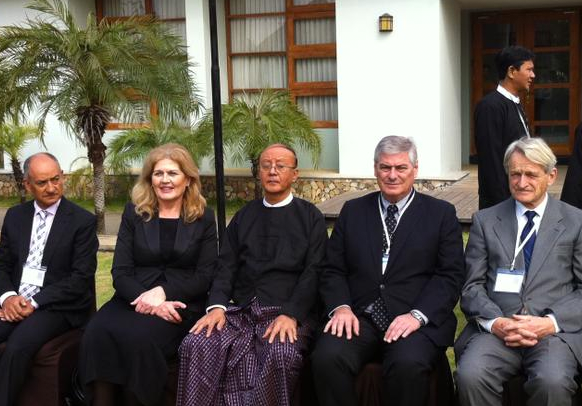
Myanmar must follow through on promising efforts to improve the independence and accountability of its legal system, and particularly its judiciary, said the ICJ today at the launch of one of its landmark book in Yangon.
The ICJ launched today the Myanmar language version of its Practitioners’ Guide to the Independence and Accountability of Judges, Lawyers and Prosecutors.
“The judiciary in Myanmar has taken important steps towards asserting its independence from the other branches of government, but we heard repeatedly from the judiciary that they still face significant obstacles in this regard,” said Wilder Tayler, ICJ’s Secretary-General.
The book launch wrapped a series of discussions regarding judicial ethics and the rule of law with the Supreme Court of the Union of Myanmar, as well as with the parliamentary Committee on Rule of Law and Tranquility.
The ICJ’s Practitioners’ Guide n°1 is the first of its kind to be published in the Myanmar language providing detailed references to international and comparative standards on the independence and accountability of judges and lawyers.
“The Supreme Court emphasized its belief that an independent judiciary plays a key role in ensuring access to justice and the protection of human rights, but with independence must come accountability,” Tayler added. “The Myanmar judiciary must be accountable not just in deciding cases according to the law and facts, but also as a separate and equal branch of the government, and ultimately, to the people of Myanmar.”
In the course of its discussions at an earlier workshop in Naypyidaw, the ICJ was repeatedly told that the judiciary is trying to address challenges to its institutional independence, as well as the independence of individual judges.
Corruption, which remains a serious problem throughout all social sectors, including the judiciary, interferes with the judiciary’s ability to provide a remedy for human rights violations and bringing perpetrators to justice.
Undue influence by powerful political and economic actors continues to hamper the push for greater trust and credibility for the judiciary among the general public.
“As we heard at the workshop, at all levels of the system, from the Supreme Court to the Townships, a lack of resources, poor working conditions and low remunerations contribute to an environment where the temptations of corruption, or outside pressure, undermine judicial independence and impartiality,” said Tayler.
“We also heard strong support from all levels of the judiciary for establishing a judicial code of conduct that incorporates international standards and best practices in response to the demands of the people of Myanmar for more rule of law. Producing such a code, and implementing it, would go a long way toward increasing the judiciary’s independence and accountability,” he added.
Wilder Tayler was joined by a senior panel of international legal experts on judicial integrity, including three ICJ Commissioners: Justice Azhar Cachalia of the Supreme Court of Appeals of South Africa, Justice Radmila Dicic of the Supreme Court of Serbia, and retired Justice Ketil Lund of the Supreme Court of Norway.
Feb 3, 2015 | Multimedia items, News, Video clips
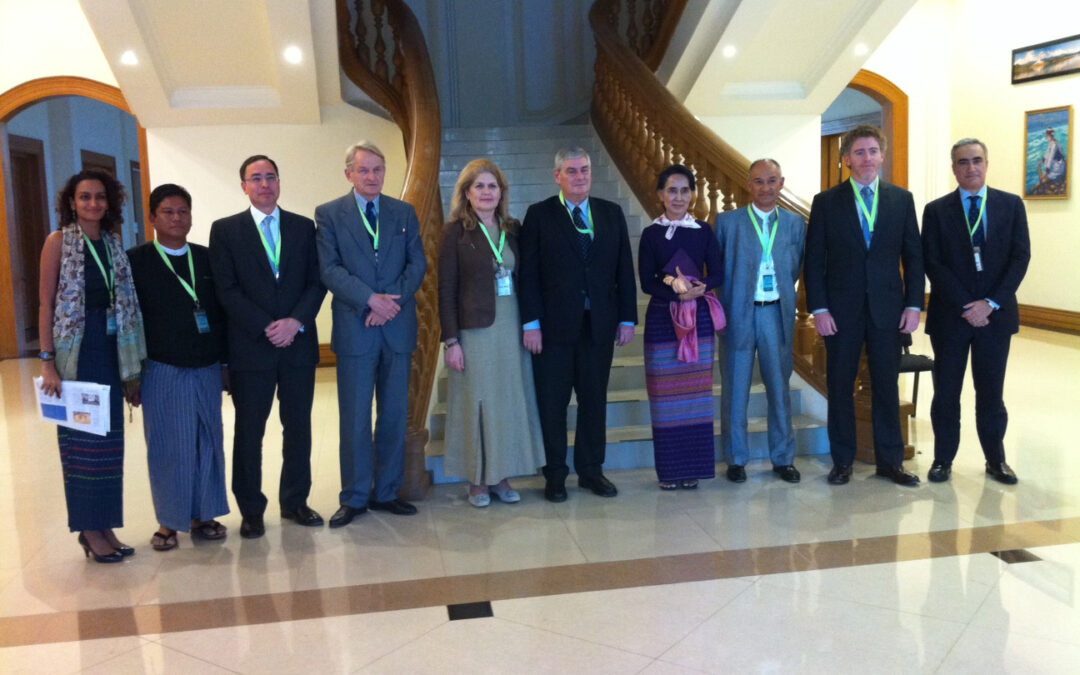
On video, ICJ Commissioner Azhar Cachalia and ICJ Asia & Pacific Regional Director Sam Zarifi, talk about a workshop with the Supreme Court of the Union of Myanmar. In parallel with this event, the ICJ met with Daw Aung San Suu Kyi.
The ICJ’s workshop with the Supreme Court of the Union of Myanmar was on the subject of judicial ethics and the rule of law, while at the meeting with Daw Aung San Suu Kyi, discussions covered the ICJ’s focus in Myanmar to support the judiciary in taking important steps towards asserting its independence from other branches of government; and to overcome significant individual and institutional obstacles, such as undue influence by the Executive in politically sensitive and criminal cases, corruption and a lack of resources.
Daw Suu and her colleagues shared information about the Rule of law Centres being initiated as a step towards building the capacity of local legal practitioners and contributing to rule of law reforms in Myanmar.
The ICJ delegation was led by Secretary-General Wilder Tayler, and included Asia & Pacific Regional Director Sam Zarifi, ICJ Commissioners Justices Azhar Cachalia, Ketil Lund and Radmila Dicic, International Legal Advisers Vani Sathisan and Daniel Aguirre and National Legal Adviser Kyawmin San.
Daw Aung San Suu Kyi is the Chairperson of the Lower House Committee for Rule of Law, Peace and Tranquility in the Myanmar Parliament and Chairperson of the National League for Democracy, and members of her Committee. She was awarded the Nobel Peace Prize in 1991.
Justice Azhar Cachalia, ICJ Commissioner and Chair of ICJ’s Executive Committee, talks about his participation in, and contribution to, an ICJ workshop with the Supreme Court of Myanmar.
Sam Zarifi, Director of ICJ’s Asia & Pacific Programme talks about ICJ’s workshop with the Supreme Court of Myanmar

Feb 3, 2015 | News
The ICJ condemns yesterday’s decision of the Giza Felonies Court to confirm the death sentences of 183 individuals that had been simultaneously imposed in one mass trial.
The charges include murder, mutilation and attempted murder and relate to an attack on a police station in Kerdasa that took place in August 2013.
According to the ICJ, the trial has involved a litany of violations of fair trial rights, including denying many of the accused the right to legal counsel, denying the right to a public hearing, refusing to allow defence witnesses to testify, prohibiting the cross-examination of prosecution witnesses by defence counsel, and failing to produce credible evidence as to the individual guilt of each accused.
“Once again, Egypt’s judiciary has abdicated its fundamental responsibility to uphold the rule of law and human rights, instead resorting to unfair mass trials and death sentences as a technique to suppress dissent and to crack down on critics of the military and Government,” said Said Benarbia, Director of the ICJ MENA Programme.
“Egypt’s judiciary must act independently, impartially, with integrity and as a check against the Executive’s arbitrary powers and policies, not as a tool to implement them,” he added.
The imposition of death sentences following unfair mass trials constitutes a gross violation of Egypt’s obligations under international human rights law, including those relating to the right to life, the prohibition of torture and other cruel, inhuman or degrading treatment or punishment, and fair trial rights.
The ICJ opposes the use of the death penalty in all circumstances as a violation of the right to life and a form of cruel, inhuman and degrading punishment.
The UN General Assembly has repeatedly, by a large majority, called for a moratorium on its use.
Even those states that retain the death penalty have acknowledged that any imposition of the death penalty through a process that fails to meet the most stringent fair trial standards, inherently violates the right to life.
Contact:
Said Benarbia, ICJ Director of the ICJ Middle East and North Africa Programme, t: 41 22 979 38 17, e: said.benarbia(a)icj.org