Dec 2, 2018 | Events, News
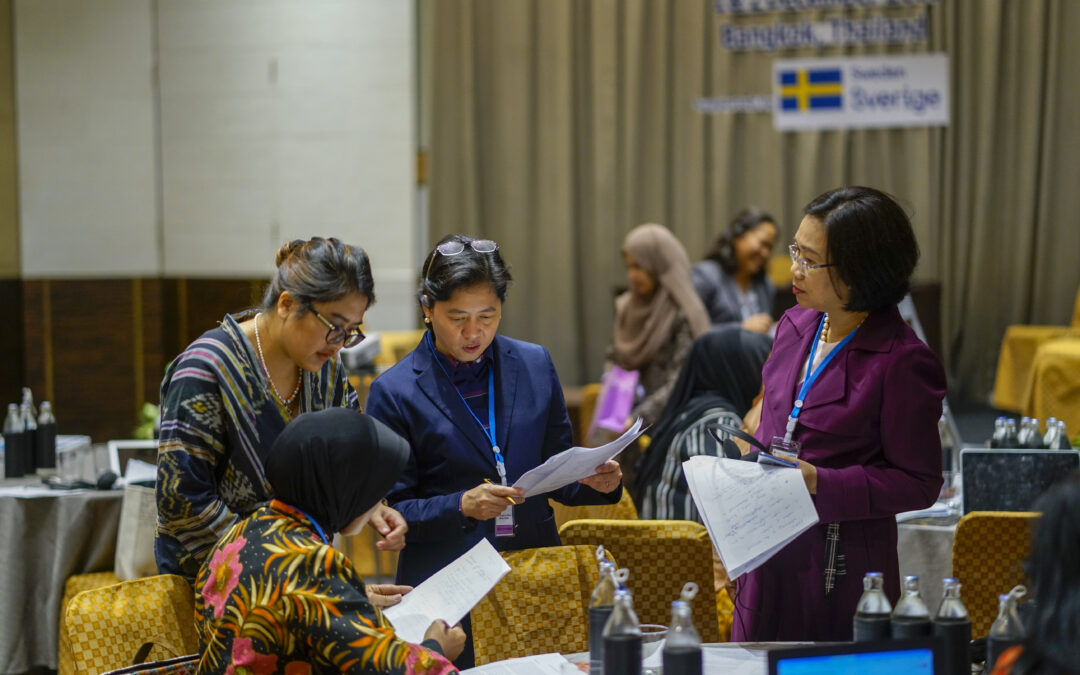
On 1-2 December 2018, the International Commission of Jurists (ICJ) held its 2018 Southeast Asia Regional Judicial Dialogue on enhancing access to justice for women in the region.
Participants included judges from Cambodia, Indonesia, Nepal, Pakistan, Philippines, Sri Lanka and Thailand.
The discussions, held in Bangkok, were focused around resources important for judges to aid in enhancing the capacity of their peers in eliminating gender discriminatory attitudes and behaviours towards women in their work. These resources include a training manual on the use of the Bangkok General Guidance for Judges in Applying a Gender Perspective, and a draft reference manual on women’s human rights and the right to a clean, healthy, safe and sustainable environment.
Frederick Rawski, ICJ’s Director of the Asia and the Pacific Programme, opened the dialogue by emphasizing how important it is for judges to be gender sensitive in their delivery of justice. This could only be done by applying a framework that gives primary attention on ensuring recognition of the applicable human rights, institutional support for the promotion of these rights, and accountability mechanisms for their implementation.
Roberta Clarke, Commissioner of the ICJ and Chair of the organization’s Executive Committee, noted that this judicial dialogue demonstrates the ICJ’s commitment to have a sustainable contribution to the implementation of international human rights standards at the domestic level. She hoped that the judges could contextualize the resources presented and bring these back to their countries for trainings of their peers.
This judicial dialogue is part of a joint project on access to justice for women that ICJ is implementing with UN Women.
Anna Karin Jatfors, UN Women-Asia Pacific’s Interim Regional Director shared that gender stereotypes and social norms which discriminate women are not unique in each country. She pointed out the importance of the ICJ and UN Women collaborating in this project to deconstruct this image to bring better access to justice to women in the region.
Overall, the dialogue was rich and substantive, with the full and active participation from all participating judges who shared their views and experiences on countering gender discrimination in cases before them. At the end of the judicial dialogue, the participating judges expressed strong interest to use the resources for capacity building initiatives of their peers in their own countries.
Contact
Emerlynne Gil, Senior International Legal Adviser, t: +662 619 8477 (ext. 206), email: Emelynne.gil(a)icj.org

Oct 11, 2018 | News
The ICJ today condemned the appointment by President Andrzej Duda of 27 judges to the Supreme Court in place of those forcibly “retired” last July.
“These appointments are patently illegitimate and deal a severe blow to the rule of law in Poland,” said Róisín Pillay, Director of the ICJ Europe and Central Asia Programme.
The new appointments purport to replace the Supreme Court Justices including President of the Supreme Court Małgorzata Gersdorf, whose forced “retirement” is in clear violations of international standards on the security of tenure and independence of judges.
The decision of the President is even more concerning since it contravenes an order of the Supreme Court suspending the law under which these appointments were made, pending a decision by the Court of Justice of the European Union.
It is a fundamental tenet of the rule of law and principles on the independence of the judiciary that the executive respect decisions duly made by the judiciary.
“In announcing these appointments now, while cases on the forced retirement of Supreme Court judges are still pending at the EU Court, President Duda has disregarded the proceedings of the EU’s apex judicial body,” Róisín Pillay added.
The ICJ considers that the legality of the appointments of the new judges is further compromised by the role played by the now politicized National Council for the Judiciary, whose independence and impartiality has been seriously compromised following recent legislative amendments.
The ICJ urges the Polish authorities to cease all interference with the Supreme Court in carrying out its legitimate functions, and to reverse the measures taken to force the retirement of Supreme Court judges.
Background
This attack against the actions of the Supreme Court occurs amid a systematic undermining of the independence of the judiciary in Poland by the Polish executive and legislative authorities, which attempt to increase political influence in the judiciary and which the ICJ has repeatedly condemned.
Earlier this year Poland issued a new law on the Supreme Court that attempts to force the “retirement” of one third of the Supreme Court judges, including the First President, by lowering the mandatory retirement age for its judges from 70 to 65. This measure clearly contravenes international human rights law and standards.
The European Commission has launched an infringement procedure for lack of compliance of this law with EU law.
In the absence of satisfactory reforms by Poland, on 24 September, the Commission referred Poland to the Court of Justice of the European Union (CJEU) and asked for interim measures to restore Poland’s Supreme Court to its situation before 3 April 2018.
At the same time Supreme Court of Poland submitted a preliminary ruling request to the CJEU seeking its interpretation on the compliance of the legislation on retirement ages of judges with EU law, in particular with the prohibition of discrimination on grounds of age under Directive 2008/78.
Following the jurisprudence of the CJEU, the Supreme Court suspended the effect of national law on the forcible retirement of the judges.
An ICJ letter of 11 July 2018, signed by 22 senior judges from all regions of the world, urged the Polish government to act immediately to reinstate the forcibly retired judges in office.

Aug 21, 2018 | News
The ICJ and its Polish Section (ICJ Poland) today expressed their support for the actions of the Supreme Court to defend the rule of law and the independence of the judiciary in Poland, including by recourse to the European Court of Justice (CJEU).
This happened in the face of repeated attack by political figures and authorities.
Preserving and safeguarding the independence of the courts is essential for the protection of human rights in Poland, the organizations said.
The ICJ and ICJ Poland urged the Polish executive and legislative authorities to cease all interference with the conduct of the Supreme Court in the carrying out of its legitimate functions.
The law on the Supreme Court that has led to the forced “retirement” of one third of the Supreme Court, including the President of the Court, Małgorzata Gersdorf, must be repealed and the judges reinstated in office, the ICJ and ICJ Poland stressed.
On 2 August, the Supreme Court of Poland took the welcome step, in accordance with European Union law, of submitting a preliminary ruling request to the Court of Justice of the European Union (CJEU) seeking its interpretation on the compliance of the recent legislation on retirement ages of judges with EU law.
Specifically, the Supreme Court enquired as to the legislation’s compliance with the principle of irremovability of judges and the prohibition of discrimination on grounds of age under Directive 2000/78. The Supreme Court has suspended the implementation of the law during the proceedings before the CJEU.
The ICJ and ICJ Poland condemn the attacks against the Supreme Court by political authorities, including President Andrzej Duda, who claimed that the suspension of the law’s implementation has no legal basis.
On the contrary, the Supreme Court of Poland acted in compliance with its duties under article 267 of Treaty of the Functioning of the European Union to raise a question concerning the interpretation of the Treaties and, in conformity with the case-law of the CJEU, to suspend the application of such measures which may violate the law of the European Union, pending resolution of the question.
The legislation raises serious issues of EU law, both in regard to protection of the rule of law under Article 2 of the TFEU, and in regard to discrimination on grounds of age.
This attack against the actions of the Supreme Court occurs amid a systematic undermining of the independence of the judiciary in Poland by the Polish executive and legislative authorities, which the ICJ, ICJ Poland, and judges of the global ICJ network have repeatedly condemned.
The organizations emphasize that irremovability of judges is one of the main pillars of judicial independence and therefore of the rule of law. An ICJ letter of 11 July 2018, signed by 22 senior judges from all regions of the world, urged the Polish government to act immediately to reinstate the forcibly retired judges in office.

Jul 18, 2018 | News, Publications, Reports
The ICJ welcomed today the lapse of Turkey’s nearly two-year state of emergency, which is expected to be effective as of midnight, but said that the authorities needed now to take a range of measures to repair the rupture to the rule of law in the country.
The ICJ’s comments came as it released its report Justice Suspended – Access to Justice and State of Emergency in Turkey, outlining how measures undertaken pursuant to a state of emergency, including the mass dismissal of judges and arbitrary arrests and prosecutions of lawyers and human rights defenders had eroded the justice institutions and mechanisms in the country.
The report recommends a number of measures including the repeal of measures enacted under the state of emergency, the restoral of the independence of the judiciary and the reform of the country’s anti-terrorism legislation.
“With the end of the state of emergency we call for the immediate withdrawal of the notifications of derogations to the European Convention on Human Rights and the International Covenant on Civil and Political Rights,” said Massimo Frigo, ICJ Senior Legal Adviser for the Europe and Central Asia Programme.
“We remain concerned that many of the emergency measures have been given permanent effect in Turkish law and will have pernicious and lasting consequences for the enjoyment of human rights and for the rule of law in Turkey,” he added.
These measures include the dismissals of hundred of thousands of people from their job, including judges and prosecutors.
Constitutional amendments, introduced during the state of emergency, permanently enshrine executive and legislative control of the governing institutions of the judiciary, contrary to international standards on judicial independence, the ICJ says.
Many of those charged with vaguely-defined offences under the state of emergency face trial before courts that are not independent and cannot guarantee the right to a fair trial, the Geneva-based organization adds.
Crucially, most of the people affected by emergency measures, including summary dismissals, have not yet had the opportunity to obtain a remedy before an effective and independent court or tribunal.
The ICJ report illustrates how the mechanisms which should address and remedy human rights violations in Turkey lack effectiveness and independence and that these deficiencies extend both to the courts and the state of emergency complaints commission.
It further finds that the ordinary functions of lawyers and activities civil society, key actors in ensuring access to justice, have been considerably curtailed.
“The Turkish Government says that they want their actions to respect the rule of law. Effective and independent remedies and reparations for human rights violations must be available to all if this principle is to have any reality in practice,” said Massimo Frigo.
Contact
Massimo Frigo, ICJ Senior Legal Adviser for the Europe and Central Asia Programme, t: +41 22 979 3805, e: massimo.frigo@icj.org
Download
Full ICJ report in PDF in English: Turkey-Access to justice-Publications-Reports-2018-ENG
Full ICJ report in PDF in Turkish: Turkey-Access to justice-Publications-Reports-2018-TUR
Jul 11, 2018 | Advocacy, News, Open letters
Twenty-two senior judges from across the globe wrote today to Polish President Andrzej Duda to condemn the recent attacks on the independence of the judiciary.
The judges, all Commissioners or Honorary Members of the International Commission of Jurists, criticized the forced resignation of 27 of 72 judges of Poland’s Supreme Court as a severe blow to the independence of the Polish judiciary in violation of international standards.
The letter was organized by the ICJ and its Centre for the Independence of Judges and Lawyers in consultation with jurists from 17 countries.
“The Polish government’s assault on the country’s judiciary is a major blow to the rule of law in Poland,” said Sam Zarifi, ICJ Secretary General.
He added:
“The situation in Poland is of concern to judges in the country, as well as in the European Union and around the world.”
“The ICJ and jurists everywhere will speak out against this surge of attacks on the judiciary that is increasingly a pattern in many countries, including several that until recently were at least rhetorically champions of the rule of law.”
“This letter shows that the commitment to the rule of law and judicial independence is not limited to just one part of the world or one legal system, but rather reflects the views of the global community of jurists.”
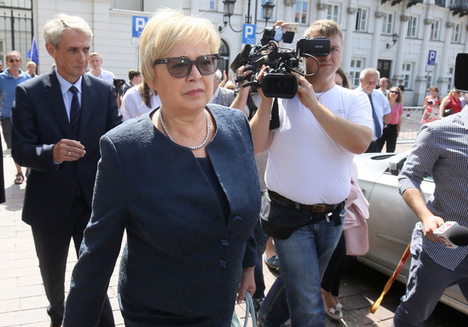
In their letter, the ICJ senior judges “condemn the recent forced retirement of 27 out of 72 Polish Supreme Court justices, including its President Małgorzata Gersdorf (photo), and urge President Duda to act immediately to restore the independence of the judiciary by reinstating them in office.”
They express grave concern “that the effective dismissal of one third of the Supreme Court, coupled with the broad discretion given to the President’s office to make exceptions, has taken place in contravention of international human rights law and standards, including the right to a fair hearing, and is contrary to basic principles of the rule of law.”
Finally, the “undersigned jurists urge the President of the Republic of Poland to act immediately to restore the independence of the judiciary by reinstating the Supreme Court justices forced into retirement, follow the recommendations of the European Commission on judicial reform, and take action to repeal the law on the Supreme Court that strikes at the very core of judicial independence.”
The signatories
- Justice Adolfo Azcuna, former Associate Justice of the Supreme Court of the Philippines
- Justice Solomy Balungi Bossa, Ugandan Judge on the International Criminal Court
- Justice Ian Binnie, retired Justice of the Supreme Court of Canada
- Justice Azhar Cachalia, Judge of the Supreme Court of Appeal of South Africa
- Dame Silvia Cartwright, former Judge of the High Court in New Zealand and of the Extraordinary Chambers in the Courts of Cambodia
- Justice Moses Chinhengo, Judge of the High Court of Botswana
- Justice Martine Comte, former President of the Orleans Court of Appeal, France
- Justice Radmila Dracigevic-Dicic, Acting President of the Supreme Court of Appeals, Judge of the Supreme Court of Serbia
- Justice Elizabeth Evatt, former Chief Justice of the Family Court of Australia
- Justice Claire L’Heureux-Dubé, former Justice of the Supreme Court of Canada
- Justice Paul J. G. Kapteyn, former Judge of the European Court of Justice
- Justice Michael Kirby, former Justice of the High Court of Australia and former President of the International Commission of Jurists
- Justice Kalthoum Kennou, Judge of the Tunisian Cassation Court
- Justice Ketil Lund, former Justice of the Norwegian Supreme Court
- Justice Qinisile Mabuza, Judge of the High Court of Swaziland
- Justice Egbert Myjer, former Judge of the European Court of Human Rights
- Justice Michèle Rivet, former President of the Quebec Human Rights Tribunal
- Justice Kalyan Shrestha, former Chief Justice of the Nepalese Supreme Court
- Justice Philippe Texier, Judge of the French Court of Cassation
- Justice Lillian Tibatemwa-Ekirikubinza, Justice of the Supreme Court of Uganda
- Justice Stefan Trechsel, former ad litem Judge at the International Criminal Tribunal for the former Yugoslavia
- Dr Rodrigo Uprimny Yepes, former Assistant Justice of the Constitutional Court of Colombia
Poland-Reinstate forcibly retired judges-Advocacy-Open letters-2018-ENG (full text of letter in PDF)