Mar 1, 2016 | Events
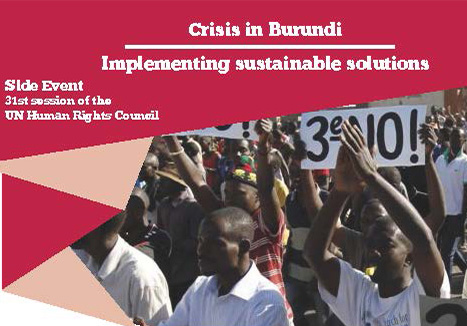
The ICJ is co-sponsoring a panel discussion on the situation for human rights in Burundi, as a side-event to the UN Human Rights Council, 4 March 2016.Details are available in the flyer available to download here: HRC31-sideeventflyer-burundi-2016
Feb 26, 2016 | Advocacy, Open letters
The open letter, which includes additional recommendations for a resolution on South Sudan to be adopted at the 31st ordinary session of the Human Rights Council (29 Feb – 24 Mar) is available here: Open Letter South Sudan
Dec 16, 2015 | Advocacy, Events
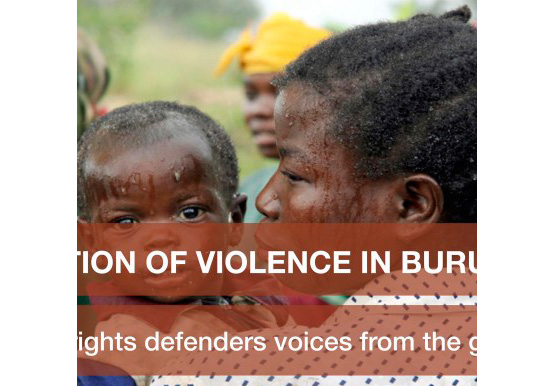
The ICJ joins other non-governmental organisations in co-sponsoring “Escalation of Violence in Burundi: Human rights defenders voices from the ground”, a side event to the Human Rights Council’s special session on Burundi, 17 December 2015.
The event will take place Thursday 17 December – 9.00-10.00 am in Room XII, Palais des Nations, Geneva
Panelists:
Mr Pierre Claver Mbonimpa, Association for the Protection of Human Rights and Incarcerated Persons (APRODH)
Ms Margaret Barankitse, Maison Shalom
Mr Anschaire Nikoyagize, Ligue ITEKA
Ms Carina Tertsakian, Human Rights Watch
The event will be moderated by Nicolas Agostini of FIDH.
The event will be webcast live by the International Service for Human Rights (ISHR).
Follow on twitter using the hash-tag #BurundiHRDs
A flyer for the event is available here: Burundi-UNHRC-Advocacy-SideEvent-2015
Oct 1, 2015 | News
At a two-day conference held in Bangkok, and first of its kind, committed to working to enhance the right to Freedom of Religion or Belief in Southeast Asia.
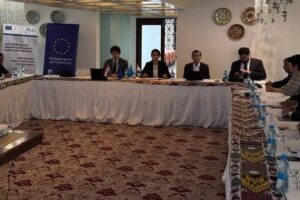
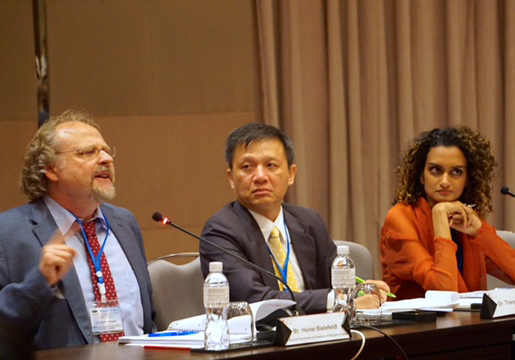
For the first time, approximately 70 human rights defenders, members of religious groups, rights groups, UN agencies and representatives from the ASEAN Intergovernmental Commission on Human Rights, ASEAN Commission on the Promotion and Protection of Rights of Women and Children, National Human Rights Institutions and other government agencies from across the region gathered together to discuss key pressing concerns regarding the right to freedom of religion or belief in Southeast Asia with the UN Special Rapporteur on Freedom on Religion or Belief, Heiner Bielefeldt.
The event was co-organized by the Asian Forum for Human Rights and Development (FORUM-ASIA), the ICJ, and Boat People SOS (BPSOS) from 30 September to 1 October 2015 in Bangkok, Thailand.
During the event, participants were able to deepen their understanding on the right to freedom of religion or belief under international law and standards, and how religious freedom and other human rights should be interpreted and applied in a complementary manner.
“Many people suffer complex violations of their human rights, for example in the intersection of religious minority status, ethnicity, gender, sexual orientation or indigenous origin,” said Heiner Bielefeldt.
The two-day conference also successfully provided a multi-stakeholder platform for the participants to share challenges and best practices, as well as brainstorm ideas on addressing violations related to state control and regulation of religion, and extreme interpretations of religion.
“The politicization of religion undermines freedom of religion or belief, not only to the detriment of minorities, but also of followers of majority religions who do not wish to see their faith be turned into a tool of political power gambling,” added the Special Rapporteur.
Notable suggestions raised by the group on addressing identified obstacles to the free practice of religion or belief included the need for reforms, such as the repeal of blasphemy laws and mandatory registrations, and the importance of dialogue between groups of the same faith, as well as those of different religions.
“We need more cooperation across boundaries, including between faith-based and secular civil society organization,” stressed the expert.
Participants at the conference also recognized the opportunity presented before them in advancing freedom of religion or belief in the region and committed to working to enhance this right by reaffirming:
- Article 18 of the Universal Declaration of Human Rights, which declares: “Everyone has the right to freedom of thought, conscience and religion; this right includes freedom to change his religion or belief, and freedom, either alone or in community with others and in public or private, to manifest his religion or belief in teaching, practice, worship and observance.”
- Freedom of religion or belief is an inalienable, non-derogable human right, encompassing the right to hold or not to hold any faith or belief, to change belief, and to be free from coercion and to manifest religion or belief.
- For freedom of religion or belief to be fully enjoyed, other human rights must also be respected, particularly the principle of nondiscrimination and freedoms of expression, assembly, association, education, and movement.
The participants also committed to:
- Defend and promote freedom of religion or belief as a universal, inalienable and non-derogable human right, as set out in the Universal Declaration, in international law and declarations, and in the work of national, regional, and global institutions.
- Defend and promote freedom of religion or belief for all persons, as individuals and in community with others, through their work and respective institutions by sharing information and mobilizing effective responses.
- Work toward the nondiscriminatory realization of freedom of religion or belief in recognition of multiple and intersectional discriminations and vulnerabilities, including, among other grounds, on grounds of ethnicity, indigenous identity, gender, sexual orientation, citizenship, and disabilities.
- Enhance global and regional cooperation by working across geographical, national, racial, ethnic, political and religious boundaries.
- Advocate for accountability and remedies for individuals and communities suffering from violence, persecution, discrimination, harassment, marginalization or other abuses of human rights because of their religion or belief.
- Express and act in solidarity with individuals and communities suffering from violence, persecution, discrimination, harassment, marginalization or other abuses of human rights because of their religion or belief.
The Conference Declaration was based on the Charter for Freedom of Religion or Belief and the New York Resolution for Freedom of Religion or Belief of the International Panel of Parliaments for Freedom of Religion or Belief (IPPFORB).
South East Asia-Decla Freedom of religion-Advocacy-2016-ENG (full Declaration, in PDF)
Sep 30, 2015 | Advocacy, Non-legal submissions
The ICJ today delivered an oral statement to the UN Human Rights Council, commenting on the landmark UN investigation and report on violations of human rights and humanitarian law in Sri Lanka.
The statement also welcomes recommendations for integration of international judges, prosecutors, lawyers and investigators into any accountability mechanism:
“The International Commission of Jurists (ICJ) welcomes the OHCHR Report on Promoting Reconciliation, Accountability and Human Rights in Sri Lanka (UN Doc A/HRC/30/61), which sets out the principal findings of the Report of the OHCHR Investigation on Sri Lanka (OISL Report, UN Doc A/HRC/30/CRP.2) documenting alleged serious violations and abuses of human rights and related crimes during the armed conflict in Sri Lanka. The ICJ commends the investigation team for its historic contribution towards reconciliation and the realization of victims’ rights in Sri Lanka.
The ICJ works with judiciaries, governments, civil society and victims around the world to address impunity and victims’ right to remedy for violations of international human rights and humanitarian law, including in situations of transition.
For over thirty years, the ICJ has documented and reported on a gradual erosion of judicial independence, impartiality and integrity under successive governments in Sri Lanka, and the resulting culture of impunity, including in the judiciary.[1]
The ICJ considers the International Criminal Court (ICC) to be the preferred mechanism for individual accountability where national authorities and courts lack the capacity or the willingness to genuinely investigate and prosecute all war crimes and crimes against humanity. In the absence of an ICC process, the ICJ’s extensive experience demonstrates that any credible and effective accountability process in Sri Lanka must involve, at a minimum, a majority of international judges, prosecutors and investigators.
The ICJ therefore welcomes the High Commissioner’s recommendation for a hybrid court and prosecutor’s office that fully integrates international judges, prosecutors, lawyers and investigators.
Also essential are the OHCHR recommendations on: mandate and resources of these mechanisms; legislating retroactive recognition of international crimes under national law; justice and security sector reform; repealing the Prevention of Terrorism Act (PTA); strengthening the Witness and Victim Protection Act; accession to the International Convention on the Protection of All Persons from Enforced Disappearances (CED), the Additional Protocols to the Geneva Convention, and the Rome Statute of the International Criminal Court; and continued monitoring of implementation through an OHCHR country office and the Council.
The ICJ welcomes that the tabled draft resolution explicitly recognises the need for international judges, prosecutors, lawyers and investigators. We call on the Council to adopt the resolution with, and call on the Government of Sri Lanka to urgently implement, these and other key elements of the recommendations of the High Commissioner’s Report in full.
[1] See, e.g., ICJ, Authority Without Accountability: The Crisis of Impunity in Sri Lanka (2012)
The statement can be downloaded in PDF format here: Sri Lanka-ICJ Oral Statement HRC-Advocacy-Non Legal submission-2015-ENG