Aug 31, 2018 | Advocacy, Non-legal submissions
Today, the ICJ made a submission to the Committee on Economic, Social and Cultural Rights in advance of Committee’s examination of South Africa’s initial periodic report under the International Covenant on Economic, Social and Cultural Rights. South Africa ratified the Covenant in 2015.
When CESCR convenes to consider South Africa’s report on 2-3 October 2018, it will therefore be the first time that the Committee has the opportunity to review a report from South Africa on the implementation of its Covenant obligations.
In its submission, supplementing submissions made by a range of South African civil society organizations, the ICJ drew the Committee’s attention to:
a) South Africa’s incomplete discharge of its obligations in terms of the Covenant;
b) The South African Government’s need for guidance from the Committee on the discharge of its obligations in terms of the right to work;
c) The South African Government’s need for guidance from the Committee on the discharge of its obligations in terms of the right to an adequate standard of living;
d) The South African Government’s failure to report effectively and accurately on its efforts to realize the ESC rights of persons with disabilities;
e) The uncertain status of the South African Government’s commitment to the enactment of legislation to ensure the implementation of the Covenant;
f) The uncertain status of the South African Government’s intention to ratify the Optional Protocol to the Covenant; and
g) The uncertain status of the South African Government’s declaration with regard to the right to education.
The ICJ’s submission invites CESCR to make various specific recommendations to the Government of South Africa in its Concluding Observations on each of these issues. Broadly, the ICJ also invites CESCR to recommend to the Government of South Africa time-bound commitments to processes leading to:
1. The full domestication of Covenant in South African law;
2. A comprehensive review of South Africa’s domestic laws and policies on ESC rights to ensure that they are implemented consistently with South Africa’s obligations in terms of the Covenant; and
2. The ratification of Optional Protocol to the International Covenant on Economic, Social and Cultural Rights.
The ICJ’s submission also supports submissions by civil society organizations and the South African Human Rights Commission inviting CESCR to recommend that South Africa withdraw its declaration relating to its “immediate” obligations in terms of the Covenant right to education.
Finally, the ICJ considers it critical that the South African Government reflect on the ways in which the Covenant to increases, alters and nuances the nature and content of its human rights commitments and obligations in terms of the realization of economic, social and cultural rights.
This the ICJ submits is particularly crucial in regard to rights which are entrenched in the Covenant but not the South African Constitution such as the right to work (Articles 6-8) and the right an adequate standard of living (Article 11).
In undertaking this process, the ICJ submits that due regard should be had the standards set out in the Covenant as interpreted by the Committee in its general comments.
SouthAfrica-ICJSubmissionCESCR-Advocacy-Non-legal submission-2018-ENG (full text, PDF)
May 28, 2018 | Advocacy, Non-legal submissions
Today, the ICJ and 22 other rights organizations submitted a paper to the 30th meeting of Chairs of the human rights treaty bodies (Chairpersons meeting) in New York (28 May-1 June).
This paper is presented to the 30th meeting of Chairs of the human rights treaty bodies (Chairpersons meeting) by non-governmental organizations that contribute to many aspects of the work of the treaty bodies, including by encouraging and supporting national partners in their use of the system.
It focuses on existing good practices in treaty body working methods and makes recommendations for further discussions.
The signing NGOs hope that this submission will provide a basis for an effort by the treaty body Chairpersons to take stock of some of the important changes to working methods that the treaty bodies have undertaken and lead to further discussion on areas where greater alignment of working methods would make a particularly meaningful contribution to NGOs’ efforts to engage with the treaty bodies and promote better implementation by States of their human rights obligations.
Universal-Amnesty-Submission-to-the-30th-meeting-of-chairs-of-the-human-rights-treaty-bodies-Advocacy-non legal submission-May-2018-ENG (Full text in PDF)
Mar 28, 2018 | Advocacy, Non-legal submissions
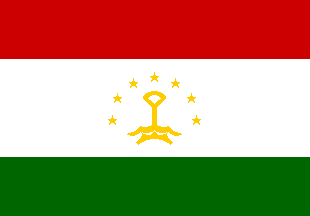
The ICJ today submitted a report to the UN Committee against Torture, calling for recommendations to be made on prevention of and accountability for continued recourse to torture and ill-treatment in Tajikistan.
The ICJ’s submission is made ahead of consideration by the Committee against Torture in April to May 2018 of Tajikistan’s third periodic report on the implementation of its obligations under the Convention against Torture and Other Forms of Cruel, Inhuman or Degrading Treatment or Punishment.
The ICJ’s report draws from an earlier study on Achieving Justice for Gross Human Rights Violations in Tajikistan and calls on the Committee against Torture to make recommendations concerning:
- The obligation to adequately sanction torture;
- The obligation to prevent torture and other forms of ill-treatment, including in places of detention;
- The obligation to investigate allegations of torture and ill-treatment;
- The use of amnesties and pardons for torture;
- The prohibition against the use of evidence obtained by torture;
- The right to complain about torture and ill-treatment; and
- The right of victims to effective remedies and reparation.
Tajikistan-CAT-Advocacy-AlternativeReport-2018ENG (download the ICJ’s submission, in PDF)

Mar 22, 2018 | Advocacy, Non-legal submissions
Today, the ICJ together with Forum for Human Rights submitted written information to the Committee against Torture ahead of its examination of the periodic report of the Czech Republic.
The two organisations argue that the Czech Republic violates Articles 2, 14 and 16 of the Convention Against Torture, by not ensuring access to a lawyer for children below the age of 15 (the age of criminal responsibility) in the pre-trial stage of juvenile justice proceedings.
1273 children younger than 15 were part of these pre-trial stage proceedings in the Czech Republic in 2017 without access to procedural guarantees, including legal counsel, unlike children aged 15-18 have under national legislation.
Children below the age of criminal responsibility do not benefit from such procedural rights and therefore, during the police questioning, they are typically left without any legal assistance and presence of a lawyer who neither can deter the police from resorting to ill-treatment or other abuses, nor work as a protection for police officers in case they face unfounded allegations of ill-treatment.
This situation constitutes a violation of the obligation to prevent torture or acts of cruel, inhuman or degrading treatment or punishment which do not amount to torture under Articles 2 and 16 of the CAT. Additionally, the Czech Republic fails to ensure access legal counsel for the purposes of an effective remedy under Article 14 of the CAT.
The joint submission aims to inform the 63rd session of the Committee Against Torture in April-May 2018 during which the Sixth periodic report of the Czech Republic will be examined.
Read the full joint submission here:
Czech-Republic-Joint-writteninformation- against-torture-2018-ENG (Full text in ENG, PDF)
Mar 14, 2018 | News
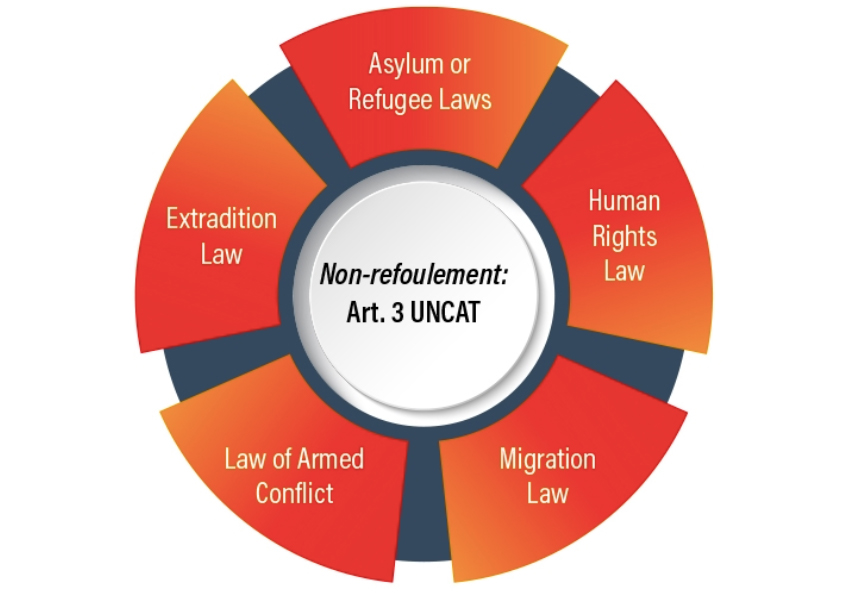
The new CTI tool on non-refoulement covers:
- constitutional and legislative provisions;
- national procedures;
- procedural rights to be guaranteed to those facing deportation or expulsion;
- training; and
- visa and stay arrangements for when return is prohibited.
There is also a section on non- refoulement in the extradition context.
The purpose of this and other CTI Implementation Tools is to inspire other States to take action through exchanges of good practices.
The tool also provides timely and practical information and advice for States in light of the recently released UN Committee against Torture’s General comment on the implementation of Article 3 of the Convention in the context of Article 22.
Some of the laws mentioned in this tool detail the powers that can be exercised by State authorities to remove a person and the constraints on those powers, as well as the relevant administrative and judicial procedures to be followed. National legislation has also detailed the rights of persons within those procedures (photo).
The tool was developed for the CTI by the ICJ with the support of the University of Bristol’s Human Rights Implementation Centre.
CTI’s series of UNCAT Implementation Tools are available here.