Aug 30, 2018 | News
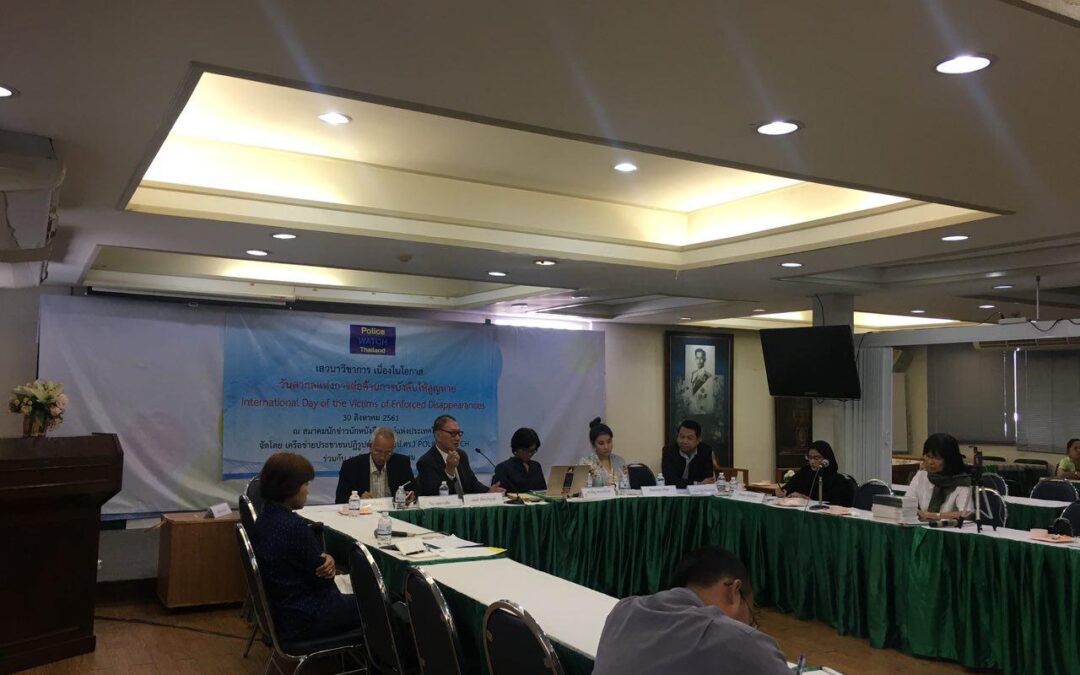
The ICJ participated in a panel discussion to commemorate International Day of the Victims of Enforced Disappearances, organized by Police Watch Thailand and Cross Cultural Foundation.
The discussion was held at the premises of the Thai Journalists’ Association.
The event began with opening remarks by Surapong Kongchantuk, Chairperson of the Cross Cultural Foundation, who called on the Thai Government to ratify the International Convention for the Protection of All Persons from Enforced Disappearance (ICPPED) and for the existing Draft Prevention and Suppression of Torture and Enforced Disappearance Act (‘Draft Act’) to come into force without undue delay.
He also emphasized that perpetrators of the crime of enforced disappearance needed to be brought to justice, and victims and relatives of victims of enforced disappearance must be provided with effective remedies and reparation.
A panel discussion followed the opening remarks, moderated by Pornpen Khongkachonkiet, Director of Cross Cultural Foundation. Panelists included Sanhawan Srisod, ICJ’s National Legal Adviser, Veera Somkomkid, from People Anti-Corruption Network, Pol.Col. Wirut Sirisawadibuth, Columnist and police reform activist, and Adul Kiewboribon, Chair of a committee of persons whose relatives disappeared during May 1992 protests against the government of General Suchinda Kraprayoon.
In her remarks, Sanhawan Srisod expressed concern at the absence of domestic legislation making torture and enforced disappearance specific crimes in Thai law and gaps in the existing Draft Act.
She also called for prompt, independent, impartial and effective investigations into the fate and whereabouts of disappeared persons consistent with international law and standards.
Human Rights Commissioner, and wife of disappeared lawyer and human rights defender Somchai Neelapaijit, Angkhana Neelapaijit, made closing remarks for the event.
The panel discussion followed a forum the ICJ co-hosted in March this year, commemorating the 14th year anniversary of the enforced disappearance of Somchai Neelapaijit, which also raised awareness about amendments to the Draft Act.
During the forum, the ICJ raised concerns about the independence of the ‘Committee managing complaints of torture and enforced disappearance cases’, which was established in May 2017, and expressed the need for further clarification on the legal framework – domestic and/or international – that will ground the Committee’s operation.
Background
The International Day of the Victims of Enforced Disappearances falls on 30 August every year.
Thailand is bound by international legal obligations under the International Covenant on Civil and Political Rights (ICCPR) and Convention against Torture and Other Cruel, Inhuman or Degrading Treatment or Punishment (CAT) – both of which it has acceded to – to investigate, prosecute, punish and provide remedies and reparation for the crimes of torture, other acts of ill-treatment, and enforced disappearance.
However, Thailand has not enacted domestic legislation recognizing enforced disappearance as a criminal offence. Thailand is also yet to ratify the ICPPED, despite signing the Convention in January 2012.
Thailand’s Ministry of Justice concluded a second round of public consultation on the Draft Act and is now reportedly in the process of evaluating the results of the consultation.
On 30 August 2017, 23 November 2017 and 12 March 2018, civil society organizations, including the ICJ, Amnesty International and Human Rights Watch, sent open letters to the Government, including to Thailand’s Minister of Justice, outlining amendments that would be necessary to bring the Draft Act in line with Thailand’s international human rights obligations.
In the absence of domestic legislation criminalizing torture and enforced disappearance, on 23 May 2017, a ‘Committee managing complaints for torture and enforced disappearance cases’ was established by the Prime Minister, pursuant to Prime Minister’s Office Order No. 131/2560 (2017).
The Committee, chaired by the Minister of Justice, consists of 15 officials drawn from different ministries,including the Ministry of Defence, the Royal Thai Police and the Internal Security Operations Command (ISOC).
Jul 24, 2018 | Events, News
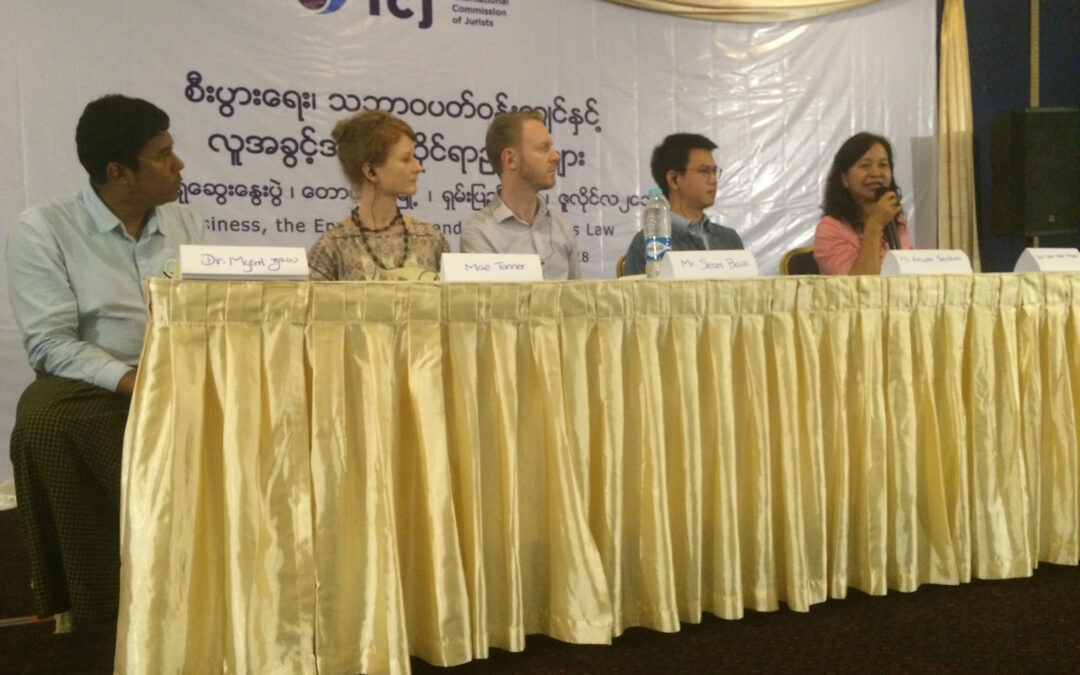
On 22 and 23 July the ICJ convened a workshop on Business, the Environment and Human Rights Law in Taunggyi, the capital of Myanmar’s Shan State.
This followed meetings between the ICJ’s legal advisers and the Shan State High Court and also with the State Advocate General on 13 July, to discuss rule of law developments.
The workshop aimed to identify ways to address the impacts of business activities on human rights and the environment, through legal advocacy including strategic litigation, and to provide a forum for cooperation and experience sharing among participants.
More than 50 lawyers, parliamentarians, human rights defenders and civil society representatives attended from Shan, Kayah and Mon states – provinces that together border Thailand, Laos and China.
An overview of the investment context was provided by Dr Myint Zaw of Paung Ku Myanmar, who also shared lessons from environmental activism in Myanmar.
As well as highlighting weaknesses in domestic law and policy, he presented concerns around lack of transparency and information sharing between the legislature and executive branches of government.
Australian lawyer and ICJ consultant Mae Tanner gave an overview of international human rights law and standards relevant to business activities and environmental protection, particularly emphasizing the obligations assumed by Myanmar in ratifying the International Covenant on Economic, Social and Cultural Rights.
She offered insights as to how UN mechanisms can be used by civil society to advance their advocacy on business and human rights in Myanmar.
Senior Advocate U Myint Thwin drew on his extensive litigation experience to share perspectives on the complex and confusing array of land laws in Myanmar and emphasized the importance of legal knowledge and training to combat corruption and achieve accountability.
The ICJ’s legal adviser Mr Sean Bain outlined the domestic laws relevant to investment and environmental protection in Myanmar and highlighted some key provisions that offer protection against human rights violations and abuses.
He noted the government’s stated aim of promoting the rule of law in Myanmar and emphasized the importance of demanding accountability, transparency and justice in this context.
Amarin Saichan, lawyer with Thai NGO EnLAW, shared experiences of pursuing strategic litigation to address unlawful and harmful business activities in Thailand, stressing the need for creativity in using the law to seek justice and accountability.
He also raised concerns around the use by government of strategic litigation against public participation in Thailand and explained how Thai lawyers are using the courts to guarantee the right protest against harmful development projects.
Participants had the opportunity to discuss how the strategies they shared could be used in the context of issues faced by their communities.
These included human rights and environmental concerns raised by energy and extractive projects, restrictions on shifting agriculture, and violations of the right to freedom of expression and assembly faced by communities who oppose state-backed developments.
They considered advocacy strategies for four case studies selected by participants from across Shan, Kayah and Mon states.
Throughout the workshop speakers and participants highlighted the importance of cooperation between civil society and lawyers, and the need to use Myanmar’s legal system more proactively as part of their broader advocacy strategies.
This workshop is part of the ICJ’s ongoing support to lawyers and civil society in Myanmar.

Jul 13, 2018 | News
The Sri Lankan Government should reconsider and reverse its decision to bring back the death penalty for drug related offences, the ICJ said today.
On 10 July, the Sri Lankan Cabinet unanimously approved an action plan to implement the death penalty for “drug smugglers”.
According to the spokesperson of the Cabinet, 19 people convicted for “large scale drug offences” who “are still involved in drug trafficking…from within prisons” would initially be those initially designated for execution.
Sri Lanka has had a moratorium on the death penalty for over four decades.
The last execution carried out in the country was in 1976.
“The resumption of executions of convicted drug offenders would constitute a violation of the right to life under international law,” said Ian Seiderman, ICJ’s Legal and Policy Director.
”And, based on experience around the globe, it will not in any way serve the purported objective of tackling the problems of drug-related crime in Sri Lanka,” he added.
Article 6 of the International Covenant on Civil and Political Rights (ICCPR), which Sri Lanka acceded to in 1980, guarantees the right to life and requires that states that have not yet abolished the death penalty must restrict capital punishment to only the “most serious crimes”.
The UN Human Rights Committee, the supervisory body for the ICCPR, considers that the death penalty may never be used for drug offences.
The extraordinarily retrograde measure of resuming executions following a 42-year moratorium would also constitute a violation of article 6, which contemplates at least progressive movement towards abolition.
The UN General Assembly has repeatedly adopted resolutions emphasizing that that the use of the death penalty undermines human dignity and calling on those countries that maintain the death penalty to establish a moratorium on its use with a view to its abolition.
In 2016, an overwhelming majority of 117 UN Member States – including Sri Lanka – voted in favor of a worldwide moratorium on executions as a step towards abolition of the death penalty.
“At least 150 countries have now either abolished the death penalty in law or practice,” added Seiderman.
The ICJ considers the death penalty to be a violation to the right to life and the right not to be subjected to cruel, inhuman or degrading punishment.
The ICJ urges Sri Lanka to reinstate its moratorium on executions and take steps towards taking all necessary measures to abolish the death penalty.
Contact:
Ian Seiderman, ICJ’s Legal and Policy Director, email: ian.seiderman(a)icj.org
Reema Omer, ICJ’s International Legal Advisor, South Asia, email: reema.omer(a)icj.org
Jul 10, 2018 | News
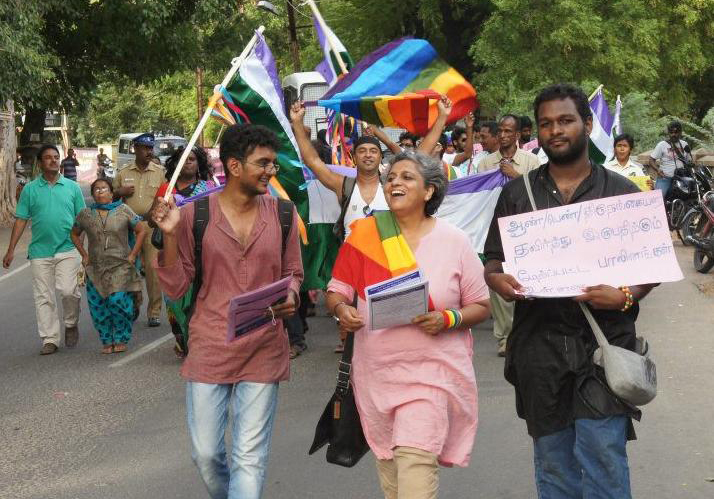
The SC is set to reconsider the criminalization of consensual same-sex relationships between adults, in response to a writ petition with significant ramifications for addressing the full range of human rights violations based on sexual orientation or gender identity in India said the ICJ.
The Indian Supreme Court commenced hearing the case, Navtej Singh Johar v. Union of India, which is joined with five connected cases, today, concerning the constitutional validity of the criminalization of consensual same-sex relations between adults under Section 377 of the Indian Penal Code in response to writ petitions filed by several LGBTI individuals.
Section 377 criminalizes “carnal intercourse against the order of nature”. Section 377 is a relic of the British colonial penal code and is replicated in several former British colonies even though it was it was finally repealed in Northern Ireland in 1982, following repeals in Scotland in 1980 and England and Wales in 1967.
“Hopefully, the Indian Supreme Court will follow and build upon the strong precedent set by the Delhi High Court in the Naz Foundation v. Govt. of NCT of Delhi that declared Section 377 and the criminalization of consensual same-sex relationships to be in violation of the Indian Constitution as well as international law in 2009,” said Sam Zarifi, ICJ’s Secretary General.
“There are real grounds for optimism as the Indian Supreme court as recently as August 2017 handed a landmark judgment in Justice K.S. Puttaswamy and Another v. Union of India and Others that declared the right to determine one’s sexual orientation and gender identity as core to the right of privacy,” he added
The ICJ has documented how section 377 has created a climate in which arbitrary arrest, extortion, harassment and blackmail of LGBTI persons in India thrives.
“The Indian judiciary’s decision to read down section 377 in Naz Foundation v. Govt. of NCT of Delhi, which was then overruled by the Supreme Court, has been used by several other jurisdictions, such as Trinidad and Tobago as support for putting an end to criminalization of same-sex relationships. So the outcome of this petition before the Indian Supreme Court is of significance not just to people in India, but to the fight against discrimination around the world,” Zarifi said.
“But even a good decision by the Indian Supreme Court will not end the discrimination against people on the basis of their sexual orientation or gender identity in India. It’s time for the Indian Parliament to repeal section 377 in its entirety and engage in a wide-ranging review to consider which gaps, if any, need to be filled, for example with respect to acts constituting rape or other sexual offences,” he added.
Contact:
Maitreyi Gupta (Delhi), International Legal Adviser for India, t: +91 7756028369 ; e: maitreyi.gupta(a)icj.org
India-Supreme Court and Section377-News-press release-2018-ENG (full story with additional information, in PDF)
Jul 8, 2018 | News
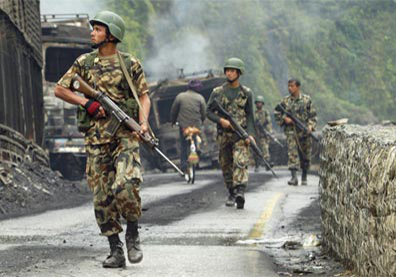
As the government begins a process of consultations around proposed amendments to the transitional justice mechanisms, the ICJ and Human Rights Watch have called on authorities to ensure the amendments comply with international human rights standards.
The government must also take into account concerns of all stakeholders, the organizations said.
The current draft law fails to address the many gaps in Nepali law that make it difficult to prosecute, especially at senior levels, for international crimes such as torture and crimes against humanity.
The Nepal government has ensured an extension of its two transitional justice commissions while also committing to future amendments to comply with international standards and Supreme Court rulings, the groups said.
The government is holding consultations around a proposed Commission on the Investigation of Enforced Disappeared Persons (CEIDP) and the Truth and Reconciliation Commission (TRC) (Amendment) Bill.
“While Nepal has engaged in a transitional justice process over the last few years, with official commissions collecting complaints, holding meetings and generic consultations throughout the country, this is still without any tangible result, and victims say it has left them confused,” said Brad Adams, Asia Director at Human Rights Watch.
“For a successful, internationally accepted process, the authorities in Nepal should focus on providing justice to victims, and not engage in trying to get perpetrators off the hook,” he added.
Human Rights Watch and the ICJ issued the statement after the Nepal government shared a draft bill purportedly to amend flaws in the laws of the CEIDP and TRC Acts.
Ahead of submitting further analysis and recommendations in the consultative process, the organizations said that Nepal authorities should take into account concerns of all stakeholders, including the groups representing victims of serious crimes by all sides during the civil war, other civil society organizations, the National Human Rights Commission (NHRC) and the United Nations Office of the High Commissioner for Human Rights (OHCHR).
Nepal’s new government under Prime Minister Khadga Prasad Oli of the Nepal Communist Party promised that the Nepali law on transitional justice would be brought into conformity with international law and standards as had been directed several times by the Supreme Court.
After years of previous governments failing to comply with the Supreme Court rulings, the new attorney general had announced that reforms to the law were underway, which victims’ groups said gave new hope, and as explicitly requested by the United Nations Human Rights Council (UNHRC) and human rights organizations.
While positive changes are noticeable including in relation to reparations, the proposed law authorizes the two transitional justice commissions to authorize prosecutions without strengthening the commissions themselves, proposes a special court without clear guidelines on impartial investigations, and includes a section permitting non-custodial sentences for the most serious crimes.
These raise concerns that the proposed draft may not meet international standards of justice and accountability.
The two commissions, which experts say require crucial bolstering, have conducted country-wide hearings and gathered nearly 60,000 cases between them.
Victim groups complain that the process has been arbitrary and confusing.
The organizations also noted a number of continuing obstacles to justice, which the bill has not addressed.
These include the continued failure to incorporate specific crimes into Nepali law that are serious crimes under international law, including torture, enforced disappearance, war crimes, and crimes against humanity.
In addition, the bill provides for the wholly inadequate sanction of short-term community service as an alternative punishment for those convicted of serious crimes, which may constitute effective impunity.
Nor does the bill address the question of command and superior responsibility for such crimes, leaving doubt as to whether those at the highest levels of authority will be held accountable for these crimes.
The international organizations were invited to a meeting with the attorney general and other stakeholders on June 21 but did not have a translated draft available ahead of the discussion.
However, during the consultation, the groups stressed the need for meaningful consultations on the bill.
The organizations noted also that universal jurisdiction, which allows for any state to prosecute those believed to have engaged in torture, enforced disappearance, or other serious crimes under international law, will remain an available option for victims to seek justice in cases of serious abuses during the civil war.
“Without a justice process that meets international standards for prosecuting the most serious crimes, such as torture and enforced disappearances, anyone suspected of such crimes in Nepal risks arrest, extradition, and prosecution in the many countries that are committed to prosecuting such crimes,” said Ian Seiderman, ICJ Legal and Policy Director.
“It is very welcome that the Nepal government is finally looking to address longstanding demands of war victims and should use this opportunity to abide by its obligations, draw up security sector reforms, and pave the way to end impunity,” he added.
Full text in English (PDF): Nepal-ICJ-HRW-Transnational-justice-reform-News-Press-releases-2018-ENG
May 17, 2018 | Feature articles, News
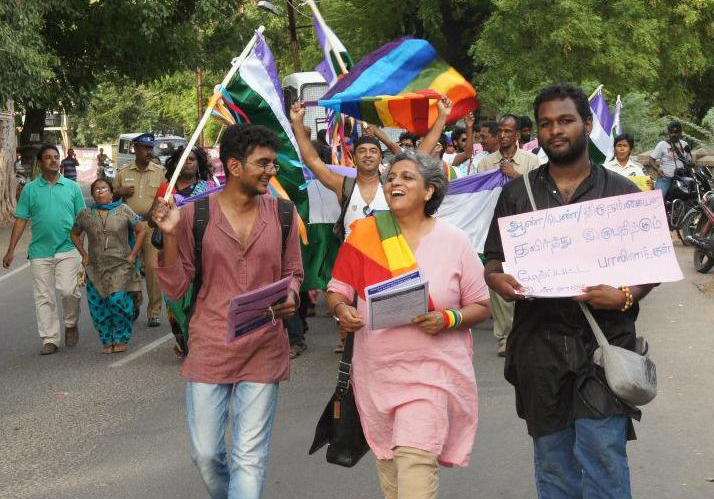
South Asian States must repeal laws that discriminate against LGBTI persons, and must respect, protect and fulfill the full range of their human rights, the ICJ said today on International Day Against Homophobia and Transphobia (IDAHO-T).
These rights include the right to equality before the law and equal protection of the law for all without discrimination, to which LGBTI persons are entitled due to their inherent dignity as human beings.
Across South Asia, discriminatory laws have enabled socially constructed gender and sexual norms to foster and perpetuate intimidation, harassment, threats of violence and violence against lesbian, gay, bisexual, transgender and intersex (LGBTI) persons, due to animosity, hostility and hatred motivated in whole or in part by their actual or perceived sexual orientation, gender identity, gender expression and/or intersex status.
Under international law, including the International Bill of Rights, that is the Universal Declaration of Human Rights and the two Covenants – the International Covenant on Civil and Political Rights and the International Covenant on Economic, Social and Cultural Rights – discrimination on the grounds of sexual orientation and/or gender identity is prohibited.
In this context, the Office of the UN High Commissioner of the Human Rights has underscored five core international human rights law obligations for States: (1) protecting individuals from homophobic and trans-phobic violence; (2) preventing torture and cruel, inhuman, and degrading treatment of LGBTI persons; (3) decriminalizing homosexuality; (4) prohibiting discrimination based on sexual orientation and gender identity; and (5) respecting the freedom of expression, association and peaceful assembly of LGBTI persons.
Under international human rights law, the principle of non-discrimination includes the right to determine one’s sexuality, sexual orientation, and gender identity and gender expression.
Contrary to their international human rights law obligations in this respect, States’ policing of gender and sexuality has created a pattern of stigma, harassment and violence.
For example, consensual same-sex sexual relations remain criminalized in seven out of eight countries in South Asia – Afghanistan, Bangladesh, Bhutan, India, Maldives, Pakistan, and Sri Lanka – based on colonial era laws, such as S. 377 of the Penal Codes of Pakistan, India, Maldives and Bangladesh, and similar legal provisions in Sri Lanka and Bhutan, that criminalize “carnal intercourse against the order of nature”.
While the enforcement of these laws rarely lead to actual criminal convictions and sentences of imprisonment, their mere continued existence creates an ominous and ongoing threat against and criminalizes entire sectors of the populations in these countries.
This, in turn, gives rise to a climate that encourages and is ripe for extortion, harassment and blackmail of LGBTI persons, by the police, as well as non-State actors, including the general public and even their own families.
While there have been some progressive developments, discrimination, violence and other human rights abuses against LGBTI people – both at the hands of State and non-State actors – remain rampant in South Asia.
Hence, on IDAHO-T, the ICJ renews its call on all South Asian Governments to repeal discriminatory laws against LGBTI persons, including laws that criminalize consensual same-sex sexual relations.
In addition, the organization urges all South Asian Governments to enable transgender persons’ right to self-identification of their gender, and to enact legislation that establishes prior, free, full, informed, genuine and consistent consent for any medically unnecessary interventions on intersex persons.
Contact
Maitreyi Gupta, ICJ International Legal Adviser in India, t: +91 7756028369; e: maitreyi.gupta@icj.org
Full text in ENG (PDF): India-IDAHO-T call-News-Feature article-2018-ENG