Jan 31, 2014 | News
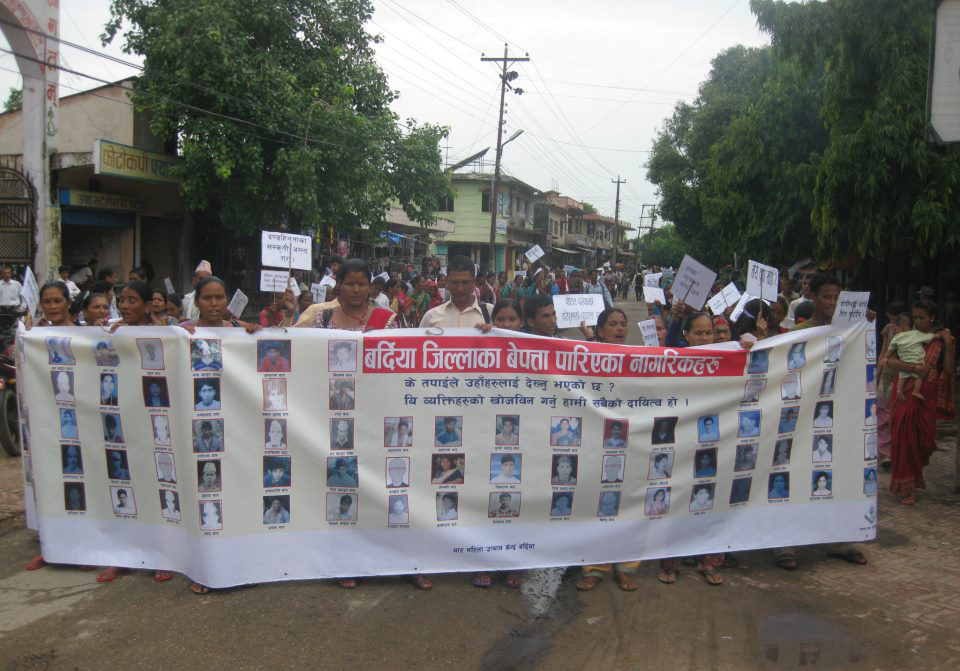
The Parliament of Nepal should reject the Ordinance on Truth, Reconciliation and Disappearances tabled this week and enact a new transitional justice mechanism that complies with international human rights law, the ICJ and HRW said today.
The Ordinance on Disappearances, Truth and Reconciliation Commission, signed by the President on 14 March, 2013, was declared unconstitutional and in violation of international human rights law by the Nepali Supreme Court on 2 January, 2014.
In a directive, the Supreme Court ordered the Ordinance be repealed or amended significantly to bring it in line with Nepal’s obligations under national and international law.
However, on 27 January, the Government reintroduced the Ordinance with no amendments in the meeting of the Legislative-Parliament – in direct contravention of the Supreme Court’s orders.
“Tabling a rejected version of the Ordinance after the Supreme Court’s landmark judgment on transitional justice is contemptuous, and raises serious concerns over the government’s respect for the rule of law in Nepal,” said Ben Schonveld, ICJ’s South Asia Director.
The Interim Constitution says clearly that the Supreme Court’s rulings are binding on the Government of Nepal. Article 116 of the Interim Constitution states that any order issued by the Supreme Court in the course of the hearing of a case shall be binding on the Government of Nepal and all its offices and courts.
The Supreme Court has previously held that any mechanism for transitional justice must conform with international standards, lead to accountability for serious human rights violations, and ensure victims their right to remedy and reparations, which includes the right to truth, justice, and guarantees of non-recurrence.
In its 2013 briefing paper, “Authority without Accountability,” the ICJ expressed concern over multiple provisions in the Ordinance, including amnesty provisions, which would entrench impunity for gross human rights violations in Nepal.
Any amnesty for gross human rights violations would add another layer to the complex web of immunities, documented in the report, that continue to shield those responsible for human rights abuse from accountability in Nepal.
“The Parliament of Nepal should strongly reject the tabled Ordinance and the government must expeditiously implement the Supreme Court’s directive,” said Meenakshi Ganguly, South Asia Director at Human Rights Watch. “The ordinance in its current form violates undertakings made as part of the peace agreement, and essentially strips victims of serious rights abuses of a proper chance at justice.”
The rights groups called on the government to implement the Supreme Court’s ruling, creating a new transitional justice law that, at a minimum:
- Establishes two separate transitional justice commissions: a “Truth and Reconciliation Commission” and a “Commission of Inquiry on Enforced Disappeared Persons;”
- Criminalizes the act of enforced disappearance in accordance with the definition set out in the International Convention on the Protection of All Persons from Enforced Disappearance and ensures that it is punishable with penalties commensurate with the gravity of the crime;
- Criminalizes other serious crimes, including crimes against humanity, and other crimes under international law, in a manner that is consistent with international law;
- Prohibits amnesties for gross human rights violations or crimes under international law;
- Does not contain a limitation period on the reporting of violations and ensures there are no time limits on the prosecutions of of serious crimes including enforced disappearance, other crimes under international law including, war crimes, and crimes against humanity;
- Ensures that the composition and structure of the Commissions complies with international standards. In particular, there should be a fair vetting system which aims to ensure the impartiality of the commission members and to ensure that no individuals against whom there are credible allegations they have committed human rights abuses are selected as Commissioners;
- Requires the necessary legal and institutional measures to be taken to enable and ensure the establishment, adequate resourcing and maintenance of effective victim and witness protection mechanisms; and
- Establishes and requires other necessary legal, administrative, institutional, or other arrangements for an effective reparation program.
Contact:
In Bangkok, Sam Zarifi: +66-857200723; or sam.zarifi(a)icj.org
In Kathmandu, Ben Schonveld +977-9804596661; : ben.schonveld(a)icj.org
Read also: ICJ releases new report on the struggle for justice in Nepal
The report Authority without accountability: the struggle for justice in Nepal can also be downloaded below:
Nepal-SUMMARY-Authority without Accountability-Publication-report summary-2012 (full text in pdf)
Nepal-FULL-Authority without accountability-publications-report-2012 (full text in pdf)
Jan 10, 2014 | News
The ICJ calls on the Bangladeshi authorities to immediately and unconditionally drop ‘cybercrime’ charges against Nasiruddin Elan and Adilur Rahman Khan, President and Secretary of the human rights group Odhikar.
“These charges are a flagrant attempt to silence critical voices, and the Bangladeshi authorities must immediately and unconditionally drop all charges against the two human rights defenders,” said Sam Zarifi, ICJ’s Asia director.
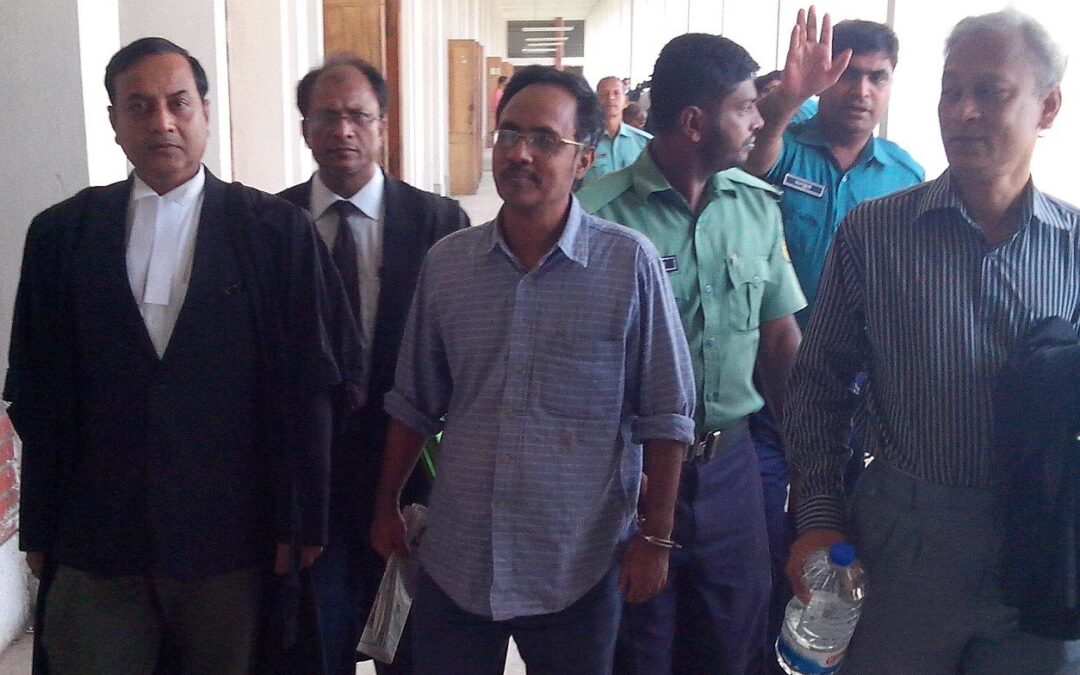
On 8 January 2014, a cyber crimes tribunal in Dhaka indicted Nasiruddin Elan (picture, on centre) and Adilur Rahman Khan under section 57 (1) and (2) of the Information and Communication Technology (ICT) Act, 2006, for publishing “fake, distorted and defamatory” information. Khan and Elan plead innocent to the charges.
The charges relate to a report by Odhikar that alleged that security forces had killed 61 people during a rally by the Islamist group Hefazat-e Islam in May 2013. The Government disputes the casualty numbers.
The trial is set to begin on 22 January 2014. Under the terms of the newly amended ACT the two human rights defenders face a minimum of seven and maximum of 14 years imprisonment.
“The ICJ has warned that the ICT Act can be used to attack freedom of expression in Bangladesh,” said Sam Zarifi. “As predicted, the Government is now using the newly amended law to silence political and public discourse through the threat of punitive sentences and deliberately vague and overbroad offences in clear violation of international law.”
In a briefing paper released on 20 November 2013, ICJ highlighted that provisions of the 2006 ICT Act (amended 2013), particularly section 57, violate Article 19 of the International Covenant on Civil and Political Rights (ICCPR), which Bangladesh ratified on 6 September 2000: the offences prescribed are poorly defined and overbroad; the restrictions imposed on freedom of expression go beyond what is permissible under Article 19(3) of the ICCPR; and the restrictions are not necessary and proportionate to achieve a legitimate purpose.
In addition, the UN Declaration on Human Rights Defenders underscores that States must take all necessary measures to protect human rights defenders “against any violence, threats, retaliation, de facto or de jure adverse discrimination, pressure or any other arbitrary action as a consequence of his or her legitimate exercise of his or her rights.”
Contact:
Sam Zarifi, ICJ Asia-Pacific Regional Director, (Bangkok), t: +66 807819002; email: sam.zarifi(a)icj.org
Ben Schonveld, ICJ South Asia Director, t: +61 422 561834; email: ben.schonveld(a)icj.org
Additional information
Adilur Rahman Khan was arrested his home on 10 August 2013 without an arrest warrant.On August 11, a Magistrate’s Court refused his bail application and remanded him for five days of custodial interrogation.
On August 12, the High Court Division of the Supreme Court stayed the remand order and directed that Adilur Rahman be sent back to jail, where he could be interrogated ‘at the gate of the jail.’
On 4 September 2013, the Detective Branch of Police filed a charge sheet against Adilur Rahman Khan and Odhikar’s Director, Nasiruddin Elan, under Section 57 of the International Communication and Technology Act 2006. On 30 October Adilur Rahman Khan was released on bail. On 6 November 2013, a Dhaka cyber crimes tribunal rejected Nasiruddin Elan’s bail application and ordered his detention in Dhaka Central Jail. Bail was granted on 24 November by the High Court. But the bail order was finally enforced after the appellate division’s order on 3 December 2013.
Dec 19, 2013 | Advocacy, News
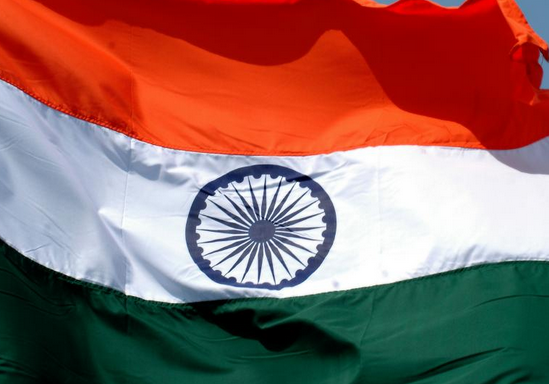
The ICJ is profoundly concerned at the judgment of 11 December 2013 of the Supreme Court of India, which effectively recriminalizes consensual same-sex sexual conduct between adults in private.
The decision by India’s highest court in Suresh Kumar Koushal and another v NAZ Foundation and others overturned the 2009 decision of the Delhi High Court.
That earlier judgment had held section 377 of the Indian Penal Code to be unconstitutional to the extent that it violated the rights to equality before the law, non-discrimination, life and personal liberty guaranteed by the Indian Constitution.
Section 377 criminalized certain consensual sexual acts in private between adults that are particularly associated with same-sex conduct.
The 2009 High Court’s ruling had the effect of decriminalizing such conduct between adults in private in India.
Its decision was based on an in-depth analysis of India’s obligations under international human rights law and standards, as well as international comparative law.
The High Court had examined the scope of the rights to equality, non-discrimination and personal liberty under the Indian Constitution and determined Section 377 to be unconstitutional.
Section 377, which was enacted in 1860, is a historical relic from colonial times bequeathed to India under the British empire; it made it an offence to voluntarily have “carnal intercourse against the order of nature” with any man, woman or animal.
Those convicted are liable to imprisonment for up to 10 years or for life and a fine.
The Supreme Court decision of 11 December reversed the High Court’s courageous and much celebrated decision.
Purporting to uphold the separation of powers, the judgment of the Supreme Court overturned the High Court by ruling that it acted in excess of its judicial review jurisdiction by failing to exercise restraint and to accord the necessary deference to the Indian legislature in its review of the constitutionality of section 377.
The Court effectively holds that the provision is not inconsistent with human rights and India’s obligations under international human right law, and that it is up to the Indian Parliament to amend or repealed it.
The ICJ is deeply troubled by the reasoning of the Supreme Court judgment.
It would appear to constitute an abdication of the essential role of the judiciary in safeguarding human rights.
In this case, the Court failed to uphold and protect the rights to equality and non-discrimination; equality before the law and equal protection of the law; dignity; privacy; freedom of expression and association; family life; and the highest attainable standard of health.
The judgment is inconsistent with India’s obligations under international human rights law.
The judgment also disconcertingly dismisses without apparent reason the wealth of evidence before the court documenting how the criminalization of same-sex sexual conduct leads directly to human rights violations.

Dec 10, 2013 | News
The ICJ urgently calls on Bangladesh President Abdul Hamid to intervene to stop the execution of Abdul Quader Mollah.
The Supreme Court handed down its judgment against Abdul Quader Mollah on 5 December 2013.
The 790-page judgment was sent to the International Crimes Tribunal on 8 December 2013 and a death warrant was issued against Abdul Quader Mollah (photo) on the same day.
It was immediately sent to the Dhaka Central Jail and he may be executed at any time unless President Abdul Hamid or the Supreme Court intervenes.
Last week, the United Nations High Commissioner for Human Rights Navi Pillay issued a statement, expressing her deep concern over the rising levels of political violence in Bangladesh, calling on both sides to ‘’halt their destructive brinkmanship.’’
‘‘In an increasingly volatile situation, executing Abdul Quader Mollah risks pushing the Government towards a state of emergency, placing democracy and rule of law in peril,’’ said Ben Schonveld, ICJ South Asia Director. ‘‘The timing of the Supreme Court’s decision and the Tribunal’s subsequent death warrant raise serious questions about the political motivations behind the ICT process as well as the independence and impartiality of the judiciary.’’
The ICJ is concerned that the International Crimes Tribunal has not adhered to international standards.
As a State party to the International Covenant on Civil and Political Rights, Bangladesh is obligated to guarantee the right to a fair trial to all suspects, which includes special protections for those facing the death penalty.
The ICJ considers the death penalty to constitute a violation of the right to life and the right to be free from cruel, inhuman or degrading punishment.
It calls on the government of Bangladesh to impose a moratorium on the carrying out death sentences with a view to abolition, in compliance with repeated United Nations General Assembly resolutions on the question.
“The use of the capital punishment is particularly egregious in the Abdul Quader Mollah case, given that Parliament retroactively changed the law to enable the Supreme Court to impose a sentence of death on appeal,’’ added Schonveld. ‘‘Retroactively changing laws to influence the outcome in a case not only goes against the prohibition on retroactivity, it undermines the independence of the judiciary and the judicial function.’’
The ICJ urges President Abdul Hamid to intervene to stop the execution of Abdul Quader Mollah.
CONTACT:
Ben Schonveld, ICJ South Asia Director (Kathmandu), t:+97714432651 ; email: ben.schonveld(a)icj.org
Sheila Varadan, ICJ International Legal Advisor, South Asia Programme (Bangkok), t: +66857200723; email: sheila.varadan(a)icj.org
BACKGROUND:
Political violence has continued to escalate in Bangladesh
Abdul Quader Mollah was indicted on six counts of crimes against humanity before the International Crimes Tribunal (ICT). On 5 February 2013, the ICT rendered its verdict, finding him guilty on five counts and acquitting him on the sixth count. The ICT sentenced him to life imprisonment on two counts for his involvement in the Alubdi mass murder and the murder and rape of a family. He was sentenced to 15 years imprisonment on the remaining three counts.
At the time of the verdict, section 21(2) of the International Crimes (Tribunal) Act 1973 did not permit the Prosecution to appeal a sentence to obtain a heavier sentence.
The ICT verdict in the Mollah case sparked widespread protests, drawing tens of thousands of protesters to Shabagh Square, demanding that Mollah be sentenced to death.
Responding to public outcry, on 14 February 2013, the Parliament of Bangladesh drafted an amendment to change Section 21(2) of the International (Crimes) Tribunal Act 1973 to allow Prosecution to appeal a sentence in a conviction to seek a heavier sentence. The amendment was passed on 17 February and deemed to apply retroactively from 14 July 2009.
Acting on the basis of the Amendment to Section 21(2), the prosecution appealed the life sentences given to Mollah, seeking the death penalty. The prosecution also appealed the acquittal handed down. The defence in turn appealed the convictions on the five counts.
On 17 September 2013, the Appellate Division of the Supreme Court issued an oral decision with no reasons overturning the acquittal and entering a conviction; overturning one of the life sentences and imposing a sentence of death; dismissing the appeal made by the defence.
On 5 December 2013, the Appellate Division of the Supreme Court issued its 790-page judgment giving its reasons for overturning the life sentence and handing down the death penalty. The 790-page judgment was forwarded to the ICT-2 on 8 December 2013. The ICT-2 then issued a warrant of death against Abdul Quader Mollah and sent it to the Central Dhaka jail to be executed.

Nov 14, 2013 | News
The International Bar Association’s Human Rights Institute (IBAHRI) and the ICJ urge the Commonwealth Heads of States meeting in Colombo this week to make Sri Lanka accountable to Commonwealth values.
The IBAHRI and the ICJ recall that the Commonwealth Charter, passed in March 2012, sets out 16 core values, which include safeguarding the independence of the judiciary, protecting the rule of law, respecting the separation of powers and promoting democratic rule.
But the two organizations point out numerous examples where these values have not been respected by the Government of Sri Lanka.
The IBAHRI and the ICJ were holding a press conference in Bangkok Thailand today after a high-level IBAHRI delegation was blocked from entering Sri Lanka late last week to attend a conference on the rule of law and independence of the legal profession hosted by the Bar Association of Sri Lanka.
Giving a statement remotely, Gabriela Knaul, UN Special Rapporteur on the Independence of Judges and Lawyers, expressed “serious concerns about acts of reprisals against judges, prosecutors, lawyers and other actors of the judicial system who cooperate, or seek to cooperate, with UN and regional human rights mechanisms.”
“Reprisals against judicial actors and legal professionals are a kind of attack to their institutional and functional independence,” she added.
Earlier this year, the IBAHRI conducted a remote fact-finding mission on the politically motivated impeachment of Chief Justice Banadranayake in January 2013, after being denied entry into Sri Lanka.
The IBAHRI Mission concluded that the Chief Justice’s removal was unlawful, undermined public confidence in the rule of law and threatened to eviscerate the country’s judiciary as an independent guarantor of constitutional rights.
In an open letter signed by 56 eminent jurists and senior judges from around the world, the ICJ also expressed its grave concern over the disregard for international standards on the independence of the judiciary and the removal of judges.
“This weakening of rule of law and independence of the judiciary is accompanied by an equally deteriorating human rights situation,” said Sheila Varadan, ICJ Legal Adviser for South Asia.
The United Nations High Commissioner of Human Rights, Navi Pillay, in her recent visit to Sri Lanka expressed concern over the curtailment or denial of personal freedoms and human rights, the persistent impunity and the failure of rule of law.
“The state of affairs in Sri Lanka sits uneasily with the aspirations set out in the Commonwealth Charter,” said Human Rights Barrister and IBAHRI Sri Lanka Mission Rapporteur, Sadakat Kadri. “The Government of Sri Lanka has spent years undermining the values and principles of the Commonwealth.”
“If the Commonwealth is to remain a relevant and effective international organization, it is paramount that those heads of State who have chosen to attend this week’s summit take measures to make Sri Lanka accountable to the core values and principles of the Commonwealth,” said IBAHRI Senior Programme Lawyer Alex Wilks.
Contact:
Sheila Varadan, ICJ Legal Advisor, South Asia Programme (Bangkok), t: +66857200723; email: sheila.varadan(a)icj.org
Notes:
- The IBAHRI delegation blocked from entering Sri Lanka included UN Special Rapporteur on the Independence of Judges and Lawyers, Ms Gabriela Knaul, former UN Special Rapporteur on the Independence of Judges and Lawyers and ICJ Commissioner Dato’ Param Cumaraswamy, and IBAHRI senior programme lawyer Alex Wilks, had intended to travel to Colombo to attend a conference on the rule of law and independence of the legal profession hosted by the Bar Association of Sri Lanka. IBAHRI Mission Rapporteur Sadakat Kadri was also unable to enter Sri Lanka as he was denied a visa.
- The Bar Association of Sri Lanka with the International Bar Association’s Human Rights Institute had planned a conference for 13 November 2013 on ‘Making Commonwealth values a reality: the rule of law and independence of the legal profession’. The 13 November 2013 conference was cancelled when the Government of Sri Lanka revoked visas for the UN Special Rapporteur and the IBAHRI delegation on 7 November 2013.
- In March 2013, a delegation of the IBAHRI undertook a remote fact-finding mission to investigate the impeachment proceedings of Chief Justice Bandaranayake, the independence of the legal profession and rule of law in Sri Lanka. The mission was conducted remotely following the cancellation of visas by the Government of Sri Lanka for the IBAHRI delegation. A report was released in April 2013 A Crisis of Legitimacy: The Impeachment of Chief Justice Bandaranayake and the Erosion of the Rule of Law in Sri Lanka.
- The ICJ released a report, Authority without Accountability: The crisis of impunity in Sri Lanka in November 2012 documenting the systemic erosion of rule of law and accountability mechanisms in Sri Lanka. The ICJ report described how decades of Emergency rule and legal immunities granted to the President and other government officials weakened the checks and balances in the Sri Lankan government, while political interference has increasingly led to attacks on the independence of the judiciary and rule of law.
Nov 6, 2013 | News
The ICJ is calling on the Bangladeshi authorities to immediately and unconditionally release Nasiruddin Elan, Director of the human rights group Odhikar.
Odhikar is an affiliate organization of the ICJ.
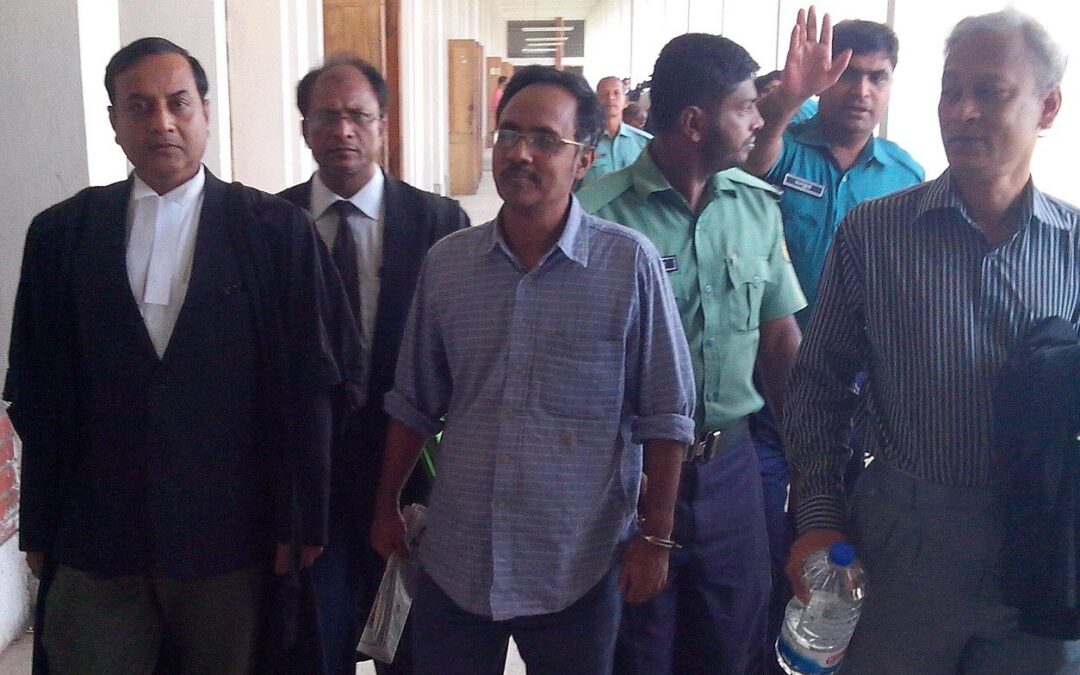
On 6 November 2013, a Dhaka cyber crimes tribunal rejected Nasiruddin Elan’s bail application and ordered his detention in Dhaka Central Jail.
Nasiruddin Elan (in the middle on the picture) has been accused of distorting information, presenting false evidence and manipulating photographs of a Government crackdown on a rally by Hefazat-e-Islam, an Islamist political organization, in May this year.
The action reportedly resulted in multiple deaths and injuries. Odhikar had reported that 61 protestors were killed by the Rapid Action Battalion (RAB) and the police. The Government contests the number of casualties.
“What we are seeing is a continuing unlawful attack on Odhikar and voices critical of the Government,” said Ben Schonveld, ICJ’s South Asia Director. “Nasiruddin Elan is being arbitrarily detained for the lawful exercise of the right to freedom of expression and his legitimate work as a human rights defender.”
“The Government should immediately drop its opposition to Nasiruddin Elan’s bail application,” he added. “We are concerned that he will be one of the many detainees who faces torture and ill-treatment during detention, as documented by Odhikar and other human rights organizations.”
Bangladesh-Elan arrest statement-news-web story-2013 (full text in pdf)