Jun 24, 2019 | News
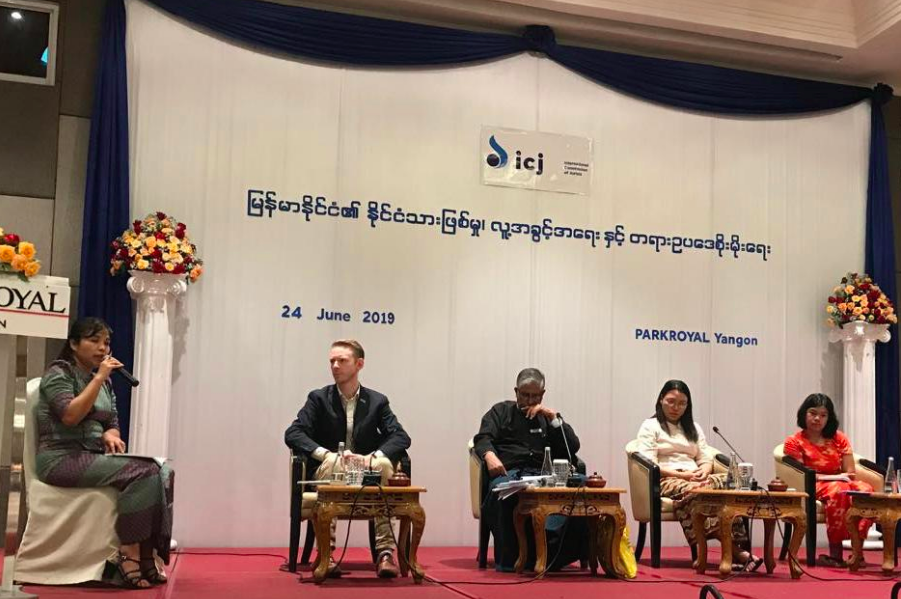
The ICJ convened a half-day panel discussion today in Yangon, Myanmar, to discuss national laws governing citizenship, and outline how, throughout the country, they have a discriminatory impact on people’s enjoyment of their human rights.
The event also provided the opportunity to introduce the ICJ’s new legal briefing Citizenship and Human Rights in Myanmar: Why Law Reform is Urgent and Possible
ICJ legal researcher Ja Seng Ing and legal adviser Sean Bain kicked off the event by noting that Myanmar’s legal framework for citizenship – enacted by unelected military governments – fuels widespread discrimination against members of ethnic minority groups throughout the country.
Bain highlighted the incompatibility of the domestic legal framework governing citizenship in Myanmar with core rule of law principles and with the State’s obligations under international human rights law, including the Convention on the Rights of the Child.
He presented the ICJ’s practical recommendations for law reform, outlined in the ICJ’s new legal briefing, including with respect to the 1982 Citizenship Law and the 2008 Constitution, and to the Child Rights Bill currently under consideration by Myanmar’s national parliament.
Senior Advocate U Ohn Maung, a lawyer with decades of experience supporting access for members of minority groups to the official documentation often necessary to obtain even basic services, emphasized that citizenship in Myanmar should be a more inclusive concept, reflective of its pluralistic, multi-ethnic demography.
Daw Zarchi Oo and Daw Su Chit shared the findings of independent civil society research.
They highlighted various groups including: migrants and migrant workers; individuals belonging to sexual and/or gender minorities; single mothers; the children of fathers who are foreign nationals or who are estranged from their fathers; and people living with disabilities, who are all adversely impacted by current legal arrangements for citizenship and by their discriminatory implementation.
Daw Zarchi Oo also spoke about her own past experience of being stateless, and Daw Su Chit elaborated on her work with civil society and others to develop a gendered analysis of the impact of discriminatory citizenship laws in Myanmar.
Around 60 participants, including from domestic civil society, the legal community, international non-government organizations, the Myanmar National Human Rights Commission, the diplomatic community and others joined this event, and participated in the discussions.
The 1982 Citizenship Law embedded the current narrow definition of citizenship, which generally links its acquisition to membership of a prescribed “national race.”
Many of the 2008 Constitution’s provisions on “fundamental rights” are restricted to citizens only, with a result being that the State generally does not recognize the human rights of persons who do not qualify as citizens under domestic law, or are otherwise excluded due to the laws’ discriminatory implementation.
The intentionally discriminatory character of the 1982 Law, and its discriminatory implementation, largely explains why many long-term residents of Myanmar lack a legal identity (more than 25 percent of persons enumerated in the 2014 Census).
The situation of Rohingya people, who the State generally does not recognize as citizens, is the most egregious example of the human rights violations associated with this system.
This event is part of the ICJ’s broader support to promote and protect human rights in Myanmar through research, analysis, advocacy and creating spaces for discussion.
See also:
ICJ convenes workshop on reforming 1982 Citizenship law
Apr 22, 2019 | Advocacy, News, Non-legal submissions
Today, the ICJ submitted recommendations to the Council of the State calling for the repeal or amendment of National Council for Peace and Order (NCPO) and Head of the NCPO (HNCPO) orders and announcements in line with Thailand’s international human rights law obligations.
The ICJ was informed by the Ministry of Foreign Affairs that the Council of the State had been tasked to review the necessity and relevance of announcements, orders, and acts of the NCPO and of the HNCPO in February 2019.
The review process is in line with Thailand’s declaration to the UN Human Rights Committee in its Follow-Up to the Concluding Observations of the Committee, submitted on 18 July and published on 10 August 2018.
In its submission to the Council of the State, the ICJ has called for the review process of HNCPO and NCPO announcements and orders to be carried out with increased public participation, openness, and transparency.
The ICJ has also made recommendations on the repeal and amendment of the following HNCPO and NCPO orders and announcements since they are clearly inconsistent with Thailand’s international human rights law obligations and the 2017 Constitution, and are neither necessary, nor proportionate, nor relevant to the current situation:
- Orders that provide the military with superior powers beyond civilian authorities;
- Orders that allow military courts to prosecute civilians;
- Orders that infringe on the rights to freedom of expression and assembly, restrict media freedom and the right to information; and
- Orders that infringe on community and environmental rights.
As main priorities, the ICJ has recommended that:
a) the exercising of law enforcement powers by military personnel to arrest and detain suspects in places not formally recognized as places of detention without judicial review should end;
b) all cases of civilians facing proceedings before military courts be transferred to civilian courts, and all civilians convicted of an offence in military courts be guaranteed a re-trial in civilian courts; and
c) all other HNCPO and NCPO orders and announcements should be repealed or amended to bring Thailand in compliance with its international human rights law obligations, and to ensure that the rights to freedom of expression, opinion and assembly, and environmental rights, among others, be respected.
Thailand-civilian prosecutions military courts-Advocacy-Non-legal submissions-2019-ENG (PDF in English)
Thailand-civilian prosecutions military courts-Advocacy-Non-legal submissions-2019-THAI (PDF in Thailand)
Further readings:
Post coup’s legal frameworks
Thailand: ICJ alarmed at increasing use of arbitrary powers under Article 44
Joint submission to the UN Human Rights Committee by the ICJ and Thai Lawyers for Human Rights
The ICJ and other groups made a joint follow-up submission to the UN Human Rights Committee
Thailand: statement to UN on situation for human rights
ICJ and Thai Lawyers for Human RIghts’ submission to the Universal Periodic Review (UPR) of Thailand
Military officers in law enforcement missions
Thailand: immediately end the practice of arbitrarily detaining persons in unofficial places of detention
Thailand: The ICJ and Human Rights Watch express concerns over detentions
The Use of Military Court
Thailand: transfer all civilians to civilian courts
Thailand: End prosecution of civilians in military tribunals
Thailand: ICJ welcomes Order phasing out prosecution of civilians in military courts but government must do much more
Freedom of expression and assembly
Thailand: lifting of the ban on political activities is welcome but more is needed
Thailand: Lift ban on political gatherings and fully reinstate all fundamental freedoms in Thailand
Thailand: misuse of laws restricts fundamental freedoms (UN statement)
Community and environmental rights
“Development” and its discontents in Thailand
Thailand: ICJ submission to the UN Committee on Economic, Social and Cultural Rights

Apr 12, 2019 | Advocacy, News, Open letters
The ICJ sent a letter urging Singapore’s government to refrain from passing into law the Protection from Online Falsehoods and Manipulation Bill 2019 (‘Online Falsehoods Bill’) in its current form.
The letter was sent to Singapore’s Prime Minister, Deputy Prime Ministers, Minister for Law and Speaker of the Parliament.
The bill is reportedly expected to be adopted and come into force in the second half of 2019.
The ICJ acknowledged the efforts of Singapore’s government to attempt to counteract potential infringements on human rights and fundamental freedoms which may emerge from abusive communications involving the spread of misinformation. It noted however that the bill may, contrary to the object and purpose of its introduction, result in far-reaching limitations on the rights to freedom of expression, opinion and information.
The ICJ indicated that its provisions present a real risk that it can be wielded in an arbitrary manner to curtail important discussion of matters of public interest in the public sphere, including content critical of the government. Critical dissent, free exchange and development of opinions, and free access to information are necessary to maintain an informed society and ensure transparency, accountability and informed debate on crucial matters of public interest.
The letter included a legal briefing highlighting the ICJ’s concerns regarding provisions of the bill which contravene international human rights law and standards.
Singapore-online regulation bill letter-advocacy-open letter-2019-ENG Letter (PDF)
Singapore-online regulation bill briefing-advocacy-open letter-2019-ENG Briefing (PDF)
See also
ICJ, ‘Singapore: Parliament must reject internet regulation bill that threatens freedom of expression’, 4 April 2019, https://www.icj.org/singapore-parliament-must-reject-internet-regulation-bill-that-threatens-freedom-of-expression/

Apr 11, 2019 | Advocacy
Today the ICJ joined twenty organizations in calling for Myanmar’s new Constitutional Amendment Committee to fully protect the right to freedom of expression in the Constitution, in line with international law and standards including Article 19 of the International Covenant on Civil and Political Rights.
The statement reads:
“20 expert organisations urge Myanmar to fully guarantee the internationally protected right to freedom of expression in the Constitution
11 April 2019 — A new parliamentary committee tasked with reviewing Myanmar’s constitution is an opportunity for the government to guarantee the democratic rights to free expression, media freedom, and access to information.
We welcome the government’s creation of the Constitutional Amendment Committee, established to review and propose amendments that will support Myanmar’s transition to democracy.
Myanmar’s 2008 Constitution does not include the guarantees required in a democracy to protect freedom of expression. Those that it does include do not meet relevant international human rights standards. This threatens the transition to and quality of Myanmar’s democracy as can be seen for example in the wide range of laws used to prosecute journalists and human rights defenders.
We call on the Constitutional Amendment Committee to recommend:
- Replacement of the current heavily prescribed guarantee for freedom of expression in Articles 354(a) and 365 with a single article that guarantees the right to freedom of expression in accordance with international standards, so that it fully reflects the requirements of Article 19 of the International Covenant on Civil and Political Rights.
- A new separate article guaranteeing the right to access information held by public authorities.
- A new separate article guaranteeing media freedom, which should prohibit prior censorship of the media or licensing of the print media and individual journalists, and should protect journalism as well as the independence of the Myanmar Press Council, Myanmar Broadcasting Council, and any future public service media.
- Each guarantee should include only those limitations that are provided by law and are necessary for the respect of the rights or reputations of others, or for the protection of national security or of public order, or of public health or morals.
We are committed to supporting Myanmar’s transition to democracy and would be happy to provide further information and guidance as the Committee conducts its review.”
Signed by 20 organizations with the support of 13 other organizations.
Full statement and list of organizations available in English and Burmese here: Myanmar-Joint Statement on FoE and Const Ref-Advocacy-2019-BUR

Apr 4, 2019 | News
Today, the ICJ urged Singapore’s Parliament not to pass the Protection from Online Falsehoods and Manipulation Bill 2019 (‘Online Falsehoods Bill’), which was tabled on Monday, 1 April.
The ICJ said that the bill, if passed into law, would result in far-reaching limitations on freedom of expression, opinion and information in Singapore, and could be wielded to curtail important discussion of matters of public interest, including content critical of the government.
“This bill, if passed, would make the government the sole arbiter of what information is permissible online and what is not, creating a real risk that the law will be misused to clamp down on opinions or information critical of the government,” said Frederick Rawski, ICJ Director for Asia and the Pacific.
The bill authorizes ministers to direct individuals, owners or operators of online platforms, digital advertising and internet intermediaries to remove, make corrections to, disable or block access to a “false statement of fact”, if such action is deemed to be “in the public interest”. Such ministerial directions can be made even if a false statement “has been amended or has ceased to be communicated in Singapore”.
The bill does not provide any real definition of “false statement of fact” and does not clarify what constitutes “public interest”. The bill also fails to provide for exceptions or defences such as honest mistake, parody, artistic merit, or public interest. Executive discretion is also not subject to judicial review or oversight under its provisions.
Criminal penalties for non-compliance with the law are severe, and include hefty fines and up to ten years’ imprisonment for violations.
These may be imposed on individuals and/or owners or operators of online platforms, as well as intermediaries who facilitate the communication of such statements, including social networking services, search engine services, internet-based messaging services and video-sharing services.
The bill is also clear that communications through SMS (Short Message Service) and MMS (Multimedia Messaging Service) fall under its remit.
“The spread of misinformation online is a complex problem that cannot be effectively addressed by simply granting broad discretion to government officials to censor online expression,” said Rawski.
“A multi-pronged approach that protects the rights to free expression, opinion and information is required, beginning with better media literacy education and free access to information, including to opinions critical of the government,” he added.
Contact
Frederick Rawski, ICJ Asia Pacific Regional Director (Bangkok), e: frederick.rawski(a)icj.org
Singapore-fake news bill-News-web story-2019-ENG (full story with additional information, in PDF)