Jun 25, 2019 | Advocacy, Non-legal submissions
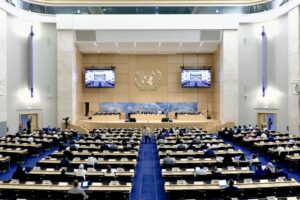
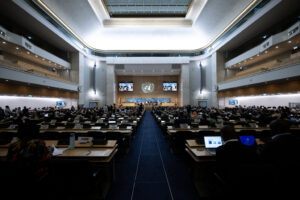
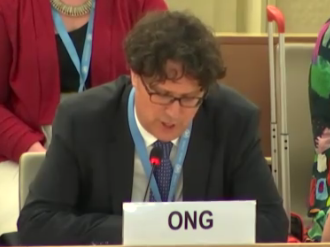
Speaking at the UN Human Rights Council in a general debate on the oral update of the High Commissioner for Human Rights, the ICJ addressed issues around “foreign fighters”, criminalisation of solidarity with migrants, and the need for international investigation of violations in the Philippines.
The statement was as follows (check against delivery):
“The International Commission of Jurists (ICJ) thanks the High Commissioner for her oral update.
The ICJ agrees that accountability for crimes under international law committed by foreign fighters is essential; equally, it must be ensured through fair procedures. Where children are concerned, their best interests must be the guiding principle. [To the extent foreign fighters are addressed in relation to counter-terrorism measures, ICJ emphasizes that not only is disregard for human rights in countering terrorism wrong and unlawful in itself, it is also ineffective and indeed itself conducive to terrorism.]
The ICJ is also concerned at the criminalisation of solidarity with migrants in Europe and elsewhere. No one should be penalised for supporting human rights, including those that States fail to uphold. On Thursday, together with the OHCHR and the Geneva Bar Association, ICJ will screen a documentary in Room XIV, the UN Cinema, showing the impact of criminalization of solidarity.
The ICJ supports calls by the High Commissioner and Special Procedures for urgent action by the Human Rights Council on the Philippines. Adoption of a resolution at the current session to establish an independent international investigation is essential.
The huge number of killings in the name of countering drugs is part of a broader pattern of impunity. For instance, at least 39 lawyers have also been killed under the current administration, some of whom were representing victims of human rights violations. A fully independent national commission of inquiry and measures actually to bring perpetrators to justice are also needed to end the pervasive culture of impunity.”
Jun 24, 2019 | Advocacy, Non-legal submissions
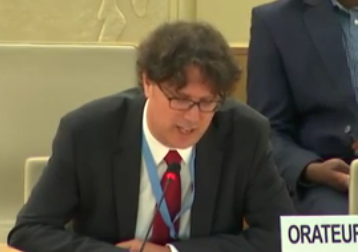
At the UN, the ICJ today highlighted the rights and duties of judges and prosecutors to exercise their freedoms of expression, assembly and association to defend the rule of law and human rights.
The oral statement was delivered in a Clustered Interactive Dialogue with the Independent Expert on Sexual Orientation and Gender Identity and the Special Rapporteur on the Independence of Judges and Lawyers, at the UN Human Rights Council in Geneva.
It read as follows:
“The International Commission of Jurists (ICJ) welcomes the report of the Special Rapporteur on the Independence of Judges and Lawyers on freedom of expression, association and peaceful assembly of judges and prosecutors.[1]
As the report acknowledges, exercise of these rights can be subject to restrictions arising from the fundamental need for judges and prosecutors to be perceived as independent and impartial. At the same time, as the report also emphasizes, any such restrictions must be provided by law and be demonstrably necessary to such legitimate aims, which in turn crucially requires proportionality.[2] These standards have been recognized both globally and in all regions of the world.[3] Any such restrictions on judges should be adopted and enforced by the judiciary itself.
We particularly welcome the recognition in the report that in situations where democracy and the rule of law are under threat, judges and prosecutors have not only the right, but potentially a duty, to speak out and organize in defence of democracy, the rule of law, and human rights, and that this can include participating in peaceful public demonstrations.[4]
Far too often in the ICJ’s work around the world, we see Executive and Legislative bodies, as well as compromised judicial hierarchies, arbitrarily or selectively targeting judges and prosecutors for removal, demotion or other disciplinary measures, precisely for exercising these rights to defend against threats to the rule of law. Examples highlighted in our submission to your study included Egypt, Morocco, Honduras, Hungary and Bulgaria.[5]
Mr. Rapporteur, how can judiciaries, governments, and civil society organisations (including international or regional legal professional associations) act internationally to support judges and prosecutors who are facing such abuse in another country?
The ICJ also welcomes the reports of the Independent Expert on protection against violence and discrimination based on sexual orientation and gender identity. We urge all States to strongly support the renewal of this essential mandate at the current session.
Thank you.”
[1] ICJ’s detailed submission to the Special Rapporteur’s consultation is available at: https://www.icj.org/judgesexpression2019/
[2] Paragraphs 39, 45, 46, 89.
[3] In addition to the global and European, Asian, and American standards cited in the report, see the African Commission on Human and Peoples’ Rights, Principles and Guidelines on the Right to a Fair Trial and Legal Assistance in Africa (2005), paras A(4)(s) and (t), and F(d) and (e).
[4] Paragraphs 61, 69, 90, 102.
[5] See for further information: https://www.icj.org/judgesexpression2019/
Jun 21, 2019 | News, Publications, Reports, Workshop reports
The ICJ has today published a report on indigenous and other traditional or customary justice systems in Asia.
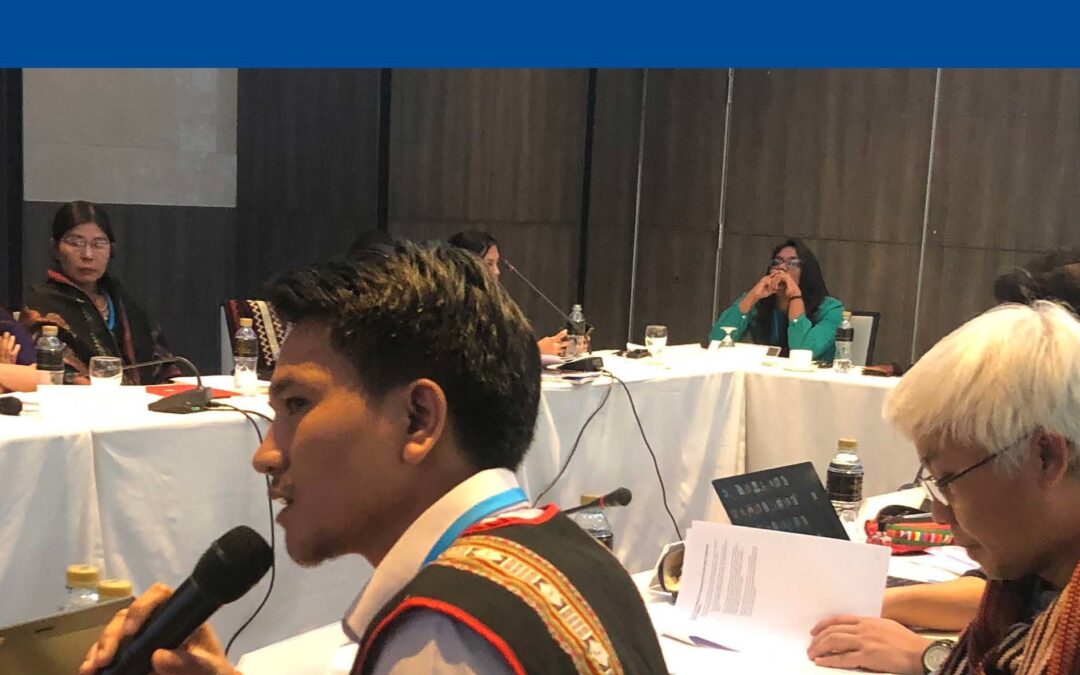
The report is based on discussions at the 2018 Geneva Forum of Judges & Lawyers which was convened in Bangkok, Thailand, in December.
The Bangkok meeting brought together judges, lawyers, and other legal experts from around the Asia-Pacific region, from both formal State justice systems and indigenous and other traditional or customary systems.
Participants reaffirmed the potential for indigenous and other traditional or customary justice mechanisms to contribute to the realization of equal and effective access to justice, particularly for indigenous, rural, poor and other marginalised populations.
Participants stressed the importance of sustained consultations and engagement directly with indigenous justice systems, to encourage their development in harmony with international human rights standards and in coordination with more official or formal national legal institutions.
Participants also highlighted the opportunities and risks associated with similar forms of constructive engagement with other, non-indigenous, traditional or customary justice systems. The relevance of UN Sustainable Development Goal 16 was also highlighted.
Participants further agreed that States must at the same time ensure that formal systems are also made more accessible, both in practical and in cultural terms, to relevant communities.
The report urges that, in line with the UN Declaration on the Rights of Indigenous Peoples, constitutional or other legal provisions should recognize the role of indigenous justice systems, within an overall framework for protection and promotion of international human rights standards.
Indigenous peoples and States should jointly consider means for improved coordination and collaboration between indigenous and non-indigenous justice systems, with a view to seeing the different systems work in harmony to provide effective access to justice and protection of human rights for all people.
The report cautions however, that a similar approach may or may not be appropriate in relation to certain other traditional and customary justice systems not covered by the UN Declaration on Rights of Indigenous Peoples.
The report also outlines experiences from a number of countries around the region, both in terms of existing obstacles to equal access to justice, and the possibilities for constructive engagement.
It also identifies a number of legal and policy questions of continuing controversy, including on the relationship between indigenous and other traditional or customary justice systems, and the official State justice system, and how international human rights and rule of law standards should be applied.
The UN Special Rapporteur on the Rights of Indigenous Peoples, a key participant in the Bangkok meeting, has announced that her report to the Human Rights Council in September 2019 will focus on indigenous justice systems.
The interactive dialogue on her report will be an important opportunity for States and civil society to further exchange views on the best means of implementing the relevant provisions of the UN Declaration on the Rights of Indigenous Peoples in the diversity of contexts around the world.
The Geneva Forum global and regional consultations, the Special Rapporteur’s report and associated dialogue, and the ICJ’s own research, global experience and expertise, will provide a foundation for the development by the ICJ of further legal, policy and practical guidance to be published in 2020.
The report summarizing discussions at the 2018 Forum should be read in conjunction with the separately published and periodically updated Traditional and Customary Justice Systems: Selected International Sources, which compiles relevant treaty provisions, standards, conclusions and recommendations of UN and other expert bodies, as well as the Report of the 2017 Forum.
The Geneva Forum is an annual global meeting of senior judges, lawyers, prosecutors and other legal and United Nations experts, convened by the ICJ through its Geneva-based Centre for the Independence of Judges and Lawyers, with the support of the Canton and Republic of Geneva (Switzerland) and other partners.
Each year, participants and the ICJ discuss an issue relevant to the independence and role of judges, lawyers and prosecutors, with a view to developing and disseminating practical guidance for practitioners.
Contact
matt.pollard(a)icj.org
Universal-Trad Custom Justice GF 2018-Publications-Thematic reports-2019-ENG (full report in PDF)

Jun 1, 2019 | Advocacy
In July 2018, it was published the “zero draft” of a proposed first universal treaty addressing business and human rights. The document was authored by Ecuador’s Ambassador in Geneva acting as chair of the Intergovernmental Working Group (IGWG) in charge of drafting the instrument.
The draft is strongly focused on issues of legal accountability of business enterprises and access to justice and remedy for those who allege harm by a business enterprise. The draft was presented and discussed in “first reading” by States and observers during the fourth session of the IGWG in October 2018.
In this document, the ICJ presents its comments to the zero draft. This commentary is not intended as a comprehensive assessment of the draft, but it rather addresses select provisions of priority concern to the ICJ on first reading. It contains recommendations on the way to strengthen them in accordance with human rights and rule of law principles.
Universal-Comments Draft Treaty BHR-Advocacy-2019-ENG (full text, in PDF)
May 20, 2019 | News
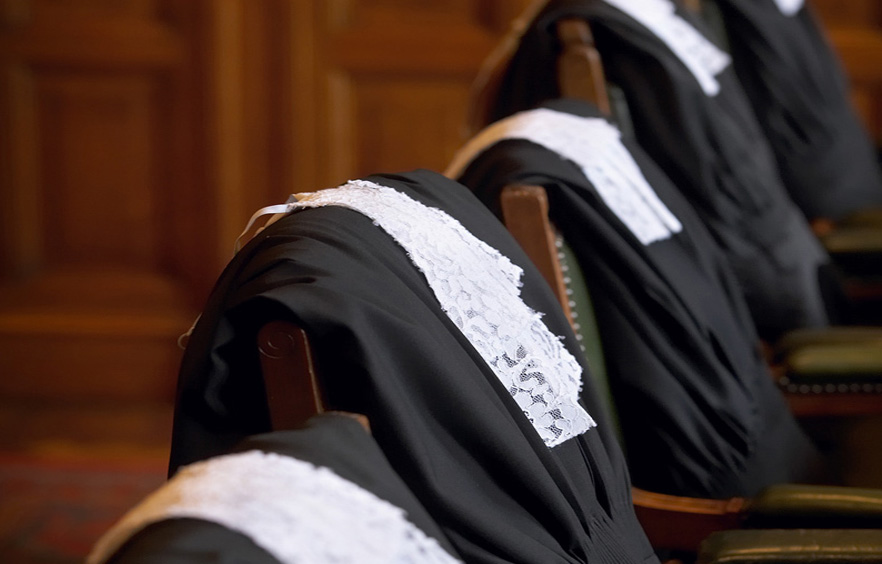
The ICJ, the Geneva Bar Association and the Geneva legal community have joined forces to launch the ICJ-Geneva Lawyers International Cooperation Initiative. Under the Initiative, Geneva lawyers will join ICJ missions on the five continents to support the independence and integrity of lawyers and judges at risk, and to promote the Rule of Law.
The Initiative launches with a mission tomorrow, May 21st. A lawyer from the Geneva Bar Association will go to Guatemala to work the ICJ team and lawyers investigating and fighting the forced displacement of the indigenous community of La Laguna de El Petén.
Missions under the initiative will typically involve, among other things:
– Trial observations;
– Fact-finding missions;
– Support for the independence of lawyers and bar associations;
– Capacity building and training activities;
– Expertise and academic support.
Since its founding in 1952, the ICJ has played a unique and preeminent role as a non-governmental organization for the defense of the Rule of Law around the world, and the independence of judges and lawyers.
With the presence of its headquarters in Geneva for more than 60 years, through the Initiative the ICJ is further deepening its special bond with the city, to spread and share the spirit of Geneva.
“International support and solidarity are crucial to the work of lawyers defending the human rights of those who are often marginalized from power,” said Michaël Sombart, Director of Strategic Partnerships of the ICJ. “With this project the ICJ can help lawyers around the world benefit from the reputation and high standing of the Swiss legal community and bring the message of the Genève humanitaire beyond borders.”
“This initiative is welcome and we support it with commitment,” said Sandrine Giroud, member of the Geneva Bar Council and Chair of its Human Rights Commission. “The Rule of Law is under attack around the world and lawyers play a vital role in its defense and the impartiality of justice. Our support for the ICJ-Geneva Lawyers International Cooperation Initiative is in line with the lawyer’s mission as a bulwark against the arbitrariness and the defense advocacy tradition of the Geneva Bar Association. We welcome this collaboration, which is part of the fight for justice and respect for fundamental rights and guarantees. ”
Nicolas Gürtner, First Secretary of the Young Bar Association of the Geneva Bar Association, said: “This project offers a remarkable opportunity for young lawyers to work alongside the jurists of international repute of the ICJ in favour of the guarantee of Rule of Law.”
The Steering Committee for the Initiative includes:
– The ICJ;
– For the Geneva Bar Association: the Commission on Human Rights and the Young Bar Association;
– Representatives of the Geneva judicial and academic world, including Professor Robert Roth, former President of the Court of Cassation, former director of the Geneva Academy, Professor Emeritus of the University of Geneva
Contact :
Michaël W. Sombart, ICJ, Director of Strategic Partnerships, t: +41 22 979 38 31 ; m: +41 77 965 98 45 ; e: michael.sombart(a)icj.org