Sep 28, 2018 | Advocacy, Non-legal submissions
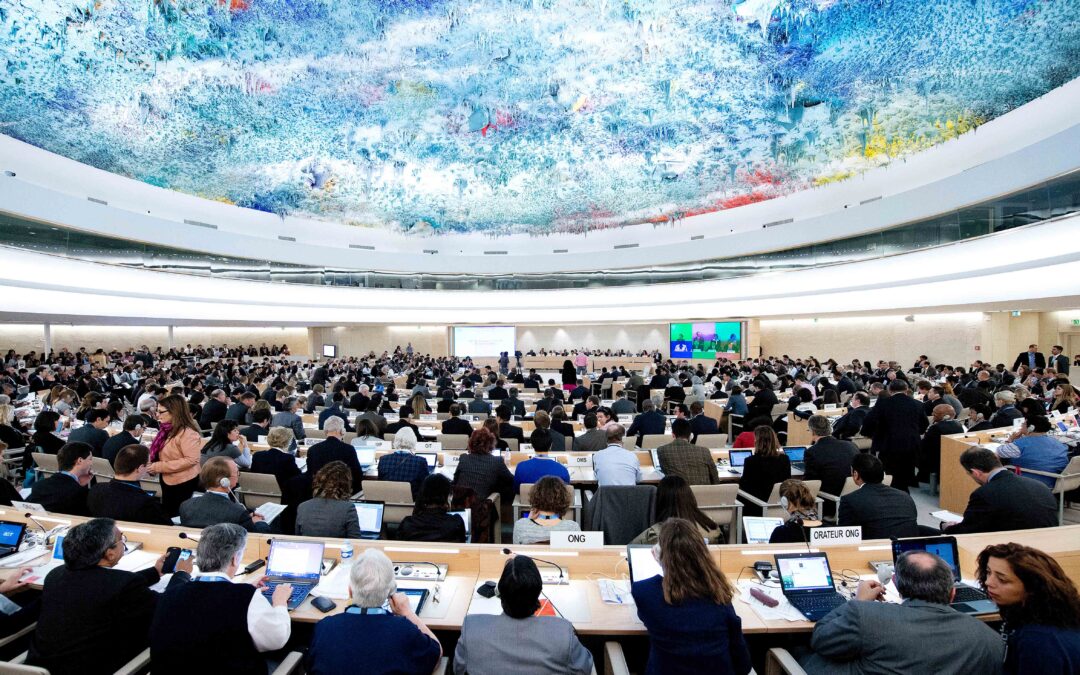
The ICJ joined other civil society organisations in addressing the UN Human Rights Council, on the successes and failures of its 39th session, concluding today.
The statement, read by International Service for Human Rights (ISHR), was as follows:
“This session, the Council adopted landmark resolutions on several country situations, further enhancing its contribution to the protection of human rights.
On Myanmar, we welcome the creation of the independent investigative mechanism, which is an important step towards accountability for the horrific crimes committed in Myanmar, as elaborated in the FFM’s report to this session. The overwhelming support for the resolution, notwithstanding China’s shameful blocking of consensus, was a clear message to victims and survivors that the international community stands with them in their fight for justice.
On Yemen, the Council demonstrated that principled action is possible, and has sent a strong message to victims of human rights violations in Yemen that accountability is a priority for the international community, by voting in favour of renewing the mandate of the Group of Eminent Experts to continue international investigations into violations committed by all parties to the conflict.
Furthermore, we welcome the leadership by a group of States on the landmark resolution on Venezuela, and consider it as an important step for the Council applying objective criteria to address country situations that warrant its attention. The resolution, adopted with support from all UN regions, sends a strong message of support to the Venezuelan people. By opening up a space for dialogue at the Council, the resolution brings scrutiny to the tragic human rights and humanitarian crisis unfolding in the country.
While we welcome the renewal of the mandate of the Commission of Inquiry (CoI) on Burundi, to continue its critical investigation and work towards accountability, however we regret that the Council failed to respond more strongly to Burundi’s record of non-cooperation and attacks against the UN human rights system.
We also welcome the Council’s adoption of the resolution on Syria, which among other things condemns all violations and abuses of international human rights law and all violations of international humanitarian law committed by all parties to the conflict.
However, on other country situations including China, Sudan, Cambodia and the Philippines, the Council failed to take appropriate action.
On Sudan, we are deeply concerned about the weak resolution that envisions an end to the Independent Expert’s mandate once an OHCHR office is set up; a “deal” Sudan has already indicated it does not feel bound by, and which is an abdication of the Council’s responsibility to human rights victims in Sudan while grave violations are ongoing. At a minimum, States should ensure the planned country office monitors and publicly reports on the human rights situation across Sudan, and that the High Commissioner is mandated to report to the Council on the Office’s findings.
We also regret the lack of concerted Council action on the Philippines, in spite of the need to establish independent international and national investigations into extrajudicial killings in the government’s ‘war on drugs’, and to monitor and respond to the government’s moves toward authoritarianism.
In addition, we regret the Council’s weak response to the deepening human rights and the rule of law crisis in Cambodia, failing to change its approach even when faced with clear findings by the Special Rapporteur demonstrating that the exclusive focus on technical assistance and capacity building in the country is failing.
We share the concerns that many raised during the session, including the High Commissioner, about China’s own human rights record, specifically noting serious violations of the rights of Uyghurs and other predominantly Muslim minorities in Xinjiang province. It is regrettable that States did not make a concrete and collective call for action by China to cease the internment of estimates ranging up to 1 million individuals from these communities.
On thematic resolutions, we welcome the adoption of the resolution on equal participation in political and public affairs but would have preferred a stronger endorsement and implementation of the Guidelines.
The resolution on safety of journalists, adopted by consensus, sets out a clear roadmap of practical actions to end impunity for attacks. Journalism is not a crime – yet too many States in this room simply imprison those that criticize them. This must end, starting with the implementation of this resolution.
We welcome the adoption by consensus of the resolution on preventable maternal mortality and morbidity and human rights in humanitarian settings. Women and girls affected by conflict have been denied accountability for too long. The implementation of this resolution will ensure that their rights, including their sexual and reproductive health and rights, are respected, protected and fulfilled.
Finally, the Council’s first interactive dialogue on reprisals was an important step to ensure accountability for this shameful practice, and we urge more States to have the courage and conviction to stand up for defenders and call out countries that attack and intimidate them.”
Signatories:
- The African Centre for Democracy and Human Rights Studies (ACDHRS)
- Amnesty International
- Article 19
- Center for Reproductive Rights
- CIVICUS
- DefendDefenders
- FIDH
- Forum Asia
- Human Rights House Foundation (HRHF)
- Human Rights Watch
- International Commission of Jurists
- International Service for Human Rights (ISHR)
Sep 18, 2018 | Events, Multimedia items, News, Video clips
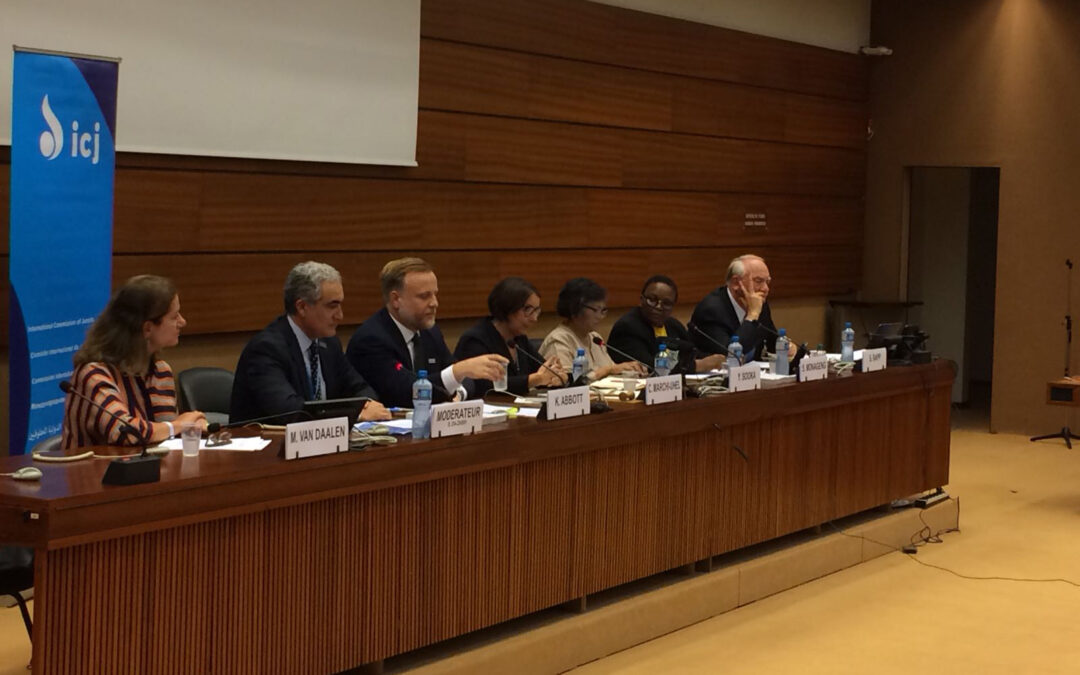
The ICJ organized this side event today (Tuesday 18 September 2018), in cooperation with the Permanent Mission of the Netherlands, at the Human Rights Council.
https://www.facebook.com/ridhglobal/videos/1005764152964172/
Background
Particularly when crimes under international law are perpetrated on a large scale in situations of crisis, there is an urgent need to preserve evidence for use in eventual criminal proceedings, whether at the International Criminal Court or other national or international tribunals
Too frequently, obstacles prevent immediate direct recourse to international courts and prosecutors. One response has been the creation of mechanisms to collect and preserve the evidence in the meantime. Examples include the International Independent and Impartial Mechanism (IIIM) for Syria, and the Commission on Human Rights in South Sudan.
At the current session of the Human Rights Council, the Fact-Finding Mission on Myanmar has called for establishment of an IIIM pending referral to the ICC or an ad hoc tribunal.
Opening Remarks:
Ambassador Monique T.G. van Daalen, Permanent Mission of the Netherlands
Moderator:
Saman Zia-Zarifi, Secretary General, International Commission of Jurists
Panelists:
- Catherine Marchi-Uhel, Head, International, Impartial and Independent Mechanism (IIIM) for Syria
- Yasmin Sooka, Chairperson, Commission on Human Rights in South Sudan
- Sanji Monageng, former Judge/Vice-President of the ICC, and Commissioner of the ICJ
- Stephen Rapp, Chair, Commission for International Justice & Accountability (CIJA), Distinguished Fellow, US Holocaust Memorial Museum, and former United States Ambassador-at-Large for Global Criminal Justice
- Kingsley Abbott, ICJ Senior Legal Adviser (Global Accountability), formerly with the Extraordinary Chambers in the Courts of Cambodia and the Special Tribunal for Lebanon
Universal-ICJ-NL-Side event-News-events-2018-ENG (flyer of the event in PDF)
Sep 17, 2018 | Events, Multimedia items, News, Video clips
This panel discussion was held today at the Palais des Nations in Geneva.
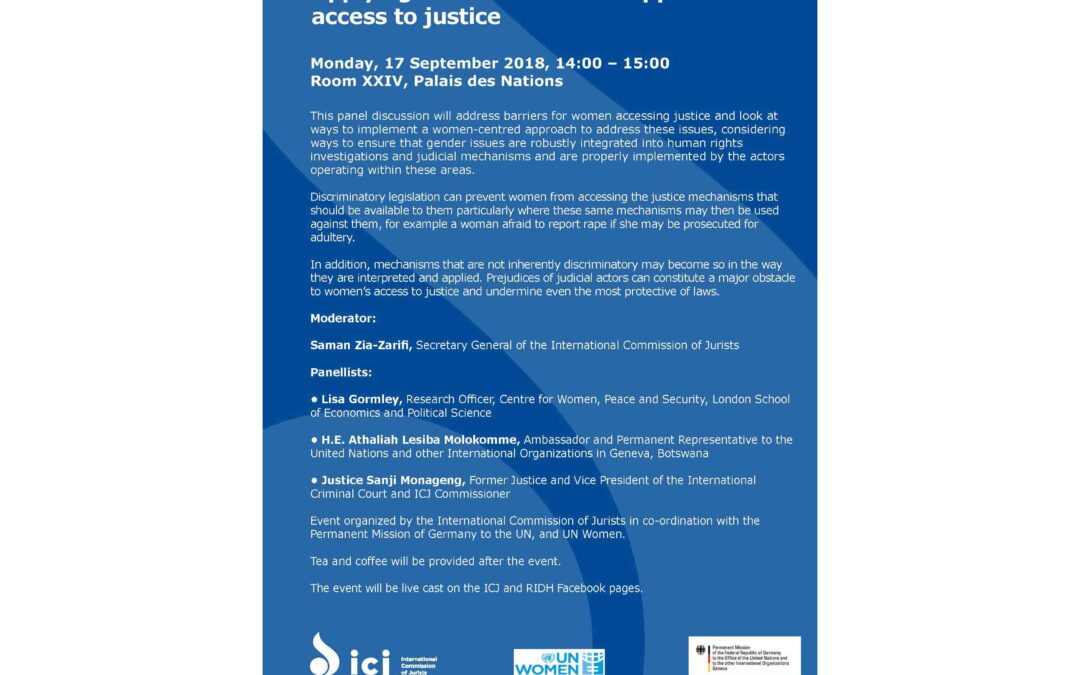
The event addressed barriers for women accessing justice and look at ways to implement a women-centred approach to address these issues, considering ways to ensure that gender issues are robustly integrated into human rights investigations and judicial mechanisms and are properly implemented by the actors operating within these areas.
Discriminatory legislation can prevent women from accessing the justice mechanisms that should be available to them particularly where these same mechanisms may then be used against them, for example a woman afraid to report rape if she may be prosecuted for adultery.
In addition, mechanisms that are not inherently discriminatory may become so in the way they are interpreted and applied. Prejudices of judicial actors can constitute a major obstacle to women’s access to justice and undermine even the most protective of laws.
Moderator:
Saman Zia-Zarifi, Secretary General of the International Commission of Jurists
Panellists:
• Lisa Gormley, Research Officer, Centre for Women, Peace and Security, London School of Economics and Political Science
• H.E. Athaliah Lesiba Molokomme, Ambassador and Permanent Representative to the United Nations and other International Organizations in Geneva, Botswana
• Justice Sanji Monageng, Former Justice and Vice President of the International Criminal Court and ICJ Commissioner
Event organized by the ICJ in co-ordination with the Permanent Mission of Germany to the UN, and UN Women.
Watch the video:
https://www.facebook.com/ridhglobal/videos/565112000574216/
Side event ICJ WHR (flyer in PDF)
Sep 11, 2018 | Events, News
The ICJ will organize this side event, in cooperation with the Permanent Mission of the Netherlands, at the Human Rights Council on Tuesday 18 September 2018 from 15:30 – 16.30 in Room XXII of the Palais des Nations.
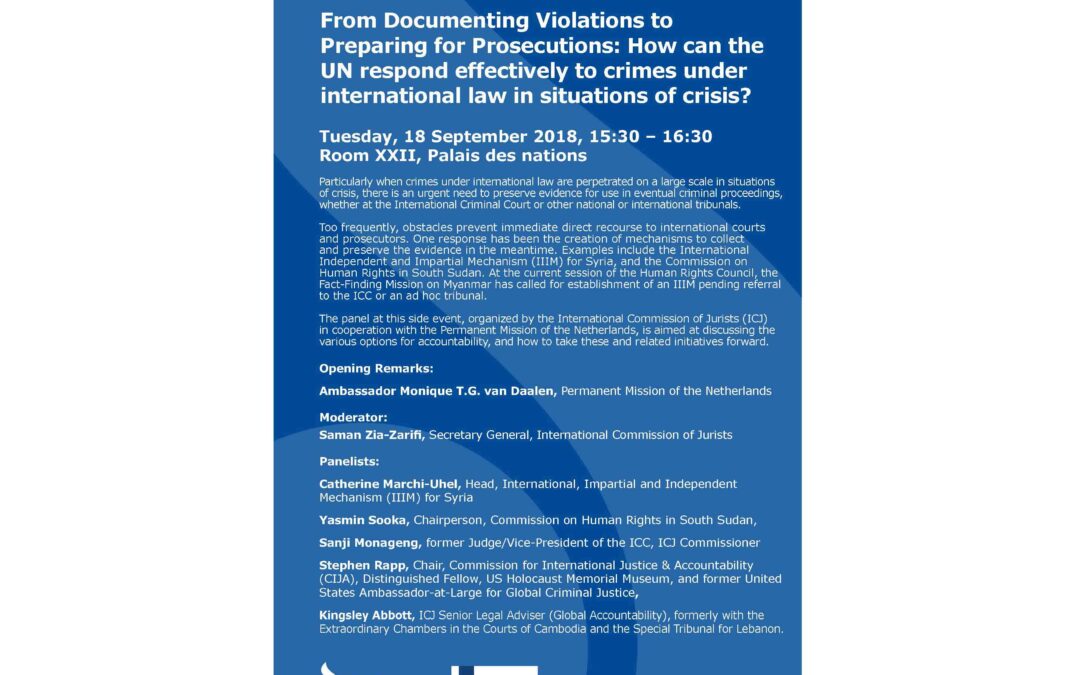
Particularly when crimes under international law are perpetrated on a large scale in situations of crisis, there is an urgent need to preserve evidence for use in eventual criminal proceedings, whether at the International Criminal Court or other national or international tribunals
Too frequently, obstacles prevent immediate direct recourse to international courts and prosecutors. One response has been the creation of mechanisms to collect and preserve the evidence in the meantime. Examples include the International Independent and Impartial Mechanism (IIIM) for Syria, and the Commission on Human Rights in South Sudan.
At the current session of the Human Rights Council, the Fact-Finding Mission on Myanmar has called for establishment of an IIIM pending referral to the ICC or an ad hoc tribunal.
The various options for accountability, and how to take these and related initiatives forward will be discussed.
Opening Remarks:
Ambassador Monique T.G. van Daalen, Permanent Mission of the Netherlands
Moderator:
Saman Zia-Zarifi, Secretary General, International Commission of Jurists
Panelists:
- Catherine Marchi-Uhel, Head, International, Impartial and Independent Mechanism (IIIM) for Syria
- Yasmin Sooka, Chairperson, Commission on Human Rights in South Sudan
- Sanji Monageng, former Judge/Vice-President of the ICC, and Commissioner of the ICJ
- Stephen Rapp, Chair, Commission for International Justice & Accountability (CIJA), Distinguished
Fellow, US Holocaust Memorial Museum, and former United States Ambassador-at-Large for Global Criminal Justice
- Kingsley Abbott, ICJ Senior Legal Adviser (Global Accountability), formerly with the Extraordinary Chambers in the Courts of Cambodia and the Special Tribunal for Lebanon
Universal-ICJ-NL-Side event-News-events-2018-ENG (flyer of the event in PDF)
Sep 11, 2018 | Advocacy, Non-legal submissions
The ICJ today addressed the new UN High Commissioner for Human Rights, Michelle Bachelet, highlighting the role of her office in countering global threats to the rule of law and human rights.
The statement was made at the UN Human Rights Council, during general debate on the High Commissioner’s oral update. It read as follows:
“Madam High Commissioner,
The International Commission of Jurists (ICJ) warmly welcomes you to your new mandate – a mandate that the ICJ has, since 1964, fought to create and support.
A multitude of issues and situations urgently call for your attention. However, a dark cloud looms over them all, and casts its shadow across the globe, including in this chamber. From different directions, various political actors driven by authoritarian ideologies and impulses, thirst for power and fraudulent populisms, grow in strength and are joining forces to mount a concerted attack on the rule of law.
They openly scorn the stated aims of the UN Charter, including “faith in fundamental human rights” and the maintenance of “justice and respect for … international law.” They seek to undermine, defame, and destroy global, regional and national institutions built over decades as bulwarks to protect human rights and human dignity. They thrive on silence or passivity by global leaders and populations, as they assault independent judiciaries, media, and civil society.
Madam High Commissioner, you can make a unique impact by speaking forcefully and publicly in defense of human rights and the rule of law, in defense of victims, and against governments and individuals who demonstrate their hostility or indifference to these aims. The ICJ stands ready to support you and your office in the challenges that lie ahead.
Thank you.”