Large movements of refugees & migrants – role of judges & lawyers
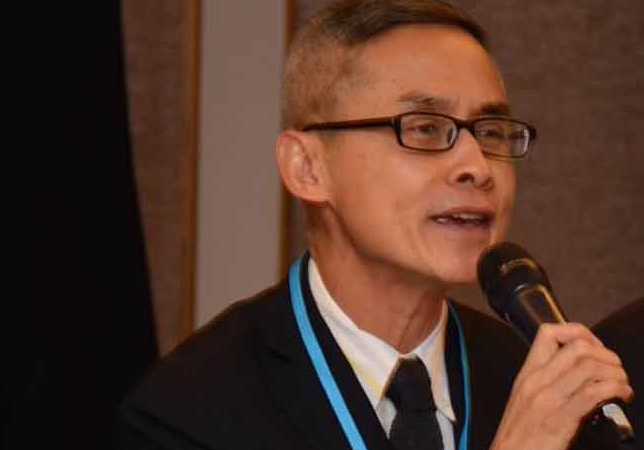
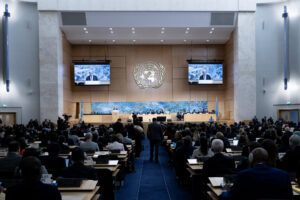
The 7th annual Geneva Forum of Judges & Lawyers, 17-18 November 2016, brought together judges, lawyers, and refugee and migration experts from around the world, as well as UN agencies to discuss the role of judges and lawyers in situations of large-scale movement of refugees and migrants.
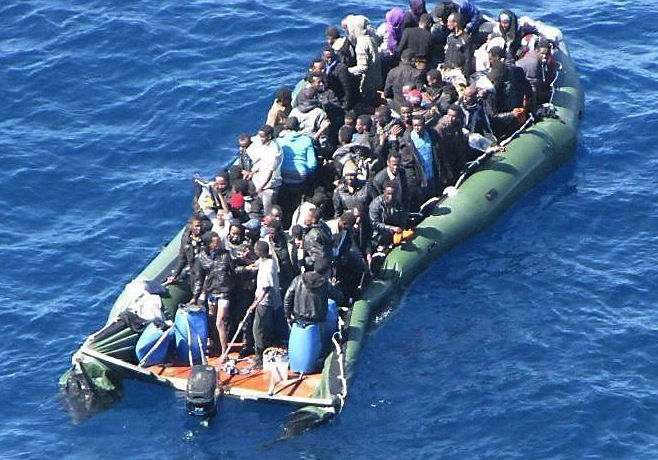
Participants reflected on practical, policy, and legal challenges posed by contemporary movements of refugees and migrants, perceived as exceptional in terms of their scale and speed. Particular situations to be considered include those in Europe (with people coming primarily from and through North Africa and the Middle East, including from Syria, Eritrea, Iraq and Afghanistan); in the Americas (including people coming to the United States of America from Central and South America); in Asia (including in relation to the Rohingya across Southeast Asia, and in relation to practices involving Australia and the Pacific); and within and from parts of Sub-Saharan Africa.
In most of these situations, the legal protections available and the respective roles of the executive, legislative and judicial branches of government in securing these protections has been a matter of debate.
Authorities world-wide have faced the challenge of ensuring that in all circumstances people have access to fair and effective procedures in relation to key decisions about their rights and interests, such as: determinations of a person’s entitlement to international protection, including determinations as to refugee status; decisions about detention or criminal proceedings based on one’s entry or presence in the country; and decisions about expulsion or onward transfer.
In some cases governments have departed radically from ordinary procedures. The framework of “crisis” or “emergency” has been increasingly invoked, sometimes to reduce judicial protections and guarantees and access to justice.
Forum participants were invited to analyze relevant legal and policy frameworks and practices at the national, regional and universal levels, and to make recommendations about the particular role of judges and lawyers in such situations, including relative to the executive and legislative branches of government.
During the Forum, the forty distinguished judges and lawyers from around the world reaffirmed the essential role of judges and lawyers in securing the rule of law and human rights in relation to large movements of refugees and migrants.
The Forum concluded with substantial agreement and reaffirmation of the essential role that judges and lawyers must be enabled to play, and must fulfil in practice, if the rights of refugees and migrants and the rule of law are to be secured, including in the context of large movements.
Participants exchanged challenges and solutions, and deliberated on a wide range of issues, including:
- on methods for best assessing evidence and credibility;
- on means for overcoming the legal, policy, and practical challenges when judges and lawyers face large numbers of claims and cases;
- on reforms to better enable immigration judges to meet basic standards of independence and impartiality;
- on the need for judiciaries and legal professions to ensure practitioners receive appropriate training and better access to information about international standards and reliable information about country situations;
- on the importance of effective access to competent legal advice and representation, including free of charge when necessary, for refugees and migrants to be able to exercise their rights and for judges to be able to decide cases in an efficient and just manner;
- on ways of supporting judges who courageously exercise their independence to uphold the rule of law and human rights, including in the face of interference or reprisal from the executive or legislative branches of government, or intense media criticism or majoritarian pressure;
- on ensuring that refugees and migrants who are victims of crime or victims of human rights violations are able to have effective access to justice and effective remedy, without discrimination arising from their status;
- on the importance of ensuring that legal processes are sensitive to the particular situation of women and children migrants, and migrants in detention.
The main output of the Forum, published in May 2017, is the ICJ Principles on the role of judges and lawyers in relation to refugees and migrants.
The Principles complement ICJ’s 2011 (updated 2014) Practitioners’ Guide No 6 on Migration and International Human Rights Law, and Practitioners Guide No 11 on Refugee Status Claims Based on Sexual Orientation and Gender Identity (2016).
The 2016 Geneva Forum of Judges & Lawyers was made possible with the support of the Republic and Canton of Geneva, Switzerland.
The ICJ is also grateful to the Swiss Confederation, and the Centre d’Accueil Genève Internationale (CAGI), for their in-kind support.
The Programme for the 2016 Forum can be downloaded in PDF format here:
en-programme-2016gf-09-11-2016
esp-programme-2016gf-09-11-2016
The List of Participants can be downloaded in PDF format here: participants-2016gf-09-11-2016
Information about the Geneva Forum from past years is available by clicking here.
The final output of the 2015 Geneva Forum was the publication of ICJ Practitioners Guide No. 13, on Judicial Accountability, available in PDF format by clicking here.
For further details, please contact Matt Pollard, senior legal adviser, matt.pollard(a)icj.org
Voices from the Geneva Forum 2016: Sanji Monageng
Voices from the Geneva Forum 2016: Guy Goodwin-Gill
Voices from the Geneva Forum 2016: Maya Sahli-Fahdel (in French)
Voices from the Geneva Forum 2016: Mónica Oehler Toca (in Spanish)
Information about related ICJ work on refugees and migrants can be accessed by clicking the links below:
ICJ and others call on the EU to protect refugee and migrant children’s rights (November 2016)