Jun 3, 2020 | Advocacy, Cases, Legal submissions
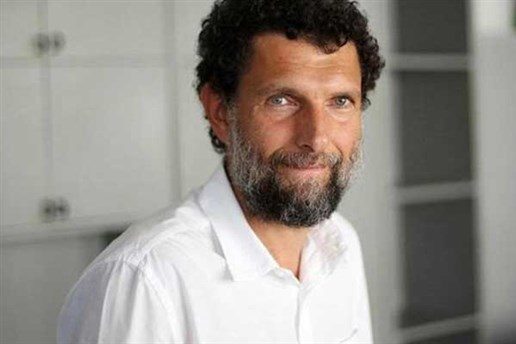
The Council of Europe Committee of Ministers should issue a decision at its 4 June 2020 meeting directing Turkey to release the human rights defender Osman Kavala and drop all charges against him, the ICJ, Human Rights Watch and the Turkish Human Rights Litigation Support Project said today.
The three groups have submitted a detailed submission to the Committee of Ministers of the Council of Europe, which oversees enforcement of European Court of Human Rights judgments. The groups outlined how Turkey continues to violate Kavala’s rights by flouting a landmark judgment, that became final on May 11 requiring his immediate release.
“The European Court ruled that Kavala’s detention is unlawful, and their binding judgment requires Turkey to release him immediately,” said Emma Sinclair-Webb, Turkey director at Human Rights Watch. “The Committee of Ministers, at its June 4 meeting, should press Turkey to comply and issue a clear message that no Council of Europe member state should be silencing human rights defenders.”
The judgment is particularly significant because it is the first final ruling against Turkey in which the court determined that in interfering with an individual’s rights Turkey acted in bad faith and out of political motivations, violating Article 18 of the European Convention on Human Rights. The court said that by detaining Kavala since November 2017 and prosecuting him, the Turkish authorities had “pursued an ulterior purpose, namely to silence him as human rights defender.”
The European Court judgment in Kavala v. Turkey (Application no. 28749/18) found violations of Article 5(1) (right to liberty and security), Article 5(4) (right to a speedy decision on the lawfulness of detention), and the rarely used Article 18 (limitation on use of restrictions on rights) taken together with Article 5(1). It required Turkey to release Kavala and said that any continuation of his detention would prolong the violations and breach the obligation to abide by the judgment in accordance with Article 46(1) of the European Convention on Human Rights..
A court ordered Kavala’s detention on November 1, 2017 on bogus allegations that he used the 2013 Istanbul Gezi Park protests as a pretext for an attempted coup, and that he was involved in the July 15, 2016 attempted military coup. On February 18, 2020, Kavala and his eight co-defendants were acquitted on charges of “attempting to overthrow the government by force and violence” in the Gezi Park trial .
But Kavala was not released, and a court detained him again immediately on the charge of “attempting to overthrow the constitution by force and violence” because of an ongoing 2016 coup-related investigation against him. Turkey’s President Recep Tayyip Erdoğan had publicly criticized his acquittal just before he was detained again. Weeks later a court ordered his detention a second time on another charge (“espionage”) but relying on the same evidence and investigation file.
“The sequence of court orders prolonging his detention and the lack of objective deliberation as to the lawfulness of any deprivation of liberty indicates that decisions have been guided by political considerations and there has been a concerted official effort to prevent Kavala’s release,” said Róisín Pillay, Director of ICJ’s Europe and Central Asia Programme . “Since the European Court’s judgment, Turkey has continued to violate Kavala’s human rights.”
The targeted harassment in Turkey of rights defenders is part of a wider trend of arbitrary detentions and abusive prosecutions of journalists, elected politicians, lawyers, and other perceived government critics. This trend has been well-documented in many reports by the Council of Europe, the European Union, and human rights organizations.
“The campaign of persecution against Osman Kavala and the failure to release him and drop all charges have perpetuated a chilling environment for all human rights defenders in Turkey,” said Ayşe Bingöl Demir, Co-Director of the Turkish Human Rights Litigation Support Project.
The three organizations made detailed recommendations to the Committee of Ministers, urging it to:
- Call on the government of Turkey to ensure the immediate release of Osman Kavala as required by the European Court’s judgment, stressing that the judgment clearly applies to his ongoing detention and persecution;
- Place the Kavala v. Turkey judgment under “enhanced procedures” and treat it as a leading case under Article 18 of the European Convention;
- Recognize that Kavala’s continuing detention violates Article 46 of the convention, concerning the binding nature of final judgments of the European Court, and that a failure to release Kavala may trigger an Article 46(4) procedure (infringement proceedings);
- Emphasize to the Government of Turkey that Kavala’s release is of added urgency in the context of the Covid-19 pandemic, which increases the risk to his health in detention;
- Ask the Government of Turkey to drop all charges under which Kavala has been investigated and detained to silence him, in conformity with the court’s findings that his rights have been violated and that his exercise of rights to freedom of expression, assembly and association was wrongfully used as evidence to incriminate him.
The groups also identified the general measures that Turkey needs to take to carry out the judgment to end politically motivated detention and prosecution of human rights defenders and other perceived government critics. These measures focus on Turkey’s structural rule of law problems. They include executive control over Turkey’s judiciary and prosecutorial authorities, and the evidence of a clear pattern of direct political interference in court decisions through frequent public speeches by Turkey’s president and proxies. A pattern of criminalizing the exercise of convention-protected rights defines many of the cases against human rights defenders and other perceived government critics.
Turkey’s international partners, including the European Union, should make it clear that the full implementation of the court’s judgment in Osman Kavala’s case will be key in measuring the credibility of any government pledges for reform, the three groups said. Any justice reform and any human rights action plan would remain hollow until the reasons that unjustly led Kavala to prison are addressed and fixed.
Kavala_v_Turkey-Execution-JointSubmissionR9_2-ICJHRWTLP-LegalSubmission-2020-eng (downaload the submission)
Kavala_v_Turkey-Execution-JointSubmissionR9_2-ICJHRWTLP-LegalSubmission-2020-tur (download the submission in Turkish)
Türkiye: AİHM Kararı Sonrası Hak Savunucusu Serbest Bırakılsın
Avrupa Konseyi Bakanları Osman Kavala’nın tahliyesinde ısrar etmelidir
(Strazburg, 3 Haziran 2020) – İnsan Hakları İzleme Örgütü, Uluslararası Hukukçular Komisyonu ve Türkiye İnsan Hakları Davalarına Destek Projesi, Avrupa Konseyi Bakanlar Komitesinin 4 Haziran 2020 tarihli toplantısında Türkiye’yi insan hakları savunucusu Osman Kavala’nın serbest bırakılmasına ve ona yönelik tüm suçlamaların düşürülmesine yöneltecek bir karar alması gerektiğini belirttiler.
Bu üç grup, Avrupa İnsan Hakları Mahkemesi kararlarının uygulanmasını denetleyen Avrupa Konseyi Bakanlar Komitesi’ne detaylı bir bildirim sundu. Gruplar, Türkiye’nin 11 Mayıs’ta kesinleşen ve Kavala’nın derhal tahliye edilmesini gerektiren bu önemli kararı göz ardı ederek, Kavala’nın haklarını ihlal etmeye devam ettiğini belirtti.
İnsan Hakları İzleme Örgütü Türkiye Direktörü Emma Sinclair-Webb, “Avrupa Mahkemesi, Kavala’nın alıkonmasının hukuka aykırı olduğuna ve bağlayıcı kararının gereği olarak Türkiye’nin Kavala’yı derhal tahliye etmesi gerektiğine karar verdi” dedi. Emma Sinclair-Webb, “Bakanlar Komitesi, 4 Haziran toplantısında, hiçbir Avrupa Konseyi üyesi devletin insan hakları savunucularını susturmaması gerektiğine dair net bir mesaj vererek buna uyması için Türkiye’ye baskı yapmalıdır” dedi.
Bu karar, Türkiye’nin kötü niyetle ve siyasi amaçlarla bir bireyin haklarına müdahale ettiğini ve Avrupa İnsan Hakları Sözleşmesi’nin 18. maddesini ihlal ettiğini tespit eden Türkiye aleyhindeki ilk nihai karar olduğundan özel bir önem taşımakta. AİHM, Osman Kavala’yı Kasım 2017’den bu yana alıkoyup yargılayan Türk makamlarının “başvuranın bir insan hakları savunucusu olarak susturulmasını sağlamak için örtülü bir amaç taşıdığını” tespit etmişti.
Avrupa Mahkemesi, Kavala/Türkiye kararında (Başvuru no. 28749/18), madde 5/1 (özgürlük ve güvenlik hakkı), madde 5/4 (alıkonmanın yasaya uygunluğuna ilişkin ivedi karar alma hakkı) ve nadiren kullanılan madde 18 (haklara getirilecek kısıtlamaların sınırlanması) ile birlikte madde 5/1’in ihlal edildiğine karar vermiştir. Karar, Türkiye’nin Kavala’yı tahliye etmesini zorunlu kılmış, tutukluluğunun devam etmesinin ihlalleri devam ettireceğini ve Sözleşmenin 46(1) maddesi uyarınca AİHM kararlarına uyma yükümlülüğünü ihlal edeceğini belirtmiştir.
Bir hakimlik 2013 İstanbul Gezi Parkı protestolarını darbe girişimine bahane olarak kullandığı ve 15 Temmuz 2016 askeri darbe girişimine müdahil olduğu iddiasıyla, Kavala’nın 1 Kasım 2017’de tutuklanmasına karar vermiştir. 18 Şubat 2020’de Kavala ve diğer sekiz sanık, Gezi Parkı davasında “cebir ve şiddet kullanarak hükümeti ortadan kaldırmaya teşebbüs” suçlamasından beraat etmiştir.
Ancak Kavala cezaevinden tahliye edilmemiş ve bir hâkim kararıyla 2016 darbesiyle ilgili devam eden bir soruşturmayla ilişkili olarak “anayasal düzeni cebir, şiddet kullanarak ortadan kaldırmaya teşebbüs” suçlamasıyla tekrar tutuklanmıştır. Tekrar tutuklanmasından kısa bir süre önce Cumhurbaşkanı Recep Tayyip Erdoğan halka açık şekilde Kavala’nın beraatini eleştirmiştir. Kavala haftalar sonra, aynı delillere ve soruşturma dosyasına dayanan bir başka suçlama ile (casusluk) bir kez daha tutuklanmıştır.
Uluslararası Hukukçular Komisyonu Avrupa ve Orta Asya Programı Direktörü, Róisín Pillay, “Tutukluluğun devamına ilişkin yargı kararlarının silsilesi ve tutuklamanın yasallığı konusunda nesnel bir değerlendirmenin olmaması, kararların siyasi beklentiler tarafından yönlendirildiğini ve Kavala’nın tahliyesini önlemek için düzenlenmiş bir siyasi çaba olduğunu göstermektedir.” dedi. Pillay, “Avrupa Mahkemesi’nin kararından bu yana Türkiye, Kavala’nın insan haklarını ihlal etmeye devam etti” tespitinde bulundu.
Türkiye’de insan hakları savunucularına yönelik taciz daha genel olarak gazetecilere, seçilmiş siyasetçilere, hukukçulara, hükümeti eleştirdiği düşünülenlere yönelik keyfi alıkoymalar ve yargısal tacizin bir parçası. Bu eğilim Avrupa Konseyi, Avrupa Birliği ve insan hakları örgütlerine ait birçok raporla belgelendirilmiştir.
Türkiye İnsan Hakları Davalarına Destek Projesi Ortak Direktörü Ayşe Bingöl Demir “Kavala’ya karşı yürütülen yıldırma kampanyası, onun tahliye edilmemesi ve hakkındaki suçlamaların düşürülmemesi, Türkiye’deki tüm insan hakları savunucuları için oluşan baskı ortamının sürmesine sebep olmuştur” dedi.
Üç örgüt, detaylı tavsiyelerde bulunarak Bakanlar Komitesi’ni:
- Avrupa Mahkemesinin kararı gereği Osman Kavala’nın derhal tahliyesinin sağlanması için Türkiye Hükümetine çağrıda bulunmaya, kararın açık şekilde devam eden tutukluluğa ve baskıları da kapsaması gerektiğini vurgulamaya,
- Kavala/Türkiye kararını nitelikli denetim prosedürü altında izlenmek üzere sınıflandırmaya ve Sözleşmenin 18. maddesi altında öncü dava olarak kabul etmeye,
- Kavala’nın devam eden tutukluluğunun kesinleşen AİHM kararlarının bağlayıcılığına ilişkin Sözleşmenin 46. maddesini ihlal ettiği tespit etmeye ve Kavala’nın tahliye edilmemesinin Madde 46/4 prosedürünü (ihlal işlemleri) başlatacağını tespit etmeye,
- Türkiye Hükümetine, Kavala’nın serbest bırakılmasının Covid-19 salgını bağlamında ek bir aciliyete sahip olduğunu ve salgının alıkonma esnasında sağlığına yönelik mevcut tehlikeyi artırdığını vurgulamaya
- Mahkemenin, Kavala’nın haklarının ihlal edildiğine, toplantı, örgütlenme ve ifade özgürlüğünü kullanmasının hatalı şekilde kendisini suçlamak için delil olarak kullanıldığına ilişkin tespitleri doğrultusunda, Türkiye Hükümeti’nden Kavala’nın susturulmak amacıyla soruşturulduğu ve alıkonduğu tüm dosyalarda tüm suçlamaların düşürülmesini talep etmeye davet etmiştir.
Örgütler ayrıca, Türkiye’nin insan hakları savunucularının ve diğer hükümeti eleştirdiği düşünülenlerin siyasi amaçlarla alıkonmalarına ve yargılanmalarına son verilmesine yönelik kararın uygulanması için alınması gereken genel tedbirleri belirlediler. Genel tedbirler, Türkiye’nin hukukun üstünlüğüne ilişkin yapısal sorunlarına odaklanmaktadır. Bu yapısal sorunlar arasında yürütmenin Türkiye’de yürütmenin yargısı ve savcılıkları üzerindeki kontrolü; Cumhurbaşkanı ve ona bağlı diğer yetkililer tarafından, sıklıkla yapılan halka açık konuşmalar aracılığıyla mahkeme kararlarına doğrudan siyasi müdahalede bulunmaya yönelik yaygın eğilime ilişkin açık deliller yer almaktadır. Sözleşme ile korunan hakların kullanılmasının suç haline getirilmesi, insan hakları savunucularına ve hükümeti eleştirdiği düşünülenlere karşı açılan birçok davanın ortak yönünü oluşturmaktadır.
Kavala_v_Turkey-Execution-JointSubmissionR9_2-ICJHRWTLP-LegalSubmission-2020-tur (download the submission in Turkish)
Kavala_v_Turkey-Execution-JointSubmissionR9_2-ICJHRWTLP-LegalSubmission-2020-eng (downaload the submission)
For more information, please contact:
Massimo Frigo (English) massimo.frigo(a)icj.org, +41229793800
May 1, 2020 | Advocacy, News
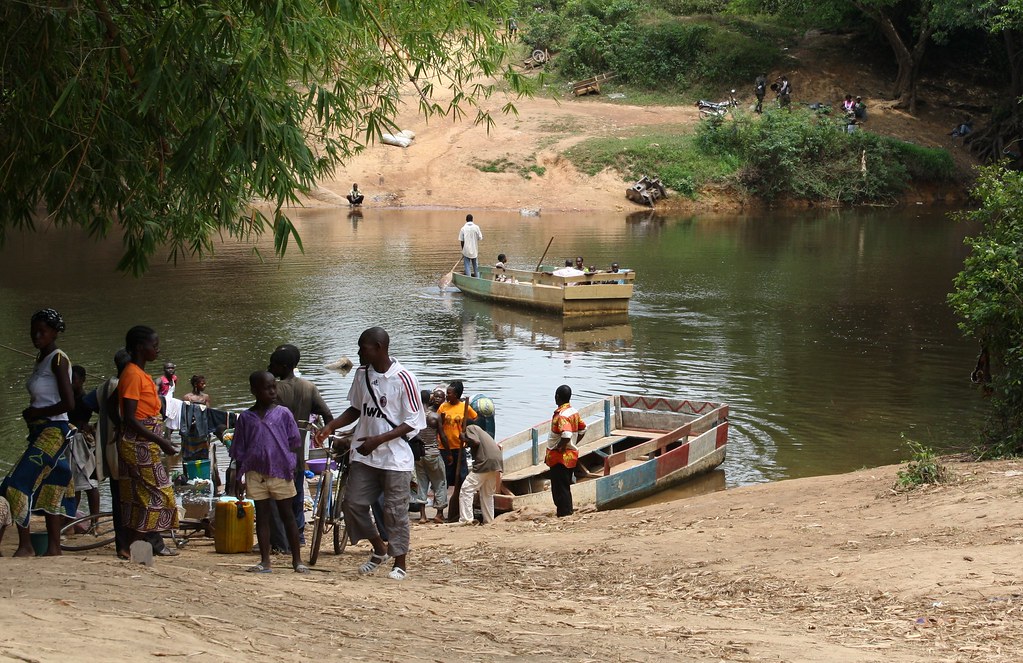
The ICJ today condemned the recent decisions of the governments of the Republic of Benin and Côte d’Ivoire to withdraw their respective declarations that gave individuals and nongovernmental organizations the right to directly bring cases of human rights violations against those States, before the African Court on Human and Peoples Rights.
The ICJ called on the authorities of both States to reconsider and rescind these decisions.
Coming after a similar withdrawal by Tanzania in November 2019, these withdrawal decisions serve to deprive the inhabitants of these countries access to a judicial remedy at the regional level for human rights violations, and undermine the effective of the African regional human rights system.
The ICJ stressed that withdrawal decisions serve to undermine Aspiration 3 of the African Union’s AGENDA 2063, by which the AU aims at “[a]n Africa of good governance, democracy, respect for human rights, justice and the rule of law.”
Both States have offered vague and unsubstantiated rationales for their decisions, but their actions follow their dissatisfaction with the outcomes of particular cases against them. Responses of this kind are effectively an attack on the independence of the Court and can serve to undermine the integrity of the Court itself.
The ICJ recalls that in February 2020, the Executive Council of the African Union called on African States to accede to the Protocol Establishing the African Court and to make the declaration required under article 34(6) of the Protocol. These decisions of the governments of Benin and Côte d’Ivoire to withdraw their article 34(6) declarations fly in the face of this call by the Executive Council of the African Union and greatly threaten the progress that has been made towards protection of human rights in Africa.
Background
Article 34(6) of the Protocol to the African Charter on Human and Peoples’ Rights establishing the African Court on Human and Peoples’ Rights requires that State Parties to the Protocol make a separate declaration in order to allow direct access to individuals and non-governmental organizations to bring cases against them before the African Human Rights Court. Benin which deposited its declaration on 8 February 2016 announced its withdrawal of the declaration on 23 April 2020. Benin claimed that its decision is based ‘dysfunctions and slip-ups’ it has increasingly observed in the work of the African Human Rights Court, allegedly resulting in the Court’s increasing departure from its mandate and core area of competence. Benin cited the earlier withdrawals of Rwanda and Tanzania as further justification for its decision.
Côte d’Ivoire, which deposited its declaration on 23 July 2013 and announced its withdrawal on 29 April 2020, says that its decision was based on what it considers to be ‘the serious and intolerable actions that the African Court has allowed itself’ and which ‘not only undermines the sovereignty of the state of Côte d’Ivoire … but are also likely to cause serious disruption to the internal legal order of states’.
Contact:
Arnold Tsunga, ICJ Africa Director, C: +27716405926, or +254 746 608 859 E: arnold.tsunga@icj.org
Solomon Ebobrah, Senior Legal Advisor, ICJ Africa, C: +234 8034927549; E: Solomon.ebobrah@icj.org
Full text, in PDF: Ivory-Coast-Statement-Advocacy-ENG-2020
Apr 24, 2020 | News
On 24 April 2020, the ICJ, Thai Lawyers for Human Rights (TLHR) and the Cross Cultural Foundation (CrCF) made a joint supplementary submission to the UN Human Rights Committee on Thailand’s implementation of its human rights obligations under the International Covenant on Civil and Political Rights (ICCPR).
In their submission, the ICJ, TLHR and CrCF detailed their concerns in relation to Thailand’s failure to implement the Committee’s recommendations, including the ongoing human rights shortcomings of the country’s Constitutional and legal framework; the continued lack of domestic legislation criminalizing torture, other ill-treatment and enforced disappearance; and reports of torture and other ill-treatment. In addition, the three human rights organizations expressed concern over the use of the Emergency Decree on Public Administration in Emergency Situation to combat the COVID-19 outbreak, and measures imposed under the Decree that may constitute a blanket restriction on fundamental freedoms, including the rights to free expression, opinion, information, privacy and freedom of assembly and association, with no opportunity for the courts to review these extraordinary measures.
The organizations’ submission also describes human rights concerns with respect to the following:
Constitution and legal framework
- Head of the NCPO Order No. 22/2561; and
- Head of the NCPO Order No. 9/2562
Extrajudicial killings, enforced disappearances and torture
- continued lack of domestic legislation criminalizing torture, other ill-treatment and enforced disappearance;
- reports of extrajudicial killings, torture, other ill-treatment, enforced disappearances, and the progress and results of investigations;
- the application of security-related laws; and
- threats and reprisals against persons working to bring to light cases of alleged torture, ill–treatment and enforced disappearance.
Download
Thailand-UN-Human-Rights-Committee-Supplementary Submission-2020-ENG (English, PDF)
Thailand-UN-Human-Rights-Committee-Supplementary Submission-2020-THA (Thai, PDF)
Background
On 23 March 2017, during its 119th Session, the Human Rights Committee adopted its Concluding Observations on the second periodic report of Thailand under article 40 of the ICCPR.
Pursuant to its rules of procedure, the Committee requested Thailand to provide a follow up report on its implementation of the Committee’s prioritized recommendations made in paragraphs 8 (constitution and legal framework) 22 (extrajudicial killings, enforced disappearances and torture) and 34 (conditions of detention), within one year of the adoption of its Concluding Observations – i.e., by 23 March 2018.
On 18 July 2018, Thailand submitted its follow-up report to the Committee. The report was published on 9 August 2018.
On 27 March 2018, the ICJ, TLHR and CrCF made a joint follow-up submission to the UN Human Rights Committee. However, since then, there have been several developments that the three organizations wish to bring to the attention of the Committee through this supplementary submission.
The UN Human Rights Committee will review Thailand’s implementation of the prioritized recommendations during its 129th Session, in June/July 2020.
Further reading
ICJ and TLHR, Joint submission to the UN Human Rights Committee, 13 February 2017
ICJ, TLHR and CrCF, Joint follow-up submission to the UN Human Rights Committee, 27 March 2018
Apr 9, 2020 | Events, News
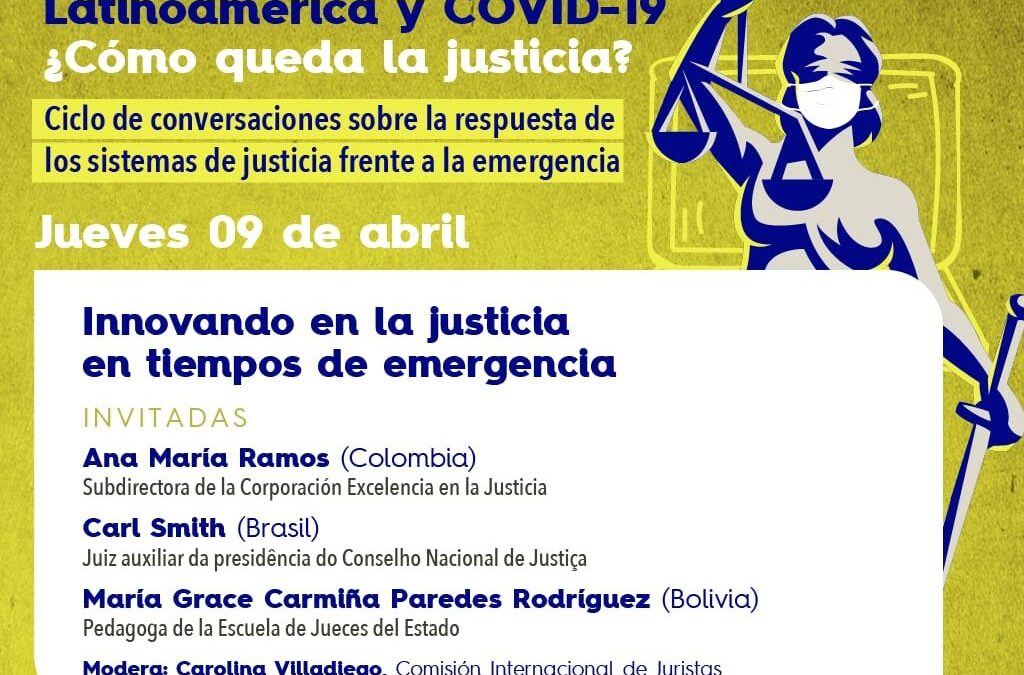
Various States in the Latin American region have adopted exceptional measures to address the pandemic and manage the health crisis. These measures impact peoples’ human rights and freedoms. A series of webinars will cover this topic. The third one takes place today.
Access to justice and the right to an effective remedy are particularly at risk. In that regard, it is worth analyzing: How are justice systems reacting to the pandemic? What is required to continue guaranteeing access to justice, especially for those people and groups most vulnerable? How does this pandemic affect the provision of services in the justice sector? How can justice systems innovate to respond to this situation?
In order to address these questions, the ICJ together with DPLF, Fundación Construir, Fundación Tribuna Constitucional, Observatorio de Derechos y Justicia, and Fundación para la Justicia y el Estado Democrático del Derecho, supports an initiative of webinars led by a group of women human rights defenders in Latin America.
The webinars will be held in Spanish and through the Zoom platform. Registrations for each webinar can be made by sending an email to info@dplf.org Registered persons will receive the zoom link where the activity can be followed.
The first three conversations are as follows:
- Essential justice services in times of emergency: Thursday 02 of April
At: 14.00 México-Central America/ 15 hours Colombia-Perú-Ecuador/ 16.00 Washington-Bolivia/ 17.00 Chile -Argentina/ 22.00 Geneva
- Working from home and being a judge: challenges for women that are judges: Tuesday 07 of April
At 14.00 México-Central America/ 15.00 Colombia-Perú-Ecuador / 16.00 Washington-Bolivia / 17.00 Chile -Argentina/ 22.00 Geneva
- Innovating in the justice system during times of emergency: Thursday 09 of April
At 14.00 México-Central America/15.00 Colombia-Perú-Ecuador/ 16.00 Washington-Bolivia/ 17.00 Chile -Argentina/ 22.00 Geneva
Apr 6, 2020 | Feature articles, Multimedia items, News, Video clips
As of 8:00am CET this morning, the Coronavirus COVID-19 Global Cases tracker by the Center for Systems Science and Engineering at Johns Hopkins University in the US recorded 169,049,480 confirmed cases of individuals who had contracted the COVID-19 disease in 192 countries, and 3,513,137 people who had succumbed to the virus. Read all the ICJ articles on the crisis.
Against this background, the aim of this blog is to highlight the necessity of ensuring the consistency of public health policies taken as part of the global responses to the COVID-19 pandemic with human rights law and standards.
As outlined in a prescient 2019 Lancet Commission report – The legal determinants of health: harnessing the power of law for global health and sustainable development – the law, and a firm commitment to the rule of law, play a critical role in the pursuit of global health with justice.
Ultimately, scientifically sound, evidence-based, human rights compliant, transparent and accountable public health policies and practices will also be more effective, as they will, in turn, elicit greater public support, including by prompting greater adherence to public health policy directives imposing restrictive measures on human rights.
As Michelle Bachelet, the UN High Commissioner for Human Rights recently affirmed, ‘COVID-19 is a test for our societies, and we are all learning and adapting as we respond to the virus. Human dignity and rights need to be front and centre in that effort, not an afterthought’.
China, where cases of COVID-19 were first documented, has been questioned from inside and outside for its response to the crisis, at first attempting to shut down information about the virus, leading to arrests and detentions. Outside China, while some COVID-19 health policies have been evidence-based, such as scaled-up, accurate testing for suspected cases, others are ineffective and overly broad, increasing stigmatization and misinformation.
Around the world, people of Asian descent have been subjected to xenophobia, stigmatization and racist attacks. Moreover, many States have now imposed extensive travel restrictions or even blanket travel bans; some have gone as far as using the COVID-19 pandemic as a pretext to promote their xenophobic and anti-asylum agenda and have now shut down their borders to refugee claimants, thereby flouting the right of anyone to seek asylum from persecution in other countries.
In a frontal attack against women’s human rights, in Texas and Ohio, the authorities have moved to ban healthcare providers from performing abortions in most circumstances – purporting to do so to respond to the global COVID-19 crisis. There is also a world of false information on COVID-19. For instance, Indonesia’s health minister suggested that Islamic prayers shielded people from the virus.
To foster scientifically accurate, human rights compliant global health responses – including to events such as the COVID-19 pandemic – it is crucial to enhance dialogue between the public health and human rights sectors. A good place to start framing a productive exchange in this respect is to take a close and simultaneous look at the International Health Regulations (IHR (2005)) – an agreement among 196 WHO Member States to work together for global health security – and to the Siracusa Principles on the Limitation and Derogation Provisions in the International Covenant on Civil and Political Rights (the Siracusa Principles), setting out criteria to determine the lawfulness of measures restricting or otherwise limiting human rights taken by States to respond to – among other things – public health emergencies.
International Health Regulations & Travel Restrictions
Article 3(1) of the IHR (2005), setting out the principles informing the regulations, recalls that, ‘[t]he implementation of these Regulations shall be with full respect for the dignity, human rights and fundamental freedoms of persons’. And, perhaps tellingly, in Article 32, concerning the treatment of travellers, the IHR proclaim, among other things, that, ‘[i]n implementing health measures under these Regulations, States Parties shall treat travellers with respect for their dignity, human rights and fundamental freedoms’.
Notwithstanding the express human rights obligations enshrined in the IHR, current public policy responses to the ongoing crisis – and even public discourses around those responses – make very few, if any, direct references to human rights and, in fact, seem to be oblivious to the impact that measures taken and/or considered in the response to COVID-19 have on human rights.
But the IHR, as noted in a recent piece by Roojin Habibi et al, restrict ‘the measures countries can implement when addressing public health risks to those measures that are supported by science, commensurate with the risks involved, and anchored in human rights. The intention of the IHR is that countries should not take needless measures that harm people or that disincentivise countries from reporting new risks to international public health authorities’.
Siracusa Principles
The 1985 Siracusa Principles provide a good basis to flesh out what a human rights compliant public health response to the COVID-19 pandemic must entail. They detail criteria – by now firmly enshrined in international human rights law and standards – to determine the lawfulness of State measures restrictive of human rights.
According to the Siracusa Principles, for instance, when a State invokes public health as a ground for limiting certain rights, its actions ‘must be specifically aimed at preventing disease or injury or providing care for the sick or injured’. Even in circumstances when it is undeniable that a public health emergency may threaten the life of a nation, the Siracusa Principles reaffirm the obligation of States to ensure that any public health response to such an emergency be rooted in and compatible with human rights law and standards. Importantly, the Principles provide further interpretive guidance to States, proclaiming that restrictions on human rights may be justifiable only when they are:
- provided for and carried out in accordance with the law;
- based on scientific evidence;
- directed toward a legitimate objective;
- strictly necessary in a democratic society;
- the least intrusive and restrictive means available;
- neither arbitrary nor discriminatory in application;
- of limited duration; and
- subject to review.
The final condition – that State action be subject to review – is critical. Analogous requirements can be seen in other areas of international law. In the asylum and refugee context, for example, detention guidelines promulgated by the United Nations High Commissioner for Refugees emphasize that confinement on health grounds beyond an initial medical check must be subject to judicial oversight. Similarly, the Human Rights Committee’s General Comment no. 35 makes clear that the International Covenant on Civil and Political Rights ‘entitles anyone who is deprived of liberty by arrest or detention’ to take their case before a court to decide on ‘the lawfulness of detention’, enshrining the principle of habeas corpus.
The General Comment adds that this right also applies to house arrest, as a form of deprivation of liberty. Of course, whether involuntary home confinement constitutes deprivation of liberty – entitling those subjected to such a measure to challenge the lawfulness of their detention before a court – is a question of fact, depending, in turn, on the degree of the physical confinement imposed. Voluntarily choosing to stay at home in response to State authorities’ exhortation to do so, on the other hand, does not constitute deprivation of liberty.
Furthermore, any State action must comply with the rule of law and should respect the separation of powers. Neither the executive nor public health authorities should be immune from having their actions legitimately scrutinized by other branches of the State, namely, the legislature and the judiciary. Checks and balances are necessary to ensure respect for human rights and for democratic legitimacy.
In conclusion, both the IHR (2005) and the Siracusa Principles remind us of the fact that State responses to global public health emergencies cannot be unfettered, and must comply with States’ human rights obligations. Public responses to health emergencies and human rights need not be in conflict – indeed, grounding States’ public health measures in the human rights framework provides the most effective way to advance global health with justice.
The Lancet Commission report suggests one way to further identify human rights and rule of law compliant measures in the current and future global public health policy response. The report calls for a partnership between ‘legal and health experts to create an independent standing commission on global health and the law’ that would propose ‘evidence-based legal interventions for addressing major global health challenges, reforms of the global health architecture and international law, and strategies to build and strengthen global and national health law capacities’.
We should heed that call.
(Article written by Sam Zarifi and Kate Powers)
Read also
Indonesia: trans women face discrimination in access to Covid-19 vaccines
Nepal: seeking a rights-based approach to healthcare
European Union and India: leaders should use meeting to demonstrate commitment to defending rights and combating Covid-19 pandemic
The unvaccinated: equality not charity in Southern Africa – new ICJ report
Indian government fails to protect right to life and health in second wave of COVID-19 Pandemic
Journalists and media platforms at increased risk in Cambodia, Thailand and Vietnam during the COVID-19 pandemic
Venezuela: lack of access to safe water aggravates the COVID-19 pandemic
Covid-19: applying human rights standards to ensure corporate accountability in the context of COVID-19 vaccine access
Vaccine patents: healthy or harmful?
ICJ calls on States to ensure human rights compliant access to COVID-19 vaccines (UN Statement)
Peru: the COVID-19 vaccine demands international and national solidarity
Harmonizing global health law and human rights law to develop rights-based approaches to global health emergencies
The ICJ and ZimRights ask for urgent intervention on access to COVID-19 vaccines from African Commission Mechanism
ICJ urges the UN Committee on Economic, Social and Cultural Rights to call on States to comply with their obligations to ensure equitable access to vaccines for all
The ICJ recommends that the African Union acknowledge COVID-19 vaccines are a “public good”
ICJ Covid-19 end of year compassion appeal
Indonesia: ICJ addresses open letter to COVID-19 Mitigation Task Force calling for special measures to protect women workers in its pandemic response
Women facing health risks and gender-based violence in Venezuela
Sri Lanka: Mahara prison killings must be properly investigated and urgent measures taken to protect detainees from COVID-19
COVID-19: ICJ publishes global guidance on the use of videoconferencing in judicial proceedings
Nepal: ICJ briefing paper outlines shortcomings in protecting the right to health during COVID-19 pandemic
Thailand: need to protect the right to health of the most marginalized highlighted in public seminar on human rights and the COVID-19 Pandemic
Sri Lanka: vulnerable groups pay the price for militarization of COVID-19 response
Lesotho: ICJ Webinar highlights COVID-19 adverse pandemic impacts on the right to equal education of children with disabilities
At UN, ICJ highlights human rights approach to COVID-19
New ICJ global report shows that the right to health must be central to State responses to COVID-19
Central Asia: ICJ calls on Central Asian States to ensure access to justice during the COVID-19 pandemic
Tajikistan: online workshop on access to justice in the times of COVID-19
India: ICJ Commissioner Justice Ajit Prakash Shah discusses the responsibility of the Courts in upholding human rights during COVID-19 pandemic
EU: the impact of COVID-19 on human rights of migrants and refugees
Israel: ensure full compliance with the International Covenant on Civil and Political Rights – new briefing paper
COVID-19: ICJ calls on African States to protect women from escalating sexual and gender based violence
ICJ briefing paper on the impact of anti-COVID-19 pandemic measures on access to justice in CIS countries
Facebook, Twitter and social media in times of COVID 19 and #BlackLivesMatter
Rights of judicial proceedings’ participants must be protected in Tunisia following COVID-19 lockdown
ICJ Covid-19 Emergency Appeal: donate now!
ICJ webinar highlights difficulties in responding to gender based violence during the Covid-19 pandemic (watch below)
The right to water in India and the COVID-19 crisis – ICJ Briefing Paper
In solidarity with the stateless
Kazakhstan: online conference on law and human rights during the COVID-19 pandemic
COVID-19 pandemic exposes India’s housing crisis – ICJ Briefing Paper
COVID-19: NGOs emphasize role of independent UN human rights experts
COVID-19: Myanmar’s ongoing Internet shutdown and hostilities threaten right to health
Judiciaries during COVID-19: South American experience
South Africa: ICJ calls on authorities immediately ensure the end of all evictions and protect the livelihoods of all
India on the brink of Hunger Crisis during COVID-19 Pandemic, warns ICJ Briefing Paper
Philippines: upholding human rights during a state of public health emergency
European Union: ICJ joins call for urgent EU response to Hungary’s COVID-19 emergency law
COVID-19: Indian authorities must act immediately to protect internal migrant workers stranded under intolerable conditions
Amid COVID-19 crisis, Polish parliament must reject regressive proposals on sexual and reproductive rights
Myanmar: Government must lift online restrictions in conflict-affected areas to ensure access to information during COVID-19 pandemic
ICJ joins in highlighting COVID-19 human rights issues at Human Rights Council
European governments must ensure safe and timely access to abortion care during the COVID-19 pandemic
Colombia: COVID-19 policies should include conflict-related measures, especially for human rights defenders
Cambodia: State of Emergency bill violates the rule of law
ICJ Guidance on the Courts and COVID-19
South Africa: authorities must work urgently to curb gender-based violence under lockdown
State measures to address COVID-19 must be gender responsive
COVID-19: the ICJ publishes a briefing paper on promoting non-citizens’ right to work in South Africa
New Zealand: unprecedented lockdown should be carefully monitored
Guatemala: the ICJ urges the Government to protect the rights of indigenous people against COVID-19
You can’t fight the virus when you live in poverty
COVID-19: Use of digital surveillance technologies must be human rights compliant
Southeast Asia: States must respect and protect rights in combating misinformation online relating to COVID-19
Turkey : ICJ urges extension of alternatives to detention for prison population amid COVID-19 crisis
COVID-19 pandemic: Zimbabwe must act urgently to protect the right to health of inhabitants
South Africa: authorities must take immediate measures to protect social and economic rights before nationwide lockdown commences
Thailand: measures under the Emergency Decree to address the COVID-19 outbreak must conform to international law
COVID-19: urgent measures must be taken by MENA governments to protect the prison population
Hungary : Parliament should not pass COVID-19 permanent emergency powers Bill
Read ICJ legal blogs on OpinioJuris
The COVID-19 measures impact on the rights of migrants and refugees in the EU: access to the right to seek asylum and reception and living conditions
The Right to Health in the Occupied Palestinian Territory during the COVID-19 Pandemic
The right to social security: navigating the narrow passage between virus suppression and economy resuscitation
A Radical Shift in Libyan and International Priorities is Necessary to Protect Health and Save Lives in Libya (+ Arabic version)
Gender Based Violence during the COVID-19 Pandemic and economic, social and cultural rights
The Right to Health of Venezuelans in Colombia: From Policy to Practice (Part 2)
The Right to Health of Venezuelans in Colombia: From Principle to Policy (Part 1)
COVID-19 Symposium: The Use of Criminal Sanctions in COVID-19 Responses – Enforcement of Public Health Measures, Part II
COVID-19 Symposium: The Use of Criminal Sanctions in COVID-19 Responses – Exposure and Transmission, Part I
COVID-19 Symposium: The Courts and Coronavirus (Part II)
COVID-19 Symposium: The Courts and Coronavirus (Part I)
COVID-19 Symposium: COVID-19 Responses and State Obligations Concerning the Right to Health (Part 2)
COVID-19 Symposium: COVID-19 Responses and State Obligations Concerning the Right to Health (Part 1)
Watch video interviews
Frederick Rawski, Director of ICJ’s Asia & Pacific Programme talks with ICJ Commissioner and former Chief Justice of the High Court of Delhi, Ajit Prakash Shah about the role of the Indian judiciary as “protector of Indian people” in the context of the Covid-19 epidemic.
ICJ Director of Media & Communications Olivier van Bogaert talks with ICJ President Robert Goldman about the COVID-19 situation in the USA and its impact on human right and the rule of law. They also discuss the killing of George Floyd.
ICJ Senior Legal Adviser Massimo Frigo (Europe Programme) talks with ICJ Vice-President Radmila Dragicevic Dicic about the COVID-19 situation in Serbia:
ICJ Senior Legal Adviser Massimo Frigo (Europe Programme) talks with prominent judge of the Tribunal of Milan, Martina Flamini about Italy, the European country that has been first hit by the COVID-19 pandemic.
ICJ Director of Media & Communications Olivier van Bogaert talks with ICJ Commissioner Belisário dos Santos Júnior about the COVID-19 pandemic in Brazil and the health, political and judicial crisis that it triggered.
ICJ Senior Legal Adviser Massimo Frigo (Europe Programme) talks with prominent human rights lawyer Zia Oloumi about France’s Rule of Law and Human Rights during COVID-19:
ICJ Communications Officer Shaazia Ebrahim talks with ICJ Legal Adviser Khanyo Farisè about the gendered impact of COVID-19 in Southern Africa.
ICJ Senior Legal Adviser Massimo Frigo (Europe Programme) talks about Poland with prominent human rights lawyer, Maria Ejchart-Dubois:
ICJ Senior Legal Adviser Massimo Frigo (Europe Programme) talks about Kazakhstan with ICJ Legal Consultant Dmitriy Nurumov.
ICJ Communications Officer Shaazia Ebrahim talks with ICJ Legal Adviser Tim Fish Hodgson about how COVID-19 has impacted socio-economic rights in South Africa:
ICJ Senior Legal Adviser Massimo Frigo (Europe Programme) talks about Uzbekistan with ICJ Legal Consultant Dilfuza Kurolova.
ICJ Senior Legal Adviser Massimo Frigo (Europe Programme) talks with Turkish lawyer and ICJ Legal Consultant Kerem Altiparmak:
ICJ Communications Officer Shaazia Ebrahim talks to ICJ Legal Adviser Justice Mavedzenge about COVID-19 and human rights issues in Zimbabwe:
ICJ Communications Officer Shaazia Ebrahim talks to Arnold Tsunga, Director of ICJ Africa Programme:
ICJ Senior Legal Adviser Massimo Frigo (Europe Programme) talks with Carolina Villadiego Burbano, ICJ Legal and Policy Adviser for Latin America, about COVID-19 and human rights issues in Colombia:
ICJ Commissioner Justice Kalyan Shreshta talks about the COVID-19 situation in Nepal:
Which answers from economic and social rights to the COVID-19 pandemic? ICJ Senior Legal Adviser Massimo Frigo (Europe Programme) talks with ICJ Legal Adviser Tim Fish Hodgson (Africa Programme)
Follow webinars
The ICJ brought together first responders from Asia and the Pacific, the Middle East and Africa to discuss how they were responding to #GBV during the #COVID19 pandemic.
Additional links
Nina Sun and ICJ Senior Legal Adviser Livio Zilli talk about Criminalization & COVID-19: Public Health and Human Rights Implications