Oct 5, 2017 | News
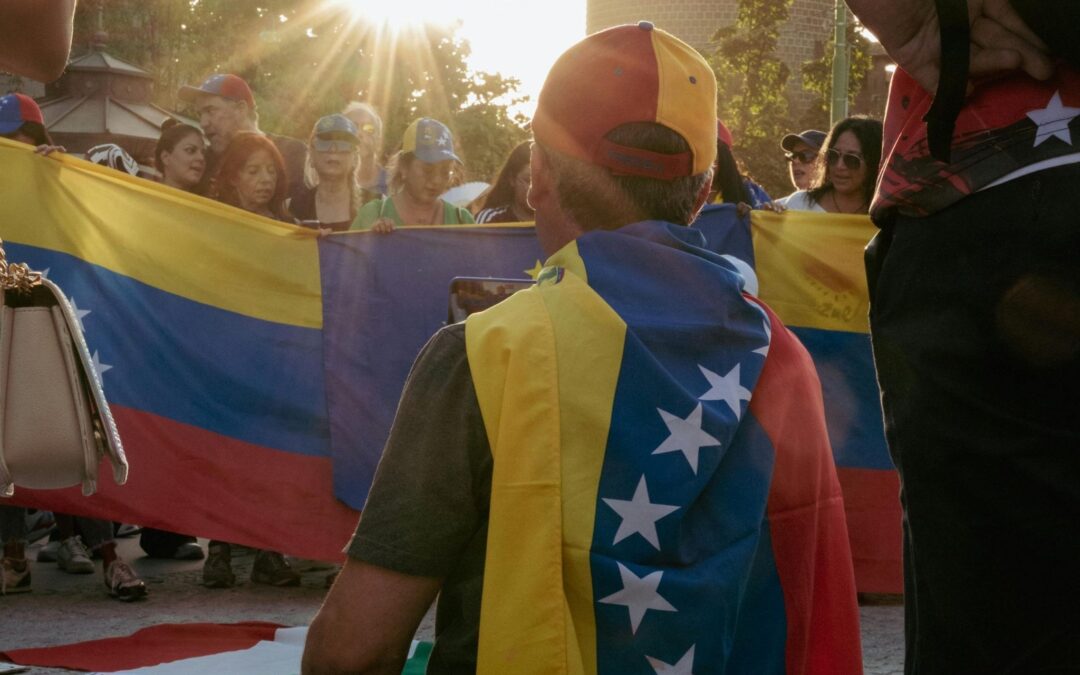
The ICJ calls for Venezuela to accept long-standing requests for country visits by UN Special Procedures whose mandates are most relevant to the rule of law and human rights crisis in the country.
The ICJ takes note of the announcement by the Venezuelan Government that it is inviting the UN Independent Expert on the promotion of a democratic and equitable international order, Mr. Alfred de Zayas, to visit the country.
This announcement, together with a recent invitation to the Special Rapporteur on the right to development is significant. For more than a decade, the Venezuelan Government has denied or left unanswered requests for visits to the country by numerous other of the independent experts (known as “Special Procedures”) of the United Nations. The last mission to Venezuela by a special procedure was the Special Rapporteur on Torture in 1996.
However, the breakdown of the rule of law and the extremely serious human rights situation in Venezuela make visits by other United Nations Special Procedures of urgent relevance.
“In the course of this year, extrajudicial and arbitrary executions, torture and ill-treatment of detainees, arbitrary detention, trial of civilians by military tribunals, and persecutions and attacks against opponents, dissidents and human rights defenders have become systematic and generalized practices in Venezuela, said Federico Andreu Guzman, ICJ South America Representative.
“It is therefore difficult to see why the Government of Venezuela would not respond to long-standing requests from Special Procedure mandates relevant to these violations in favour of proactively inviting other UN experts”, Andreu Guzman added.
The ICJ therefore calls on the Government of Venezuela to invite to visit the country the Working Group on Arbitrary Detention and the Special Rapporteurs on extrajudicial, summary or arbitrary executions; the independence of judges and lawyers; torture and other cruel, inhuman or degrading treatment or punishment; the rights to freedom of peaceful assembly and association; the promotion and protection of the right to freedom of opinion and expression; and on the situation of human rights defenders. All of these UN experts have long-standing requests to visit Venezuela, some for many years, which the Venezuelan Government has failed so far to accept.
“Under the Charter of the United Nations, Member States have the obligation to cooperate with the UN Special Procedures on human rights. This duty is of particular importance when the State is a member of the Human Rights Council, as is the case with Venezuela”, said Andreu Guzman.
The ICJ also calls on the Government of Venezuela to accept the request for a visit to the country that, since 2004, has been repeatedly issued by the Inter-American Commission on Human Rights.
Background
For several years, the following Special Procedures of the UN Human Rights Council have made requests to visit Venezuela: the Special Rapporteur on extrajudicial, summary or arbitrary executions; the Special Rapporteur on the situation of human rights defenders; the Working Group on Arbitrary Detention; the Special Rapporteur on the independence of judges and lawyers; the Special Rapporteur on the rights to freedom of peaceful assembly and association; the Special Rapporteur on violence against women, its causes and consequences; the Special Rapporteur on torture and other cruel, inhuman or degrading punishment; the Special Rapporteur on the promotion and protection of the right to freedom of opinion and expression; the Working Group on the issue of human rights and transnational corporations and other business enterprises; the Special Rapporteur on adequate housing as a component of the right to an adequate standard of living; and the Special Rapporteur on the right to food.
At the regional level, although it denounced the American Convention on Human Rights in September 2012, Venezuela is still a State party to three Inter-American human rights treaties (Inter-American Convention to Prevent and Punish Torture; Inter-American Convention on Forced Disappearance of Persons; and Inter-American Convention on the Prevention, Punishment and Eradication of Violence Against Women). However, Venezuela has systematically ignored recommendations of the Inter-American Commission on Human Rights (IACHR) and has also denied IACHR requests to visit the country, made since 2004.
Contacts
Federico Andreu-Guzmán, ICJ South America Representative, tel: +57 311 481 8094; email: federico.andreu(a)icj.org
Carlos Ayala Corao, ICJ Commissioner (Venezuela), tel: +57 414 243 4872; email: cayala(a)cjlegal.net
Alex Conte, ICJ Global Redress and Accountability Initiative, tel: +22 979 3802; email: alex.conte(a)icj.org
Oct 5, 2017 | Advocacy, Non-legal submissions
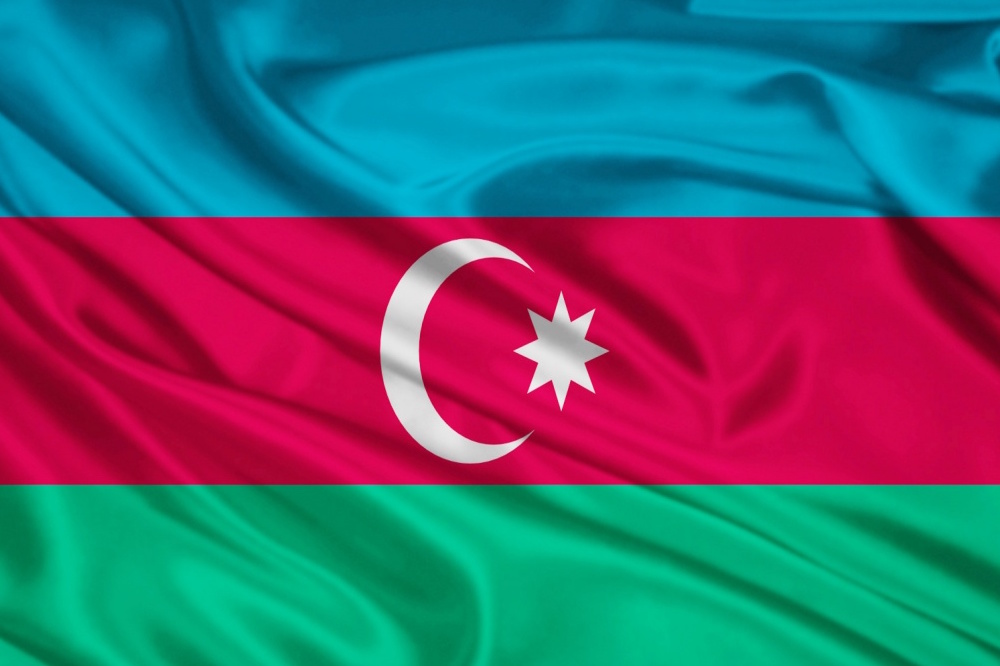
Today, the ICJ made a submission to the Universal Periodic Review of Azerbaijan.
The submission brings to the attention of the members of the Human Rights Council’s Working Group on the UPR issues concerning:
- Azerbaijan’s legislation governing the legal profession;
- the situation of lawyers in practice;
- the lack independence of the legal profession;
- the role of the Bar Association with regard to attacks on lawyers;
- international human rights instruments.
With respect to each of the above-mentioned concerns, the ICJ calls upon the Working Group on the UPR and the Human Rights Council to make a number of recommendations to the authorities of Azerbaijan.
Azerbaijan-UPR-Advocacy-non-legal submissions-2017-ENG (download the submission)
Sep 28, 2017 | Advocacy, Uncategorized
The ICJ today called on the UN Human Rights Committee and a group of UN Special Procedure mandates to take urgent follow up action on Venezuela in light of the grave and ever deteriorating human rights situation in the country.
In a letter to the UN Human Rights Committee, the treaty body responsible for monitoring implementation by States parties to the International Covenant on Civil and Political Rights (ICCPR), the ICJ called for urgent action by the Committee, either through its established follow-up procedure and/or through requesting a special interim report. The Committee’s follow-up procedure was referenced in the Committee’s Concluding Observations on Venezuela’s fourth periodic report under the ICCPR. Special interim reports may be requested by the Committee under Article 40(1)(b) of the ICCPR.
The ICJ also called for urgent action to be taken by the following UN Special Procedure mandates: the Working Group on Arbitrary Detention, the Special Rapporteur on freedom of opinion and expression, the Special Rapporteur on freedom of assembly and of association, the Special Rapporteur on the independence of judges and lawyers and the Special Rapporteur on torture and other cruel, inhuman or degrading treatment. This group of Special Procedure mandates had on 4 August 2017 issued a joint statement on the human rights situation in Venezuela.
The ICJ’s letters draw attention to several critical areas of concern:
- The rapidly deteriorating human rights situation;
- The lack of accountability of perpetrators of human rights violations;
- The lack of effective remedies and reparation for victims of human rights violations;
- The lack of independence of the judiciary;
- The institutional crisis arising from decisions of the Supreme Court of Justice;
- The unconstitutional election of the new National Constituent Assembly;
- The dismissal of the former Attorney General;
- The recent establishment of a ‘Truth Commission’;
- The intended revision of Venezuela’s Constitution; and
- Venezuela’s failure to notify its state of emergency under the ICCPR.
ICJ-Correspondence-VenezuelaFollowUp-HRCttee-2017-09-28 (download letter to the Human Rights Committee, in PDF)
ICJ-Correspondence-VenezuelaFollowUp-SPs-2017-09-28 (download letter to the Special Procedure mandates, in PDF)
ICJ reports:
Venezuela: the Supreme Court of Justice has become an arm of an authoritarian executive
Venezuela: rule of law and impunity crisis deepens
Venezuela: dismissal of Attorney General a further blow to the rule of law and accountability
Venezuela: Human rights and Rule of Law in deep crisis
Strengthening the Rule of Law in Venezuela

Sep 12, 2017 | News, Publications, Reports, Thematic reports
The Venezuelan Supreme Court has ceased to act as an independent court upholding the rule of law, but has become an arm of an authoritarian executive, the ICJ said in a new report released today.
The ICJ report The Supreme Court of Justice: an instrument of executive power says that through a series of rulings issued since December 2015, the Venezuelan Supreme Court has progressively dismantled the rule of law, undermined human rights and failed to faithfully apply key elements of the country’s Constitution.
In rulings on 27 and 28 March 2017 (Sentencias 155 and 156), the Supreme Court of Justice (SCJ) delivered a blow to the rule of law, effectively claiming legislative powers for itself, depriving the National Assembly of its Constitutional powers and granting sweeping arbitrary powers to the executive, the ICJ notes.
“These decisions amount to a coup d’état against the Constitutional order and have ushered in a new reign of arbitrary rule,” said Sam Zarifi, the ICJ Secretary General.
The report analyses SCJ jurisprudence issued since December 2015 in the light of international law and standards, rule of law principles and the Venezuelan Constitution, and in relation to the Constitutional functions and faculties of the legislative power, parliamentary oversight, states of emergency and the amnesty.
It finds that:
- The SCJ has been decisively co-opted by the Venezuelan executive;
- The Court’s members are mainly from the United Socialist Party of Venezuela (Partido Socialista Unido de Venezuela) and/or ex-Government officials; and
- It has become a political instrument increasingly used against the political and social opposition.
The report also says the Court has interpreted the Constitution in an arbitrary manner, omitting to analyse key Constitutional standards while granting a supra-Constitutional status to standards of lesser rank.
It has abrogated due process and judicial review and so stripped the National Assembly of its Constitutionally mandated functions with regard to legislative matters, parliamentary oversight, regulation and internal administration in order to benefit the government politically, the ICJ adds.
“The rulings have not been issued with impartiality on the basis of facts and in accordance with law, as required under rule of standards,” Zarifi said.
“They are in flagrant violation of the Venezuelan Constitution. The SCJ has issued its decisions based on political considerations and ideological and party loyalties to the executive power,” he added.
The report also outlines key recommendations on the administration of justice which various UN and Inter-American procedures and bodies have made to Venezuela going back a number of years.
None of these recommendations appear to have been taken into account by the Venezuelan authorities. These include reparations ordered by the Inter-American Court of Human Rights, which are binding on Venezuela as a matter of law.
“The Venezuelan authorities are in breach of its international obligation to cooperate in good faith with international human rights bodies and procedures,” Zarifi said.
Finally, the report concludes that the SCJ has undermined the rule of law by violating the principle of the separation of powers and infringing upon the Constitutional functions and autonomy of the legislative power.
As a consequence of its decisions based on the political interests of the executive power, the SCJ has lost the essential attributes of an authentic judicial power, such as independence, impartiality, autonomy and legitimacy.
“The SCJ has assumed the role of giving an appearance of judicial legitimacy to the arbitrary political actions of the executive thus abandoning the exercise of its Constitutional function as the guarantor of the rule of law, human rights and fundamental freedoms,” Zarifi added.
Contact:
Sam Zarifi, ICJ Secretary General, t +41 79 726 44 15 ; e sam.zarifi@icj.org
Federico Andreu-Guzman, ICJ South America Representative, t +57 311 481 8094 ; e federico.andreu@icj.org
Download the report:
Venezuela-Suprem Court-Publications-Reports-Thematic reports-2017-ENG (in PDF)
Further readings:
Venezuela: rule of law and impunity crisis deepens
Venezuela: dismissal of Attorney General a further blow to the rule of law and accountability
Venezuela: Human rights and Rule of Law in deep crisis
Strengthening the Rule of Law in Venezuela
Sep 3, 2017 | News
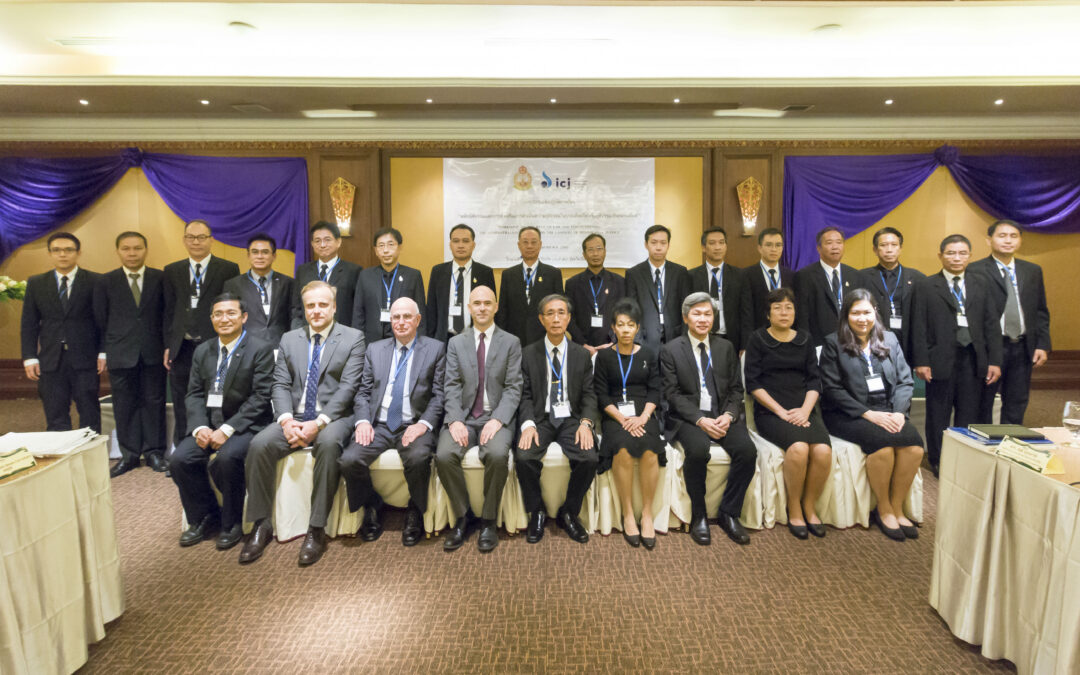
On 2 and 3 September, the ICJ held a workshop on “the Rule of Law and Strengthening the Administration of Justice in the Context of Restorative Justice” for members of the Thai judiciary.
The workshop was held in Chiang Mai.
Twenty-two judges attended the workshop, with an observer from the Thailand Institute of Justice (TIJ).
The objective of the workshop was to discuss how to best apply international standards of restorative justice within Thailand’s justice system.
Restorative justice is based on the fundamental principle that criminal behavior not only violates the law, but also injures victims and the community.
A restorative process is any process in which the victim and the offender and, where appropriate, any other individuals or community members affected by a crime participate together actively in the resolution of matters arising from the crime, with the help of a facilitator.
Frederick Rawski, Regional Director of ICJ Asia and the Pacific, recognized in his opening statement that implementation of restorative justice, including constructive non-custodial sentencing and measures, could assist in combating the problem of overcrowding in detention facilities in the North of Thailand, particularly with respect to drug-dependent offenders.
The workshop made reference to the United Nations Declaration of Basic Principles on the Use of Restorative Justice Programmes in Criminal Matters, which was adopted by the United Nations Economic and Social Council in 2002.
Speakers at the Workshop included Chief Justice Somnuk Panich from Office of the Chief Justice Region V, who formally opened the workshop, Judge Dr. Dol Bunnag, Presiding Judge of Intellectual Property and International Trade Court, who summarized the landscape of restorative justice in Thailand, and Judge Sir David James Carruthers from New Zealand, an international expert on restorative justice in New Zealand.
ICJ’s Senior International Legal Adviser Kingsley Abbott moderated the two-day workshop.
The ICJ ended the workshop with a statement reiterating its commitment towards working with Thailand’s judiciary to strengthen the rule of law and administration of justice in Thailand.