Sep 26, 2014 | News
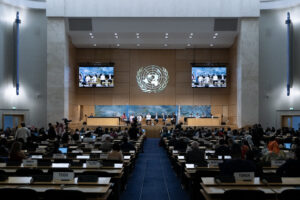
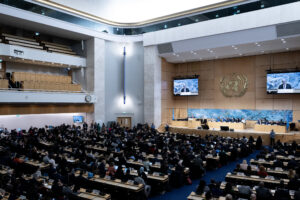
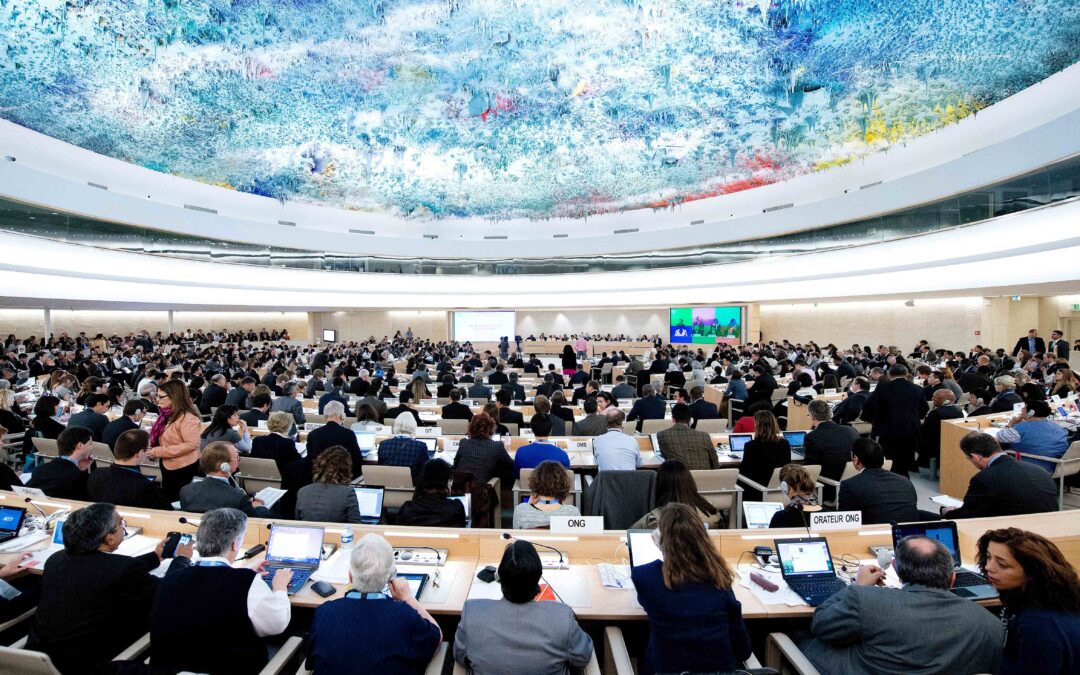
As the UN Human Rights Council approached the conclusion of its 27th regular session tonight, it adopted resolutions including on the topics of violence and discrimination on the basis of sexual orientation or gender identity and the protection of civil society space.
The resolutions on civil society space, and on non-violence and non-discrimination on grounds of sexual orientation or gender identity, were adopted after a series of hostile amendments were defeated.
The resolution on sexual orientation and gender identity, led by Brazil, Chile, Colombia and Uruguay, recognizes the worldwide problem of violence and discrimination, and builds on a resolution on the same subject from 2011. It calls for the High Commissioner for Human Rights to update the report produced under the 2011 resolution.
The States that supported the resolution on sexual orientation and gender identity overcame a series of amendments brought by Congo, Djibouti, Egypt, Malaysia, Nigeria, South Sudan, Uganda, and United Arab Emirates. The amendments would have among other things deleted all references to sexual orientation and gender identity from the resolution text, fundamentally changing its purpose, and perpetuating a complete denial of the very real violence and discrimination inflicted on lesbian, gay, bisexual, transexual and intersex people in all regions of the world.
The civil society space resolution, which was led by Chile, Ireland, Japan, Sierra Leone, Tunisia, draws on discussions at a Panel convened by the Council earlier in the year. It affirms the valuable contribution made by civil society in countries around the world, expresses concern about the threats and challenges faced by civil society, and requests the High Commissioner for Human Rights to produce practical recommendations for addressing these threats and concerns.
The texts of the resolutions (in the final draft form on which they were adopted – the official final versions are not yet available) are available here: Civil Society Resolution Sexual Orientation Gender Identity Resolution
A joint NGO press release on the resolution on sexual orientation and gender identity is available here.
The ICJ maintains databases of jurisprudence, legislation and UN action on the topic of sexual orientation and gender identity.

Sep 15, 2014 | Advocacy, Non-legal submissions
The ICJ supports a joint oral statement, delivered by ARC International, in relation to the Panel on “Protection of the Family”, at the UN Human Rights Council today.
The oral statement emphasised the importance of recognising the diversity of forms of families around the world.
It also noted that familes can be sites for transmissions of values, and that this can on the one hand include the promotion of human rights values, or on the other hand values incompatible with respect for human rights.
Finally, the statement highlighted that a human rights-based approach to family policies must recognise that individuals within families have human rights that require protection. Indeed, while families have the potential to help protect the human rights of their members from violations, families also have the potential to conceal abuses of human rights within the family.
The full statement in PDF format may be downloaded here: Universal-ProtectionofFamily-Advocacy-nonlegalsubmission-2014.EN
Jul 2, 2014 | Advocacy, Position papers
The ICJ and other NGOs have issued a joint statement urging the UN Human Rights Council to ensure that a discussion of “protection of the family” in September will reflect diversity and focus on human rights.
The ICJ is concerned, due to the way the resolution to establish the Panel discussion has been pursued, that some States will seek to exploit it as a vehicle for promoting a narrow, exclusionary and patriarchal concept of “the family” that denies equal protection to the human rights of individuals who belong to the various and diverse forms of family that exist across the globe.
Previous UN resolutions on the family include language, agreed by all States, that recognized that “various forms of the family exist”. The authors of the resolution deliberately omitted this language, despite this issue being consistently raised by other States throughout the negotiations.
A wholly inappropriate procedural tactic was used by some states to block discussion of a proposed amendment that would have restored the “various forms” language.
Efforts to ensure that the resolution clearly acknowledged and addressed the fact that the family is also a setting in which human rights abuses sometimes take place were partially successful.
The Panel topic will be “on the protection of the family and its members to address the implementation of States’ obligations under relevant provisions of international human rights law and to discuss challenges and best practices in this regard” (emphasis added).
The resolution reaffirms “that States have the primary responsibility to promote and protect the human rights and fundamental freedoms of all human beings, including women, children and older persons”. Unfortunately, however, the text of the resolution still does not give enough emphasis to this important aspect.
The organizations affirm that they will continue to insist on recognition that various forms of the family exist, and that individuals should not be discriminated against as a result of the form of family to which they happen to belong.
States should not fail to promote and protect the rights of persons because they belong to particular forms of family.
The organizations will continue to insist that the promotion and protection of the human rights of individuals within all families must be of the paramount importance to the UN Human Rights Council.
The joint statement may be downloaded in PDF here: HRC26-Joint statement family resolution-Advocacy-Position paper-2014
Jun 27, 2014 | Advocacy, Non-legal submissions
The ICJ and other civil society organizations highlighted progress in relation to accountability in the field of business and human rights, together with some continuing concerns, and unacceptable procedural tactics including in relation to a resolution on “protection of the family”.
Jun 27, 2014 | Agendas, Events
The ICJ is today holding an expert roundtable on asylum claims based on sexual orientation, gender identity or expression.
Participants include asylum judges and lawyers; officials from national refugee status determination authorities, the Office of the UN High Commissioner for Refugees and the Office of the UN High Commissioner for Human Rights; asylum academics; and staff members from other NGOs, including the Organization for Refuge, Asylum & Migration (ORAM), the Human Dignity Trust (HDT), the Advice on Individual Rights in Europe (AIRE) Centre and the Belgian Refugee Council.
At the roundtable, taking place in Brussels, participants will discuss: the legal challenges and responses in the context of asylum claims based on sexual orientation, gender identity or expression and refugee law; reflections on the UNHCR’s Guidelines on International Protection No. 9: Claims to refugee status based on Sexual Orientation and/or Gender Identity; the concept of persecution and assessment of evidence in the context of those claims; and the relevance of European human rights law to asylum claims based on sexual orientation, gender identity or expression.
The programme of the expert roundtable can be downloaded here.
This roundtable forms part of a broader project of the ICJ on international protection claims based on sexual orientation, gender identity or expression. The ICJ’s commentary on the related CJEU judgment in X, Y and Z v The Netherlands can be downloaded here.